WTO MC14 Latest News
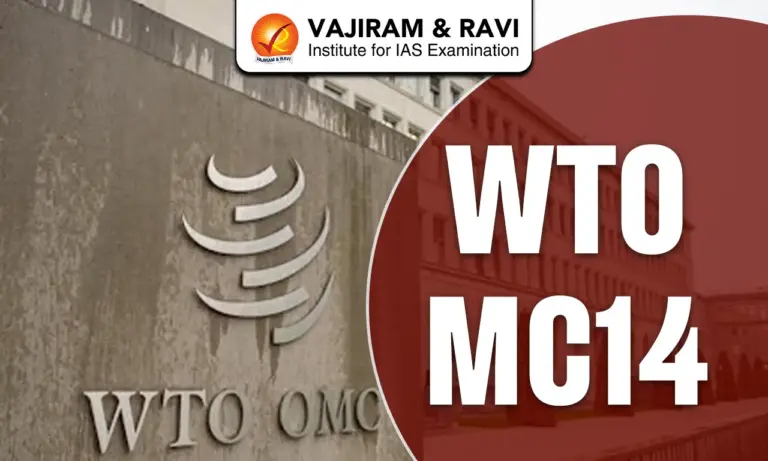
- The WTO’s 14th Ministerial Conference (MC14) will be held from March 26–29 in Yaoundé, Cameroon.
- As the organisation’s highest decision-making body, it meets roughly every two years and has the authority to take decisions on WTO rules and set the future direction of global trade negotiations.
MC14: A Multilateral Meeting in a Unilateral World
- The MC14 is taking place against a deeply troubled backdrop for global trade.
- Rising US-China geopolitical rivalry, ongoing global conflicts, and the increasing securitisation of trade relations have collectively weakened the foundations of multilateral cooperation.
- Most significantly, trade multilateralism is in retreat as unilateralism surges. The US has launched a sweeping assault on the WTO-based trading order by weaponising tariffs — imposing them arbitrarily in ways that violate two cardinal WTO principles:
- The Most Favoured Nation (MFN) Rule — which prohibits discriminatory treatment between trading partners.
- Bound Rate Obligations — which prevent countries from imposing tariffs beyond mutually agreed ceilings.
- Beyond tariffs, the US has also begun negotiating one-sided bilateral trade agreements through tariff coercion — pressuring countries into deals on American terms, further bypassing the multilateral framework that the WTO was built to uphold.





Why Trade Multilateralism Is in Crisis
- The roots of the crisis lie in Washington’s growing belief that the WTO — which the US itself was instrumental in creating in 1995 — has not served American interests.
- Two developments have driven this disillusionment:
- China’s Rise — China’s meteoric economic growth over the past two decades has significantly narrowed the power gap between Washington and Beijing.
- Failed Expectations — The US had hoped that China’s WTO accession (which it facilitated) would discipline Beijing’s state-led industrial policies. It did not.
The US Response: Dismantling the WTO from Within
- Rather than reforming the WTO, the US chose to weaken it:
- It paralysed the WTO’s Appellate Body — the organisation’s highest judicial arm — by relentlessly blocking the appointment of its members.
- Without a functioning Appellate Body, the WTO’s dispute settlement system — its most powerful enforcement tool — has been rendered ineffective.
- This gives the US the freedom to act outside WTO legal constraints and confront China on its own terms
The WTO’s Internal Weakness: Consensus Paralysis
- Beyond US actions, the WTO suffers from a structural weakness — its consensus-based decision-making makes drafting new trade rules extremely slow.
- In over three decades, the WTO has produced only two new agreements:
- Trade Facilitation Agreement
- Agreement on Fisheries Subsidies
- This sluggishness has pushed countries to seek trade rule-making through Free Trade Agreements (FTAs) — bypassing the multilateral framework altogether.
Key Issues at MC14
1. Plurilateral Agreements: A Way Forward or a Pandora’s Box
- A central debate at MC14 is whether plurilateral agreements — deals between fewer than all WTO members — should be incorporated into the WTO rulebook (Annex 4).
- Two key agreements are in focus:
- Investment Facilitation for Development — endorsed by 120+ countries
- Agreement on Electronic Commerce
- While inclusion in Annex 4 requires consensus among all members, many countries see plurilateral agreements as the best way to reinvigorate the WTO’s stalled legislative function.
- India, however, warns that opening this door could fragment the system — a logjam MC14 must resolve.
2. The E-Commerce Moratorium
- First agreed in 1998 and renewed every two years, this moratorium prevents WTO members from imposing tariffs on electronic transmissions. It is set to expire on March 31. Developed countries want it made permanent.
- Developing countries like India are reluctant — as digital trade has surged, continuing the moratorium could mean significant revenue losses.
3. Special and Differential Treatment (SDT)
- SDT recognises that not all WTO members are on equal footing and grants special rights to developing countries and LDCs.
- The US wants to weaken SDT by excluding larger developing economies — China, India, Brazil, and Indonesia — from its benefits. Developing countries must strongly resist this move.
4. Restoring the Appellate Body
- With the WTO’s dispute settlement system paralysed by the US blocking Appellate Body appointments, MC14 must unequivocally demand its restoration to put the WTO’s judicial function back on track.
5. Defending Foundational WTO Principles
- The US is expected to use MC14 to challenge core WTO principles, particularly the MFN (Most Favoured Nation) rule.
- Developing countries that benefit from these principles must mount a strong, united opposition.
What Should India Do at MC14
- India, a long-standing advocate of trade multilateralism, must now lead by example.
- It should use MC14 to champion multilateralism, forge alliances with developing countries, and reclaim its role as the normative leader of the Global South.
- To do this effectively, India must be willing to revisit entrenched positions — including its opposition to plurilateral agreements — and explore innovative solutions like electing Appellate Body members through voting.
- A failed MC14 would hand a victory to American unilateralism and its coercion-based trade order — an outcome deeply damaging to the developing world.
Source: TH

 Last updated on March, 2026
→ UPSC Final Result 2025 is now out.
→ UPSC has released UPSC Toppers List 2025 with the Civil Services final result on its official website.
→ Anuj Agnihotri secured AIR 1 in the UPSC Civil Services Examination 2025.
→ UPSC Marksheet 2025 is now out.
→ UPSC Notification 2026 & UPSC IFoS Notification 2026 is now out on the official website at upsconline.nic.in.
→ UPSC Calendar 2026 has been released.
→ Check out the latest UPSC Syllabus 2026 here.
→ UPSC Prelims 2026 will be conducted on 24th May, 2026 & UPSC Mains 2026 will be conducted on 21st August 2026.
→ The UPSC Selection Process is of 3 stages-Prelims, Mains and Interview.
→ Prepare effectively with Vajiram & Ravi’s UPSC Prelims Test Series 2026 featuring full-length mock tests, detailed solutions, and performance analysis.
→ Enroll in Vajiram & Ravi’s UPSC Mains Test Series 2026 for structured answer writing practice, expert evaluation, and exam-oriented feedback.
→ Join Vajiram & Ravi’s Best UPSC Mentorship Program for personalized guidance, strategy planning, and one-to-one support from experienced mentors.
→ Shakti Dubey secures AIR 1 in UPSC CSE Exam 2024.
→ Also check Best UPSC Coaching in India
WTO MC14 FAQs
Q1. What are the key battles at WTO MC14 over trade rules and global equity?+
Q2. Why is trade multilateralism in crisis at WTO MC14?+
Q3. What is the e-commerce moratorium issue at MC14?+
Q4. What is Special and Differential Treatment (SDT)?+
Q5. Why is restoring the Appellate Body important?+
Tags: mains articles upsc current affairs upsc mains current affairs WTO MC14