What’s in Today’s Article?
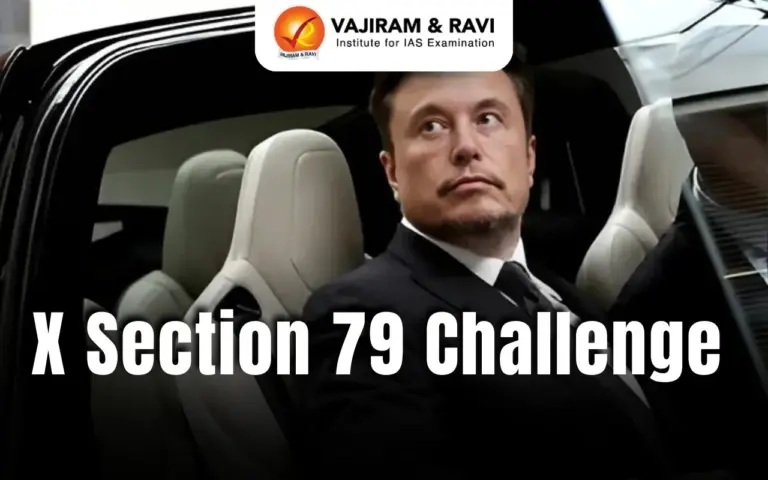
- X Section 79 Challenge Latest News
- Shreya Singhal Case & Section 69A of the IT Act
- Government’s Use of Section 79 of the IT Act
- X’s Legal Challenge Against Section 79(3)(b) Orders
- X Section 79 Challenge FAQs
X Section 79 Challenge Latest News
- Elon Musk-owned X (formerly Twitter) has challenged the Indian government’s use of Section 79(3)(b) of the IT Act, 2000 for content moderation and removal orders.
- The company argues that this provision is being misused to bypass the safeguards provided under Section 69A, which is specifically designed for content regulation.
- X contends that the government’s approach undermines due process and transparency in content moderation.





Shreya Singhal Case & Section 69A of the IT Act
- SC Strikes Down Section 66A (2015)
- In Shreya Singhal v. Union of India (2015), the Supreme Court struck down Section 66A of the IT Act, which criminalized sending false information causing “annoyance or inconvenience.”
- The Court held it unconstitutionally vague, giving excessive power to the government to restrict free speech.
- Section 69A Becomes the Primary Law
- After this decision, Section 69A became the main law governing online content moderation.
- It empowers the Centre to block content hosted on any digital platform if deemed necessary under Article 19(2) of the Constitution.
- Safeguards & Justification
- Unlike Section 66A, Section 69A includes safeguards:
- Blocking orders must be necessary under reasonable restrictions outlined in Article 19(2) (e.g., sovereignty, security, public order, morality, etc.).
- The government must record reasons for blocking, allowing legal challenges.
Government’s Use of Section 79 of the IT Act
- Section 79: Safe Harbour for Intermediaries
- Section 79 of the IT Act provides “safe harbour” protection to intermediaries (such as X), shielding them from liability for third-party content.
- However, Section 79(3)(b) states that intermediaries can be held liable if they fail to remove unlawful content after receiving actual knowledge or a government notification.
- SC’s Restriction on Section 79(3)(b) (Shreya Singhal Case)
- In Shreya Singhal v. Union of India (2015), the Supreme Court limited the scope of Section 79(3)(b), ruling that removal obligations apply only when:
- A court order directs removal, or
- The government issues a notification, but only if the content violates Article 19(2) restrictions (e.g., national security, public order, defamation).
- In Shreya Singhal v. Union of India (2015), the Supreme Court limited the scope of Section 79(3)(b), ruling that removal obligations apply only when:
- Government’s Expanded Use of Section 79(3)(b)
- October 2023: The Ministry of Electronics and Information Technology (MeitY) issued a directive allowing ministries, state governments, and police to issue blocking orders under Section 79(3)(b).
- October 2024: MeitY launched “Sahyog”, a portal enabling authorities to issue and upload blocking orders, potentially expanding censorship beyond the SC’s prescribed limits.
X’s Legal Challenge Against Section 79(3)(b) Orders
- Allegations of Bypassing Safeguards
- X has challenged the Ministry of Electronics and IT (MeitY) before the Karnataka High Court, arguing that its content removal orders under Section 79(3)(b)bypass the safeguards outlined in Section 69A.
- The company cites the Shreya Singhal ruling, asserting that content can only be censored through Section 69A procedures or a court order.
- X’s Argument on Section 79
- X contends that Section 79 is only a “safe harbour” provision that shields intermediaries from liability for third-party content.
- It argues that the government is now misusing this provision to create an “unlawful blocking regime” without the legal protections mandated by law.
- The Grok Controversy & Safe Harbour Debate
- X’s AI chatbot, Grok 3, has been under scrutiny for using Hindi slang and posting government-critical responses.
- While X hasn’t received an official notice, the Centre has reportedly contacted the company.
- A key legal question now arises: Does AI-generated content fall under “third-party” content for safe harbour protection under Section 79?
- Courts will need to determine whether X is liable for Grok’s responses.
X Section 79 Challenge FAQs
Q1. Why is X challenging the government’s use of Section 79?
Ans. X argues that Section 79(3)(b) is being misused to bypass legal safeguards for content moderation under Section 69A.
Q2. What legal protections does Section 79 provide?
Ans. Section 79 grants intermediaries safe harbour, shielding them from liability for third-party content unless ordered by courts or authorities.
Q3. How did the Shreya Singhal case impact Section 79?
Ans. The 2015 ruling limited content takedowns under Section 79 to cases where a court or government order meets constitutional restrictions.
Q4. What is X’s main argument in court?
Ans. X claims that Section 79 is being misused to create an unlawful censorship mechanism without the due process of Section 69A.
Q5. How does the Grok controversy relate to Section 79?
Ans. The debate over whether AI-generated content qualifies as third-party speech under Section 79 raises new legal questions for AI accountability.

 Last updated on March, 2026
→ UPSC Final Result 2025 is now out.
→ UPSC has released UPSC Toppers List 2025 with the Civil Services final result on its official website.
→ Anuj Agnihotri secured AIR 1 in the UPSC Civil Services Examination 2025.
→ UPSC Marksheet 2025 is now out.
→ UPSC Notification 2026 & UPSC IFoS Notification 2026 is now out on the official website at upsconline.nic.in.
→ UPSC Calendar 2026 has been released.
→ Check out the latest UPSC Syllabus 2026 here.
→ UPSC Prelims 2026 will be conducted on 24th May, 2026 & UPSC Mains 2026 will be conducted on 21st August 2026.
→ The UPSC Selection Process is of 3 stages-Prelims, Mains and Interview.
→ Prepare effectively with Vajiram & Ravi’s UPSC Prelims Test Series 2026 featuring full-length mock tests, detailed solutions, and performance analysis.
→ Enroll in Vajiram & Ravi’s UPSC Mains Test Series 2026 for structured answer writing practice, expert evaluation, and exam-oriented feedback.
→ Join Vajiram & Ravi’s Best UPSC Mentorship Program for personalized guidance, strategy planning, and one-to-one support from experienced mentors.
→ Shakti Dubey secures AIR 1 in UPSC CSE Exam 2024.
→ Also check Best UPSC Coaching in India