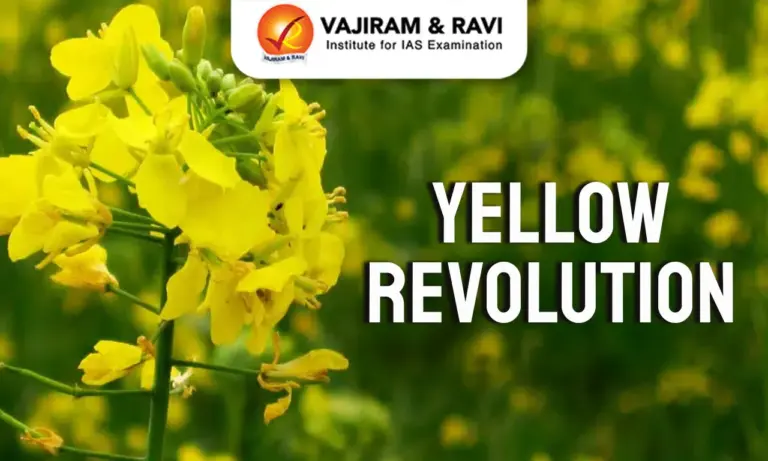
The Yellow Revolution refers to a period in Indian agriculture (primarily 1986–1987) marked by a concerted effort to increase the production of oilseeds. The goal was to reduce dependency on imports of edible oils. The major oilseeds targeted included mustard, groundnut, soybean, sunflower, safflower, sesame, linseed, castor, and niger.
Sam Pitroda, a renowned telecom engineer and policy maker, is known as the Father of Yellow Revolution in India. He led the technological push that enabled this transformation. Under his guidance, the Oilseeds Technological Mission (OTM) was launched in 1986.
Why Was the Yellow Revolution Needed?
By the early 1980s, India was a major importer of its edible oil needs. Domestic production was not enough. Several issues including traditional methods of cultivation, low-yielding varieties, poor storage infrastructure, and pests that often decimated crops.
The over dependence on foreign imports was draining foreign exchange and creating economic vulnerability. The need to increase domestic oilseed production became both an agricultural and economic imperative. Hence, the Yellow Revolution.
Yellow Revolution History
The groundwork for this shift began with the launch of the Technology Mission on Oilseeds (TMO), initiated by then Prime Minister Rajiv Gandhi. This mission was structured, time-bound, and scientific, a break from past fragmented efforts. It had one job, transforming oilseed production using improved seeds, better practices, and institutional support.
Some of the critical components that formed the backbone of this effort:
- Introduction of high-yielding varieties of oilseed crops.
- Better access to irrigation, pesticides, and fertilizers.
- Financial incentives, including minimum support prices.
- Creation of oilseed-specific cooperatives.
- Stronger linkages between research institutions and farmers.





Yellow Revolution Objectives
- Reduce edible oil imports by scaling domestic production.
- Push modern agronomic practices and technologies.
- Create co-operatives, provide technical training, and ensure fair prices.
- Make oilseed farming viable and profitable, especially in semi-arid and rain-fed regions.
- Enhance post-harvest handling to reduce wastage.
Yellow Revolution Features
By 1995, India’s oilseed production had nearly doubled from about 12 million tonnes in 1986 to around 24 million tonnes. Cultivated land expanded to over 26 million hectares. Thousands of oilseed societies involving lakhs of farmers were formed. Some of the other major Yellow Revolution Features includes:
- Oilseed Technology Mission (OTM) focused on increasing yields through hybrid seeds and scientific cultivation.
- Institutions like the National Dairy Development Board (NDDB) and the National Oilseeds and Vegetable Oils Development Board (NOVOD) were supporting in. NDDB was especially instrumental in setting up oilseed cooperatives, modeled after the dairy movement.
- Farmers received free or subsidized inputs like fertilizers, pesticides, irrigation equipment, and extension services.
- The government ensured procurement support and improved logistics like warehousing and transportation.
- While several oilseeds were promoted, special focus was on mustard, groundnut, soybean, and sunflower.
Yellow Revolution Impact
The success of the Yellow Revolution in India can be attributed to multiple key focus areas that worked in tandem to boost oilseed production and transform rural agriculture. From technological advancements to policy reforms and increased socio-economic inclusion, especially of women, each component played a crucial role in shaping a self-sufficient oilseed economy. The table below outlines Yellow Revolution Impact on India’s agricultural landscape.
| Yellow Revolution Impact | |
| Key Success Area | Description |
|
Increased Production |
Significant rise in oilseed output, especially in Gujarat, Rajasthan, MP, and Punjab; improved yield via hybrid seeds and better techniques. |
|
Socio-Economic Boost |
Elevated rural incomes; reduced regional disparities where modern methods were embraced. |
|
Policy Changes |
Introduced mission-mode agricultural policy with defined goals, deadlines, and accountability, shaping future reforms. |
|
Technological Adoption |
Farmers adopted scientific methods, irrigation, crop rotation, and pest management, improving efficiency and sustainability. |
|
Women in Agriculture |
Enhanced female participation in mustard and other oilseed farming; rise in women’s involvement in agricultural cooperatives and rural economic roles. |
Yellow Revolution Challenges
- Oilseed crops are sensitive to diseases and pests. A bad year could wipe out entire yields.
- Many oilseeds are grown in rain-fed or semi-arid areas, which limits productivity.
- After the initial push, research and extension activities slowed down in many regions.
- While production increased in the 1990s, the momentum wasn’t sustained. By the 2000s, India was again importing a significant share of its edible oil, nearly 60% by 2019.
- Despite higher yields, a lot of post-harvest losses occurred due to poor storage and processing.
Yellow Revolution Present Situation
Fast forward to the 2020s. India still imports the bulk of its edible oil from countries like Malaysia, Brazil, Indonesia, and Argentina. Despite the gains of the Yellow Revolution, domestic production hasn’t kept pace with population growth and rising consumption.
There are several reasons for this:
- Expansion of oilseed cultivation has hit a ceiling. There’s limited arable land left.
- Climate change has worsened growing conditions.
- Farmers often find growing cereals or cash crops more profitable.
- Inadequate investment in oilseed R&D and extension services.
Yellow Revolution Future Expectations
- Revive Farmer Co-operatives as these were the backbone of the first revolution. They need to be reactivated and modernized.
- Public-Private Partnerships as private players can bring in scale, innovation, and export market access.
- Promote Processing Infrastructure by Modernising cold chains, storage, and small-scale oil mills.
- Educate Farmers, Train them on sustainable practices, market trends, and diversification strategies.
- Policy Stability includes Ad-hoc export bans or import tariff changes hurt farmer morale.

 Last updated on March, 2026
→ UPSC Final Result 2025 is now out.
→ UPSC has released UPSC Toppers List 2025 with the Civil Services final result on its official website.
→ Anuj Agnihotri secured AIR 1 in the UPSC Civil Services Examination 2025.
→ UPSC Marksheet 2025 is now out.
→ UPSC Notification 2026 & UPSC IFoS Notification 2026 is now out on the official website at upsconline.nic.in.
→ UPSC Calendar 2026 has been released.
→ Check out the latest UPSC Syllabus 2026 here.
→ UPSC Prelims 2026 will be conducted on 24th May, 2026 & UPSC Mains 2026 will be conducted on 21st August 2026.
→ The UPSC Selection Process is of 3 stages-Prelims, Mains and Interview.
→ Prepare effectively with Vajiram & Ravi’s UPSC Prelims Test Series 2026 featuring full-length mock tests, detailed solutions, and performance analysis.
→ Enroll in Vajiram & Ravi’s UPSC Mains Test Series 2026 for structured answer writing practice, expert evaluation, and exam-oriented feedback.
→ Join Vajiram & Ravi’s Best UPSC Mentorship Program for personalized guidance, strategy planning, and one-to-one support from experienced mentors.
→ Shakti Dubey secures AIR 1 in UPSC CSE Exam 2024.
→ Also check Best UPSC Coaching in India
Yellow Revolution FAQs
Q1. What is the Yellow Revolution in India?+
Q2. Who is known as the Father of the Yellow Revolution in India?+
Q3. Why was the Yellow Revolution launched?+
Q4. Which crops are associated with the Yellow Revolution?+
Q5. What are the key components of the Yellow Revolution?+
Tags: yellow revolution