What’s in today’s article?
- Why in News?
- What is an FIR?
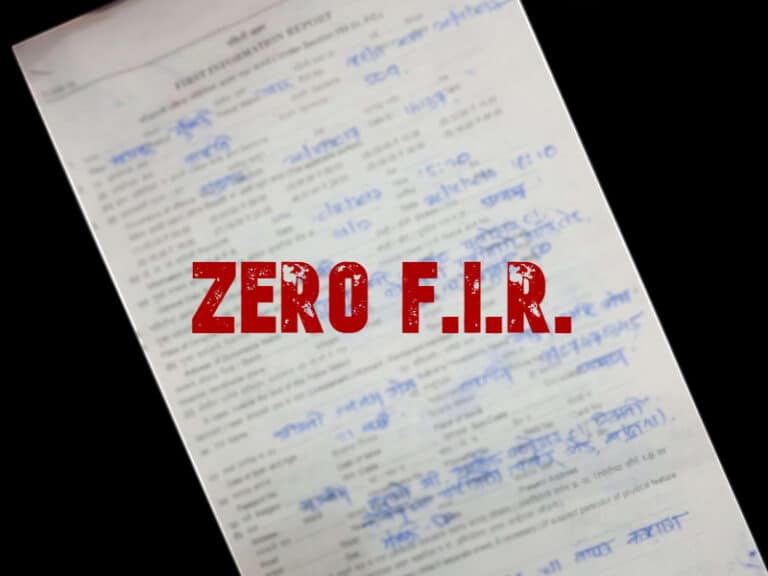
- What is a Zero FIR?
- Issue of zero FIRs in Manipur
Why in News?
- Hundreds of zero FIRs registered in police stations across Manipur and the stalled investigations in these cases are among key challenges the state police are facing.
What is an FIR?
- The term first information report (FIR) is not defined in the Indian Penal Code (IPC), Code of Criminal Procedure (CrPC) 1973 or in any other law.
- In police regulations or rules, information recorded under Section 154 of CrPC is known as FIR.
- Section 154 states that every information relating to the commission of a cognizable offence, if given orally to an officer in charge of a police station, shall be reduced to writing.
- A copy of the information (as recorded) shall be given (free of cost) to the informant.
- In essence, 3 important elements of an FIR:
- the information must relate to the commission of a cognizable offence,
- it should be given in writing or orally to the head of the police station and
- it must be written down and signed by the informant, and its key points should be recorded in a daily diary.





What is a Zero FIR?
- A zero FIR can be filed in any Police Station by the victim, irrespective of their residence or the place of occurrence of crime.
- A police station that receives a complaint regarding an alleged offence committed in the jurisdiction of another police station, registers an FIR and then transfers it to the relevant police station for further investigation.
- No regular FIR number is given and after receiving the Zero FIR, the revenant police station registers a fresh FIR and starts the investigation.
- It came up after the recommendation in the report of the Justice Verma Committee set up after the 2012 Nirbhaya gang rape case to suggest amendments to the Criminal Law.
- The objective of a Zero FIR is to ensure the victim doesn’t have to run from pillar to post to get a police complaint registered.
- The provision is meant to provide speedy redressal to the victim so that timely action can be taken after the filing of the FIR.
Issue of zero FIRs in Manipur:
- Filed in huge scale:
- In the state, which has seen nearly 3 months of violence, thousands of zero FIRs have been registered across the state.
- For example, 202 zero FIRs have been registered at Saikul (a foothill area bordering Meitei-dominated areas) police station since the start of the violence.
- These are mostly in cases where there has been violence in Kuki-dominated areas.
- In some other police stations like Churachandpur police station (over 1,700 zero FIRs), Kangpokpi police station (over 800) many more such FIRs have been registered.
- A peculiar challenge
- With fault lines in the state running deep, just transferring cases to relevant police stations has been a challenge.
- For example, in the case of three Kuki-Zomi women being stripped and sexually assaulted in Meitei-dominated Thoubal district, a zero FIR was transferred to the relevant police station more than a month later.
- Why is police investigation a challenge?
- Investigating cases of such transferred FIRs is a challenging process, exacerbated by tensions in the state.
- For example, police personnel (IO) from one community cannot go to another community’s area and it is hard to proceed with the investigation without meeting the victim.
Q1) What is the history behind the Indian Penal Code (IPC)?
The IPC – a comprehensive code intended to cover all substantive aspects of criminal law, was drafted on the recommendations of the first law commission of India established in 1834 under the Charter Act 1833 under the chairmanship of TB Macaulay. It came into force in India during British rule in 1862.
Q2) Why are Meitei and Kuki fighting in Manipur?
The violence in Manipur was sparked by a court ruling that granted the majority Meitei “scheduled tribal status”, entitling them to the same economic benefits and quotas in government jobs and education as the minority Kuki.
Source: In Manipur, a fresh challenge for police: Scores of zero FIRs | IE

 Last updated on March, 2026
→ UPSC Final Result 2025 is now out.
→ UPSC has released UPSC Toppers List 2025 with the Civil Services final result on its official website.
→ Anuj Agnihotri secured AIR 1 in the UPSC Civil Services Examination 2025.
→ UPSC Marksheet 2025 is now out.
→ UPSC Notification 2026 & UPSC IFoS Notification 2026 is now out on the official website at upsconline.nic.in.
→ UPSC Calendar 2026 has been released.
→ Check out the latest UPSC Syllabus 2026 here.
→ UPSC Prelims 2026 will be conducted on 24th May, 2026 & UPSC Mains 2026 will be conducted on 21st August 2026.
→ The UPSC Selection Process is of 3 stages-Prelims, Mains and Interview.
→ Prepare effectively with Vajiram & Ravi’s UPSC Prelims Test Series 2026 featuring full-length mock tests, detailed solutions, and performance analysis.
→ Enroll in Vajiram & Ravi’s UPSC Mains Test Series 2026 for structured answer writing practice, expert evaluation, and exam-oriented feedback.
→ Join Vajiram & Ravi’s Best UPSC Mentorship Program for personalized guidance, strategy planning, and one-to-one support from experienced mentors.
→ Shakti Dubey secures AIR 1 in UPSC CSE Exam 2024.
→ Also check Best UPSC Coaching in India