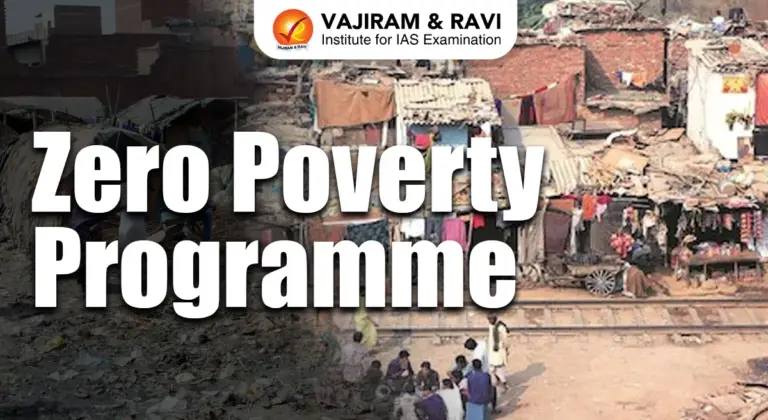
The Zero Poverty Programme is a major social welfare initiative launched by the Government of Uttar Pradesh with the aim of eliminating extreme poverty and ensuring inclusive development. The programme is named after Baba Saheb Dr. Bhimrao Ambedkar, reflecting his vision of educational, social, and economic upliftment of the poor and marginalized sections of society.
The scheme focuses on identifying families who are still deprived of basic facilities and connecting them with all government welfare schemes through a structured and technology-driven approach.
What is Zero Poverty?
“The Zero Poverty Programme directly supports ‘SDG 1 – No Poverty’. It means a situation where no individual or family is deprived of basic human needs such as housing, sanitation, clean drinking water, electricity, healthcare, and livelihood opportunities.”
In Uttar Pradesh, the concept of Zero Poverty emphasizes holistic empowerment, where welfare benefits are combined with skill development and employment support so that families can achieve long-term self-reliance rather than depending only on subsidies.
What does SDG 1 (No Poverty) aim to achieve?
SDG 1, “No Poverty,” is the first of the 17 United Nations Sustainable Development Goals, aimed at ending poverty in all its forms everywhere by 2030.
It focuses on eradicating extreme poverty, defined by the international poverty line, and
Reducing vulnerability through social protection systems, access to basic services, and equal rights to resources.





Zero Poverty Programme Objectives
The main objectives of the Zero Poverty Programme are:
- To ensure that no person in Uttar Pradesh is deprived of basic facilities
- To link poor and marginalized communities with all eligible government schemes
- To identify 20-25 deprived families in every Gram Panchayat
- To include 14-15 lakh families in the first phase of the scheme
- To promote educational, social, and economic upliftment in line with Dr. Ambedkar’s philosophy
- To provide special focus on historically disadvantaged and vulnerable communities
- To support the state’s broader goal of zero poverty through skill development and employment
Zero Poverty Programme Features
The Zero Poverty Programme adopts a multi-dimensional approach to eradicate poverty by combining welfare delivery, skill development, and digital governance.
- Identification of Deprived Families: 20-25 families in every Gram Panchayat who are still deprived of basic facilities are identified.
- Welfare Scheme Coverage: Families receive benefits under Pradhan Mantri Awas Yojana, toilets, drinking water, electricity, LPG connections, Ayushman Bharat health cards, and pension schemes.
- Focus on Vulnerable Communities: Special priority is given to Musahar, Tharu, Vantangiya, Kol, Buksa, Chero, Gond, and Saharia communities.
- Skill Development: Guaranteed skill training is provided to heads of poor families in seven focus areas, including hospitality services and language skills, enhancing employability.
- Community Sanitation Support: Committees maintaining Gram Panchayat community toilets receive regular monthly honorarium for sustainability.
- Digital Infrastructure: Central portal (Zero-poverty.in) and department microsites facilitate coordination, while apps like Mop-Up and Rishta monitor beneficiary identification and DBT/benefit flows.
- Feedback Mechanism: Alerts and voice-based feedback collection ensure participation even from remote areas.

 Last updated on March, 2026
→ UPSC Final Result 2025 is now out.
→ UPSC has released UPSC Toppers List 2025 with the Civil Services final result on its official website.
→ Anuj Agnihotri secured AIR 1 in the UPSC Civil Services Examination 2025.
→ UPSC Marksheet 2025 is now out.
→ UPSC Notification 2026 & UPSC IFoS Notification 2026 is now out on the official website at upsconline.nic.in.
→ UPSC Calendar 2026 has been released.
→ Check out the latest UPSC Syllabus 2026 here.
→ UPSC Prelims 2026 will be conducted on 24th May, 2026 & UPSC Mains 2026 will be conducted on 21st August 2026.
→ The UPSC Selection Process is of 3 stages-Prelims, Mains and Interview.
→ Prepare effectively with Vajiram & Ravi’s UPSC Prelims Test Series 2026 featuring full-length mock tests, detailed solutions, and performance analysis.
→ Enroll in Vajiram & Ravi’s UPSC Mains Test Series 2026 for structured answer writing practice, expert evaluation, and exam-oriented feedback.
→ Join Vajiram & Ravi’s Best UPSC Mentorship Program for personalized guidance, strategy planning, and one-to-one support from experienced mentors.
→ Shakti Dubey secures AIR 1 in UPSC CSE Exam 2024.
→ Also check Best UPSC Coaching in India
Zero Poverty Programme FAQs
Q1. What is the Zero Poverty Programme?+
Q2. Why is the programme named after Baba Saheb Dr. Bhimrao Ambedkar?+
Q3. How does the Zero Poverty Programme align with Sustainable Development Goals (SDGs)?+
Q4. How are beneficiary families identified under the programme?+
Q5. How many families will be covered in the first phase?+
Tags: economy economy notes zero poverty programme