What’s in today’s article?
- Why in News?
- Government’s Caution and Legal Obligations
- Blinkit’s Ambulance Service Details
- India’s Need for Ambulance Services
- Government and Market Dynamics
- Conclusion
Why in News?
- A day after Blinkit, a Zomato-owned quick commerce platform, announced the launch of a 10-minute ambulance service, Union Commerce Minister Piyush Goyal emphasized the need for the initiative to adhere to India’s legal framework.
- The announcement has sparked discussions about regulatory compliance, healthcare accessibility, and the state’s accountability in providing basic services.





Government’s Caution and Legal Obligations:
- Compliance with laws: Union Minister Piyush Goyal underscored that Blinkit must meet legal requirements under Indian law, including guidelines outlined in the Central Motor Vehicle Rules and Automotive Industry Standard (AIS) 125.
- State-level variations: For ambulances supported by the National Health Mission (NHM), compliance depends on agreements between operators and state governments.
- Concerns raised: Experts have highlighted regulatory gaps and the pressing issue of ambulance shortages in India.
Blinkit’s Ambulance Service Details:
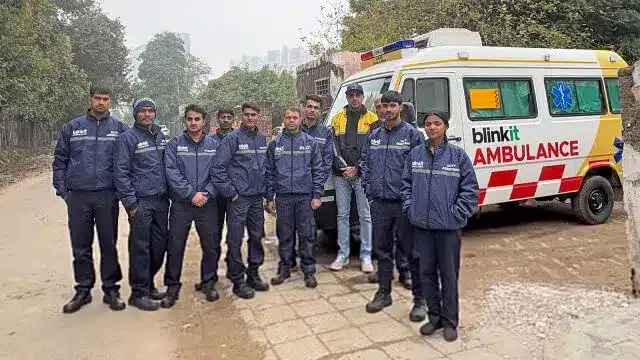
- Service launch: The initiative will start with five ambulances in Gurugram, with plans to expand to all major cities within two years.
- Features and pricing:
- Each ambulance is equipped with essential life-saving equipment like oxygen cylinders, AEDs, monitors, and emergency medicines, staffed by a paramedic, an assistant, and a trained driver.
- The service is priced at a flat Rs 2,000 fee.
- Non-profit motive: Blinkit CEO Albinder Dhindsa emphasized that the service aims to address critical healthcare gaps rather than generate profit.
India’s Need for Ambulance Services:
- Pandemic lessons: The COVID-19 pandemic exposed severe shortages in ambulance services, particularly during emergencies.
- Current landscape:
- India has 17,495 operational Basic Life Support (BLS) ambulances and only 3,441 Advanced Life Support (ALS) ambulances.
- Regional disparities persist, with northeastern states particularly underserved.
- Importance of ALS ambulances: These are crucial for trauma-related emergencies during the “golden hour” and are better equipped for critical care.
Government and Market Dynamics:
- National Ambulance Services (NAS):
- The Ministry of Health and Family Welfare supports one ALS ambulance per 5 lakh population and one BLS ambulance per 1 lakh population.
- States can request additional ambulances to address regional needs.
- Market growth: The Indian ambulance market, valued at $1,502.8 million in 2022, is projected to grow at a 5.12% CAGR from 2024 to 2028.
- Registration trends: Ambulance registrations peaked in 2021 but have since declined, indicating reduced focus on healthcare post-pandemic.
Conclusion:
- Blinkit’s 10-minute ambulance service initiative has the potential to address critical gaps in India’s healthcare infrastructure.
- However, ensuring regulatory compliance, addressing regional disparities, and increasing the number of ALS ambulances remain key challenges.
- As private players like Blinkit step in, the government must simultaneously strengthen its healthcare delivery systems to meet the growing demands of the population.
Q.1. What is the National Health Mission (NHM)?
The National Health Mission (NHM) is a program in India that aims to provide equitable, affordable, and quality healthcare services to all citizens.
Q.2. What is the National Health Policy 2017?
The National Health Policy 2017 envisages the attainment of the highest possible level of health and wellbeing for all at all ages, through a preventive and promotive health care orientation in all developmental policies.
Source: On Blinkit’s 10-minute ambulance service, govt’s ‘law of land’ caution

 Last updated on March, 2026
→ UPSC Final Result 2025 is now out.
→ UPSC has released UPSC Toppers List 2025 with the Civil Services final result on its official website.
→ Anuj Agnihotri secured AIR 1 in the UPSC Civil Services Examination 2025.
→ UPSC Marksheet 2025 is now out.
→ UPSC Notification 2026 & UPSC IFoS Notification 2026 is now out on the official website at upsconline.nic.in.
→ UPSC Calendar 2026 has been released.
→ Check out the latest UPSC Syllabus 2026 here.
→ UPSC Prelims 2026 will be conducted on 24th May, 2026 & UPSC Mains 2026 will be conducted on 21st August 2026.
→ The UPSC Selection Process is of 3 stages-Prelims, Mains and Interview.
→ Prepare effectively with Vajiram & Ravi’s UPSC Prelims Test Series 2026 featuring full-length mock tests, detailed solutions, and performance analysis.
→ Enroll in Vajiram & Ravi’s UPSC Mains Test Series 2026 for structured answer writing practice, expert evaluation, and exam-oriented feedback.
→ Join Vajiram & Ravi’s Best UPSC Mentorship Program for personalized guidance, strategy planning, and one-to-one support from experienced mentors.
→ Shakti Dubey secures AIR 1 in UPSC CSE Exam 2024.
→ Also check Best UPSC Coaching in India