
Chambal River Latest News
Efforts to reclaim degraded land from Chambal ravines expose both people and biodiversity to ecological risks from erosion and flooding.
About Chambal River
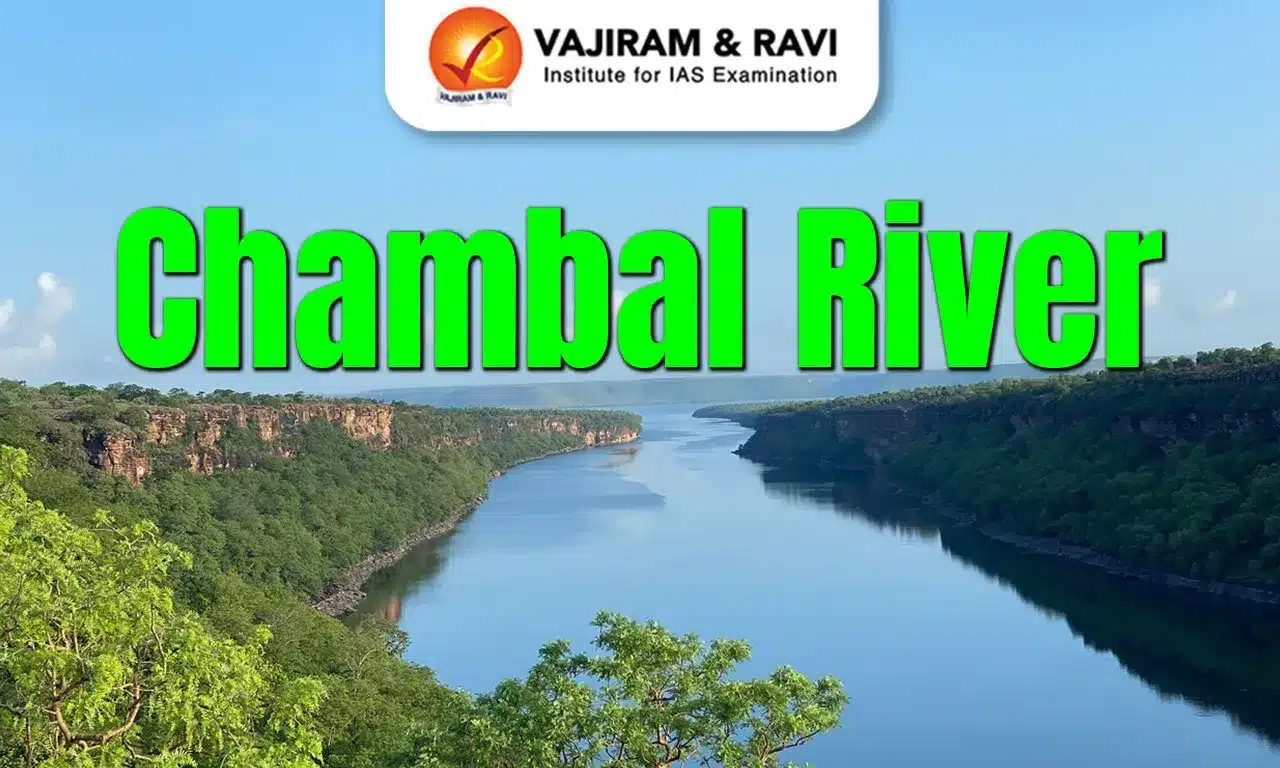
- The Chambal River, called Charmanvati in ancient times, is one of the major tributaries of the Yamuna River.
- Located in Central India, the river forms part of the greater Gangetic drainage system.
- It is known for its clear and pristine waters, and it is also one of the cleanest rivers in India.
- Course:
- It is a perennial river and has its source in Janapav, located to the south of Mhow Town close to Indore on the southern sides of the Vindhya Mountain Range in Madhya Pradesh.
- The river flows north-northeast through Madhya Pradesh, running for a time through Rajasthan, then forming the boundary between Rajasthan and Madhya Pradesh before turning southeast to join the Yamuna in Uttar Pradesh.
- It flows through three Indian states: Madhya Pradesh, Rajasthan, and Uttar Pradesh.
- It is the largest of the rivers flowing through Rajasthan.
- Total Length: 1024 kilometres
- Drainage:
- To its south, east, and west, the basin is defined by the Vindhyan mountain ranges, while the northwestern boundary is marked by the Aravalli range.
- The Chambal and its tributaries drain the Malwa region of northwestern Madhya Pradesh, while its tributary, the Banas, which rises in the Aravalli Range, drains southeastern Rajasthan.
- Tributaries: The main tributaries of Chambal include the Banas and Mej rivers on the left and the Parbati, Kali Sindh, and Shipra rivers on the right.
- Major Dams: Gandhi Sagar, Jawahar Sagar, Rana Pratap Sagar, and Kota Barrage dams are built on this river.
- Notable Landmark: Pachnada confluence in Uttar Pradesh, where it meets the Kwari, Yamuna, Sind, and Pahuj rivers.
- National Chambal Sanctuary:
- Established in 1979, it covers 5400 sq.km. across Rajasthan, Madhya Pradesh, and Uttar Pradesh.
- Known for protecting the critically endangered Gharial crocodile, along with other crocodile species, turtles, and diverse fish.
- A hotspot for birdwatching with over 300 bird species, including the endangered Indian Skimmer.





What is a Ravine?
- It is a narrow valley with steep sides, usually caused by stream bank erosion.
- Their slopes can be quite sharp, often between 20% and 70% in gradient.
- Ravines are smaller than canyons and larger than gullies.
Source: DTE
Last updated on January, 2026
→ Check out the latest UPSC Syllabus 2026 here.
→ Join Vajiram & Ravi’s Interview Guidance Programme for expert help to crack your final UPSC stage.
→ UPSC Mains Result 2025 is now out.
→ UPSC Notification 2026 is scheduled to be released on January 14, 2026.
→ UPSC Calendar 2026 has been released.
→ UPSC Prelims 2026 will be conducted on 24th May, 2026 & UPSC Mains 2026 will be conducted on 21st August 2026.
→ The UPSC Selection Process is of 3 stages-Prelims, Mains and Interview.
→ Prepare effectively with Vajiram & Ravi’s UPSC Prelims Test Series 2026 featuring full-length mock tests, detailed solutions, and performance analysis.
→ Enroll in Vajiram & Ravi’s UPSC Mains Test Series 2026 for structured answer writing practice, expert evaluation, and exam-oriented feedback.
→ Join Vajiram & Ravi’s Best UPSC Mentorship Program for personalized guidance, strategy planning, and one-to-one support from experienced mentors.
→ UPSC Result 2024 is released with latest UPSC Marksheet 2024. Check Now!
→ UPSC Toppers List 2024 is released now. Shakti Dubey is UPSC AIR 1 2024 Topper.
→ Also check Best UPSC Coaching in India
Chambal River FAQs
Q1. Where does the Chambal River originate?+
Q2. The Chambal River is a major tributary of which river?+
Q3. Chambal River flows through which Indian states?+
Q4. What is the total length of the Chambal River?+
Tags: chambal river prelims pointers upsc current affairs upsc prelims current affairs