Air Pollution is an important environmental issue in India, affecting the public health, economic growth and the quality of life. Caused due to rapid industrialisation, urbanisation and vehicular emissions, the problem of air pollution has been out of control. In this article, we are going to cover all about Air Pollution in India and ways to control it.
Air Pollution
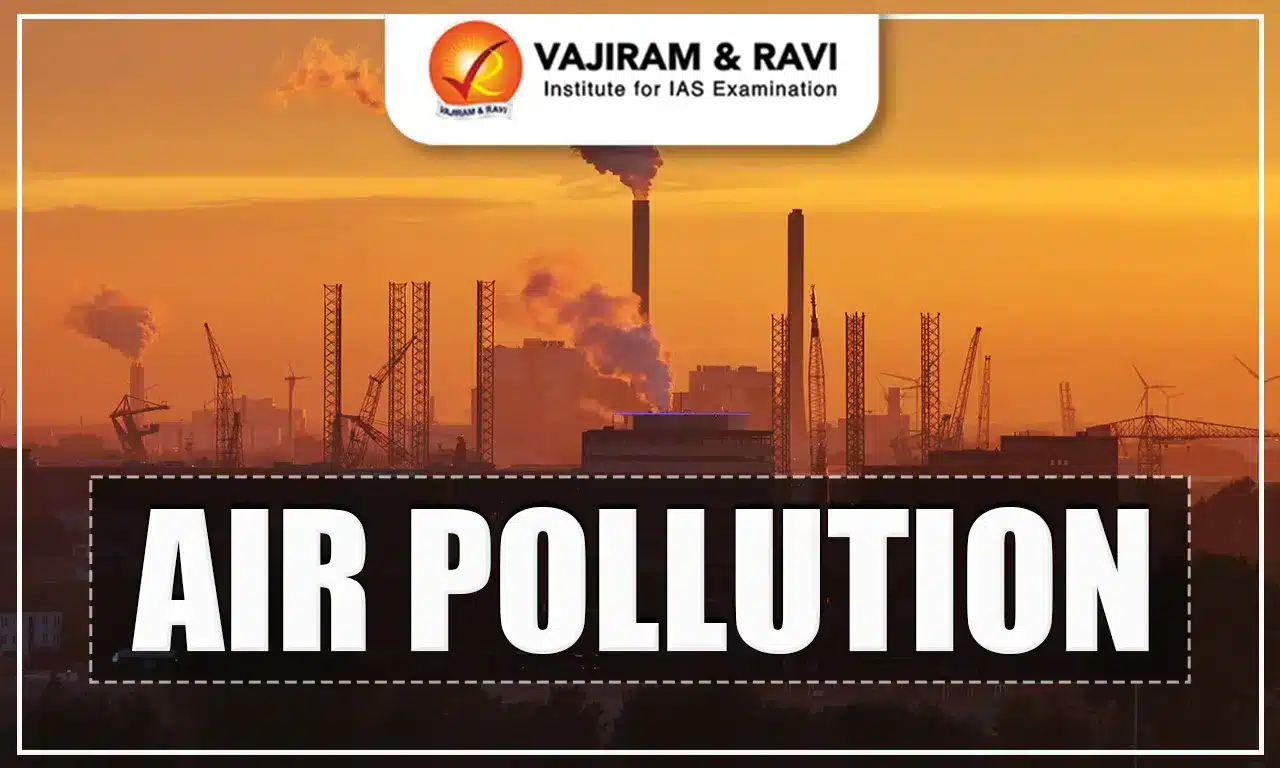
Air Pollution refers to the contamination of the atmosphere and the environment due to harmful substances that affect human health, ecosystems and the climate.
Air Pollution appears in the form of gases, solid particles and the combination of both.
Causes of air pollution include industries, vehicles, burning of fossil fuels and natural processes like dust storms.
Air pollution is one of the most serious forms of environmental pollution all over the world.
Air Pollution in India Severity
The deterioration in the quality of air in India has been an alarming issue in India for over two decades:
- India is ranked as one of the most polluted countries all over the world, with high levels of particulate matter. (PM2.5)
- In 2021, about 97% of the population will have been exposed to PM2.5 levels exceeding WHO’s air quality guidelines, putting people at risk for severe health problems.
- Urban cities like Delhi and other metropolitan cities have constantly failed to meet the air quality standards.
- Small towns and medium sized cities are also now a victim to rising levels of pollution.
- Apart from the particulate matter, pollutants such as nitrogen oxides, sulfur dioxide and toxic compounds are contributing to the crisis.


Air Pollution Effects
Air Pollution in India has the following effect:
- Health Impacts:
- Causes respiratory diseases like asthma, bronchitis, and chronic obstructive pulmonary disease (COPD).
- Increases the risk of cardiovascular problems and premature deaths.
- According to the Health Effects Institute (2018), annual deaths from air pollution in India are projected to rise from 1.1 million in 2015 to 1.7 million in 2030.
- Environmental Impacts
-
-
- Pollutants contaminate soil and water bodies, harming ecosystems and biodiversity.
- High emissions of sulfur dioxide and nitrogen oxides cause acid rain, which damages crops, forests, and aquatic systems.
- Greenhouse gases such as carbon dioxide and methane exacerbate global warming and climate change.
-
- Economic Impacts
-
- Declines agricultural productivity by degrading soil quality and crop health.
- Raises healthcare costs due to increased disease burden.
- Reduces labour productivity owing to illness-related absenteeism.
- The annual economic cost of air pollution in India is estimated at over $150 billion.
Air Pollution Controlling Measures
In order to control air pollution, the Government of India has taken up the following measures:
- The Air (Prevention and Control of Pollution) Act, 1981 provides a legal foundation for regulation of air pollution all over India.
- The Central Pollution Control Board (CPCB) and State Pollution Control Boards have the power to monitor and regulate air quality.
- The National Ambient Air Quality Standard provide permissible limits for 12 key pollutants, forming a basis for monitoring and compliance.
- Introduction of cleaner fuels like CNG, LPG and biodiesel.
- Setting up nationwide monitoring networks to assess ambient air quality.
- Enforcement of Bharat Stage VI (BS-VI) vehicle emission norms nationwide since 2020.
- Adoption of common pollution control facilities to reduce industrial emissions.
- Promotion of green crackers and installation of Smog Towers in high-pollution zones.
Air Pollution Air Quality Index (AQI)
The Air Quality Index is a simple, colour coded system that provides people with accessible information on air quality. It uses a “one number-one colour-one description” model to make data easy to understand.
- AQI covers eight pollutants: PM10, PM2.5, NO2, SO2, CO, O3, NH3, and Pb.
- The quality of air is divided into six categories on the basis of pollutant concentration and health impact: Good, Satisfactory, Moderately Polluted, Poor, Very Poor, and Severe.
- Each category indicates potential health risks, ranging from minimal effects to severe health impacts even on healthy individuals.
National Clean Air Programme (NCAP)
The National Clean Air Programme was launched in 2019, as a national strategy to fight against air pollution.
- Aims to achieve a 20-30% reduction in PM levels by 2024. (2017 was base year)
- Revised to aim for a 40% reduction by 2026.
- The key focus areas include strengthening monitoring networks, public awareness and capacity building.
Air Pollution Institutional Measures: CAQM and CAP
The Commission for Air Quality Management was set up by the Air Quality Management in NCR and Adjoining Areas Act, 2021 to ensure balanced action in MCR and neighboring states.
Comprehensive Action Plan has been designed for Delhi-NCR to meet air quality standards through:
- Time-bound targets for clean air.
- Regional cooperation across states.
- Emergency response systems to reduce exposure during pollution peaks.
- Addressing both seasonal sources (stubble burning, firecrackers) and consistent sources (vehicular and industrial emissions).
Graded Response Action Plan (GRAP)
GRAP was introduced in India in 2017 as an emergency response framework for Delhi-NCR
- It prescribes graded measures based on AQI levels (Moderate, Poor, Very Poor, Severe, and Severe+).
- The plan ensured incremental actions, such as traffic restrictions, construction bans, and industrial shutdowns during severe pollution episodes.
- Implementation requires coordination among 13 agencies across Delhi, Haryana, Uttar Pradesh, and Rajasthan.
Air Pollution Control Measures
In order to control air pollution, the following measures can be opted:
- Promotion of clean energy sources such as solar, wind, and geothermal power.
- Adoption of energy-efficient appliances, such as LED bulbs, to reduce energy demand.
- Encouraging public transportation and carpooling to reduce vehicular emissions.
- Energy conservation practices at household and industrial levels.
- Improved traffic management and enforcement of emission norms.
- Development of green corridors and urban green belts to absorb pollutants.

 Last updated on Oct, 2026
→ UPSC 2027 Notification will be released on 13 January 2027 at upsconline.nic.in.
→ Check Nobel Prize 2026 Winners List here.
→ Download PIB PRiSM Monthly Magazine 2026 here.
→ Check UPSC Monthly Current Affairs Magazine The Recitals here.
→ Check out the latest UPSC Syllabus here.
→ Download UPSC Model Answers for Mains 2026
→ UPSC Mains Question Paper 2026 is out now for Essay & GS Paper 1, 2, 3 & 4.
→ UPSC Calendar 2027 has been released.
→ Enroll in Vajiram & Ravi’s UPSC Mains Test Series 2027 for structured answer writing practice, expert evaluation, and exam-oriented feedback.
→ Join Vajiram & Ravi’s UPSC Mentorship Program 2027 for personalized guidance, strategy planning, and one-to-one support from experienced mentors.
→ Go through the UPSC Mains Previous Year Papers to enhance your preparation.
→ UPSC has released UPSC Toppers List 2025 with the Civil Services final result on its official website.
→ Also check Best UPSC Coaching in India
Air Pollution FAQs
Q1. What is the Air Pollution Act?+
Q2. What are the 7 main causes of air pollution?+
Q3. What are the 4 types of air pollutants?+
Q4. What are three major air pollutants?+
Q5. What is the classification of air pollution?+
Tags: air pollution