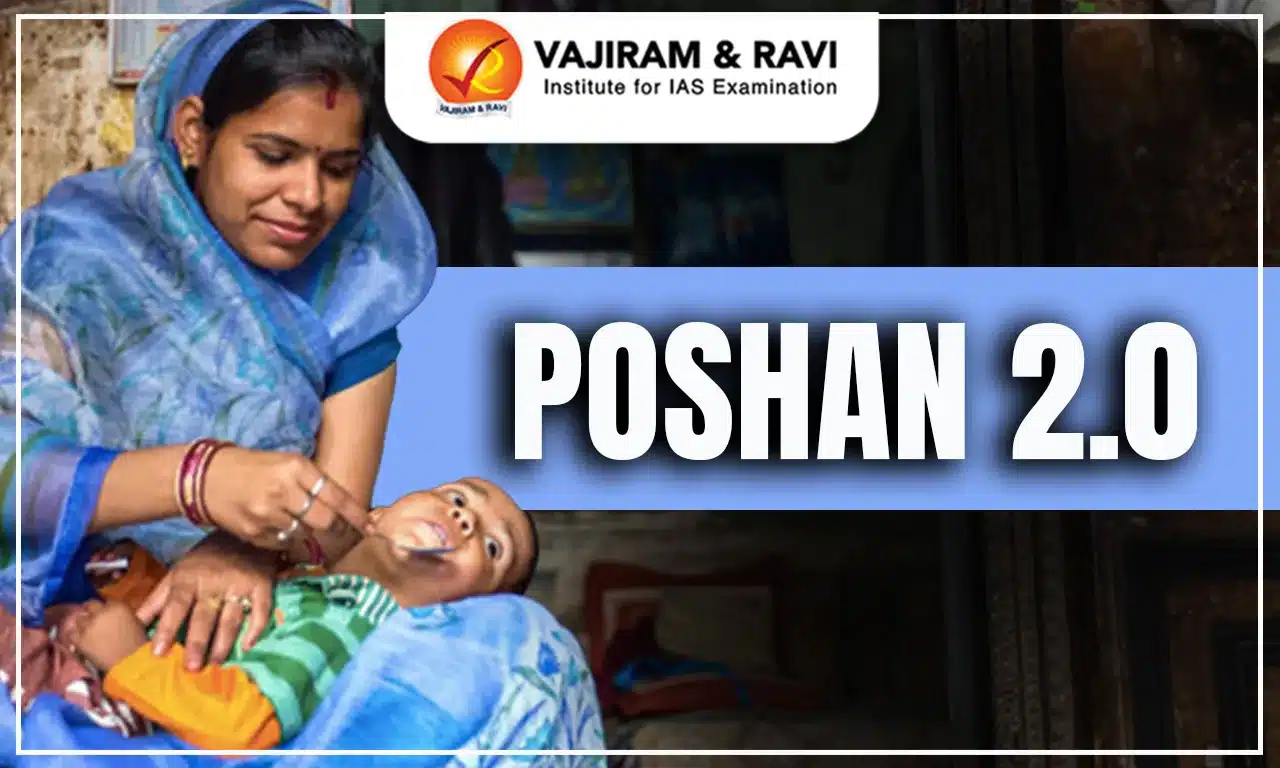
Poshan 2.0, launched by the Ministry of Women and Child Development in 2021, is an Integrated Nutrition Support Programme aimed at combating malnutrition among children, adolescent girls, pregnant women, and lactating mothers. It streamlines earlier schemes and focuses on human capital development through improved nutrition and targeted interventions.
Poshan 2.0 adopts a multi-pronged strategy including Supplementary Nutrition, Early Childhood Care, upgraded Anganwadi infrastructure, and use of technology through the Poshan Tracker. It emphasises community engagement, behaviour change, and convergence across ministries to ensure better service delivery and sustainable nutritional outcomes.
POSHAN 2.0 Overview
Poshan 2.0 is an Integrated Nutrition Support Programme launched by the Ministry of Women and Child Development, Government of India. It aims to address the challenges of malnutrition among children, adolescent girls, pregnant women, and lactating mothers. The program was announced in the Union Budget 2021-22 and is implemented during the 15th Finance Commission period from 2021-22 to 2025-26.
POSHAN 2.0 Objectives
The primary objectives of Poshan 2.0 are to:
- Contribute to the human capital development of the country.
- Address the challenges of malnutrition.
- Promote nutrition awareness and good eating habits for sustainable health and well-being.
- Address nutrition-related deficiencies through key strategies.
POSHAN 2.0 Components
Poshan 2.0 streamlines nutrition and early childhood care efforts by integrating key schemes under focused verticals, including Supplementary Nutrition and modernised Anganwadi infrastructure. It also reinforces maternal and child health through Poshan Abhiyaan and traditional wellness practices.
- Nutrition Support: Through the Supplementary Nutrition Programme (SNP) for children aged 6 months to 6 years, pregnant women and lactating mothers, and adolescent girls in aspirational districts and the North Eastern Region.
- Early Childhood Care and Education: For children aged 3-6 years, including early stimulation for children aged 0-3 years.
- Anganwadi Infrastructure: Modern, upgraded Saksham Anganwadi centres.
- Poshan Abhiyaan: A key component focusing on maternal nutrition, infant and young child feeding norms, treatment protocols for Severe Acute Malnutrition (SAM) and Moderate Acute Malnutrition (MAM), and wellness through AYUSH practices.


POSHAN 2.0 Approaches
Poshan 2.0 is supported by the Poshan Tracker, a robust ICT centralised data system linked with the RCH Portal (Anmol) of the Ministry of Health and Family Welfare. This system enables real-time monitoring and tracking of all Anganwadi centres, workers, and beneficiaries on defined indicators. Poshan 2.0 emphasises the use of technology and community engagement to drive behavioural change. It includes:
- Home visits and community-based events.
- Mass media activities through Jan Andolan.
- Mobile-based technology (ICDS-CAS) to monitor and track services and propose corrective actions.
POSHAN 2.0 Achievements
Poshan 2.0 has achieved major milestones in enhancing nutritional outcomes and early childhood development through initiatives like Saksham Anganwadis, real-time tracking via the Poshan Tracker, and fortified food distribution. It also emphasises behavioural change, community engagement, and structured early childhood education frameworks. Key achievements include:
- Upgradation of Anganwadi Centres (AWCs): 1.7 lakh AWCs approved for transformation into Saksham Anganwadis, promoting creative, social, emotional, and cognitive development.
- Nutrition Through Innovation:
- Poshan Tracker: This system monitors over 10 crore beneficiaries, including pregnant women, lactating mothers, and children, providing real-time data to optimise service delivery.
- Malnutrition Status in India as per Poshan Tracker Data 2025
- 5.46% of children under five were reported as wasted (low weight for height).
- 15.93% of children under five were underweight (low weight for age).
- Among children aged 0–6 years, underweight prevalence stood at 16.50%.
- Community-Based Management of Acute Malnutrition (CMAM): A new module has been integrated to identify and address malnutrition in children.
- Fortified Rice Distribution: More than 12.87 lakh metric tonnes of fortified rice have been allocated to improve micronutrient intake.
- Jan Andolan for Behavioural Change: Through community-based events like Poshan Maah and Poshan Pakhwada, millions of people have engaged in activities to raise awareness about nutrition.
- Over 30 crore sensitisation activities took place in 2024.
- Early Childhood Care & Education (ECCE): The release of two important frameworks and curricula for early childhood care:
- Aadharshila: A comprehensive curriculum for children aged 3 to 6 years, launched in 2024.
- Navchetana: A framework for early childhood stimulation for children from birth to 3 years, introduced in 2024.
POSHAN 2.0 Challenges
POSHAN 2.0 has improved nutrition services but faces challenges like data delays, connectivity issues, and persistent undernutrition in vulnerable areas, limiting its full effectiveness.
- Real-time Data Delays: Although the Poshan Tracker monitors over 10 crore beneficiaries, delays in data entry and updating have been reported, limiting prompt action.
- Technology and Connectivity Gaps: Many backward and tribal districts continue to lack reliable internet and digital infrastructure, affecting the effective use of digital tools.
- For example, of the estimated 16.1 crore children under six, only 8.61 crore are enrolled in Anganwadi services, indicating a significant need for enhanced outreach and coverage expansion.
- Persistent Undernutrition in Vulnerable Communities: Despite expanded coverage, high rates of stunting and wasting persist in hard-to-reach populations such as tribal belts and urban slums.
- For example, the central and eastern states face the highest malnutrition burdens. Bihar leads with 20.98% underweight and 9.31% wasting among children.
- Supply Chain and Meal Delivery Interruptions: The COVID-19 pandemic caused major disruptions in the delivery of hot cooked meals and fortified foods, which continue to challenge program effectiveness in some states.
- For example, intermittent ration supply was reported in parts of Uttar Pradesh and Odisha even post-pandemic.
POSHAN 2.0 Way Forward
The road ahead for Poshan 2.0 focuses on enhancing implementation through digital innovation, fostering stronger inter-ministerial coordination, and empowering communities for sustained nutritional impact.
- Strengthening Existing Strategies: Poshan 2.0 builds upon the foundation of the original Poshan Abhiyaan, focusing on key areas like the first 1000 days of a child's life, access to quality services, cross-sectoral convergence, leveraging technology, and community involvement.
- Leveraging Technology: "Poshan Tracker" is a crucial component, providing real-time data collection and intervention, and facilitating prompt supervision and management of services.
- Cross-Sectoral Convergence: Poshan 2.0 aims to coordinate efforts across multiple ministries, including those related to water, sanitation, and health.
- Community Involvement: A key aspect of the program is involving the community through awareness campaigns and encouraging behavioural change around nutrition.
- Improving Nutritional Quality: The initiative emphasises diet diversity, food fortification, and the inclusion of millets in the diet.
- This involves ensuring quality control and testing in accredited labs and providing nutritious take-home rations and hot cooked meals.
Cross-Ministerial Coordination: POSHAN 2.0’s success depends on stronger coordination between ministries like MWCD, MoHFW, and Jal Shakti. Improving joint planning and accountability will help overcome convergence challenges and ensure effective nutrition service delivery.
| Other Related Posts | |
| Poshan 2.0 | Hunger in India |
| Poshan Abhiyaan | |

 Last updated on Sep, 2026
→ UPSC 2027 Notification will be released on 13 January 2027 at upsconline.nic.in.
→ Asian Games 2026 are being held in Aichi-Nagoya, Japan, from 19 September to 4 October.
→ Check out the latest UPSC Syllabus here.
→ Download UPSC Model Answers for Mains 2026
→ UPSC Mains Question Paper 2026 is out now for Essay & GS Paper 1, 2, 3 & 4.
→ UPSC Calendar 2027 has been released.
→ Enroll in Vajiram & Ravi’s UPSC Mains Test Series 2027 for structured answer writing practice, expert evaluation, and exam-oriented feedback.
→ Join Vajiram & Ravi’s UPSC Mentorship Program 2027 for personalized guidance, strategy planning, and one-to-one support from experienced mentors.
→ Go through the UPSC Mains Previous Year Papers to enhance your preparation.
→ UPSC has released UPSC Toppers List 2025 with the Civil Services final result on its official website.
→ Also check Best UPSC Coaching in India
Poshan 2.0 FAQs
Q1. What is the Poshan 2.0 scheme?+
Q2. Are ICDS and Poshan 2.0 the same?+
Q3. Which act covers Poshan 2.0 ?+
Q4. What is the budget of Saksham Anganwadi and Poshan 2.0 in 2025?+
Q5. Who are the beneficiaries of Poshan 2.0?+
Tags: poshan 2.0