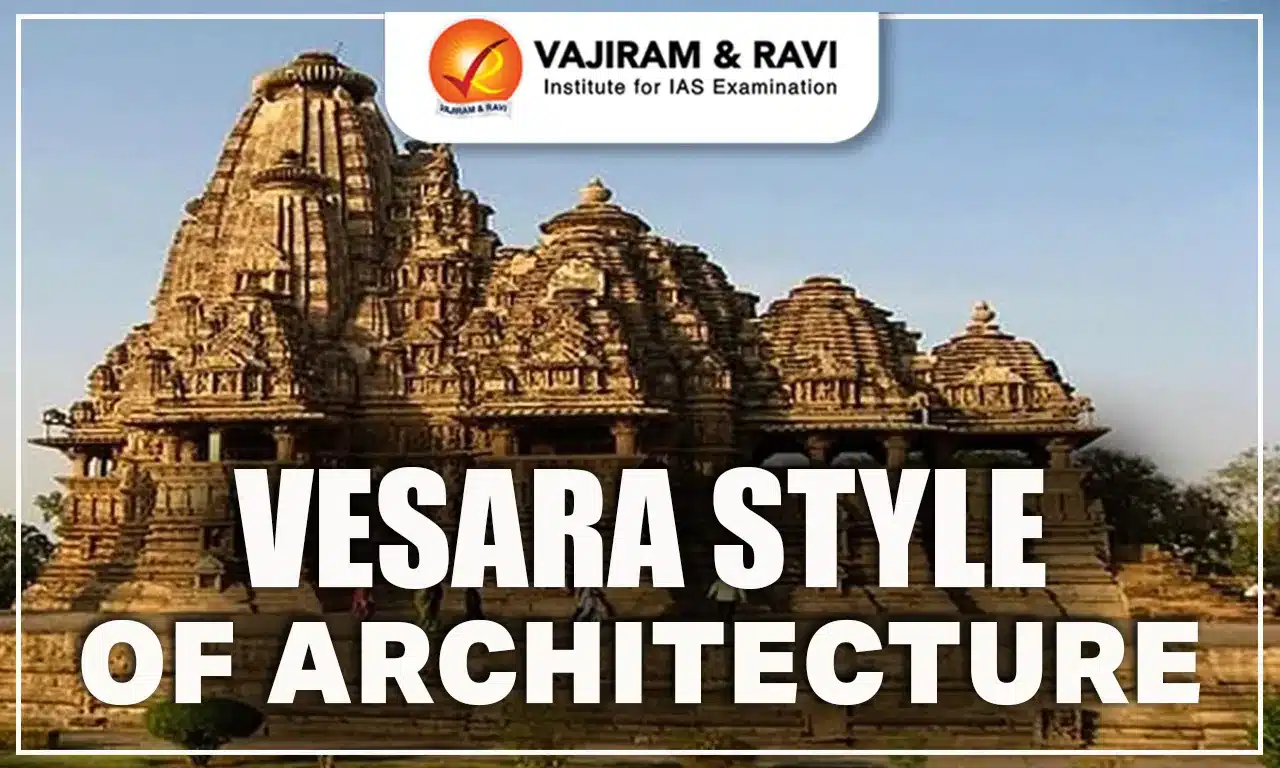
Vesara style of architecture is a mix of Indian temple styles that combines parts of the Dravidian (Southern) and Nagara (Northern) traditions. This blended style is especially seen in the temples built by the later Chalukyas and Hoysalas in the Deccan region, particularly in Karnataka.
The Vesara style of architecture features Dravidian-style layouts combined with Nagara-inspired shikharas, often pyramidal in profile but shorter and more intricate. Characteristic elements include miniature shikharas, multiple tiers, and refined ornamentation, distinguishing it from the taller Nagara superstructures and the simpler Dravidian vimanas.
Vesara Style of Architecture About
Vesara style of architecture represents a unique hybrid of temple architecture that developed in the Deccan region of India during the medieval period. It emerged as a synthesis of the Nagara style of North India and the Dravidian style of South India, making it a distinct architectural form.
- Origin: The word “Vesara” is believed to derive from the Sanskrit term “vishra,” which conveys the idea of transition or a place of convergence, symbolising its position as an intermediate style that bridges Northern and Southern architectural traditions.
- Patrons: Emerging in the Deccan region—especially Karnataka—during the early medieval period, the Vesara style of architecture originated with the Chalukyas of Badami between the 6th and 8th century CE and matured under the Rashtrakutas, Hoysalas, and Vijayanagara dynasties.
- Evolution: The Vesara style of architecture initially evolved as a replica of the Dravidian style, particularly the octagonal form.
- However, it soon transformed into a distinct style, characterised by its star-shaped plan and projecting angles.
- These angles lay in circles, with their centres located in the middle of the shrine and mandap, respectively.
- Examples: Some well-known examples of Vesara style temples include the Kailashnath Temple at Ellora, Doddabasappa Temple at Dambal, Ladkhan Temple at Aihole, and temples at Badami.
Vesara Style of Architecture Features
The Vesara style of architecture can be understood through its unique features, which mark it as a fusion style distinct from purely Nagara or Dravidian traditions. Some of the defining characteristics include:
- Hybrid Shikhara/Vimana: The towers of Vesara temples often combined Nagara’s curvilinear spires with Dravidian’s pyramid-like, layered vimanas. Initially, they featured flat or slightly inclined rooftops, but in the later phases, a tower-like structure (vimana) began to appear.
- Distinctive Temple Layout: The plan on which the temple's superstructure is built is what distinguishes this style. It is circular, ellipsoidal, or apsidal from the foundation to the pinnacle.
- Ornamentation: The distinctive features of this style of architecture are the ornamentation of temple walls and pillars. Chalukyan temples show an indigenous quality.
- Mantapa: In Chalukyan temples, the mantapa (hall) is designed with two distinct kinds of ceilings. One type is the domical ceiling, resembling a dome and supported by four pillars, while the other is the square ceiling, usually enriched with elaborate carvings and depictions from mythology.
- Pillars: The pillars inside these temples are relatively small yet richly decorated. Their intricate ornamentation not only enhances the visual appeal but also reflects the unique artistic identity of Chalukyan architecture.
- Transformation of Towers: The Chalukyan architects redefined temple towers by shortening and progressively reducing the Dravida storeys with rich ornamentation, while in Nagara towers, they emphasised vertical elevation over inclined storeys, creating a distinct architectural transformation.


Vesara Style of Architecture Influence of Nagara and Dravidian Styles
The Vesara style of temple architecture is best understood as a hybrid architectural tradition that creatively fuses elements from both the Nagara (northern) and Dravidian (southern) styles, resulting in a unique regional expression primarily in the Deccan region.
- Shrine Layout: Vesara temples often adopt the Panchayatana layout, featuring a main sanctum with four subsidiary shrines at the corners, reflecting Nagara architectural influence.
- However, this layout is not universal; later Vesara temples, especially those of the Hoysala dynasty, also use stellate (star-shaped) and square ground plans, showing regional creativity within the style.
- Antarala (Vestibule): The transitional space between the sanctum and the hall, called antarala, is similar to layouts in Odishan temples. This shows how eastern influences mixed with Deccan architecture.
- Pillar Ornamentation: Vesara temple pillars in Karnataka showcase intricate carvings and miniature spire-like motifs inspired by northern Nagara architectural vocabulary.
- Mandapas (Halls): Vesara temples have a pillared mandapa hall or halls, generally aligned axially with the sanctum. This feature comes primarily from Dravidian architecture, where mandapas serve as gathering or worship spaces.
- Walls and Gopurams: The Dravidian tradition of enclosing temple complexes with high compound walls and gopurams (gateway towers) also influenced Vesara, particularly during the Vijayanagara period.
Famous Vesara Style of Temple Architectures
Vesara-style temples are mainly centred in Maharashtra, Karnataka, and Andhra Pradesh. From the 7th to 13th centuries, this style flourished as a highly florid architectural design in Chalukya, Rashtrkutas, Hoyasala, and Kakatiya temples.
Chalukyan Architecture
The Chalukyan architecture marks a significant phase in the development of Vesara style temples, with roots in both rock-cut and structural temple constructions. Initially centered around the Western Chalukya kingdom, this tradition is noted for its amalgamation of northern and southern Indian architectural idioms.
- Early Temples: Early Chalukyan temples include rock-cut caves such as Ravana Phadi in Aihole, known for graceful sculptural forms and large depictions of deities like Nataraja surrounded by saptamatrikas.
- Fusion of Dravida and Nagara: The Virupaksha temple at Pattadakal, built during the reign of Vikramaditya II, showcases advanced Dravida features like intricate carvings and distinct vimanas, alongside Nagara influences.
- Papnath temple also exemplifies this hybridisation, emphasizing the creative competition between architects of the period.
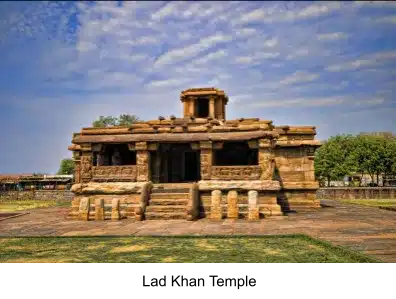
- Wooden-Roofed Temples: The Lad Khan temple at Aihole shows inspiration from wooden-roofed hill temples but was built in stone, showing how local adaptations were made within Chalukyan architecture.
Rashtrakuta Architecture
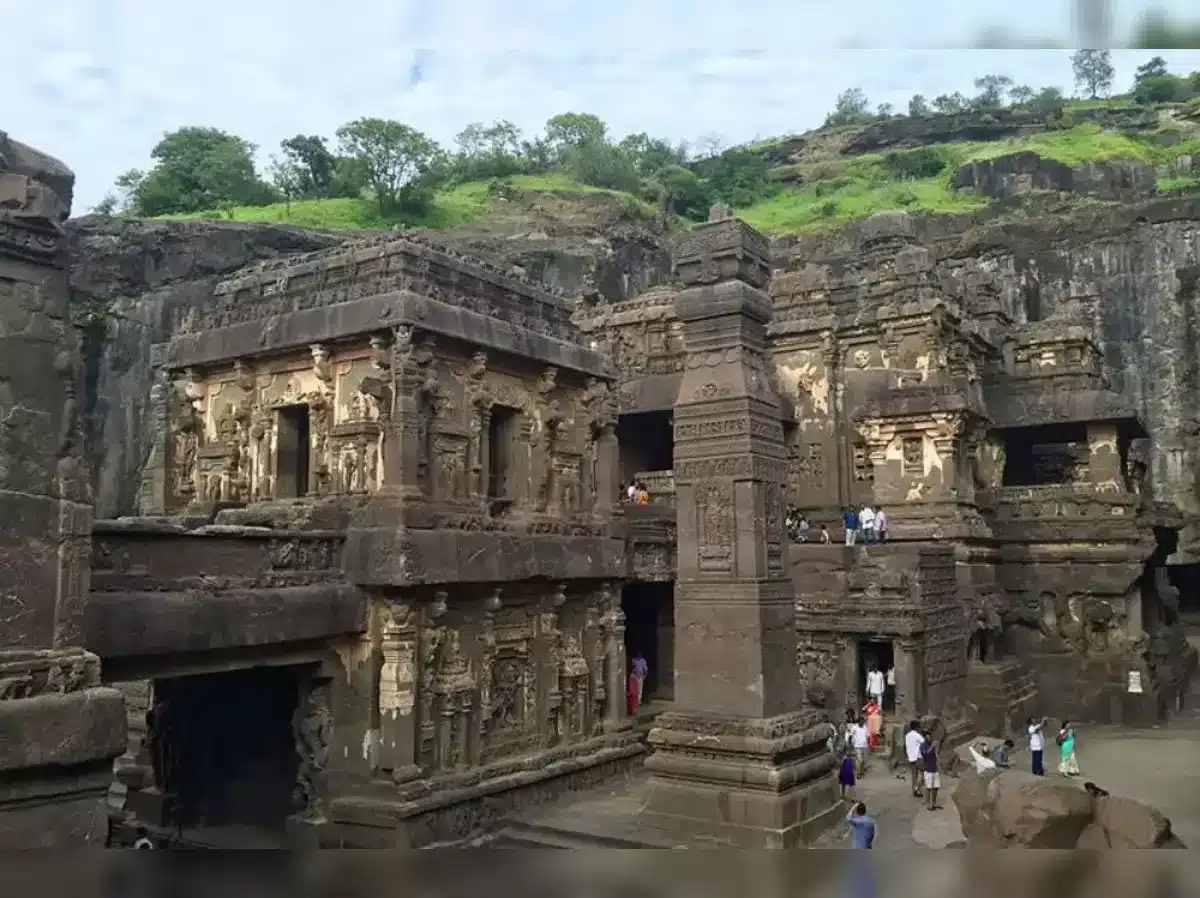
The Rashtrakutas advanced Vesara architecture (8th–10th century CE), creating monumental rock-cut temples. The Kailashnath Temple at Ellora, carved from a single basalt rock, epitomizes their engineering brilliance and artistic vision.
- Fusion of Styles: The Kailashnath Temple integrates a Dravidian-style base and multi-tiered vimana with Nagara ornamental elements, demonstrating a seamless synthesis of northern and southern traditions within one colossal monolithic structure.
- Grandeur and Scale: The Rashtrakutas emphasized grandeur and scale without compromising on sculptural detailing, spreading their Vesara idiom across the Deccan.
- Religious Symbolism: Their temples typically housed Shiva and included features like gopuram-like gateways and a complex layout of subsidiary shrines and dedicated spaces, blending religious symbolism with engineering genius.
- Sculptural Dynamism: The Rashtrakuta architecture at Ellora is notable for the integration of sculptural dynamism and spatial complexity, marking a significant evolution of the Vesara style from the structural temples of the Chalukyas.
Hoysala Architecture
The Hoysala period, centred in Karnataka, is renowned for its distinctive elaboration within the Vesara style, particularly the complex geometrical plans and ornate stone work.
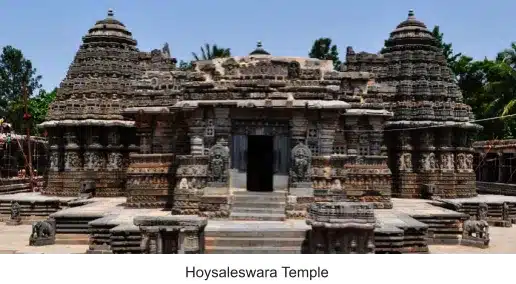
- Geometric Innovation: Temples by the Hoysala dynasty are notably stellate or star-shaped in ground plan, developed from a simple square into a highly intricate form with multiple projections.
- Material and Craftsmanship: Built primarily from soapstone, these temples allowed artisans to achieve exceptional sculptural detailing, resulting in delicate jewelry-like ornamentation and intricate carvings unmatched in Indian architectural traditions.
- Ornamentation and Friezes: The Hoysaleshvara Temple at Halebid exemplifies decorative richness, with elaborate friezes like elephant processions, each uniquely carved, alongside finely wrought depictions of gods adorned with jewel-like embellishments.
- Hybrid Vesara Features: Hoysala temples seamlessly blended Nagara shikhara motifs with Dravidian layouts, emphasizing spatial intricacy, sculptural elegance, and elaborate mandapas designed for cultural activities like music, dance, and public rituals.
Vijayanagara Architecture
The Vijayanagara Empire temples represent the culmination and fusion of centuries of South Indian Dravida traditions with influences from Islamic architecture due to neighbouring sultanates.
- Scale and Grandeur: The architectural style is marked by grandeur, scale, and cultural synthesis. Vijayanagara ruins show a vibrant urban centre where temple complexes were not only religious but also served as centres of wealth and administration.
- Sculptural Elements: Sculpturally, these temples adhered to Chola ideals but incorporated novel elements, occasionally depicting foreigners, illustrating cultural interactions.
- Architectural Features: Architectural features include massive gopurams, extensive pillared halls, and intricately carved mandapas reflecting the empire's wealth and cosmopolitan ethos.
- Dynamic Vesara Tradition: These temples exemplify a dynamic period of South Indian temple architecture, signifying both continuity and change within the Vesara tradition, rooted in innovation and cross-cultural exchange.

Vesara Style of Architecture PYQs
Question 1: The Nagara, the Dravida, and the Vesara are the (UPSC Prelims 2012)
(a) three main racial groups of the Indian subcontinent
(b) three main linguistic divisions into which the languages of India can be classified
(c) three main styles of Indian temple architecture
(d) three main musical Gharanas prevalent in India
Ans: (c)

 Last updated on Oct, 2026
→ UPSC 2027 Notification will be released on 13 January 2027 at upsconline.nic.in.
→ Check Nobel Prize 2026 Winners List here.
→ Download PIB PRiSM Monthly Magazine 2026 here.
→ Check UPSC Monthly Current Affairs Magazine The Recitals here.
→ Check out the latest UPSC Syllabus here.
→ Download UPSC Model Answers for Mains 2026
→ UPSC Mains Question Paper 2026 is out now for Essay & GS Paper 1, 2, 3 & 4.
→ UPSC Calendar 2027 has been released.
→ Enroll in Vajiram & Ravi’s UPSC Mains Test Series 2027 for structured answer writing practice, expert evaluation, and exam-oriented feedback.
→ Join Vajiram & Ravi’s UPSC Mentorship Program 2027 for personalized guidance, strategy planning, and one-to-one support from experienced mentors.
→ Go through the UPSC Mains Previous Year Papers to enhance your preparation.
→ UPSC has released UPSC Toppers List 2025 with the Civil Services final result on its official website.
→ Also check Best UPSC Coaching in India
Vesara Style of Architecture FAQs
Q1. Which dynasty started the Vesara style?+
Q2. What are the three styles of temple architecture?+
Q3. What is the difference between Dravidian and Vesara?+
Q4. What is the Deccani or Vesara style?+
Q5. What are the unique features of Vesara style?+
Tags: vesara style of architecture