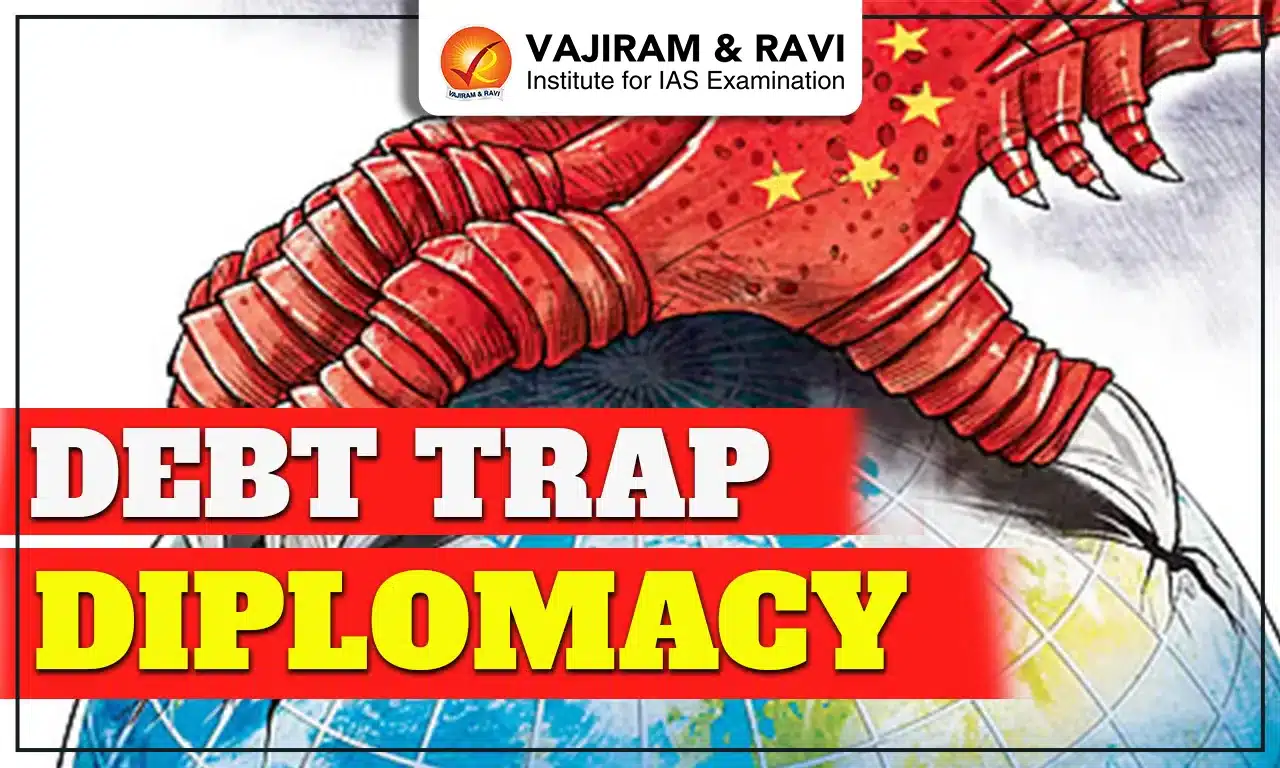
Debt Trap Diplomacy refers to a strategy where powerful creditor countries provide large loans to financially vulnerable nations with terms that may be difficult to meet, creating dependency and allowing the lender to gain strategic or political leverage. The concept of Debt Trap Diplomacy gained prominence in the context of China’s Belt and Road Initiative (BRI), with countries like Sri Lanka, Pakistan, and Djibouti facing rising debt vulnerabilities.
Debt-trap diplomacy has become a key concern in South Asia, Africa, and the Indian Ocean Region, influencing geopolitical alignments, regional infrastructure projects, and India’s strategic and economic interests.
Debt Trap Diplomacy Meaning
Debt Trap Diplomacy is an international relations strategy in which a creditor nation or institution provides loans to another country, sometimes under terms that are difficult to repay.
- Objective: The goal is often to gain economic, political, or strategic leverage when the borrowing nation is unable to meet its obligations.
- Origin: The term was coined by Indian academic Brahma Chellaney in 2017, mainly to describe China’s approach under the Belt and Road Initiative (BRI), where lending practices are viewed as a means for geopolitical gains.
- Example: In 2022, Sri Lanka defaulted on its external debt and had to seek an IMF bailout, with Chinese lenders holding about 10% of its foreign debt.
Debt Trap Diplomacy Features
Debt trap diplomacy involves loans with strict terms, tied agreements, and collateral requirements that increase dependence. Defaults can give lenders control over assets or influence over policies. Borrowing countries face greater repayment pressure, economic risks, and reduced autonomy. Key features of Debt Trap Diplomacy include:
- Targeted Strategic Lending: In debt trap diplomacy, loans are given to economically weak or politically unstable countries, often with strategic locations or valuable resources, as seen in South Asia, Africa, and Central Asia.
- Countries with weak credit ratings, limited financing options, or geopolitical importance are more susceptible to debt distress.
- Challenging Loan Terms: Some loans have commercial interest rates, strict repayment schedules, or clauses favouring the lender’s contractors or materials, though repayment difficulties also depend on the borrower’s economic situation.
- Tied Loans and Collateral: Borrowers may need to use goods, labour, and services from the creditor country, increasing dependency. Strategic assets can be pledged as collateral.
- Leverage Through Default: If borrowers default, creditors can gain influence over national policies or infrastructure, but often prefer debt restructuring or renegotiation instead of asset seizure.
- Economic and Development Risks: Overreliance on such loans increases repayment pressure, foreign currency risk, and long-term economic vulnerability, limiting policy autonomy.


Debt Trap Diplomacy China
Debt trap diplomacy of China is a debated concept that alleges China intentionally offers unsustainable loans for infrastructure projects to developing nations, creating debt burdens that force them to cede strategic assets or political leverage to China. The term is often associated with China's Belt and Road Initiative (BRI).
- These loans are frequently offered on non-concessional terms, such as high interest rates, short repayment periods, and contracts tied to Chinese firms or resources, making borrowers vulnerable.
- When countries struggle to repay, China may gain control over key infrastructure, secure long-term leases, or extract policy concessions, deepening economic dependence and expanding its geopolitical influence.
- Examples:
- Sri Lanka: Hambantota Port leased to China for 99 years in 2017, raising US$1.12 billion.
- Pakistan: China–Pakistan Economic Corridor (CPEC) loans from China exceed US $25 billion, creating fiscal dependence.
- Djibouti: China holds over half (50%-70%) of Djibouti’s external debt.
Debt Trap Diplomacy China Implications
The Debt Trap Diplomacy of China has several implications. It creates economic and strategic challenges for borrowing countries by increasing dependence on China. While loans fund infrastructure and development, they often lead to high debt burdens, fiscal stress, and reduced sovereignty, especially for smaller or vulnerable nations:
- Loan Dependency and Financial Vulnerability: Heavy reliance on Chinese loans increases repayment pressure and may force countries to seek International Monetary Fund (IMF) assistance.
- Example: Pakistan’s debt to China rose from $7.6 billion in 2016 to $26.5 billion in 2022. IMF approved a $7 billion Extended Fund Facility (EFF) package in September 2024 for Pakistan, aimed at promoting economic stability and inclusive growth.
- Loss of Strategic Assets: Countries struggling to repay Chinese loans may be forced to transfer control of key infrastructure to China, compromising their sovereignty and security.
- Example: Sri Lanka leased the Hambantota Port to a Chinese company for 99 years after being unable to service its debt.
- High Debt Burden from Infrastructure Projects: While BRI projects (ports, railways, highways, hydropower) boost connectivity, they also increase fiscal stress and foreign exchange pressure.
- Debt Restructuring Risks: Restructuring terms are sometimes opaque, creating continued dependency and vulnerability.
- Economic and Sovereignty Risks: Rising debt pressures national budgets, affects currency stability, limits long-term planning, and reduces bargaining power in global affairs.
Debt Trap Diplomacy Impact on India
Debt-trap diplomacy in South Asia, through large loans and strategic infrastructure projects, is reshaping regional dynamics. It affects India’s security, economic influence, and diplomatic leverage, especially in the Indian Ocean Region (IOR) and the broader Indo-Pacific Region.
- Strategic Security Concerns: Chinese control over ports and infrastructure in neighbouring countries, such as Hambantota Port in Sri Lanka, Gwadar Port in Pakistan, can be used for surveillance or military purposes.
- This threatens India’s maritime security and limits its ability to ensure a free, open, and secure Indo-Pacific.
- Reduced Regional Influence: India’s role as the main development and security partner in South Asia can be weakened as countries like Nepal, Sri Lanka, Pakistan, and the Maldives increasingly depend on Chinese loans and projects.
- Economic Competition: The influx of Chinese investments may lead to increased economic competition, challenging India's position in regional markets and India-China relations.
- Diplomatic Pressure: Debt dependency can lead countries to align foreign policies with Beijing’s interests and affect India’s influence in international forums such as the United Nations.
- High Counter-Engagement Costs: India provides credit lines, financial aid, and strategic investments to maintain influence. Countering Chinese influence requires significant economic and diplomatic focus, potentially diverting India’s resources from other strategic priorities.
- Example: $2.5 billion credit line and fuel support to Sri Lanka during its economic crisis.
Debt Trap Diplomacy Global Response
In response to concerns over China’s Belt and Road Initiative (BRI) and its potential debt-trap implications, several international efforts have been launched to provide transparent and sustainable infrastructure alternatives:
- Debt Restructuring: Debt-distressed countries are increasingly seeking debt relief and restructuring through multilateral frameworks such as the G20's Common Framework and the Debt Service Suspension Initiative (DSSI), encouraging China to participate in these cooperative efforts to ease debt burdens.
- Regional Counteractions: Countries such as Malaysia have renegotiated or cancelled costly BRI projects, while others—including India, Japan, and the EU—now promote their own infrastructure funds and partnerships.
- Global Gateway is introduced by the European Union to provide credible, alternative infrastructure financing to countries that might otherwise rely on debt-heavy Chinese projects.
- Build Back Better World (B3W) Initiative: Proposed by the G7 at the 47th summit, B3W aims to fill the infrastructure investment gap in developing and lower-income countries, countering China’s growing influence.
- Blue Dot Network (BDN): Launched by the US, Japan, and Australia in November 2019 at the Indo-Pacific Business Forum, BDN brings together governments, the private sector, and civil society to promote high-quality, transparent, and sustainable infrastructure standards globally.
Debt Trap Diplomacy Way Forward
Debt trap diplomacy of China can be countered by India through transparent development, responsible financing, and targeted regional investments. Strengthening strategic partnerships and offering technical support to neighbours can help safeguard sovereignty and reduce dependence on debt-heavy projects.
- Promote Transparent Development: Ensure full disclosure of loan terms, interest rates, and repayment schedules to debtor countries and the global community to prevent hidden debt risks and improve accountability.
- Multilateral Debt Restructuring: Strengthen international cooperation frameworks like the G20's Common Framework to fairly restructure unsustainable debts and provide relief to distressed countries, involving all creditors, including China.
- Alternative Infrastructure Financing: Encourage development and funding of alternative sustainable infrastructure projects with transparent terms from institutions like the G7, World Bank, and regional partnerships to reduce dependency on Chinese loans.
- Strengthen Technical and Governance Support: Provide advisory services, project management guidance, and governance support to partner nations so they can assess loans carefully and safeguard sovereignty.
- Regional and International Oversight: Establish or empower regional bodies and international watchdogs to monitor debt sustainability, detect predatory lending, and mediate disputes to safeguard debtors’ sovereignty and development interests.
Debt Trap Diplomacy UPSC PYQs
Question 1. “China is using its economic relations and positive trade surplus as tools to develop potential military power status in Asia.” In the light of this statement, discuss its impact on India as her neighbour. (UPSC Mains 2017)

 Last updated on Sep, 2026
→ UPSC 2027 Notification will be released on 13 January 2027 at upsconline.nic.in.
→ Asian Games 2026 are being held in Aichi-Nagoya, Japan, from 19 September to 4 October.
→ Check out the latest UPSC Syllabus here.
→ Download UPSC Model Answers for Mains 2026
→ UPSC Mains Question Paper 2026 is out now for Essay & GS Paper 1, 2, 3 & 4.
→ UPSC Calendar 2027 has been released.
→ Enroll in Vajiram & Ravi’s UPSC Mains Test Series 2027 for structured answer writing practice, expert evaluation, and exam-oriented feedback.
→ Join Vajiram & Ravi’s UPSC Mentorship Program 2027 for personalized guidance, strategy planning, and one-to-one support from experienced mentors.
→ Go through the UPSC Mains Previous Year Papers to enhance your preparation.
→ UPSC has released UPSC Toppers List 2025 with the Civil Services final result on its official website.
→ Also check Best UPSC Coaching in India
Debt Trap Diplomacy FAQs
Q1. What is debt trap diplomacy?+
Q2. Who coined the term debt trap diplomacy?+
Q3. How does debt-trap diplomacy impact a country’s sovereignty?+
Q4. What countries are in the debt trap?+
Q5. Is India in debt trap?+
Tags: debt trap diplomacy