Colonialism is a system in which one nation establishes political, economic, and social control over another to exploit its resources, labor, and markets. Colonialism, as known from the European powers such as Spain, Britain, and France expanded through conquest, trade monopolies, and settlements, using military, technological, and ideological tools to maintain dominance.
In India, colonialism unfolded in phases: the East India Company first monopolised trade and drained wealth; later, India became a supplier of raw materials and a market for British goods, causing deindustrialisation; finally, British control was consolidated through investments and administrative expansion. Globally, colonialism reshaped societies, creating economic dependency, cultural domination, and social hierarchies, while decolonisation after World War 2 restored sovereignty but left enduring political and economic challenges.
Colonialism Meaning
Colonialism is described as a system where one nation establishes political, economic, and social control over another to exploit its resources, markets, and labor. It emerged alongside industrial capitalism, with colonies integrated into a dependent and unequal global economic system, establishing hybrid economies that were neither entirely pre-capitalist nor fully capitalist.
- The control over production, trade, and governance was generally held by a foreign capitalist class, whose primary aim was to extract surplus wealth for the imperial power rather than promote local development.
Colonialism examples
Several European powers dominated the world through colonialism, exploiting colonies for resources, trade, and strategic advantage. These empires reshaped economies, societies, and global power structures. Some of the prominent examples include:
- Spanish Empire (15th – 19th Century): As one of the earliest European colonial powers, Spain controlled large territories in the Americas, Africa, and Asia. It extracted wealth through gold, silver, and other valuable resources.
- British Empire (17th – 20th Century): One of the largest empires in history, Britain controlled territories across Asia, Africa, the Americas, and Oceania. It used military and economic power to extract resources like cotton, tea, and rubber from its colonies.
- French Empire (17th – 20th Century): France held colonies in Africa, Asia, and the Caribbean. Its colonial economy focused on producing cash crops such as coffee, sugar, and cocoa for export to the metropole.
Colonialism History
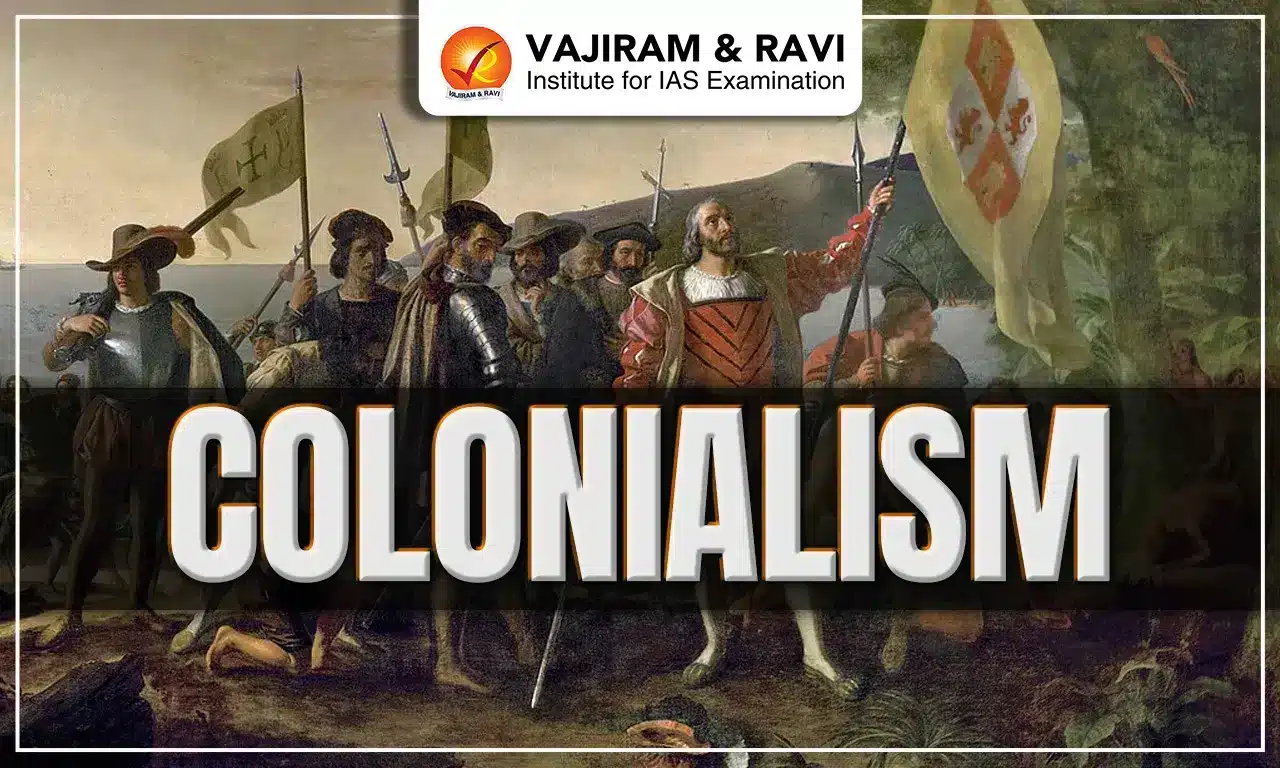
Colonialism began in the 15th century as European powers, especially Portugal and Spain, sought new trade routes and territories. This era marked the start of overseas expansion, with colonies in Asia, Africa, and the Americas exploited for resources, labour, and strategic advantage.
- Early Expansion (15th–17th Century): Portugal and Spain pioneered overseas exploration, establishing trade posts and military bases.
- England, France, and the Netherlands soon followed, expanding European influence across continents.
- 18th–19th Century Expansion: European powers consolidated their colonies, intensifying resource extraction and territorial control.
- The Industrial Revolution increased the demand for raw materials and new markets, intensifying imperial competition.
- German Colonial Empire: Germany joined the colonial race after 1884, acquiring territories in Africa and Asia.
- By 1914, it was the third largest colonial power after Britain and France, including areas in modern-day Namibia, Tanzania, Rwanda, Cameroon, and parts of the Pacific.
- British Rule in India: Britain emerged as the largest colonial power, with India as its most valuable colony. India supplied enormous wealth, raw materials, and manpower, significantly supporting Britain’s industrial and global dominance.
- Global Scramble for Colonies: By the late 19th century, most of the world was divided among European powers in what became known as the Scramble for Africa and intensified imperial expansion in Asia and the Pacific.
- Decolonisation: Latin American countries gained independence in the early 19th century.
- African and Asian countries mostly achieved independence after World War 2, in the mid-20th century, marking the decline of European colonial empires.
- Legacy of Colonialism: Centuries of colonial rule left former colonies with economic, social, and political inequalities, shaping global disparities that persist to the present day.


Colonialism Forms
Colonialism took different forms based on the objectives of the imperial power and the characteristics of the colony. Its types reflect the strategies of domination and resource control employed by colonisers.
- Extractive Colonialism: This form focused on the exploitation of resources, labour, and wealth from the colony for the benefit of the imperial power. Local economies were reorganised to serve imperial interests, leaving colonies economically dependent and underdeveloped.
- Settler Colonialism: Here, people from the colonising country settled permanently in the colony, establishing communities, infrastructure, and institutions. Settler colonies often reshaped the social, cultural, and economic structures of the territory, emphasising long-term occupation.
- Direct Rule: The coloniser imposed its own administrative and political systems directly on the colony, replacing local governance structures and ensuring that imperial objectives were implemented efficiently.
- Indirect Rule: Colonial control was exercised through existing local authorities or traditional institutions, while the imperial power oversaw resources, security, and major policies. This allowed the coloniser to maintain dominance with minimal administrative effort.
Colonialism Characteristics
Colonialism combined economic, political, and cultural control, ensuring that the colony’s resources, labour, and governance primarily served the interests of the imperial power, while the local development of the colony was deliberately stifled.
- Subordination to a Global Capitalist System: Colonies were positioned to serve the economic and strategic interests of the imperial power rather than their own development.
- Unequal Exchange: Colonies produced low-value raw materials with simple technology, while the imperial powers produced high-value manufactured goods, keeping colonies economically and technologically dependent.
- External Integration with Internal Disarticulation: Colonial economies were linked to global markets but internally fragmented; agriculture, industry, and trade were oriented to meet imperial needs, preventing cohesive economic growth.
- Drain of Wealth: Resources and surplus were transferred to the imperial power through unrequited exports and used to maintain colonial administration and military, limiting local capital accumulation.
- Foreign Political Domination: Governance was controlled by the coloniser, suppressing indigenous political authority and consolidating imperial power.
- Systematic Exploitation and Underdevelopment: The colonial system exploited colonies economically, politically, and socially, leading to persistent underdevelopment despite abundant local resources.
- Cultural Imposition and Social Hierarchies: Colonisers imposed their language, culture, religion, and social norms, creating racial and cultural hierarchies to justify domination.
Colonialism Causes
Colonialism emerged from a combination of economic, political, social, religious, and technological factors, reflecting the ambitions and capabilities of European powers.
- Economic Motives: European powers aimed to acquire wealth and resources such as gold, silver, spices, and agricultural products. Colonies provided raw materials for European industries and captive markets for manufactured goods. Mercantilist policies further encouraged territorial expansion to accumulate national wealth through trade.
- Political and Military Rivalry: The rise of powerful nation-states intensified imperial competition. Colonies were acquired to enhance national prestige, secure strategic advantages, and assert dominance over rivals, often through military conquest and territorial control.
- Religious Motives: The spread of Christianity and the belief in a “civilising mission” motivated European powers to convert indigenous populations and justify their colonial rule.
- Technological Advancements: Innovations in navigation, shipbuilding, and weaponry enabled Europeans to explore distant lands, overcome geographical barriers, and establish effective control over colonies.
- Demographic Pressures: Population growth and social transformations in Europe, such as the enclosure movement, created surplus labour and displaced populations, who were encouraged to migrate and settle in colonies.
- Ideological Justifications: Ideas of racial superiority, social Darwinism, and the civilising mission provided Europeans with a moral and intellectual rationale for domination and exploitation.
Colonialism Impact
Colonialism has profoundly shaped the political, economic, social, and cultural fabric of the world, leaving a complex legacy with both negative and positive dimensions.
- Political and Economic Control: Colonial powers imposed foreign governance systems, often suppressing indigenous political institutions and exploiting resources to serve imperial centers.
- Cultural Assimilation and Loss of Identity: Colonisers often sought to replace indigenous languages, customs, and traditions with their own, leading to cultural erosion.
- Social Stratification and Inequality: Colonial rule created hierarchies favoring Europeans, marginalising indigenous populations, and institutionalising social inequalities.
- Economic Exploitation: Colonies were integrated into global trade as suppliers of raw materials and labor, creating extractive economies benefiting the colonizers.
- Example: India became a raw material supplier and market for British manufactured goods, resulting in deindustrialisation and economic dependency.
- Infrastructure Development: Railways, ports, and administrative networks were developed primarily to facilitate resource extraction and control rather than local development.
- Cultural Exchange and Syncretism: Colonial periods saw blending of cultures, religions, and languages, creating unique syncretic identities, such as Afro-Caribbean cultures.
- Resistance and Independence Movements: Nearly every colonised region experienced resistance, leading to movements for independence.
- Long-Term Consequences: Postcolonial states continue to face poverty, political instability, and social fragmentation rooted in colonial structures.
Colonialism in India
Colonialism in India unfolded in distinct phases, each reinforcing economic exploitation, political control, and social transformation.
- First Stage (Mid-18th Century to Early 19th Century): The British East India Company secured political power and monopolised trade, especially after the conquest of Bengal (Battle of Plassey, 1757) and expansion into South India.
- Indian traders and weavers were ruined as the Company imposed trade restrictions and forced sales at low prices.
- Wealth drained continuously from India to Britain, famously described as a “sponge” drawing riches from the Ganges to the Thames. Traditional social and ideological systems were largely respected during this phase.
- Second Stage – Free Trade and Deindustrialisation: India became a supplier of raw materials and a market for British manufactured goods. Traditional industries declined, per capita income stagnated, and economic dependency deepened.
- Infrastructure such as railways, postal, and telegraph systems was expanded to integrate India into the global capitalist economy.
- Modern legal systems and Western education were introduced to train administrators, while colonial ideology undermined indigenous culture under the guise of a civilising mission.
- Third Stage – Era of Finance Capital and Consolidation: This phase involved massive British and global capital investment in railways, plantations, mining, jute mills, shipping, and banking.
- British control was further strengthened amid growing imperial rivalries. Reactionary policies under Viceroys like Curzon reinforced permanent British trusteeship and suppressed moves toward self-government.
- Industrial growth occurred during periods of fluctuating foreign capital and global economic disruptions such as the World Wars and the Great Depression, but it did not lead to a full industrial revolution in India.
Decolonisation
Decolonisation was the process through which colonies gained independence from imperial powers, achieving political, social, and economic sovereignty. It became a major global phenomenon after World War 2, driven by nationalist movements, anti-colonial struggles, and evolving international norms supporting self-determination.
- Timeline: The major wave of decolonisation began in the mid-20th century.
- India achieved independence from Britain in 1947, setting a precedent for Asia and Africa.
- Ghana became the first sub-Saharan African country to gain independence in 1957, followed by Nigeria, Kenya, and Algeria in the 1960s.
- Southern African nations, including Zimbabwe and Namibia, faced prolonged struggles that extended into the late 20th century.
- International Role: The United Nations promoted self-governance, oversaw transitions, and pressured colonial powers to relinquish control.
- Impact: Decolonisation reshaped global politics and economics. Newly independent states often faced political instability, ethnic conflicts, and economic dependency, reflecting the long-term legacies of colonial exploitation.
Colonialism UPSC PYQs
Question 1: What were the major political, economic and social developments in the world which motivated the anti-colonial struggle in India? (UPSC Mains 2014)
Question 2: The anti-colonial struggles in the West Africa were led by the new elite of Western-educated Africans. Examine. (UPSC Mains 2016)
Question 3: What problems were germane to the decolonization process of Malay peninsula? (UPSC Mains 2017)

 Last updated on Sep, 2026
→ UPSC 2027 Notification will be released on 13 January 2027 at upsconline.nic.in.
→ Check out the latest UPSC Syllabus here.
→ Download UPSC Model Answers for Mains 2026
→ UPSC Mains Question Paper 2026 is out now for Essay & GS Paper 1, 2, 3 & 4.
→ UPSC Calendar 2027 has been released.
→ Enroll in Vajiram & Ravi’s UPSC Mains Test Series 2027 for structured answer writing practice, expert evaluation, and exam-oriented feedback.
→ Join Vajiram & Ravi’s UPSC Mentorship Program 2027 for personalized guidance, strategy planning, and one-to-one support from experienced mentors.
→ Go through the UPSC Mains Previous Year Papers to enhance your preparation.
→ UPSC has released UPSC Toppers List 2025 with the Civil Services final result on its official website.
→ Also check Best UPSC Coaching in India
Colonialism FAQs
Q1. What do you mean by colonialism?+
Q2. Which country started colonialism?+
Q3. What is an example of colonialism?+
Q4. What is the main purpose of colonialism?+
Q5. Who was the first country to colonise India?+
Tags: colonialism