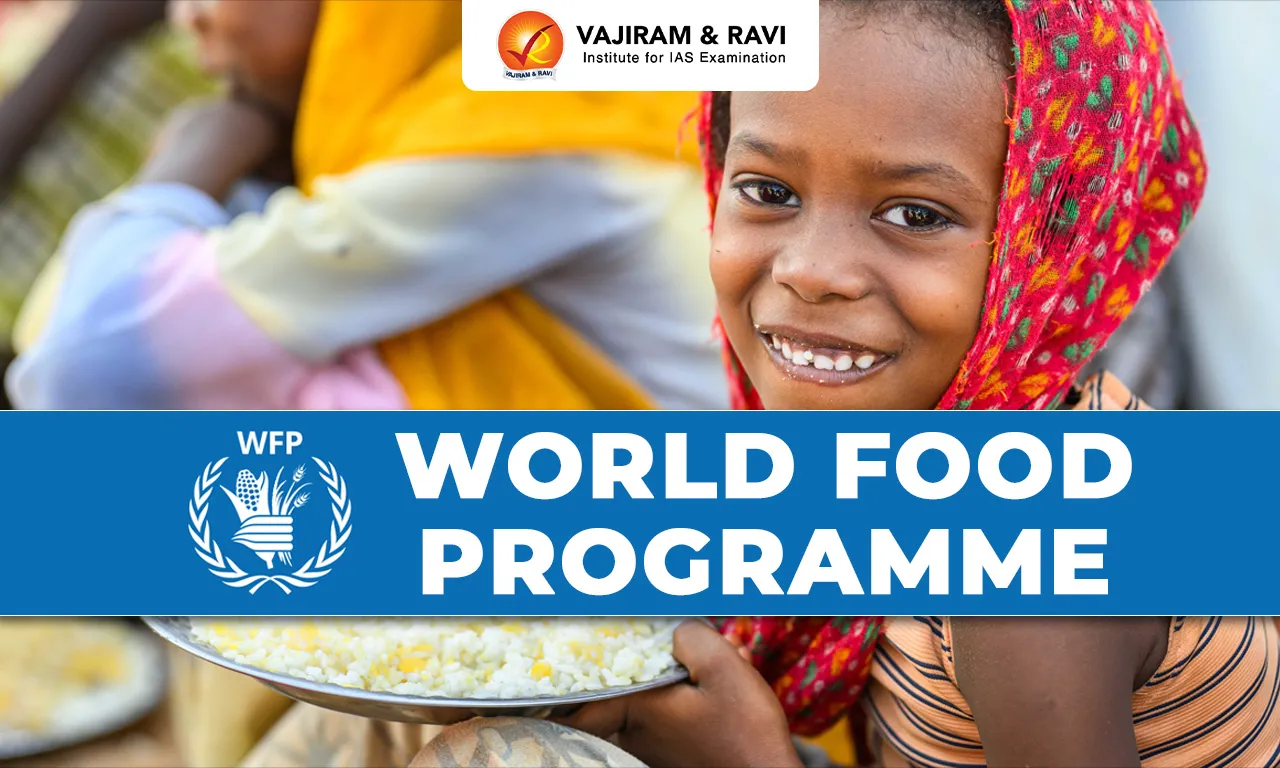
The United Nations World Food Programme (WFP) is a UN agency that works to combat hunger and food insecurity by providing emergency food assistance, improving nutrition and supporting vulnerable communities. It plays an important role in responding to conflicts, disasters and food crises and contributes to SDG 2 (Zero Hunger).
The World Food Programme (WFP) faces growing challenges from prolonged conflicts, climate change, rising food prices and funding shortages. Disrupted supply chains, limited humanitarian access and increasing global food insecurity further constrain its ability to provide timely assistance to vulnerable populations.
World Food Programme (WFP) About
The World Food Programme is the largest humanitarian United Nations (UN) organisation that helps people recover from war, natural catastrophes, and the effects of harsh weather by saving lives in times of need and utilising food aid to create a pathway to peace, stability, and prosperity.
- World Food Programme Established: Established in 1961 by the Food and Agriculture Organisation (FAO) and the United Nations General Assembly (UNGA), the WFP is also part of the UN Sustainable Development Group (UNSDG).
- Goal: To help achieve the global commitment of ending hunger, ensuring food security, and improving nutrition by 2030.
- Global Reach: In order to achieve its purpose, the World Food Programme (WFP) is present in more than 120 nations and territories.
- World Food Programme Nobel Prize: The WFP won the 2020 Nobel Peace Prize for its efforts to end hunger, improve peace in areas affected by conflict, and stop hunger from being used as a weapon of war.
World Food Programme Headquarters
The World Food Programme (WFP) is headquartered in Rome, Italy, which also hosts the headquarters of the Food and Agriculture Organisation (FAO) and the International Fund for Agricultural Development (IFAD), making Rome a major centre for global food and agricultural cooperation.
World Food Programme Funding
The World Food Programme (WFP) is 100% voluntarily funded, receiving no UN-assessed dues. The agency relies primarily on contributions from governments, corporations, and private donors.
- In order to reach 110 million people by 2026, the WFP will need US$13 billion in funding, despite a period of severe global funding shortages.
- 93.5 per cent of all government contributions are directly used to fund operations that save and transform lives.
Reports Released by World Food Programme (WFP)
The World Food Programme (WFP) releases a variety of regular and flagship publications tracking global hunger, malnutrition, and food security. The most prominent reports include the following:
- Global Report on Food Crises (GRFC): A vital annual reference point that provides consensus-based assessments of acute food insecurity and malnutrition across countries affected by crises.
- The State of Food Security and Nutrition in the World (SOFI): Co-published with five UN agencies (including WFP), this comprehensive report details the global status of hunger, food affordability, and progress toward the Sustainable Development Goals.
- Hunger Hotspots: Released twice a year by the WFP and the Food and Agriculture Organisation (FAO), this early warning report identifies regions and countries facing severe acute food insecurity in the near term.
World Food Programme Objectives
The World Food Programme focuses on achieving the United Nations Sustainable Development Goal of "Zero Hunger" (SDG 2) by 2030, while responding to immediate humanitarian needs and strengthening long-term food and nutrition security.
- Prevent and Fight Hunger: Provide emergency food and cash assistance during conflicts, disasters and humanitarian crises while building community resilience.
- Counter Climate Shocks & Support Healthy Diets: Help vulnerable communities manage climate risks, improve nutrition and expand school meal programmes.
- Enhance Economies and Food Systems: Strengthen food systems, livelihoods and markets, support smallholder farmers, and help governments improve food and nutrition security.
- Harness Innovation and Technology: Use digital platforms, data, drones, blockchain technology and other innovations to improve the efficiency and reach of food assistance.


World Food Programme Organisational Structure
The WFP has a governance structure that combines intergovernmental oversight with an executive Secretariat responsible for implementing its programmes.
- Executive Board: The World Food Programme is governed by a 36-member Executive Board. Eighteen members are chosen by the FAO Council and eighteen by the UN Economic and Social Council (ECOSOC) for three-year periods.
- Executive Director: The Executive Director of the World Food Programme is appointed jointly by the UN Secretary-General and the Director-General of FAO. He is appointed for a fixed five-year period.
- In addition, WFP has three Assistant Executive Directors and one Deputy Executive Director.
World Food Programme Functions
WFP performs both humanitarian and long-term development functions, combining emergency food assistance with measures that strengthen food security, nutrition, and resilience.
- Food Purchasing & Supply-Chain Management: WFP purchases, transports, stores, and distributes food through its global supply chain. In 2025, it operated 600+ warehouses and purchased US$2 billion in goods and services from 153 countries.
- Cash and Voucher Delivery: WFP assesses local markets to choose between food, cash, or vouchers. In 2025, it provided around US$2 billion in cash transfers and US$170 million in commodity vouchers.
- Early Warning & Anticipatory Action: WFP uses forecasts, early-warning data and pre-arranged financing to act before climate disasters. In 2025, it protected 6.3 million people in 47 countries and provided early-warning information to 15 million+ people.
- Partnerships: WFP works through partnerships to advance the 2030 Agenda and the 17 Sustainable Development Goals (SDGs), coordinating with governments and other stakeholders.
- Strategic Planning & Support: Under its 2026–2029 Strategic Plan, WFP has reduced its integrated strategic outcomes from five to three, focusing on urgent needs, resilience and stronger food-security and nutrition systems.
World Food Programme and India
Since 1963, the World Food Programme (WFP) has operated in India. Since India became self-sufficient in cereal production, its role has progressively changed from direct food distribution to technical support, capacity building, and bolstering government food security institutions.
- Public Distribution System (PDS): In order to better ensure that subsidised food reaches its intended recipients, WFP assists the government in enhancing the Targeted Public Distribution System's effectiveness, accountability, and openness.
- Food Fortification: To boost micronutrient intake and treat anaemia, WFP offers technical assistance for fortifying government-distributed commodities, such as rice and foods used in nutrition programmes.
- Food-Security Mapping: To identify food-insecure areas and assist evidence-based policymaking, WFP uses Vulnerability Analysis and Mapping (VAM) and other data-based methods.
World Food Programme Challenges
Over 300 million people suffer from acute food insecurity, which presents significant challenges for the World Food Programme. Its ability to provide life-saving assistance is severely limited by rising operating expenses, acute financing shortages, etc.
- Severe Funding Shortfalls: Food ration cuts and pipeline suspensions are necessary due to donor donations falling short of the rapidly increasing global demands.
- Conflict and Access Restrictions: Aid workers are put at risk, local agricultural infrastructure is destroyed, and humanitarian access is physically blocked by active fighting in hotspots like Sudan and the Middle East.
- El Niño and Climate Shocks: Strong El Niño cycles, unpredictable weather patterns, and widespread droughts destroy local crop production, causing millions of people to experience unexpected food emergencies.
- Inflation and Supply Chain Expenses: The cost of food, fuel, and transportation is inflated by geopolitical upheavals and rising energy prices, so each dollar can purchase far less relief.
World Food Programme Way Forward
The World Food Programme should move beyond repeated emergency relief towards anticipatory action, resilient food systems and stronger national capacities.
- Prioritise Anticipatory Action: Increase early-warning systems and forecast-based financing to help vulnerable areas before climate shocks and disasters worsen.
- Create Resilient Food Systems: To lessen recurrent food crises, make investments in livelihoods, local value chains, climate-resilient agriculture, and sustainable natural resource management.
- Boost National Ownership: With the help of WFP's technical assistance, gradually transition from direct delivery to government-led systems for social protection, nutrition, and food security.
- Enhance Financing Efficiency: As humanitarian demands surpass available funds, mobilise consistent and varied funding and concentrate resources on high-impact activities.

 Last updated on Oct, 2026
→ UPSC 2027 Notification will be released on 13 January 2027 at upsconline.nic.in.
→ Asian Games 2026 are being held in Aichi-Nagoya, Japan, from 19 September to 4 October.
→ Check Nobel Prize 2026 Winners List here.
→ Download PIB PRiSM Monthly Magazine 2026 here.
→ Check UPSC Monthly Current Affairs Magazine The Recitals here.
→ Check out the latest UPSC Syllabus here.
→ Download UPSC Model Answers for Mains 2026
→ UPSC Mains Question Paper 2026 is out now for Essay & GS Paper 1, 2, 3 & 4.
→ UPSC Calendar 2027 has been released.
→ Enroll in Vajiram & Ravi’s UPSC Mains Test Series 2027 for structured answer writing practice, expert evaluation, and exam-oriented feedback.
→ Join Vajiram & Ravi’s UPSC Mentorship Program 2027 for personalized guidance, strategy planning, and one-to-one support from experienced mentors.
→ Go through the UPSC Mains Previous Year Papers to enhance your preparation.
→ UPSC has released UPSC Toppers List 2025 with the Civil Services final result on its official website.
→ Also check Best UPSC Coaching in India
World Food Programme FAQs
Q1. What is the World Food Programme?+
Q2. Is India a member of WFP?+
Q3. Where is the World Food Programme's headquarters located?+
Q4. Who is behind the World Food Programme?+
Q5. Which country has the worst hunger problem?+
Tags: quest UPSC International Relations and Institutions Notes world food programme