Question
Do you think digital technology promotes social empowerment? Explain with examples.
Detailed Solution
Digital technology has shifted empowerment from merely access to services towards access to information, opportunities and voice; however, its benefits depend on digital access, literacy and inclusion.
Digital Technology as an Enabler of Social Empowerment
- Financial Autonomy: Digital payments and banking enhance economic agency among women, migrants and informal workers; JAM–UPI enables low-cost transactions without dependence on intermediaries.
- Welfare Empowerment: DBT and Aadhaar-enabled delivery reduce dependence on middlemen and improve access to entitlements; this particularly empowers poor, elderly and vulnerable beneficiaries through direct and portable transfers.
- Educational Empowerment: Digital learning expands opportunities for rural, tribal and disadvantaged students; DIKSHA and PM e-VIDYA provide learning resources beyond geographical and infrastructural constraints.
- Healthcare Inclusion: Telemedicine improves access for rural communities, elderly persons and persons with mobility constraints; e-Sanjeevani enables remote doctor consultations, reducing distance barriers.
- Women’s Agency: Digital literacy and connectivity strengthen women’s voice, livelihood choices and access to markets; Sanchar Shakti supported rural women, including SHG members, in using ICT for skills and economic opportunities.
- Tribal & Marginalised Livelihoods: Digital platforms can connect tribal artisans and small producers to wider markets, reducing dependence on local intermediaries; platforms such as TRIFED’s Tribes India support digital marketing of tribal products.
- Voice & Civic Participation: Digital platforms enable marginalised groups to express concerns and access grievance redressal; MyGov and CPGRAMS provide channels for citizens to communicate with public authorities.
- Inclusion & Identity: Digital accessibility can improve social participation of persons with disabilities and other excluded groups; accessible digital services reduce barriers to information, welfare and public services.
Digital Technology as a Source of New Exclusion
- Access & Infrastructure Divide: Unequal connectivity and device access exclude remote and poorer communities; only 14.9% of rural households have internet access compared with 42% of urban households.
- Gendered Digital Divide: Social norms and unequal access to devices constrain women’s digital participation; NFHS-6 found only 64% of women aged 15–49 had ever used the internet, compared with 80% of men.
- Technology-Induced Welfare Exclusion: Authentication and connectivity failures can prevent genuine beneficiaries from accessing entitlements; a study in Ranchi, Jharkhand, found biometric authentication problems affecting PDS access.
- Cybersecurity Vulnerability: Greater digital dependence exposes citizens to fraud, identity theft and online exploitation; NCRB recorded 86,420 cybercrime cases in 2023, of which 59,526 (68.9%) involved fraud.
- Algorithmic & Accessibility Exclusion: Biased datasets can disadvantage under-represented groups, while inadequate vernacular and disability-friendly interfaces can exclude persons with disabilities and low-literacy users.
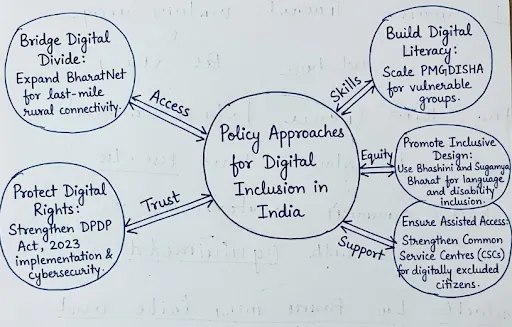
As Amartya Sen’s capability approach suggests, development is about expanding people’s substantive freedoms; digital technology can fulfil this role only when access, capability and inclusion accompany connectivity.
Latest UPSC Exam 2027 Updates
Last updated on Oct, 2026