The Ravi River is one of the five major rivers of the Punjab region and an important tributary of the Indus River system. Originating in the Himalayas of Himachal Pradesh, it flows through the Chamba region, enters the Punjab plains, crosses into Pakistan and eventually joins the Chenab River. Its tributaries, including the Budhil, Siul and Ujh, contribute to its drainage network. Major infrastructure such as Chamera projects, the Ranjit Sagar Dam and Madhopur Headworks supports hydropower generation and irrigation.
The Ravi River also sustains agriculture, local livelihoods, aquatic habitats and cultural heritage. However, water diversion, pollution, infrastructure development, floods and climate change pose significant challenges. Sustainable management requires efficient irrigation, pollution control, catchment conservation, climate adaptation and transboundary cooperation under applicable water agreements.
Ravi River Origin
The Ravi River originates in the Himalayas of Himachal Pradesh, where snow-fed streams descend through the mountainous terrain of the Chamba region.
- Ravi’s source region is in the Himalayas of Chamba district, Himachal Pradesh, at an elevation of approximately 4,300 metres. The upper catchment lies between the Pir Panjal and Dhauladhar ranges, with steep valleys, rocky riverbeds and fast-flowing mountain streams.
- The river is traditionally associated with the Bara Bhangal region. Its headwaters receive water from melting snow, glacier-fed streams and precipitation. As the Ravi descends from the mountains, it collects water from tributaries draining the surrounding Himalayan slopes.
- Historically, the river has been known by several names:
- Parushni or Parushni: A name associated with the Ravi in Vedic tradition.
- Iravati: A name used in ancient Indian traditions.
Ravi River States Distribution
The Ravi basin extends from the western Himalayas into the Punjab plains, crossing Indian administrative regions before continuing through Pakistan towards its confluence with the Chenab.
- In India, the river and its drainage basin are associated primarily with the following regions:
- Himachal Pradesh: The upper Ravi flows through the Chamba region, including mountainous valleys and settlements dependent on river water.
- Jammu and Kashmir: Parts of the wider basin and tributary network extend into this Union Territory, particularly around the adjoining Kathua region.
- Punjab: The river descends towards the plains near Madhopur, where headworks and canals divert water for irrigation.
- After crossing into Pakistan, the Ravi flows through Punjab province. It is historically associated with Lahore and eventually joins the Chenab River.
- The river forms part of the India–Pakistan boundary for a section of its course. Its transboundary character makes water allocation, irrigation management and flood preparedness important to both countries.


Ravi River Course and Hydrology
The Ravi flows through steep Himalayan valleys before reaching the Punjab plains, where its slope decreases, and its water is diverted through irrigation and hydropower infrastructure.
Course of the river
- Upper course: The river flows through the mountainous Chamba region, where the channel is steep, rocky and characterised by rapids and gorges. Snowmelt plays an important role in sustaining its flow.
- Middle course: After descending from the Himalayas, the Ravi reaches the plains near Madhopur in Punjab. Here, the river is connected to irrigation infrastructure, including the Upper Bari Doab Canal system.
- Lower course: The Ravi crosses into Pakistan and continues through Punjab’s plains. It passes the Lahore region before joining the Chenab River, contributing to the wider Indus drainage system.
Hydrological characteristics
- The Ravi is a perennial Himalayan river, although its discharge varies by season. Its flow depends on snowmelt, precipitation, tributary inflows and water-management operations.
- The Ravi River length is approximately 725 kilometres and has an Indian catchment area of 14,442 square kilometres.
- The river’s flow is particularly rapid in its upper reaches. In the plains, its water is regulated and diverted for irrigation, hydropower and other uses.
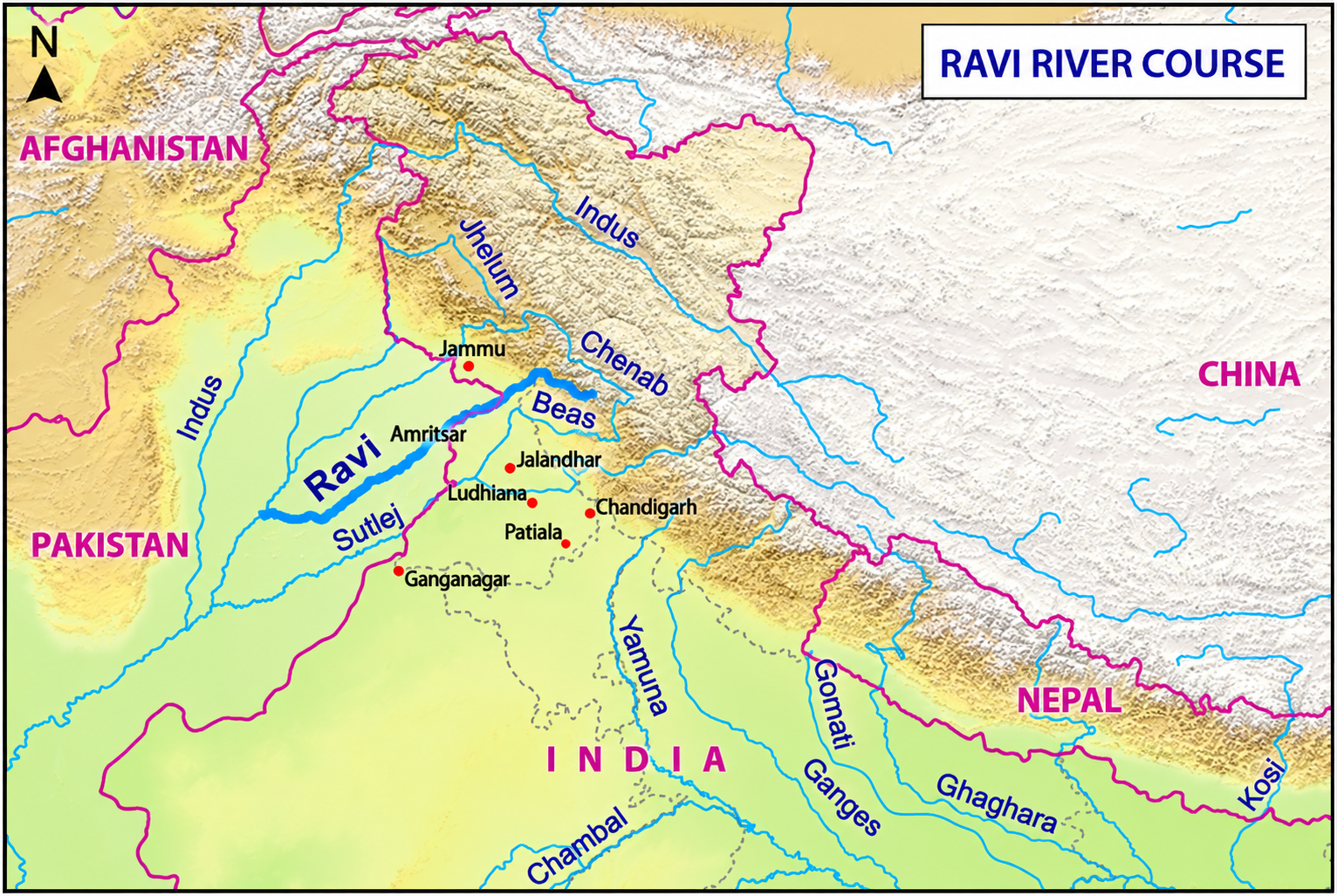
Ravi River Map
The course of the Ravi River is shown in the map below.
Ravi River Major Tributaries
The Ravi receives water from Himalayan streams and tributaries that drain neighbouring valleys, sustain its discharge and connect mountain catchments with downstream agricultural regions. The principal tributaries and associated streams include:
- Budhil River: An important tributary draining the Himalayan region of Chamba. It contributes to Ravi’s flow downstream of its headwaters.
- Nai or Dhona River: A major tributary joining the Ravi downstream from its source.
- Siul (Seul) River: Drains parts of the Chamba region and joins the Ravi below Bharmour.
- Ujh River: An important tributary in the wider Ravi basin, associated with the Jammu and Kashmir region.
- Sewa River: A tributary in the wider basin that flows through the adjoining Jammu and Kashmir region.
- Baira Siul system: The Baira and Siul streams are associated with the Baira Siul hydropower development in Himachal Pradesh.
Ravi River Major Dams and Hydropower Projects
Dams and hydropower projects regulate Ravi River flows, generate electricity and support irrigation, while also influencing sediment movement and river ecosystems.
- Chamera Hydroelectric Projects: The Chamera projects are located on the Ravi in Himachal Pradesh’s Chamba district.
- The India-WRIS dam inventory lists Chamera I, Chamera II and Chamera III as hydropower dams.
- They use the river’s steep gradients to generate electricity.
- Ranjit Sagar Dam: Also known as the Thein Dam, Ranjit Sagar is a multipurpose project on the Ravi near Pathankot.
- It supports hydropower generation and irrigation, making it an important component of water-resource management in the region.
- Shahpur Kandi Dam: The Shahpur Kandi project is situated downstream of Ranjit Sagar, near Pathankot in Punjab.
- It is designed to support irrigation and hydropower generation and is significant for the utilisation of Ravi water within India.
- Madhopur Headworks: Madhopur Headworks is a key water-diversion structure on the Ravi.
- It supplies water to canal systems, including the Upper Bari Doab Canal, which has played an important role in agricultural development in Punjab.
Ravi River Ecology and Biodiversity
The Ravi River’s ecology spans diverse Himalayan mountain zones, fertile alluvial plains, and degraded urban corridors, supporting a fragile network of aquatic and terrestrial biodiversity.
- Himalayan river habitats: Originating near the Rohtang Pass and Bara Bhangal in Himachal Pradesh, India, the upper reaches flow through cold, fast-moving mountain channels (such as the Budhil and Tantgari) in the Chamba and Kullu valleys. This zone features clean, cold water supporting high-altitude aquatic life.
- Forests and catchment vegetation: Vegetation in the upper basin helps stabilise slopes, reduce erosion and regulate runoff. Changes in forest cover and land use can influence sediment entering the river, particularly during intense rainfall.
- Aquatic ecosystems: The Ravi and its tributaries provide habitat for aquatic organisms, including fish.
- Studies document over 38 fish species across 21 genera and 10 families in the Ravi River basin. This includes several vulnerable species and a couple of endangered species according to IUCN status
- Maintaining adequate river flows, water quality and connectivity between river stretches is important for the long-term health of these ecosystems.
- Terrestrial and Avian Life: The riparian buffers, floodplains, and surrounding wetlands host varied bird species, small mammals, and occasional larger wildlife such as leopards or the Indian wolf in upper forested tracts.
- Protected Areas: The Ravi River basin supports several key protected areas (wildlife sanctuaries) across Himachal Pradesh and Punjab in India.
- Kalatop-Khajjiar Wildlife Sanctuary.
- Kugti Wildlife Sanctuary.
- Tundah Wildlife Sanctuary.
- Gamgul-Siyabehi Wildlife Sanctuary.
- Dhauladhar Wildlife Sanctuary.
- Kathlour Kushalian Wildlife Sanctuary.
Ravi River Importance
The Ravi River is important for agriculture, electricity generation, regional livelihoods, historical settlements and transboundary water management across northwestern India and Pakistan.
- Agricultural importance: Ravi water supports irrigation in the plains of Punjab. Headworks and canal networks divert river water to agricultural fields, helping farmers cultivate crops and sustain rural livelihoods.
- Hydropower generation: The river’s steep upper course provides opportunities for hydroelectricity. Projects such as Chamera and Ranjit Sagar use the Ravi’s water resources to generate power.
- Water-resource management: Dams and headworks help regulate flows and distribute water for irrigation and other purposes. Effective operation is important for balancing water supply, electricity generation and downstream needs.
- Historical and cultural significance: The Ravi has been associated with ancient Indian traditions and historical accounts. Its former names, including Parushni, Iravati and Hydraotes, reflect its significance across different periods and cultures.
- Human communities and cultural landscapes: The Ravi is closely linked to the lives and traditions of communities in the basin, including the Gaddi people of Himachal Pradesh. Their livelihoods, movement through mountain landscapes and cultural practices are connected with the river and surrounding environment.
- Transboundary significance: The Ravi is one of the Eastern Rivers under the Indus Waters Treaty of 1960, along with the Beas and Sutlej. Water allocation and infrastructure management are consequently important aspects of India–Pakistan relations.
Ravi River Challenges
The Ravi faces environmental and management pressures from water diversion, pollution, infrastructure development, changing river flows and the growing vulnerability of Himalayan communities.
- Water diversion and altered flows: Dams, headworks and canals divert substantial quantities of water for irrigation and power generation. Changes in the timing and quantity of flows can affect downstream habitats and the availability of water in some river stretches.
- Pollution from urban areas: Wastewater and urban discharges can degrade river water quality, particularly where treatment and disposal systems are inadequate. Pollution can affect aquatic organisms and create risks for communities that depend on river water.
- Agricultural pollution: Runoff from farmland can carry fertilisers, pesticides and sediment into the river. These pollutants can affect water quality and aquatic ecosystems, especially when combined with untreated wastewater.
- Hydropower and infrastructure impacts: Dam construction, tunnelling and related activities can alter river habitats and landscapes. Poorly managed construction may increase erosion, sedimentation and risks to nearby settlements.
- Floods and landslides: The mountainous upper basin is vulnerable to intense rainfall, floods and landslides. These events can damage roads, bridges, farmland and settlements, while also carrying large quantities of sediment into the river.
- Climate change: Changes in temperature, snowfall, glacier conditions and rainfall patterns may affect the timing and variability of Ravi flows. These changes create uncertainty for water management and can compound existing flood and water-security risks.
- Transboundary management: The river’s cross-border course makes coordination over water infrastructure, flow information and environmental management important. Differences in water needs and infrastructure planning can complicate basin-wide management.
Ravi River Way Forward
Sustainable management of the Ravi requires improved pollution control, climate-resilient infrastructure, efficient irrigation, ecosystem restoration and coordinated planning across the river basin.
- Strengthen pollution control: Urban wastewater should be treated before discharge into the river. Regular water-quality monitoring and enforcement of pollution-control standards can help reduce contamination from domestic and industrial sources.
- Improve irrigation efficiency: Modern irrigation methods, better canal management and reduced water losses can improve the productive use of Ravi water. Efficient distribution can support agriculture while reducing unnecessary withdrawals.
- Protect the Himalayan catchment: Catchment restoration, forest conservation and slope stabilisation can help reduce erosion and sediment runoff. Development activities in sensitive mountain areas should be planned with adequate environmental safeguards.
- Assess hydropower impacts: Environmental assessments should examine the effects of dams and hydropower projects on river connectivity, sediment movement, aquatic habitats and local communities. Monitoring should continue after projects become operational.
- Strengthen flood preparedness: Improved rainfall monitoring, river-flow forecasting and early-warning systems can reduce the impact of floods. Local authorities should prepare evacuation plans and identify vulnerable settlements and critical infrastructure.
- Integrate climate adaptation into basin planning: Water planning should account for changing rainfall, snowmelt, extreme weather and future water demand. Long-term assessments can help identify vulnerable areas and improve the resilience of irrigation and hydropower infrastructure.
- Support local communities: Residents should participate in decisions affecting river resources, infrastructure and conservation. Community involvement can improve environmental monitoring and help ensure that development considers local livelihoods and cultural heritage.
Ravi River UPSC PYQs
Q1. Rivers that pass through Himachal Pradesh are: (UPSC Prelims 2010)
(a) Beas and Chenab only
(b) Beas and Ravi only
(c) Chenab, Ravi and Satluj only
(d) Beas, Chenab, Ravi, Satluj and Yamuna
Ans: (d)

 Last updated on Oct, 2026
→ UPSC 2027 Notification will be released on 13 January 2027 at upsconline.nic.in.
→ Check Nobel Prize 2026 Winners List here.
→ Download PIB PRiSM Monthly Magazine 2026 here.
→ Check UPSC Monthly Current Affairs Magazine The Recitals here.
→ Check out the latest UPSC Syllabus here.
→ Download UPSC Model Answers for Mains 2026
→ UPSC Mains Question Paper 2026 is out now for Essay & GS Paper 1, 2, 3 & 4.
→ UPSC Calendar 2027 has been released.
→ Enroll in Vajiram & Ravi’s UPSC Mains Test Series 2027 for structured answer writing practice, expert evaluation, and exam-oriented feedback.
→ Join Vajiram & Ravi’s UPSC Mentorship Program 2027 for personalized guidance, strategy planning, and one-to-one support from experienced mentors.
→ Go through the UPSC Mains Previous Year Papers to enhance your preparation.
→ UPSC has released UPSC Toppers List 2025 with the Civil Services final result on its official website.
→ Also check Best UPSC Coaching in India
Ravi River FAQs
Q1. Where does the Ravi River originate?+
Q2. What are the ancient names of the Ravi River?+
Q3. Which river does the Ravi River join?+
Q4. What is the Indus Waters Treaty’s relationship with the Ravi River?+
Q5. What are the major tributaries of the Ravi River?+
Tags: quest ravi river UPSC Geography Notes