Question
Vijayanagara architecture exemplifies the amalgamation of past traditions with contemporary practices. Elucidate with examples
Detailed Solution
Developed under the Vijayanagara Empire (14th–16th centuries), Hampi became a “living synthesis” of inherited South Indian architectural traditions and the empire’s contemporary political, religious and urban needs. Its monuments therefore reveal not mere continuity, but selective adaptation and creative fusion of earlier forms with new architectural innovations.
Continuity with Earlier Architectural Traditions
- Dravidian Temple Tradition: Continued Pallava–Chola tradition of temple architecture, retaining elements such as garbhagriha, mandapa, prakara and vimana; the Virupaksha Temple, Hampi reflects this continuity with established South Indian forms.
- Chola Legacy: Continued tradition of separate Amman shrines and elaborate temple enclosures; this became prominent in Vijayanagara temple complexes.
- Hoysala–Chalukya Influence: Adopted richly carved pillars and sophisticated water structures; the Pushkarani at Hampi reflects earlier Western Chalukya–Hoysala traditions.
- Traditional Iconography: Continued extensive depiction of Ramayana, Mahabharata and Puranic themes; Hazara Rama Temple is particularly noted for narrative reliefs.
Contemporary Innovations and Architectural Adaptation
- Hydraulic Innovation: Urban architecture incorporated sophisticated water-management systems; Royal Centre Pushkarani used stepped granite construction, while Queen’s Bath had channels supplying and draining its bathing pool.
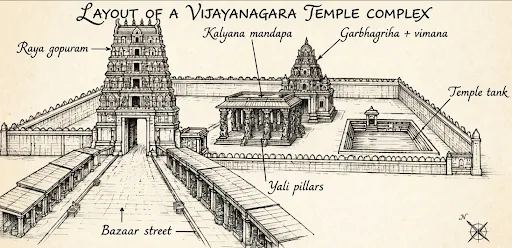
- Integrated Urban Planning: Temples, bazaars, residential quarters, tanks and fortifications were integrated with Hampi's natural landscape, transforming the traditional temple-centred settlement into a large imperial metropolis..
- New Ritual Spaces: The growing importance of royal festivals created specialized spaces such as Kalyana Mandapas & chariot streets; Achyutaraya Temple illustrates this expansion of ritual architecture.
- Royal-Civic Architecture: Architecture increasingly served ceremonial & political functions; Mahanavami Dibba provided a monumental platform for royal ceremonies and processions, with carvings depicting horses, soldiers and courtly life.
- Monumental Scale: Earlier Dravidian forms were enlarged into lofty gopurams and massive enclosures; Krishna Temple at Hampi exemplifies this monumentalization.
- Indo-Islamic Synthesis: Contact with Deccan Sultanates introduced arches, vaults & domes into secular architecture; Lotus Mahal combines cusped arches with Hindu-derived decorative forms, while Elephant Stables use domed chambers and arched entrances.
Vijayanagara architecture was neither a break from past nor mere imitation; it evolved Dravidian traditions through monumentality, new ritual spaces, engineering & cross-cultural influences, making Hampi, in UNESCO’s words, an evolved form of Dravidian architecture marked by innovation and experimentation.
Last updated on Oct, 2026