The World Intellectual Property Organisation (WIPO) is a specialised agency of the United Nations that promotes the protection and effective use of intellectual property (IP) worldwide. It supports inventors, creators, businesses and researchers through international IP systems, policy cooperation, technical assistance and reliable intellectual property data. WIPO provides a global platform where countries work together to develop international rules and standards for patents, trademarks, copyrights, industrial designs and other forms of IP.
The World Intellectual Property Organisation also administers international filing systems and treaties that simplify cross-border protection. Through these activities, it seeks to encourage innovation, creativity, technology transfer and sustainable economic development across countries.
World Intellectual Property Organisation (WIPO) About
The full form of WIPO stands for World Intellectual Property Organisation. It is an intergovernmental organisation; the headquarters of WIPO is in Geneva, Switzerland, and it became one of the United Nations specialised agencies in 1974.
- WIPO works across different areas of intellectual property, including patents, copyrights, trademarks, industrial designs and geographical indications, helping creators, innovators and businesses protect their intellectual assets internationally.
- WIPO Established Year: WIPO was established in 1967 but came into force in 1970 when the Convention establishing WIPO entered into force. Its founding convention was signed in 1967. WIPO subsequently became a UN specialised agency in 1974.
World Intellectual Property Organisation (WIPO) History
The history of the World Intellectual Property Organisation goes back to the 19th-century development of international agreements for protecting inventions, trademarks and creative works across national boundaries. Its institutional evolution eventually produced the modern global IP organisation. Major milestones in WIPO history
- 1883 Paris Convention: Established an international framework for protecting industrial property, including patents, trademarks and industrial designs.
- 1886 Berne Convention: Created international cooperation for protecting literary and artistic works.
- 1891 Madrid Agreement: Established an international system for registration of trademarks.
- 1893 BIRPI: The offices administering the Paris and Berne Conventions were combined into the United International Bureaux for the Protection of Intellectual Property (BIRPI).
- 1967 WIPO Convention: The Convention establishing WIPO was signed in Stockholm.
- 1970 WIPO established: The WIPO Convention entered into force, and BIRPI was transformed into WIPO.
- 1974 UN specialised agency: WIPO became part of the UN system as a specialised agency.
- 1978 PCT System: The international patent filing system under the Patent Cooperation Treaty began operating.
- 1994 WIPO Arbitration and Mediation Centre: WIPO established a mechanism for resolving international commercial IP disputes.
- 1998 WIPO Academy: The Academy was established to provide IP education and training.
- 2007 Development Agenda: WIPO formally adopted its Development Agenda to integrate development considerations into its work.


World Intellectual Property Organisation (WIPO) Members
The WIPO membership comprises 194 Member States, which collectively determine the organisation's direction, programmes, budget and major activities through its decision-making bodies. Criteria for Becoming a WIPO Member.
- A state can become a member of the World Intellectual Property Organisation by depositing an instrument of ratification or accession with the WIPO Director General.
- Under the WIPO Convention, membership is open to a state that meets any of the following conditions.
- The state is a member of the Paris Union for the Protection of Industrial Property or the Berne Union for the Protection of Literary and Artistic Works.
- The state is a member of the United Nations or one of its specialised agencies or is a member of the International Atomic Energy Agency (IAEA).
- The state is a party to the Statute of the International Court of Justice.
- A state may also become a member of the World Intellectual Property Organisation if it is invited by the WIPO General Assembly to join the organisation.
World Intellectual Property Organisation (WIPO) Objectives
The objectives of WIPO centre on creating an international intellectual property rights environment that supports innovation, creativity and economic development.
- Develop international IP norms and standards: Facilitate the negotiation and implementation of international treaties and standards governing intellectual property.
- Support innovation: Help innovators and entrepreneurs use IP as an instrument for technological and economic development.
- Facilitate cross-border IP protection: International filing systems reduce the complexity of seeking protection in multiple countries.
- Strengthen developing countries: Provide technical assistance, training and policy support to help countries build effective IP systems.
- Providing Reliable IP Data and Analysis: Make accessible, high-quality and multilingual intellectual property information, statistics and analytical resources available to support policymaking, research and informed decision-making.
- Address emerging IP issues: Provide forums for discussing challenges arising from technologies such as artificial intelligence and other frontier technologies.
World Intellectual Property Organisation (WIPO) Governance Structure
The World Intellectual Property Organisation (WIPO) governance structure combines member-state decision-making with a professional secretariat responsible for implementing agreed programmes and activities.
- WIPO General Assembly: The World Intellectual Property Organisation General Assembly is one of the principal decision-making bodies through which member states determine the organisation's strategic direction.
- WIPO's member states participate in annual assemblies, where strategic and organisational matters are considered.
- WIPO Coordination Committee: The Coordination Committee forms part of WIPO's institutional governance and participates in matters concerning the organisation's administration and coordination.
- WIPO Conference: It brings together states that are parties to the World Intellectual Property Organisation Convention, regardless of whether they belong to a particular WIPO-administered Union.
- It discusses matters of general interest in intellectual property, adopts recommendations and approves the Conference's budget and programme for legal and technical assistance.
- WIPO Secretariat: The Secretariat implements decisions taken by member states and manages WIPO's programmes and services. It is headed by the Director General.
- WIPO's current Director General is Daren Tang, who became Director General in 2020, and his term runs through 2026. He will continue serving as the Director General of the World Intellectual Property Organisation for his second consecutive term till 2032.
- Oversight mechanisms: WIPO's activities are subject to internal and external oversight, including the Independent Advisory Oversight Committee, External Auditor and Internal Oversight Division.
World Intellectual Property Organisation (WIPO) Treaties
The World Intellectual Property Organisation administers treaties that create common international standards, facilitate international IP registration and establish classification systems for organising IP information. The World Intellectual Property Organisation currently administers 28 treaties, including the WIPO Convention.
- IP Protection Treaties: These treaties establish internationally agreed standards for protecting different forms of intellectual property.
- Examples: Paris Convention, Berne Convention, WIPO Copyright Treaty, WIPO Performances and Phonograms Treaty, Singapore Treaty and Patent Law Treaty.
- Global Protection System Treaties: These systems simplify international applications by allowing applicants to seek protection in several participating countries through a centralised filing mechanism.
- Examples: Patent Cooperation Treaty (PCT), Madrid Protocol, Hague Agreement, Lisbon Agreement and Budapest Treaty.
- Classification Treaties: These treaties establish classification systems that make information on inventions, trademarks and industrial designs easier to organise and retrieve.
- Examples: Nice Agreement, Locarno Agreement, Strasbourg Agreement and Vienna Agreement
World Intellectual Property Organisation Treaties and Their Purpose
| Treaty/System | Main purpose | India's Participation |
|
Paris Convention |
International protection of industrial property |
Acceded in September 1998; in force from 7 December 1998 |
|
Berne Convention |
Protection of literary and artistic works |
India has been a member since 1928 |
|
PCT |
International patent filing system |
Acceded in 1998; in force from 7 December 1998 |
|
Madrid Protocol |
International registration of trademarks |
Acceded in 2013; in force from 8 July 2013 |
|
Hague Agreement |
International registration of industrial designs |
Not a member |
|
Budapest Treaty |
International recognition of microorganism deposits for patent procedure |
Acceded in 2001; in force from 17 December 2001 |
|
Marrakesh Treaty |
Improved access to published works for persons who are blind, visually impaired or otherwise print-disabled |
Ratified in 2014; in force from 30 September 2016 |
|
WIPO Copyright Treaty |
Copyright protection in the digital environment |
Acceded in 2018; in force from 25 December 2018 |
|
WIPO Performances and Phonograms Treaty |
Rights of performers and producers of phonograms |
Acceded in 2018; in force from 25 December 2018 |
|
Nice Agreement |
Classification of goods and services for trademark registration |
Acceded in 2019; in force from 7 September 2019 |
|
Locarno Agreement |
Classification of industrial designs |
Acceded in 2019; in force from 7 September 2019 |
|
Vienna Agreement |
Classification of figurative elements of trademarks |
Acceded in 2019; in force from 7 September 2019 |
World Intellectual Property Organisation (WIPO) Patents
The World Intellectual Property Organisation and patents are closely connected through the Patent Cooperation Treaty (PCT). The PCT provides a unified international application procedure that allows applicants to seek patent protection in multiple countries through a single international application. However, patents are ultimately granted or refused by national or regional patent offices.
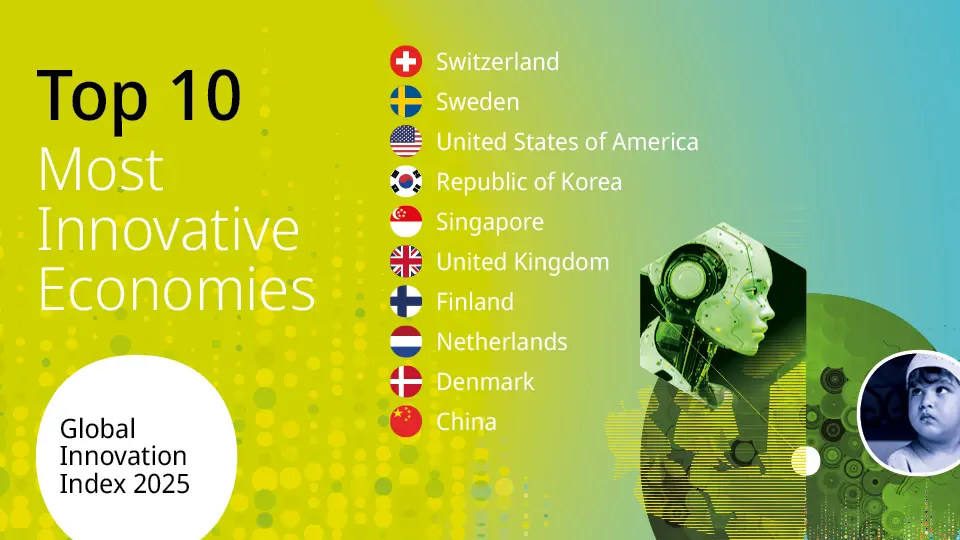
WIPO Global Innovation Index
The Global Innovation Index (GII) assesses innovation performance across around 140 economies and identifies the world’s top 100 innovation clusters.
- Tracks Trends: Monitors innovation through investment, technological progress, adoption and socioeconomic outcomes.
- Policy Resource: Provides insights for governments, businesses and researchers to strengthen innovation ecosystems globally.
World Intellectual Property Organisation (WIPO) and India
India's engagement with WIPO operates alongside a comprehensive domestic intellectual property framework covering different forms of IP. India is a party to more than 16 WIPO-administered treaties and has been a member of WIPO since 1975. Also, major Indian laws in line with WIPO are listed below:
- Patents Act, 1970: Governs patents and patent protection in India.
- Copyright Act, 1957: Protects literary, artistic, musical and other copyrighted works.
- Trade Marks Act, 1999: Regulates registration and protection of trademarks.
- Geographical Indications of Goods (Registration and Protection) Act, 1999: Provides for registration and protection of geographical indications.
- Designs Act, 2000: Protects industrial designs.
- Protection of Plant Varieties and Farmers' Rights Act, 2001: Protects plant varieties while recognising farmers' rights.
- Semiconductor Integrated Circuits Layout-Design Act, 2000: Protects semiconductor integrated circuit layout designs.
- Also, the Copyright Office is headquartered in New Delhi, while the Office of the Controller General of Patents, Designs and Trade Marks (CGPDTM) is headquartered in Mumbai and operates through patent and trademark offices in multiple cities.
WIPO vs WTO
WIPO and the World Trade Organisation (WTO) both deal with intellectual property rights (IPR), but their mandates are different. Key differences are
| WIPO | WTO |
|
Specialised UN agency |
International organisation governing global trade |
|
Administers IP treaties |
Administers TRIPS Agreement |
|
Focuses broadly on IP cooperation |
Links IP protection with international trade |
|
Provides registration systems and technical assistance |
Provides a trade-related enforcement framework |
WIPO and Traditional Knowledge
WIPO plays an important role in developing international approaches to the protection of traditional knowledge (TK), traditional cultural expressions (TCEs), and genetic resources (GRs). These issues are particularly relevant to developing countries, where traditional knowledge and biological resources may have significant cultural and economic value.
- India has sought to protect traditional knowledge through mechanisms such as the Traditional Knowledge Digital Library (TKDL).
- The TKDL documents traditional medicinal knowledge in a structured format and helps patent authorities identify prior art, thereby helping prevent the grant of inappropriate patents based on already-known traditional knowledge.
World Intellectual Property Organisation UPSC PYQs
Q1. Consider the following statements: (UPSC Prelims 2022)
- The World Intellectual Property Organisation (WIPO) is a specialised agency of United Nations System of Organisations
- WIPO has its headquarters at Rome
- The Trade Related Aspects of Intellectual Property Rights (TRIPS) Agreement is binding on all WTO members
- Least developed country members of WTO are not required to apply the provisions of TRIPS Agreements for a period of 20 years from the general date of application of the Agreement
Which of these statements are correct?
a) 1, 2, 3 and 4
b) 2, 3 and 4 only
c) 1, 2 and 4 only
d) 1 and 3 only
Ans: (d)

 Last updated on Oct, 2026
→ UPSC 2027 Notification will be released on 13 January 2027 at upsconline.nic.in.
→ Check Nobel Prize 2026 Winners List here.
→ Download PIB PRiSM Monthly Magazine 2026 here.
→ Check UPSC Monthly Current Affairs Magazine The Recitals here.
→ Check out the latest UPSC Syllabus here.
→ Download UPSC Model Answers for Mains 2026
→ UPSC Mains Question Paper 2026 is out now for Essay & GS Paper 1, 2, 3 & 4.
→ UPSC Calendar 2027 has been released.
→ Enroll in Vajiram & Ravi’s UPSC Mains Test Series 2027 for structured answer writing practice, expert evaluation, and exam-oriented feedback.
→ Join Vajiram & Ravi’s UPSC Mentorship Program 2027 for personalized guidance, strategy planning, and one-to-one support from experienced mentors.
→ Go through the UPSC Mains Previous Year Papers to enhance your preparation.
→ UPSC has released UPSC Toppers List 2025 with the Civil Services final result on its official website.
→ Also check Best UPSC Coaching in India
World Intellectual Property Organisation FAQs
Q1. Where is WIPO headquarters?+
Q2. Is India a member of WIPO?+
Q3. Who funds WIPO?+
Q4. How many countries are members of WIPO?+
Q5. When was WIPO founded?+
Tags: quest upsc economy notes world intellectual property organisation