
Question
Critically examine the challenges of demographic transition in contemporary India.
Detailed Solution
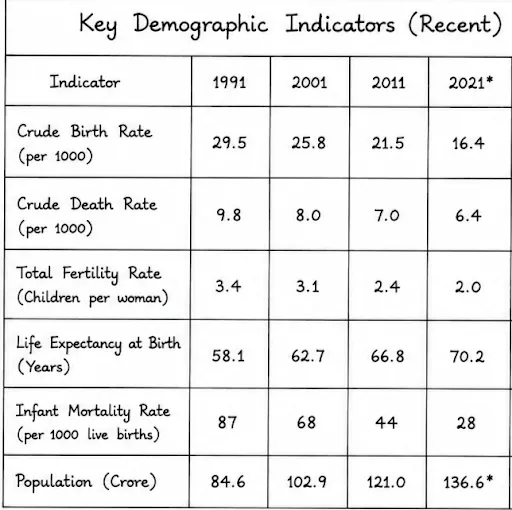
India is experiencing an uneven demographic transition, from a young, growing population towards lower fertility and an aging population, with States moving through these stages at different speeds.
Demographic Transition in Contemporary India.
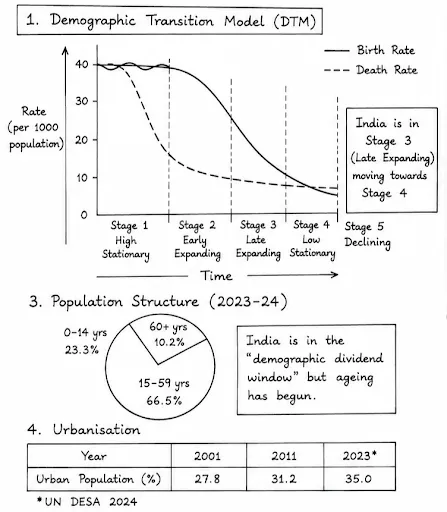
Challenges of India’s demographic transition
- Uneven transition across States: Fertility has fallen rapidly in southern and some western States, while several northern States remain relatively younger.

a. Example: Bihar’s TFR (2.8) remains significantly higher than Kerala’s (1.5), creating divergent demographic needs. - The “demographic dividend” is not automatic: A large working-age population becomes an advantage only with productive employment, skills and health.
a. Example: The Economic Survey 2024-25 highlighted the need to create around 78.5 lakh non-farm jobs annually to absorb the growing workforce. - Ageing and dependency burden: Falling fertility and rising longevity are gradually increasing the elderly population, especially in early-transition States.
a. Example: UNFPA’s India Ageing Report 2023 projects India’s elderly share to reach nearly 20% by 2050. - Feminisation of ageing: Women generally live longer and face greater economic vulnerability due to lower labour-force participation, unpaid care work and weaker asset ownership, increasing care and social-security needs.
- Pressure on health and social-security systems: Demographic ageing shifts demand from maternal-child health towards NCDs, geriatric care and long-term care.
a. Example: India’s growing burden of diabetes, cardiovascular diseases and dementia requires stronger primary and geriatric healthcare. - Migration and regional imbalance: Uneven demographic opportunities encourage migration towards economically advanced States like Maharashtra, Delhi-NCR and Gujarat, creating pressure on urban housing and services.
- Gender and demographic imbalance: Son preference persists despite fertility decline, creating skewed sex ratios in some States.
a. Example: NFHS-5 recorded SRB of 893 in Haryana and 891 in Rajasthan, against 929 nationally. - Political economy of demographic ageing: Early-transition States face faster ageing, raising concerns over representation and fiscal fairness.
a. Example: The 16th Finance Commission reduced demographic-performance weight from 12.5% to 10%, reflecting concerns over penalising States for successful fertility reduction.
Way Forward
- Integrate education, skilling, nutrition and healthcare to convert the large working-age population into a productive demographic dividend.
- Expand crèches, safe transport, flexible work and women-focused skilling to raise female workforce participation.
- Strengthen geriatric healthcare, pensions and long-term care to prepare for the projected rise in India’s elderly population.
- Adopt State-specific demographic strategies, aligning employment, welfare and healthcare with divergent fertility, ageing and migration patterns.
- Ensure portable social security, affordable housing and basic services for migrants, while promoting reskilling and flexible work for healthy ageing
India must move from merely “managing population numbers” to managing demographic change, converting its youth advantage into productive employment while preparing institutions for an ageing and increasingly diverse society.
Latest UPSC Exam 2027 Updates
Last updated on Oct, 2026







