Question
In international relations, ethical considerations are often subjugated to the strategic interests of nation-states. Discuss this from an ethical perspective.
Detailed Solution
Contemporary geopolitics—from the Gaza humanitarian crisis to the Ukraine conflict—frequently reflects Realpolitik, where Kantian cosmopolitan ethics are systematically subordinated to Machiavellian state survival.
The Subjugation of Ethics to Strategic Interests
- Primacy of National Survival: A state's highest moral obligation is the security of its own citizens, often rendering external altruism a liability.
- Example: India purchasing discounted Russian crude oil despite Western moral pressure, prioritizing domestic energy security over global sanctions.
- Utilitarian Security over Absolute Rights: States frequently rationalize human rights violations or collateral damage by citing the "greater good" of long-term national stability.
- Selective Enforcement of Moral Norms: International ethical frameworks are often weaponized by powerful states to police weaker nations while granting themselves immunity.
- Example: Superpowers bypassing the UN to launch unilateral military attacks
- Economic Pragmatism Trumps Ideology: In a hyper-globalized economy, resource acquisition and trade dependencies consistently override human rights advocacy.
- Example: The weak global diplomatic response to human rights issues in Xinjiang due to the world's heavy reliance on Chinese manufacturing.
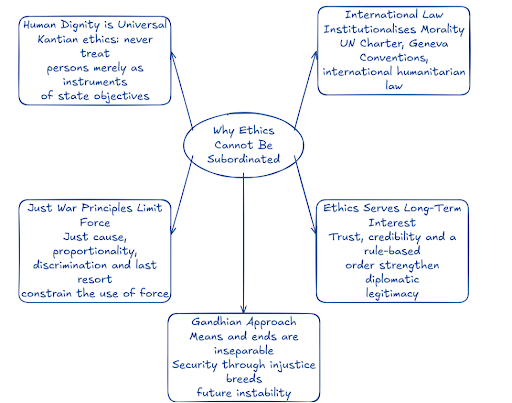
Way Forward: Harmonizing Ethics with Strategic Interests
- Ethic of Responsibility: Foreign policy must transcend rigid moralism to balance noble intentions with the practical consequences of state survival.
- Example: India providing humanitarian assistance (Vaccine Maitri) during global crises.
- Rules-Based International Order: States must anchor global engagements in universally binding treaties to prevent raw coercive power from dictating terms.
- Example: Universal compliance with the UN Convention on the Law of the Sea (UNCLOS) to ensure freedom of navigation in global waters.
- Democratizing Global Governance Institutions: Reforming decision-making bodies to dismantle arbitrary hegemony and provide genuine moral representation to the Global South.
- Adopting Enlightened Self-Interest: Treating national progress and global welfare as interconnected, realizing that helping others ultimately helps oneself.
- Indian philosophy of Vasudhaiva Kutumbakam.
- Preserving the Global Commons: Shared global resources like oceans and space must be protected as human heritage, not fought over as strategic assets.
- Example: Gandhian concept of Trusteeship.
The ethical objective is not to eliminate national interest, but to civilise it—ensuring that sovereignty becomes a means for human welfare, rather than a shield against moral accountability.
Latest UPSC Exam 2027 Updates
Last updated on Oct, 2026