
Question
On the request of his Personal Assistant (PA), the District Magistrate (DM) stops the transfer of a schoolteacher who takes private tuition for his daughter diagnosed with learning disability. In this context, discuss the aspects of empathy versus compliance with rules.
Detailed Solution
The DM acts out of genuine empathy for his PA's daughter with a learning disability, but by stopping a lawful transfer for personal reasons, he compromises rule-based governance. The case tests whether compassion can be pursued without sacrificing fairness, legality and public trust.
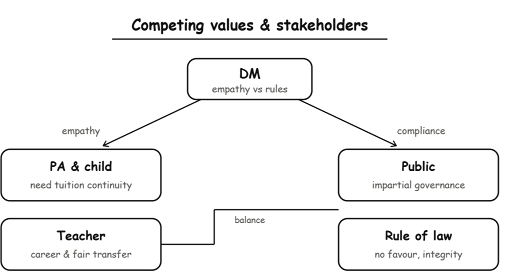
Ethical issues involved in the case
- Conflict of interest: The DM uses official authority to benefit his own subordinate, blurring public duty and private favour.
- Nepotism and favouritism: Halting a lawful transfer for personal proximity denies others equal, fair treatment.
- Abuse of discretion: Discretionary power is exercised for an extraneous, personal reason rather than public interest.
- Empathy versus rule of law: Genuine compassion for a disabled child clashes with impartial, rule-based administration.
- Distributive justice: Privileged access to relief violates fairness towards unconnected citizens in similar need.
- Integrity and public trust: A single favour-based exception erodes institutional credibility and invites precedent.
The case for empathy
- Compassionate governance: Administration must be humane, not mechanical. (e.g., Article 21 dignity; Nolan's "leadership with compassion.")
- Special needs deserve consideration: Learning disability warrants continuity of support. (e.g., RPwD Act, 2016; RTE inclusive-education mandate).
- Emotional intelligence: Sensitivity to human situations is a core administrative virtue. (e.g., Goleman's emotional intelligence; care ethics (Carol Gilligan)).
- Ethics of care over rigid rules: Relationships and human context carry moral weight. (e.g., Gandhi's talisman—"recall the weakest person.")
The case for compliance
- Impartiality: A public office cannot bend rules for personal proximity. (e.g., conflict-of-interest norms; Weber's rational-legal authority)
- Precedent risk: One exception invites countless favour-based demands. (e.g., Kant's universalisability test)
- Distributive justice: Privileged access denies equal treatment to the unconnected. (e.g., Rawls' fairness; Article 14 equality).
- Accountability: Discretionary favours erode institutional trust and invite scrutiny. (e.g., 2nd ARC probity norms; CVC vigilance oversight)
- Integrity as non-negotiable: Duty must override personal sentiment in public office. (e.g., Rohini Nayyar - honest-officer exemplars).
Empathy without abandoning rules is the ethical resolution
- Reject arbitrary favour: Do not halt the transfer solely on personal request. (e.g., conflict-of-interest recusal)
- Seek a rule-based route: Explore lawful options like mutual or request transfers if norms permit. ( e.g., transparent transfer-policy provisions).
- Address the real need: Arrange special-education support or resource teachers for the child. (e.g., Samagra Shiksha inclusive resources; RPwD Act, 2016).
- Transparency: Any accommodation must be documented, objective and available to all. (e.g., RTI-based openness)
- Institutional solution: Strengthen systemic provision for children with disabilities district-wide. ( e.g., district inclusive-education cells).
Broader principle: reconciling head and heart
- Empathy channels, rules constrain: Compassion should guide how rules are applied, not whether they apply. (e.g., Gandhi's talisman for the weakest)
- Universalisability: A fair decision is one extendable to every citizen in like circumstances. (e.g., Kant's categorical imperative).
- Means as sacred as ends: A just goal cannot justify an unfair, favour-based process. (e.g., Gandhian purity of means)
- Compassion within justice: True empathy uplifts all in need, not merely the connected few. (e.g., Rawls' priority to the least advantaged)
Public office demands that compassion flow through fairness, not around it. The DM should reject the arbitrary favour yet meet the child's needs lawfully and transparently, proving empathy and integrity are partners, not rivals, in just administration.
Last updated on Oct, 2026







