
Question
Seema is a senior bureaucrat with a reputation of honesty and professional efficiency. She has recently been posted as the District Collector (DC) to Surinder Nagar, where a large industrial area is being established.
The new industrial area had caused many farmers to submit applications for change of land use (CLU) to convert their farmlands into residential areas. There is an unusually large backlog of these applications awaiting processing. Seema noticed that some applications had been approved selectively with no visible chronological pattern. The case files showed a few complaints of some approvals being subject to receipt of large bribes from the applicants.
On further fact-finding, Seema realized that a small group of touts was controlling this illegal activity through some subordinate officials in the Collectorate. This had created a fear in the other employees who were reluctant to process any application. The resultant backlog has been piling up thereby hindering local economic progress and causing public dissatisfaction.
Seema was faced with a major moral and administrative challenge of dismantling this corruption network without hampering daily administrative operations. An aggressive internal investigation would result in institutional resistance and, possibly, a backlash from labour unions. Conversely, ignoring this situation would encourage the wrongdoers and unnecessarily continue this avoidable harassment to the populace.
(a) What are the ethical issues involved in this case?
(b) Discuss the options open to Seema. Identify the recommended option and justify it.
Detailed Solution
Land-use conversion remains a notorious rent-seeking node in district administration. The case highlight a severe ethical crisis in land administration, where systemic corruption undermines public probity and transparency.
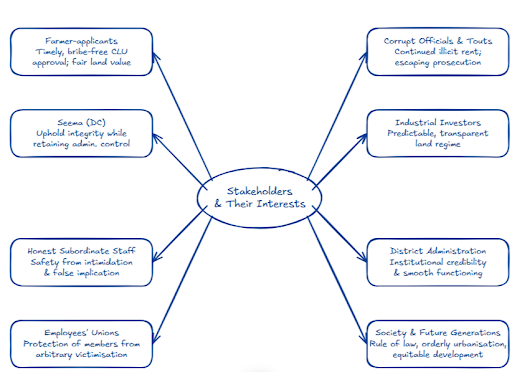
(a) Ethical issues involved
- Corruption and abuse of public office: Accepting bribes for CLU approvals represents misuse of entrusted authority for private gain, violating probity and the fiduciary character of public office.
- Violation of equality and fairness: Selective approvals without a chronological or objective basis undermine procedural justice and create unequal access to government services.
- Exploitation of vulnerable citizens: Farmers are being forced to pay bribes for legitimate administrative services, amounting to coercive rent-seeking and abuse of power.
- Institutionalisation of corruption: The involvement of touts and subordinate officials indicates that corruption has evolved from individual misconduct into an organised institutional network.
- Erosion of public trust: When citizens believe that government decisions can be purchased, the legitimacy and credibility of the state are weakened.
(b) Options available to Seema
- Conduct an aggressive investigation and immediately suspend suspected officials
|
Merits |
Demerits |
|
|
- Ignore the irregularities temporarily and focus on clearing the backlog
|
Merits |
Demerits |
|
|
- Phased investigation with systemic reforms and simultaneous backlog clearance
|
Merits |
Demerits |
|
|
Recommended course of action
I would choose Option 3, combining investigation, protection of whistleblowers and systemic administrative reform.
Immediate measures
- Initiate a confidential preliminary inquiry to identify the corrupt officials, touts, financial transactions and modus operandi.
- Secure relevant files and digital records to prevent tampering or destruction of evidence.
- Refer cases involving prima facie criminal misconduct to the appropriate vigilance/anti-corruption agency.
- Ensure that disciplinary action follows due process and natural justice, rather than collective punishment.
- Protect honest employees and create a safe channel for whistleblowing.
Administrative reforms
- Introduce first-in-first-out and transparent criteria for CLU applications.
- Digitise applications and enable applicants to track their status.
- Reduce unnecessary human interfaces through faceless/online processing wherever feasible.
- Introduce time-bound disposal and automatic escalation of delayed cases.
- Conduct periodic randomised audits of approvals.
- Display clear fees, timelines and procedures publicly to reduce opportunities for touts.
- Establish a grievance-redressal mechanism for applicants facing demands for bribes.
Ethical justification
- Kantian ethics: Kant's principle of treating persons as ends in themselves is violated when officials exploit farmers as sources of illicit income.
- Seema therefore has a duty to restore citizens' dignity and equal treatment.
- Aristotle's virtue ethics: A good administrator requires courage, justice, prudence and temperance.
- Seema must have the courage to confront corruption but the prudence to avoid indiscriminate action.
- Rawls' theory of justice: The CLU system should operate according to fair procedures, irrespective of wealth or connections.
- Preferential approval to those who can pay violates the principle of fair equality of opportunity.
- Utilitarianism: The recommended approach maximises overall welfare by simultaneously reducing corruption, restoring administrative efficiency, protecting honest employees and facilitating legitimate economic activity.
- Gandhian ethics: Gandhi's emphasis on means being as important as ends is relevant. Seema cannot justify arbitrary or vindictive action merely because the objective of eliminating corruption is desirable.
- Nolan principles of public life: Selflessness, integrity, objectivity, accountability, openness, honesty and leadership provide an appropriate ethical framework for Seema's conduct.
As Sardar Patel observed, “The civil service must be above all political and personal considerations.” Seema must therefore make integrity institutional, accountability impartial and administration citizen-centric, thereby converting an ethical crisis into an opportunity for administrative reform.
Last updated on Oct, 2026







