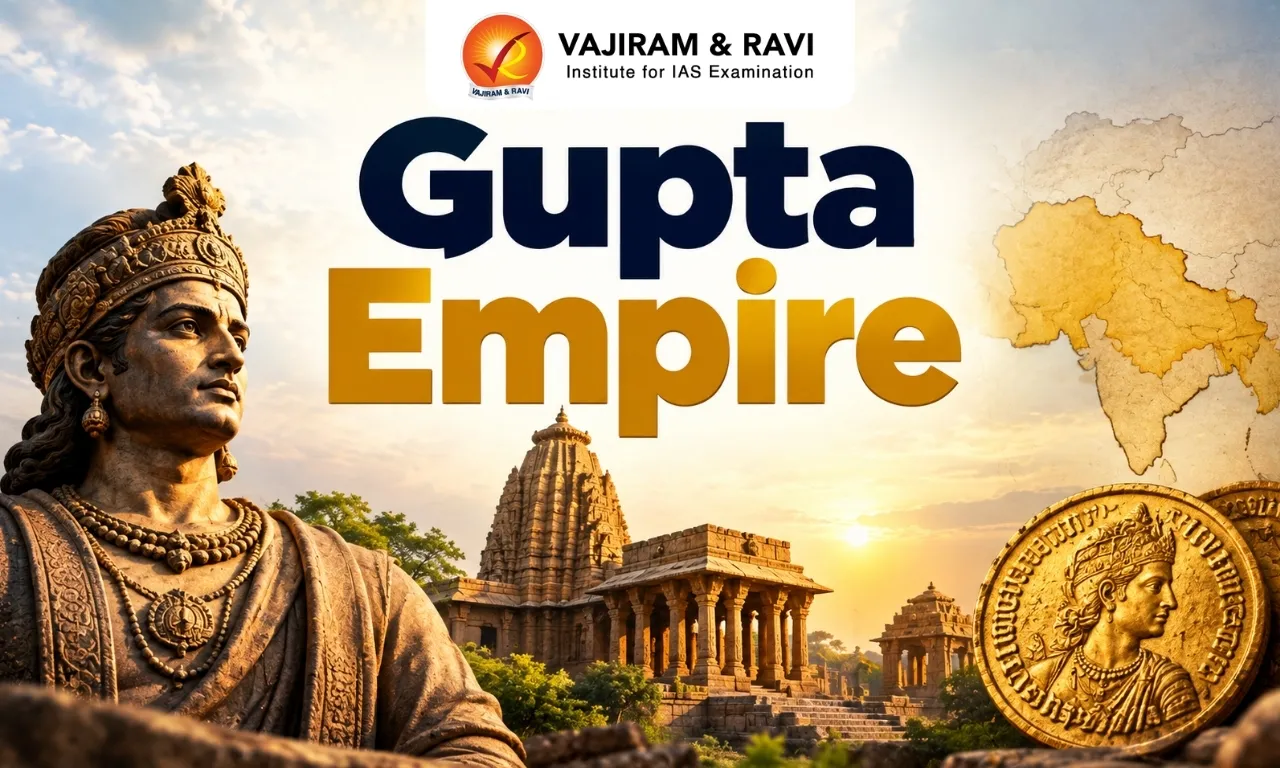
The Gupta Empire, from the 4th to the 6th century CE, marked a classical age in North India, renowned for its extensive territory and cultural zenith. Originating from the fertile regions of Eastern U.P. and Bihar, the Guptas leveraged local iron ore to build their empire. Celebrated for their patronage of the arts, architecture, and literature, their era is often hailed as a ‘Golden Age’.
However, the empire later faced challenges from Huna invasions, succession disputes, weakening central authority, and the rise of regional powers, which gradually reduced Gupta control and contributed to its decline.
Gupta Empire History
The early Guptas were initially a relatively small ruling family in northern India, probably centred in the regions of present-day eastern Uttar Pradesh and Bihar. The dynasty expanded considerably under Chandragupta I, who adopted the imperial title Maharajadhiraja.
- The major phase of Gupta expansion began in the 4th century CE. Samudragupta conducted extensive military campaigns and established Gupta influence over large parts of northern India while also receiving the submission of several rulers outside the directly administered core territory.
- His successor Chandragupta II, traditionally identified with Vikramaditya, expanded Gupta influence towards western India and defeated the Western Kshatrapas. This gave the Guptas access to important western trade routes.
- The empire reached a high point during the 4th and early 5th centuries CE. Later, invasions by the Hun groups, internal political problems and the emergence of regional powers weakened Gupta authority. By the 6th century, imperial Gupta power had substantially declined.
Founder of Gupta Empire
Sri Gupta is generally regarded as the founder of the Gupta dynasty. However, Chandragupta I is often described as the founder of the Gupta Empire in the imperial sense, because he greatly expanded the kingdom and adopted the title Maharajadhiraja.
Gupta Empire Time Period
The Gupta Empire is generally dated to approximately 320–550 CE, spanning the mid-3rd century (with early regional foundations around 240 CE) to the mid-6th century. Gupta rulers and successor branches continued in some regions beyond the decline of the imperial power.
Gupta Empire Capital City
Pataliputra was an important imperial centre of the Guptas and is generally regarded as their principal capital. Other cities, including Ujjain, also gained considerable political and cultural importance, particularly during the later Gupta period.
Gupta Empire Rulers
Capable rulers of the Gupta dynasty left a notable impact on the history and influence of the Indian subcontinent. Key Gupta rulers were:
|
Ruler Name |
Key Points |
|
Chandragupta I (320 – 335 CE) |
- The Gupta Empire began with his accession in 319-320 CE. - To strengthen his authority, he entered into a matrimonial alliance with the Lichchhavis of Nepal. - By 321 AD, he expanded his kingdom from the Ganges River to Prayag through conquest. - His kingdom included Bengal, parts of present-day Bihar, with Pataliputra as its capital, and Uttar Pradesh. - He struck coins bearing his and his queen's names. |
|
Samudragupta (c. 335/336 – 375 CE) |
- He followed a policy of warfare and conquest. - His rule extended over a significant portion of the Indian subcontinent, directly or indirectly, encompassing empires in Punjab and Nepal to the Pallavas of Kanchi. - He minted coins depicting the mythological theme of the Asvamedha (horse sacrifice), symbolising his role as a restorer. - Title Kaviraja, meaning "king among poets", due to his skill in poetry. |
|
Chandragupta II (c. 376 – 413/415 CE) |
- Through his daughter's (Prabhavati) marriage to Rudrasena II, a prince from the Vakataka dynasty in the Deccan, he indirectly ruled over the Vakataka kingdom. - He successfully seized control of the western Malwa and Gujarat regions from the Shakas. - An inscription on the iron pillar at Mehrauli (Delhi) indicated that his kingdom encompassed northwestern regions of India and Bengal. - He adopted the titles Simhavikrama and Vikramaditya, symbolising his strength and power. - Minted coins made of silver, copper, and gold (Dinara), with his coins often referred to as Chandra. - His court had nine renowned intellectuals known as the Navratnas (nine gems). |
|
Kumaragupta Ⅰ (c. 415 – 455 CE) |
- He assumed the titles of 'Shakraditya' and 'Mahendraditya' as part of his royal designations. - He performed Ashvamedha sacrifices. - Established Nalanda University, which gained global recognition as a prestigious educational institution. - Noteworthy inscriptions from Kumaragupta I's reign include those found in Karandanda, the Mandsor Bilsad inscription, and the Damodar Copper Plate inscription. |
|
Skandagupta (c. 455 – 467 CE) |
- He assumed the title of 'Vikramaditya' as part of his royal designation. - An inscription found in Junagarh/Girnar during his reign mentions that his governor, Parnadatta, undertook the repair of the Sudarshan Lake. - Following his death, several successors such as Purugupta, Kumaragupta II, Buddhagupta, Narasimhagupta, Kumaragupta III, and Vishnugupta were unable to protect the Gupta Empire from the Huns. |


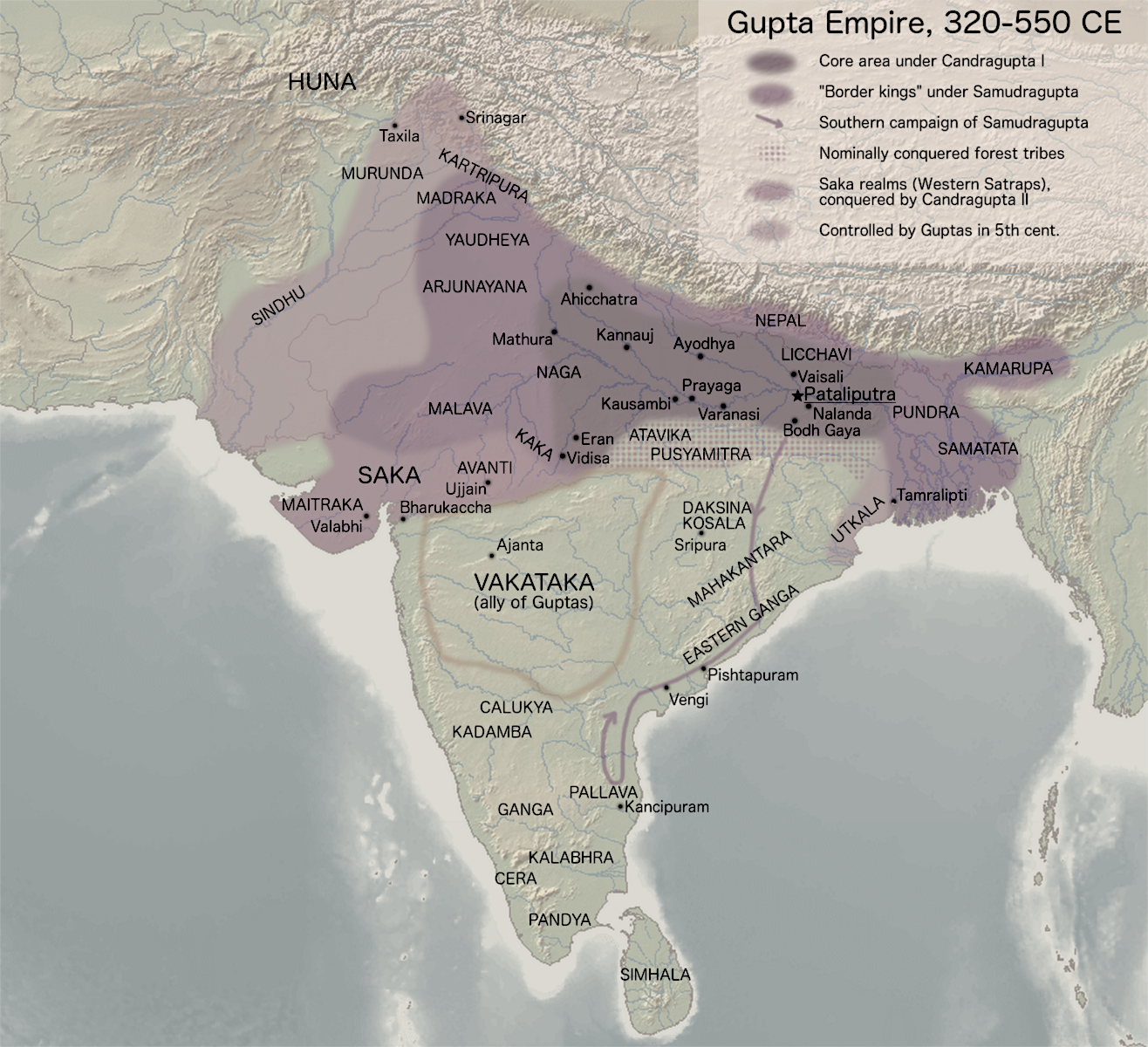
Gupta Empire Map
The Gupta Empire was centred in the Gangetic plains of northern India and expanded considerably under Samudragupta and Chandragupta II. At its height, Gupta influence extended across much of northern and central India, reaching parts of present-day Rajasthan, Gujarat, Madhya Pradesh, Uttar Pradesh, Bihar, Odisha and Bengal.
Gupta Empire Administration
The Gupta Empire’s administration was marked by well-organised divisions and a hierarchical structure that ensured effective governance:
King
- The king was the linchpin of the Gupta administration, assuming titles like Paramabhattaraka and Paramesvara, reflecting their divine status akin to deities on Earth as per Smriti texts.
- Duties of the monarch included:
- Formulating state policies for war and peace.
- Safeguarding the realm and its denizens.
- Leading the military in conflicts.
- Supporting the Brahmanas, Sramanas, and the needy.
- Honouring scholars and religious figures.
- Acting as the chief adjudicator, delivering justice based on sacred laws and traditions.
- Appointing key central and provincial officials.
Council of Ministers and Other Officials
The Mahanandanayaka (Chief Justice) supported the king’s judicial authority. Provincial judicial responsibilities were managed by Uparikas, while Vishayapatis oversaw district-level matters. Village disputes were typically settled by the headman and elders.
- Notably, Fa-Hien, the Chinese traveller, observed the absence of capital punishment.
- The Mahapratihara (palace guard chief) and Pratihara (ceremonial overseer) were among other significant officials.
- An intelligence network was operational, and Dutakas were tasked with executing land grants.
- The Mahasandhivigrahika managed affairs related to war and peace.
Army
This system ensured a well-maintained and organised military, ready for both defence and expansion when necessary. The military organisation during the Gupta period included:
- King: Led the army during wartime.
- Sandhi-Vigrahika: Minister responsible for peace and war during peacetime.
- Mahabaladhikrita: A high-ranking military official.
- Specialised commanders: Included Pilupati (elephants), Asvapati (horses), and Narapati (infantry).
- Ranabhandagarika: Officer in charge of military supplies and soldiers’ welfare.
Revenue Administration
The primary fiscal resources for the Gupta state were land revenue and fines. The Akshapataladhikrita oversaw account registers, ensuring the collection of royal dues and the prevention of financial misconduct. Pustapala maintained records and verified transactions.
- Taxes and Duties:
- Uparikara tax was imposed on commodities like textiles and oils during intercity trade.
- Merchants paid a commercial tax known as Sulka.
- The king could mandate labour (Visthi), collect land tax (Bali), and solicit additional levies.
- Royal Income:
- The monarch’s revenue streams included profits from royal estates, woodlands, treasure discoveries, mineral extraction, and salt production.
Provinces, Districts and Villages
The Gupta Empire was organised into territorial divisions known as Desas, Rashtras, or Bhuktis, as recorded in historical inscriptions.
- Uparikas, appointed by the king, administered the Bhuktis, which were further segmented into districts or Vishayas. These districts were managed by officials such as Ayuktaka or Vistiyapati, appointed by the provincial governors.
- In Bengal, district administration involved an Adhikarana (office) that included representatives from key local communities like Nagarasresthi (merchant leader), Sarthavaha (caravan chief), Prathama-Kulika (artisan head), and Prathama Kayastha (scribe community head), with Pustapalas handling records.
- Villages were led by a Gramapati or Gramadhyaksha (village headman).
- North Bengal featured administrative units above the village level, termed Astakuladhikarana, which incorporated village representatives such as Gramikas, Kutumbis, and Mahattaras.
- Village Life and Occupations:
- Villages were composed of various professional groups including carpenters, weavers, potters, oil pressers, goldsmiths, and farmers, who likely formed local bodies for managing village affairs.
- Disputes within the village were resolved with the help of Grama-buddhas or village elders, emphasising a community-based approach to governance.
Gupta Empire Religion
The Guptas were a Hindu dynasty known for their devout Hinduism, but they allowed Buddhists and Jainists to practice their religions.
- Nalanda University: Founded by Kumaragupta I around 455 CE, it became a renowned centre for learning and is associated with the formalisation of the caste system through endogamy during this era.
- Narasimhagupta Baladitya: Influenced by Mahayana Buddhism, he constructed a sangharama and a 300-foot-high vihara in Nalanda and was celebrated for his patronage of Buddhism.
- Vajra: As the son of Narasimhagupta, he continued the legacy of supporting Buddhism, evidenced by Xuanzang’s accounts of his devout sponsorship.
Gupta Empire Economy
The Gupta Empire experienced favourable economic and social conditions that fostered cultural and intellectual development. Fa-hein, a Chinese traveller, provides insights into the economic life of the Gupta Empire. He mentions that Magadha was filled with cities, and the wealthy people supported it through charitable offerings.
- Decline in Long-distance Trade:
- Compared to earlier periods, there was a decline in long-distance trade during the Gupta period. India's trade with the Eastern Roman Empire, exporting silk, decreased after the Eastern Romans learnt silk cultivation from the Chinese.
- Demand for Indian silk abroad had already weakened by the mid-fifth century. Silk weavers from western India migrated to Mandasor in Malwa and shifted to other professions.
- Emergence of Priestly Landlords:
- In eastern and central Madhya Pradesh, a significant development during the Gupta period was the rise of priestly landlords.
- Land grants made to priests led to the cultivation of new areas but resulted in a lower status for local tribal peasants.
- Forced labour (Vishti) was imposed on peasants in central and western India.
- However, agricultural knowledge improved in the tribal regions of central India due to the involvement of Brahmanas, and more land was brought under cultivation.
Coins of Gupta Empire
The coins of the Gupta Empire are acclaimed as masterpieces of ancient Indian numismatic art, depicting the economic affluence, military prowess, and cultural refinement of India's classical "Golden Age".
- Gold Dinaras: The Gupta kings predominantly issued high-purity gold coins known as Dinaras, which derived from Kushan weight standards (between 7.8 and 8.0 grams).
- Silver and Copper: The Guptas also issued silver coins after their conquest of Gujarat, primarily for local trade, and the use of copper coins was limited compared to the Kushan Empire.
- Iconography: The front (obverse) often depicted the king in various dynamic stances (standing, fighting, or playing an instrument), whilst the rear (reverse) featured Hindu deities, most commonly the goddess Lakshmi.
Gupta Empire Society
Gupta-period society was largely agrarian and hierarchical, with social life influenced by the varna system, occupational divisions and religious traditions. The period witnessed the growth of towns, trade and guilds, while land grants and the increasing importance of Brahmanas influenced social and economic relations.
- Brahmanas' Supremacy and Gupta rulers: Large-scale land grants to Brahmanas suggest a rise in Brahmanas' dominance during the Gupta period.
- The Guptas, originally believed to be Vaishyas, were recognised as Kshatriyas by the Brahmanas.
- The Brahmanas portrayed the Gupta kings as god-like figures, legitimising their position and establishing the Guptas as strong supporters of the Brahmanical order.
- Proliferation of Castes: The number of castes increased due to the assimilation of foreigners and tribal people. Each group of foreigners was considered a caste, often with Kshatriya status.
- The Hunas, who arrived in the fifth century, eventually became recognised as one of the Rajput clans.
- Land grants to tribal chiefs resulted in the formation of new castes, with the ordinary tribal members assigned a lower origin.
- Improved Status of Shudras: Shudras experienced some improvements during this period. They were permitted to hear recitations of the Ramayana, Mahabharata, and Puranas, which represented the Kshatriya tradition.
- Shudras could worship Krishna and perform certain domestic rites, which contributed to the economic status of the Shudras. From the seventh century onwards, Shudras were mainly associated with agriculture.
- Increase in Untouchables: The number of untouchables, particularly the chandalas, grew during the Gupta period. The chandalas, mentioned by Fa-Hsien, lived outside the village and were involved in the meat and flesh trade. The chandalas' disabilities became noticeable, and their presence attracted attention.
- Status of Women: Women of higher varnas did not have independent sources of livelihood, unlike women of lower varnas.
- Women from vaishya and Shudra backgrounds engaged in agricultural operations and domestic services, granting them more freedom.
- In Gupta times, members of higher varnas acquired more land, becoming more polygamous and treating women as property.
- Widow immolation was first recorded in AD 510, but post-Gupta law books allowed widow remarriage in certain circumstances.
- Women's Property Rights: The oldest Smritis recognised gifts received by brides during marriage as their property. Gupta and post-Gupta law books expanded the scope of these gifts, known as strident.
- Women were allowed to sell and mortgage their immovable property, suggesting they received shares in landed property. However, patriarchal communities generally did not allow daughters to inherit landed property.
- Niyoga and Widow Remarriage: Niyoga, the practice of a younger brother or kinsman marrying the widow of the elder brother, was practised in Vedic times but not allowed during Gupta and earlier periods.
- Widow remarriage was also prohibited for higher varnas but permitted among the shudras, who could practice both niyoga and widow remarriage.
Gupta Empire Art and Architecture
Gupta Art and Architecture is regarded as a major phase in the development of classical Indian art and architecture. Gupta artists developed refined forms of Buddhist, Hindu, and Jain sculptures, while temple architecture gradually moved from rock-cut traditions towards structural temples.
- Cave Architecture: Udayagiri Caves are important Gupta-period rock-cut monuments, featuring the famous Varaha relief associated with Vishnu.
- Temple Architecture: The period witnessed the growth of structural temples, such as the Dashavatara Temple at Deogarh, Bhitargaon Temple, and Sanchi Temple 17.
- Sculpture: The Mathura and Sarnath schools produced refined images of Buddha and Hindu and Jain deities, noted for graceful forms and spiritual expression.
- Paintings: Ajanta and Bagh caves preserve important paintings associated with the artistic traditions of the period.
- Pillars and Inscriptions: The Allahabad Pillar Inscription, composed by Harisena, records the conquests and achievements of Samudragupta and is a major source for Gupta political history.
- Mehrauli Iron Pillar: Associated with Chandragupta II, the pillar demonstrates the advanced metallurgical skills of the Gupta period and is notable for its resistance to corrosion
Gupta Literature and the Navaratnas
The Gupta period witnessed significant development of Sanskrit literature, poetry, grammar, and scientific writing. Traditional accounts associate Chandragupta II's court with the Navaratnas (Nine Gems).
- Vetala Bhatta- Author of Mantrashastra
- Vararuchi- Author of Prakrit Prakasha
- Kahapanaka- Author of Jyotishya Shastra
- Shanku- Author of Shilpa Shastra
- Ghatakarapara- Expert in sculpture and architecture
- Dhanvantri- Physician of Ayurveda
- Varahamihira- His literary work includes: Pancha Siddhantika, Brihadsamhita, and Brihat Jataka
- Amarasimha- Author of Amarakosha
- Kalidasa- Author of Abhijnashakuntalam, Meghdootam and many more.
Gupta Empire Science and Technology
The Gupta period witnessed important advances in mathematics, astronomy, medicine, metallurgy, and engineering. Scholars combined earlier Indian knowledge with new observations and methods, contributing to the development of scientific traditions.
- Mathematics – Aryabhata: Aryabhata, who lived around 476–550 CE, composed the Aryabhatiya around 499 CE. His work included mathematical methods and trigonometric concepts.
- Astronomy: Aryabhata's work dealt with planetary motions, eclipses, and astronomical calculations and recognised the rotation of the Earth.
- Trigonometry: The Aryabhatiya used ardha-jya (half-chord), which developed into jya/jiva and is historically connected with the later transmission of the concept of sine into Arabic and European mathematics.
- Metallurgy: The Mehrauli Iron Pillar, generally dated to the Gupta period and associated with Chandragupta II, demonstrates sophisticated iron-working technology and remarkable corrosion resistance.
Gupta Empire Significance
The Gupta Empire holds a prominent place in ancient Indian history due to its contributions to political consolidation, economic growth, literature, science, art, and culture. Its achievements created enduring intellectual and cultural traditions that influenced subsequent Indian kingdoms.
- Political Consolidation: The Guptas established a powerful empire across large parts of northern and central India, providing a period of relative political stability.
- Cultural Development: The period witnessed major growth in Sanskrit literature, art, architecture, and religious traditions, contributing to the development of classical Indian culture.
- Scientific Advancement: Scholars such as Aryabhata made important contributions to mathematics and astronomy, particularly in astronomical calculations and trigonometry.
- Architectural Development: Gupta rulers and communities promoted structural temple architecture, with monuments such as the Dashavatara Temple at Deogarh representing an important stage in temple development.
- Literary Growth: Kalidasa and other Sanskrit scholars contributed significantly to poetry, drama and classical literature.
- Economic Prosperity: Extensive gold coinage, trade networks and guild activity indicate the importance of commerce and craft production during the period.
- Educational Tradition: Centres of learning, particularly Nalanda, developed into important institutions for higher learning and attracted students and scholars from different regions.
Gupta Empire Decline
The mighty Gupta Empire stumbled under the rule of Skandagupta and his successors. Several reasons could be attributed to the same:
- Huna Invasions: The Huna people, also known as Huns, invaded Gupta territory, inflicting severe damage on the empire. By the 6th century CE, the empire had been fragmented into provincial states due to attacks from various directions.
- Internal conflicts: Major conflicts and divisions among the royal clans destabilized the rule and weakened the empire. The Huns successfully colonised regions such as Gandhara, Punjab, Gujarat, and Malwa, eroding the control of the Gupta Empire.
- Economic Factors: Declining long-distance trade, reduced commercial activity, weakening coinage, and dependence on land grants affected state revenues and gradually weakened the economic foundation of the empire.
Gupta Empire UPSC PYQs
Q1: How do you justify the view that the level of excellence of the Gupta numismatic art is not at all noticeable in later times? (UPSC Mains 2017)
Q2: With reference to the period of the Gupta dynasty in ancient India, the towns Ghantasala, Kadura and Chauf were well known as (UPSC Prelims 2020)
- Ports handling and foreign trade
- Capital of powerful kingdoms
- Places of exquisite stone art and architecture
- Important Buddhist pilgrimage centres
Ans: (a)
Q3: With reference to forced labour (Vishti) in India during the Gupta period, which one of the following statements is correct? (UPSC Prelims 2019)
- It was considered a source of income for the State, a sort of tax paid by the people.
- It was totally absent in the Madhya Pradesh and Kathiawar regions of the Gupta Empire.
- The forced labourer was entitled to weekly wages.
- The eldest son of the labourer was sent as the forced labourer.
Ans: (a)
Q4: There are only two known examples of cave paintings of the Gupta period in ancient India. One of these is the paintings of Ajanta caves. Where is the other surviving example of Gupta paintings? (UPSC Prelims 2010)
- Bagh Caves
- Ellora Caves
- Lomas Rishi Caves
- Nasik Caves
Ans: (a)

 Last updated on Oct, 2026
→ UPSC 2027 Notification will be released on 13 January 2027 at upsconline.nic.in.
→ Check Nobel Prize 2026 Winners List here.
→ Download PIB PRiSM Monthly Magazine 2026 here.
→ Check UPSC Monthly Current Affairs Magazine The Recitals here.
→ Check out the latest UPSC Syllabus here.
→ Download UPSC Model Answers for Mains 2026
→ UPSC Mains Question Paper 2026 is out now for Essay & GS Paper 1, 2, 3 & 4.
→ UPSC Calendar 2027 has been released.
→ Enroll in Vajiram & Ravi’s UPSC Mains Test Series 2027 for structured answer writing practice, expert evaluation, and exam-oriented feedback.
→ Join Vajiram & Ravi’s UPSC Mentorship Program 2027 for personalized guidance, strategy planning, and one-to-one support from experienced mentors.
→ Go through the UPSC Mains Previous Year Papers to enhance your preparation.
→ UPSC has released UPSC Toppers List 2025 with the Civil Services final result on its official website.
→ Also check Best UPSC Coaching in India
Gupta Empire FAQs
Q1. Who founded the Gupta Empire?+
Q2. Who came first, Gupta or Maurya?+
Q3. Why did the Gupta Empire collapse?+
Q4. Who was the king of the Gupta Empire?+
Q5. Who was the last Gupta emperor?+
Tags: gupta empire quest upsc ancient history notes