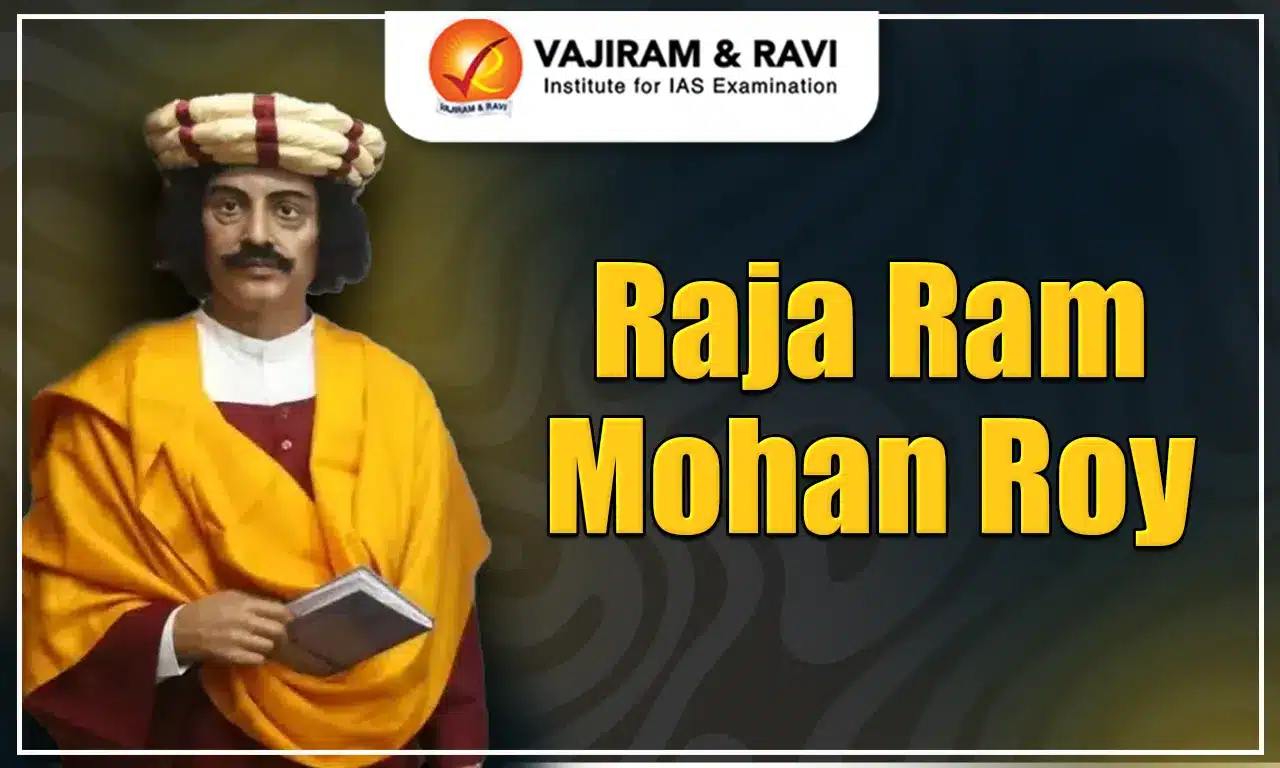
Raja Ram Mohan Roy (1772–1833) was a prominent Indian social reformer, scholar, and founder of the Brahmo Samaj, a socio-religious reform movement. Often referred to as the "Father of Modern India", Rajaram Mohan Roy played a pivotal role in the 19th-century Indian Renaissance, advocating for social, religious, and educational reforms. His contributions spanned various aspects of Indian society, including religion, social justice, education, and journalism.
Roy strongly opposed practices such as Sati, child marriage, caste discrimination, and religious orthodoxy. His most notable achievement was his campaign against Sati, which ultimately contributed to the enactment of the Bengal Sati Regulation, 1829, under Governor-General Lord William Bentinck. He also advocated for women's rights, including their right to property and education.
Raja Ram Mohan Roy Biography
Raja Ram Mohan Roy, often hailed as the "Father of the Indian Renaissance," was a visionary reformer whose efforts paved the way for modern India. Born on May 22, 1772, in Radhanagar, Bengal, Rajaram Mohan Roy belonged to a prosperous and orthodox Brahmin family.
Raja Ram Mohan Roy Early Life and Education
Roy was born into a Brahmin family and received a comprehensive education, mastering several languages, including Sanskrit, Persian, Arabic, and English. His early exposure to diverse cultures and philosophies significantly influenced his reformist ideas.
- East India Company: Roy's tenure with the East India Company until 1814 exposed him to British oppression, fuelling his commitment to social and religious reforms. His experiences abroad further strengthened his resolve to fight against injustices and paved the way for modern India.
- Death: In 1830, he visited England as the Mughal emperor's unofficial representative, receiving a warm welcome from Unitarians and King William IV. Roy died of a fever in Bristol, where he was buried.
Raja Ram Mohan Roy Contributions
Raja Ram Mohan Roy's contributions to Indian society were multifaceted, encompassing social, religious, educational, and political reforms. His tireless efforts to eradicate social evils and promote progressive values laid the groundwork for a more equitable and enlightened India.
Social Reforms
Raja Ram Mohan Roy's social reforms were instrumental in challenging and dismantling oppressive practices that plagued Indian society. His efforts were driven by a profound commitment to justice and equality, reflecting his deep empathy for the marginalised and oppressed.
- Atmiya Sabha: In 1814, Roy founded the Atmiya Sabha (i.e., the Society of Friends), a philosophical discussion circle in Kolkata, to address the issues of idolatry, rigid caste structures, and meaningless rituals that dominated society. This platform became a space for intellectual and social discourse aimed at eradicating these social ills.
- Abolition of Sati: One of his most significant contributions was the campaign against the barbaric practice of Sati, where widows were forced to immolate themselves on their husband's funeral pyre.
- Roy was horrified by this custom and worked tirelessly to raise awareness and lobby the British government to ban it.
- His relentless efforts led to the official abolition of Sati with Regulation XVII in 1829, under the British Governor-General, Lord William Bentinck.
- Opposition to Child Marriage and Polygamy: Raja Ram Mohan Roy strongly opposed child marriage and polygamy, which were widespread in 19th-century India. He also advocated for women's education, viewing it as essential for social change and empowering women to make informed life choices.
Raja Ram Mohan Roy Religious Reforms
Raja Ram Mohan Roy's religious reforms were rooted in his belief in monotheism and his desire to purify Hinduism from superstitious practices. He sought to promote a rational and enlightened approach to religion, advocating for the unity of all faiths.
- Promotion of Monotheism: The monotheistic beliefs of Islam and Christianity deeply influenced Raja Ram Mohan Roy. He believed in the existence of one God and sought to reform Hinduism by emphasising the worship of a singular divine entity.
- In 1803, Roy published "Tuhfat-ul-Muwahhidin" (A Gift to Monotheists), a treatise advocating monotheism and rational religious thought. He argued that religion's essence lay in its ethical teachings and moral values rather than rituals and ceremonies.
- Critique of Idol Worship: Rajaram Mohan Roy was a staunch critic of idol worship, which he viewed as a deviation from the true essence of religion. He believed that idol worship promoted superstition and diverted people from understanding the deeper philosophical aspects of faith.
- Interfaith Dialogue and Religious Tolerance: Raja Ram Mohan Roy was a proponent of interfaith dialogue and religious tolerance. He believed that all religions shared common values and sought to promote harmony among different faith communities.
- He criticised Christian ritualism and rejected Christ as God's incarnation. In Precepts of Jesus (1820), he attempted to distinguish between the moral and philosophical message of the New Testament, which he praised, and its miracle stories.
- Brahmo Samaj: In 1828, he founded the Brahmo Samaj, a socio-religious reform movement that rejected idol worship and emphasised rationalism and humanism.
Educational Reforms
Raja Ram Mohan Roy’s educational reforms aimed to promote critical thinking, scientific inquiry, and a modern curriculum that would prepare Indians for the challenges of the contemporary world. He was a visionary educationist who recognised the transformative power of education in shaping society.
- Establishment of the Anglo-Hindu School: Founded by Raja Ram Mohan Roy in 1822, the Anglo-Hindu School was a pioneering institution offering a curriculum that merged traditional Indian subjects with Western sciences and humanities.
- Emphasising critical thinking and scientific inquiry, it aimed to provide a well-rounded education and modernise Indian schooling.
- The school's success influenced the adoption of Western educational methods in India and inspired further educational reforms.
- Vedanta College: In 1826, Raja Ram Mohan Roy established the Vedanta College to teach his monotheistic doctrines alongside modern subjects.
- Advocacy for Female Education: Raja Ram Mohan Roy strongly advocated for female education, recognising its importance in achieving gender equality and social progress. He argued that educating women would lead to the overall development of society, as educated women could contribute to family and community welfare.
Political Reforms
Raja Ram Mohan Roy's political reforms aimed to secure greater rights and freedoms for Indians under British colonial rule. He pioneered the Indian nationalist movement, advocating for constitutional reforms and representation for Indians in governance.
- Advocacy for Civil Rights: Raja Ram Mohan Roy opposed British oppression and advocated for civil rights, fair governance, and a just legal system. He petitioned for Indians to hold administrative roles under equitable British rule.
- Promotion of Freedom of the Press: Raja Ram Mohan Roy was a staunch supporter of freedom of the press, recognising its importance in promoting informed public discourse and holding authorities accountable. He founded several newspapers contributing to development of press in India. These included the Brahmanical Magazine (1821), the Bengali weekly Samvad Kaumudi (1821), and the Persian weekly Mirat-ul-Akbar.
- Tax Reforms: Raja Ram Mohan Roy condemned the oppressive practices of Bengali zamindars and called for the establishment of minimum rents and the elimination of taxes on tax-free lands.
Literary Contributions
Raja Ram Mohan Roy was a prolific writer and translator who contributed significantly to Indian literature. His works include translations of Vedic texts, philosophical treatises, and essays on social and political issues. He also promoted vernacular languages to make education and knowledge accessible to all, emphasising the need for literature in native tongues to reach a wider audience.
- Tuhfat-ul-Muwahhidin (1803/1804): Translated as "A Gift to Deists", this pathbreaking early work questioned irrational religious beliefs and superstitions to promote monotheism.
- Vedanta Granth (1815) & Vedanta Sara (1816): These foundational works provided accessible translations and summaries explaining ancient Vedantic philosophy to the public.
- Upanishad Translations (1816–1819): He translated major sacred texts into Bengali, including the Kenopanishad, Ishopanishad, Kathopanishad, and Mundaka Upanishad.
- A Conference between the Advocate for and an Opponent of the Practice of Burning Widows Alive (1818): Published in both Bengali and English, this treatise systematically challenged and condemned the practice of Sati.
- The Precepts of Jesus (1820): This analytical work separated the core ethical and moral teachings of the New Testament from Christian miracle stories.
- Gaudiya Vyakaran (1833): Written in Bengali, this notable grammar book played a critical role in shaping modern Bengali prose structure.
- Contributions to Journalism:
- Sambad Kaumudi (1821): He launched this Bengali weekly newspaper to actively advocate for social reforms, freedom of the press, and rational public discourse.
- Mirat-ul-Akhbar (1822): As the first Persian-language journal in India, he utilised this platform to campaign for civil liberties and progressive ideas.


Raja Ram Mohan Roy Ideology
Raja Ram Mohan Roy's ideology was characterised by a commitment to monotheism, social reform, education, women's rights, rationalism, and religious tolerance. As the "Father of the Indian Renaissance”, his visionary ideas laid the foundation for a more progressive and enlightened society.
- Monotheism: Raja Ram Mohan Roy's monotheism emphasised the worship of a single divine entity, focusing on ethics over rituals. His beliefs were shaped by his studies of Hinduism, Islam, and Christianity.
- Social Reform: Raja Ram Mohan Roy fought to abolish social evils like sati, child marriage, and caste discrimination, promoting dignity, equality, and justice for all.
- Education: He advocated for modern education that blended traditional Indian knowledge with Western sciences, stressing the importance of English education to empower Indians.
- Women's Rights: Roy championed women's rights, opposing practices like sati and child marriage while advocating for women's education and equality.
- Rationalism: He promoted reason and critical thinking to challenge orthodox beliefs and foster an enlightened, inclusive society.
- Religious Tolerance: Roy believed in the unity of religions and promoted harmony through interfaith dialogue and tolerance.
Raja Ram Mohan Roy UPSC PYQs
Q1: Trace the rise and growth of socio-religious reform movements with special reference to Young Bengal and Brahmo Samaj. (UPSC Mains 2021)
Q2: The women’s questions arose in modern India as a part of the 19th-century social reform movement. What are the major issues and debates concerning women in that period? (UPSC Mains 2017)
Q3: Consider the following statements about Raja Ram Mohan Roy: (UPSC Prelims 2025)
- He possessed great love and respect for the traditional philosophical systems of the East.
- He desired his countrymen to accept the rational and scientific approach and the principle of human dignity and social equality of all men and women.
Which of the statements given above is/are correct?
(a) 1 only
(b) 2 only
(c) Both 1 and 1
(d) Neither 1 nor 2
Ans: (c)
Q4: Which of the following statements is/are correct regarding Brahmo Samaj? (UPSC Prelims 2012)
- It opposed idolatry
- It denied the need for a priestly class to interpret the religious texts
- It popularised the doctrine that the Vedas are infallible.
Select the correct answer using the codes given below:
(a) 1 only
(b) 1 and 2 only
(c) 3 only
(d) 1, 2 and 3
Ans: (b)

 Last updated on Oct, 2026
→ UPSC 2027 Notification will be released on 13 January 2027 at upsconline.nic.in.
→ Check Nobel Prize 2026 Winners List here.
→ Download PIB PRiSM Monthly Magazine 2026 here.
→ Check UPSC Monthly Current Affairs Magazine The Recitals here.
→ Check out the latest UPSC Syllabus here.
→ Download UPSC Model Answers for Mains 2026
→ UPSC Mains Question Paper 2026 is out now for Essay & GS Paper 1, 2, 3 & 4.
→ UPSC Calendar 2027 has been released.
→ Enroll in Vajiram & Ravi’s UPSC Mains Test Series 2027 for structured answer writing practice, expert evaluation, and exam-oriented feedback.
→ Join Vajiram & Ravi’s UPSC Mentorship Program 2027 for personalized guidance, strategy planning, and one-to-one support from experienced mentors.
→ Go through the UPSC Mains Previous Year Papers to enhance your preparation.
→ UPSC has released UPSC Toppers List 2025 with the Civil Services final result on its official website.
→ Also check Best UPSC Coaching in India
Raja Ram Mohan Roy FAQs
Q1. What was Raja Ram Mohan Roy famous for? +
Q2. Did Raja Ram Mohan Roy believe in God?+
Q3. Why was Raja Ram Mohan Roy called the father of Indian Renaissance?+
Q4. Which organisation was founded by Raja Ram Mohan Roy?+
Q5. Who gave the Raja title to Ram Mohan Roy?+
Tags: quest raja ram mohan roy upsc modern history notes