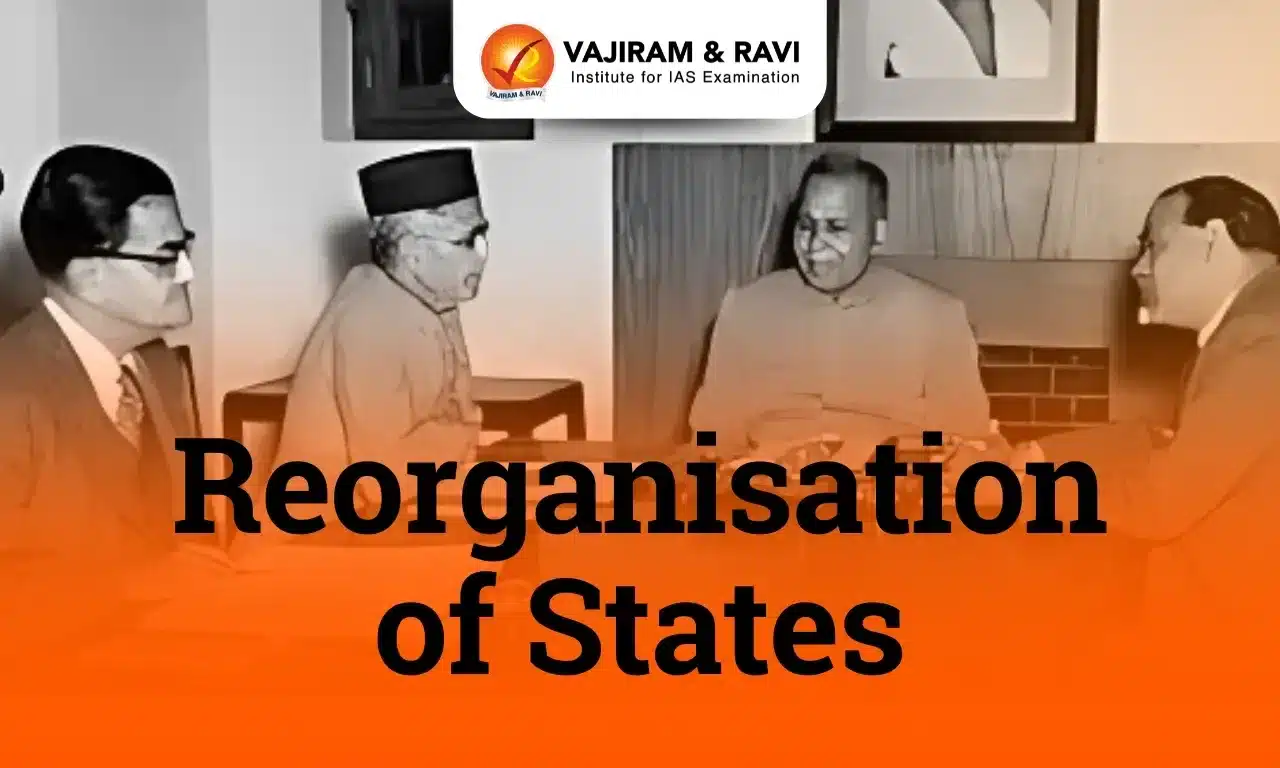
The Reorganisation of States in India was an important reform that took place after the country gained independence. It was marked by the States Reorganisation Act of 1956, which was a response to a major reform for the linguistic reorganisation of states. This act followed the Linguistic Provinces Commission (Dhar Commission), which had earlier rejected language as a basis for dividing states. However, public demands, particularly in South India, led to the appointment of the States Reorganisation Commission in 1953. The Act, enacted on 31 August 1956, created new states like Andhra Pradesh, Kerala, and others.
The Reorganisation of States Act of 1956 was a pivotal moment in India’s history, but it didn’t signal the end of the reorganisation process. Later, several new states and Union Territories were established to accommodate regional identities and administrative requirements.
Reorganisation of States Historical Background
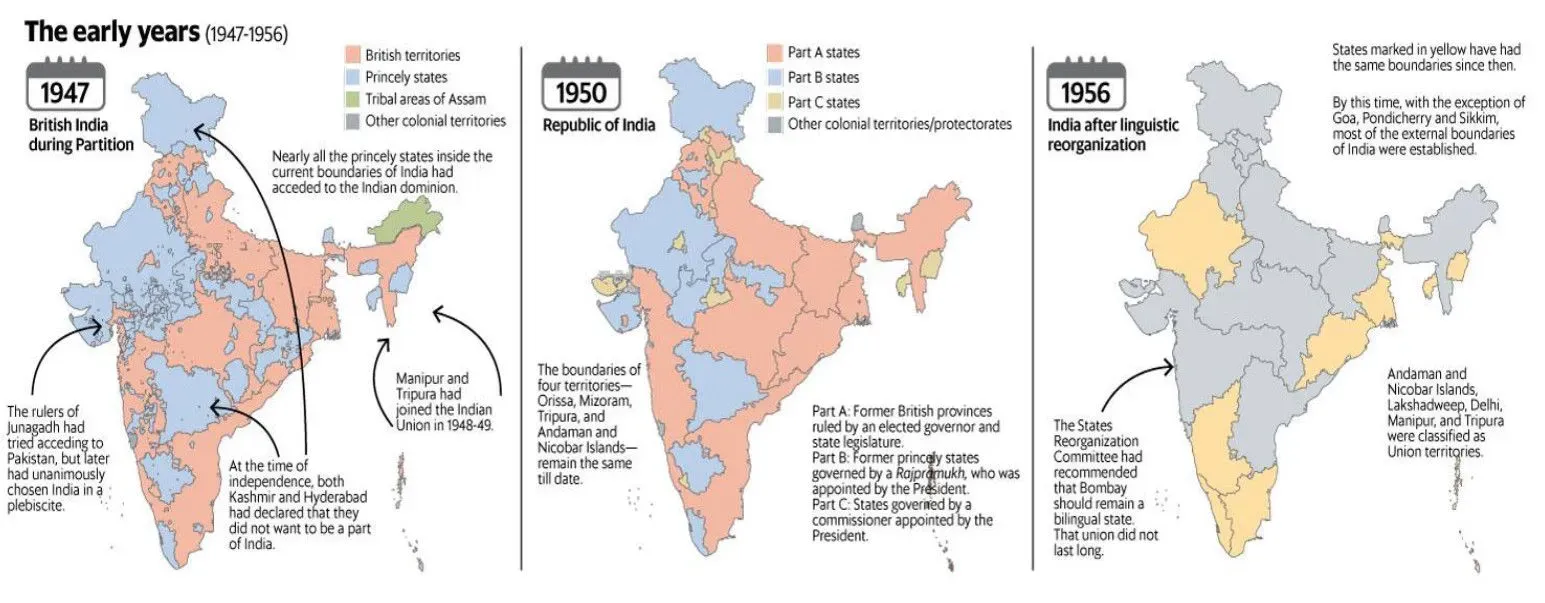
After India gained independence, there was a need for better governance and administrative structures. The formation of states considered financial, economic, and language considerations. The 1950 Constitution grouped territories into four parts: Part A, Part B, Part C, and Part D (Initial States Classification in 1951).
- Part A States (Nine States): Included Assam, West Bengal, Bihar, Bombay, Madhya Pradesh (formerly Central Provinces and Berar), Madras, Orissa, Punjab, and Uttar Pradesh (formerly United Provinces). These states were primarily based on historical regions and shared cultural and linguistic ties.
- Part B States (Nine States): Comprising Hyderabad, Jammu and Kashmir, Saurashtra, Mysore, Travancore-Cochin, Madhya Bharat, Rajasthan, Patiala and East Punjab States Union (PEPSU). These states had unique characteristics and were formed with local identities in mind.
- Part C States (Ten States): Included Delhi, Kutch, Himachal Pradesh, Bilaspur, Coorg, Bhopal, Manipur, Ajmer, Cooch-Behar, and Tripura. These states were a mix of former Chief Commissioners’ provinces and centrally administered areas.
- Part D Territory: The Andaman and Nicobar Islands (Part D) were governed by a Chief Commissioner / Lieutenant Governor appointed by the Indian President.
|
Commission |
Key Details |
|
Dhar Commission |
- Constituted: June 1948. - Members: SK Dhar, JN Lal, and Panna Lall. - Main Recommendations: The commission proposed the establishment of two new provinces:
- The commission rejected the idea of organising provinces solely or primarily on linguistic grounds. - It emphasised factors such as geographical continuity, financial self-sufficiency, administrative convenience, and future development capacity for state reorganisation. - Emphasised safeguarding tribal rights, including land rights and cultural practices. |
|
JVP Committee |
- Constituted: December 1948. - Members: Jawaharlal Nehru, Sardar Vallabhbhai Patel, and Congress President Pattabhi Sitaramayya. - Main Recommendations:
|
|
State Reorganisation Commission (Fazl Ali Commission) |
- Constituted: 1953. - Members: Justice Fazal Ali, Sardar K. M. Panikkar, and Hriday Nath Kunzru. - Main Recommendations:
- Based on these recommendations, the States Reorganisation Act, 1956 was passed, creating 14 centrally governed states and 6 union territories. - It also led to the passing of the 7th Constitutional Amendment Act in 1956, which replaced the four types of states known as Part A, B, C, and D with two categories: States and Union Territories.
|
Reorganisation of States Post-1956 State Formation
The State Reorganisation Commission and subsequent acts paved the way for state organisations in India. The reorganisations have been based on multiple factors, language being merely one of them.
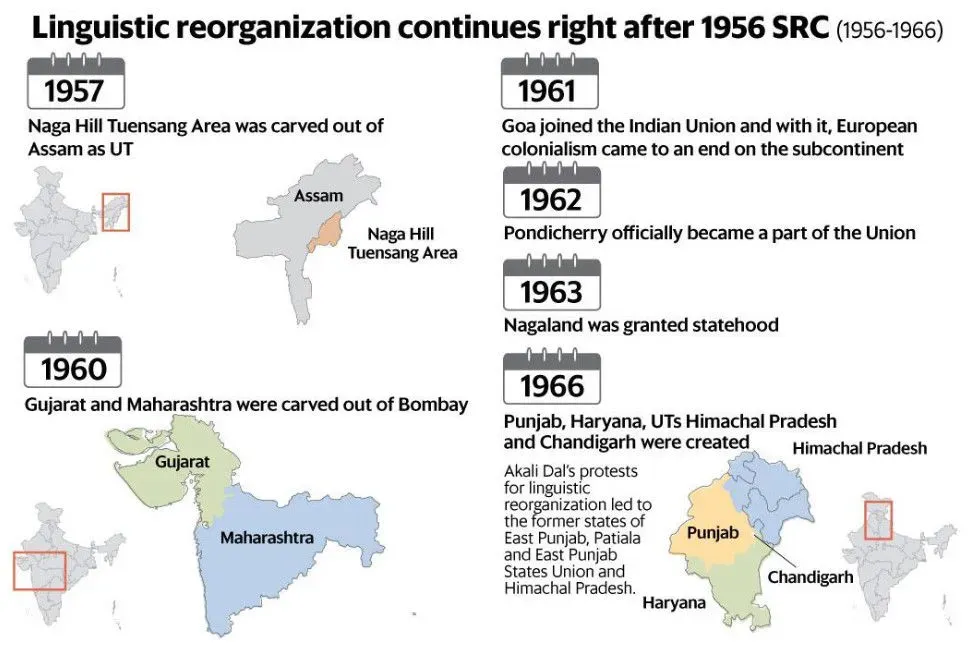
- Maharashtra and Gujarat (1960): The Bombay Reorganisation Act of 1960 led to the creation of Maharashtra and Gujarat.
- This resulted from agitations like the Samyukta Maharashtra movement (for Marathi-speaking regions) and the Mahagujarat movement (for Gujarati-speaking regions).
- Punjab, Haryana, and Himachal Pradesh (1966): The Punjabi Suba movement advocated for a separate state for Punjabi-speaking people.
- The Punjab Reorganisation Act of 1966 led to the creation of Punjab (for Sikhs and Punjabi speakers), Haryana (for Hindi speakers), and Himachal Pradesh (for hilly terrain). Chandigarh, however, remained a Union Territory.
- Himachal Pradesh, initially a union territory, was granted statehood in 1971.
- Goa and Daman & Diu (1987): Goa became a state in 1987 following nationalistic movements. Indian troops had captured Goa and Daman & Diu in 1961. Daman & Diu, however, remained a Union Territory.
- Puducherry (1962): Comprising former French settlements, it was transferred to India in 1954 and became a union territory in 1962.
- Nagaland (1963): Formed by separating the Naga Hills and Tuensang area from Assam, it became the 16th state of India.
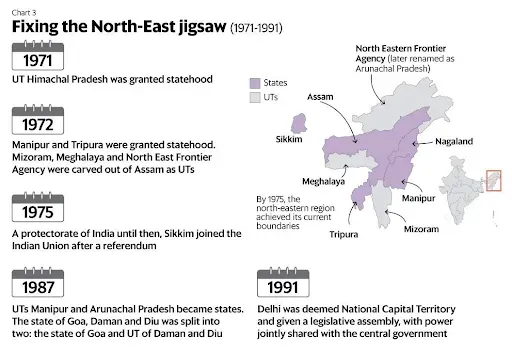
- Manipur, Tripura and Meghalaya (1972): These former union territories were granted statehood, increasing the total number of states in India to 21.
- Sikkim (1975): Initially a “protectorate” under India, Sikkim was granted the status of an associate state in 1974 and became a full-fledged state in 1975.
- Mizoram, Arunachal Pradesh and Goa (1987): These three new states were established, with Mizoram and Arunachal Pradesh previously being union territories.
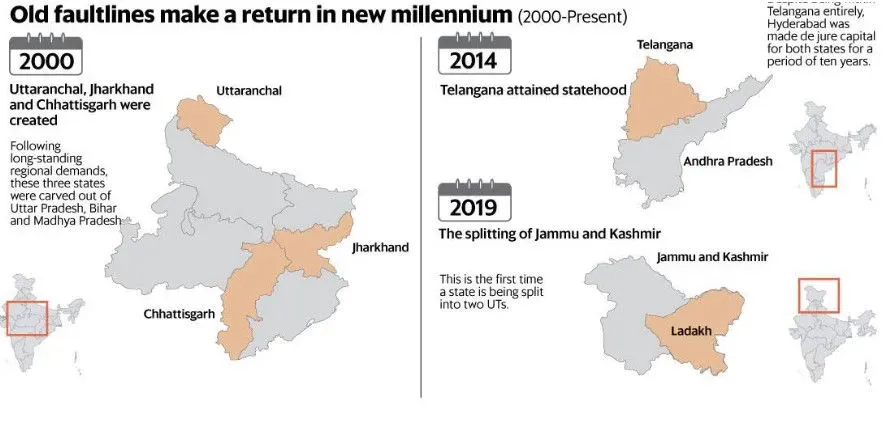
- Chhattisgarh, Uttarakhand and Jharkhand (2000): These states were formed by dividing the territories of Madhya Pradesh, Uttar Pradesh, and Bihar respectively.
- Telangana (2014): Formed from the territories of Andhra Pradesh, it became the 29th state of India.
- Jammu & Kashmir and Ladakh (2019): The former state of Jammu and Kashmir was divided into two separate union territories.
Current Statehood Demands
Despite so many reorganisations of the states after independence, various regions continue to seek separate statehood or reorganisation of states due to political, economic, or other issues:
- Uttar Pradesh: Proposals for dividing Uttar Pradesh into smaller states like Purvanchal, Pashchim Pradesh, Bundelkhand, and Awadh Pradesh have been discussed.
- Maru Pradesh: A demand from western Rajasthan.
- Vidarbha: The Nagpur and Amravati divisions of eastern Maharashtra aspire to be a separate state.
- Other Demands: Delhi, Gorkhaland, Kamtapur, North Bengal, Jungle Mahal, Bodoland, Barak Valley, Coorg, Baghelkhand, Rayalaseema, Saurashtra, Mithila, Panun Kashmir, Bru Land, and Chakma territory in Arunachal Pradesh all represent diverse aspirations.


Reorganisation of States Significance
The Reorganisation of states through the States Reorganisation Act of 1956 replaced colonial-era administrative units with states built around common languages and regional cultures. By honouring local identities, this single reform defused early separatist movements, brought government closer to everyday people, and held the diverse nation together.
- Democratic Governance: The reorganisation enabled administration in local languages, thus enhancing civic participation, transparency, and grassroots political inclusion.
- National Unity & Consolidation: Accommodating linguistic identities integrated diverse regions into the national fold, preventing separatist movements.
- Administrative Rationalisation: The reform did away with the complicated Part A, B, C, and D state divisions left behind by the British and princely states, establishing a clear two-tier model of States and Union Territories.
- Targeted Development: Carving out smaller states over time helped address regional economic imbalances, giving smaller ethnic and tribal groups direct control over their own resource allocation and local growth.
- Cooperative Federalism: The reorganisation balanced regional aspirations with a strong central framework, fostering institutional harmony in Centre–State relations.
Reorganisation of States UPSC PYQs
Q1: Trace India’s consolidation process during the early phase of independence in terms of polity, economy, education, and international relations. (UPSC Mains 2025)
Q2: The political and administrative reorganisation of states and territories has been a continuous ongoing process since the mid-nineteenth century. Discuss with examples. (UPSC Mains 2022)
Q3: Discuss whether the formation of new states in recent times is beneficial or not for the economy of India. (UPSC Mains 2018)
Q4: Has the formation of linguistic states strengthened the cause of Indian unity? (UPSC Mains 2016)
Q5: Consider the following pairs: (UPSC Prelims 2025)
|
|
State |
|
Description |
|
I. |
Arunachal Pradesh |
: |
The capital is named after a fort, and the State has two National Parks |
|
II. |
Nagaland |
: |
The State came into exis-tence on the basis of a Constitutional Amendment Act |
|
III. |
Tripura |
: |
Initially a Part 'C' State, it became a centrally administered territory with the reorganization of States in 1956 and later attained the status of a full-fledged State |
How many of the above pairs are correctly matched?
a) Only one
b) Only two
c) All the three
d) None
Ans: (c)

 Last updated on Oct, 2026
→ UPSC 2027 Notification will be released on 13 January 2027 at upsconline.nic.in.
→ Check Nobel Prize 2026 Winners List here.
→ Download PIB PRiSM Monthly Magazine 2026 here.
→ Check UPSC Monthly Current Affairs Magazine The Recitals here.
→ Check out the latest UPSC Syllabus here.
→ Download UPSC Model Answers for Mains 2026
→ UPSC Mains Question Paper 2026 is out now for Essay & GS Paper 1, 2, 3 & 4.
→ UPSC Calendar 2027 has been released.
→ Enroll in Vajiram & Ravi’s UPSC Mains Test Series 2027 for structured answer writing practice, expert evaluation, and exam-oriented feedback.
→ Join Vajiram & Ravi’s UPSC Mentorship Program 2027 for personalized guidance, strategy planning, and one-to-one support from experienced mentors.
→ Go through the UPSC Mains Previous Year Papers to enhance your preparation.
→ UPSC has released UPSC Toppers List 2025 with the Civil Services final result on its official website.
→ Also check Best UPSC Coaching in India
Reorganisation of States FAQs
Q1. What was the total number of states formed as a result of the State Reorganisation Act of 1956?+
Q2. What was the process of State reorganisation in India?+
Q3. Which was the First State of Independent India?+
Q4. Who was the chairman of the State Reorganisation Commission?+
Q5. What was the main recommendation of the State Reorganisation Commission?+
Tags: quest reorganisation of states UPSC Post-Independence India Notes