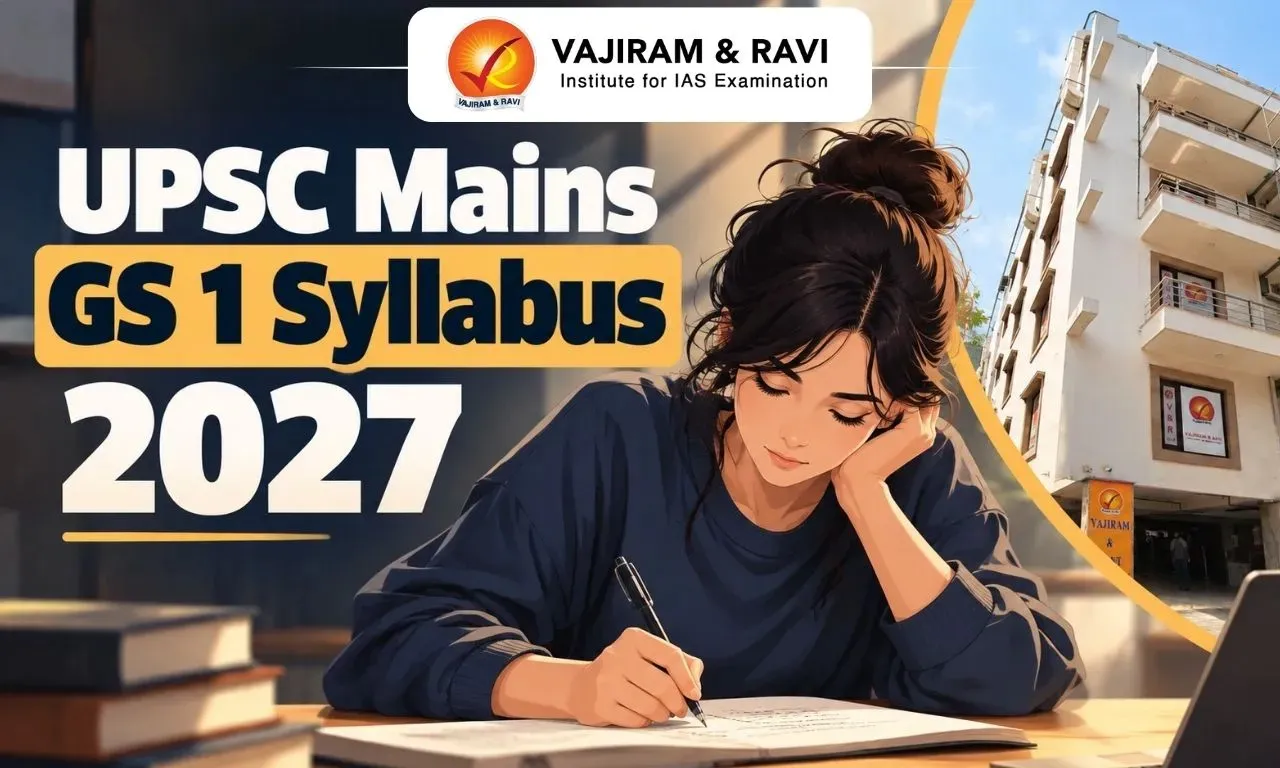
UPSC Mains GS 1 Syllabus 2027 covers Indian Heritage and Culture, History, Geography and Indian Society. The paper tests a candidate’s understanding of India’s historical development, cultural heritage, social structure, geographical features and important events and processes shaping the world.
UPSC Mains GS 1 Syllabus 2027 Overview
UPSC Mains GS 1 is a 250-mark paper covering Indian Heritage and Culture, History, Geography of the World and Society, with 20 compulsory questions to be answered in 3 hours.
| UPSC Mains GS 1 Syllabus 2027 Overview | |
| Particulars | Details |
|
Paper |
General Studies Paper 1 (GS 1) |
|
Paper Code |
Paper-II |
|
Maximum Marks |
250 Marks |
|
Duration |
3 Hours |
|
Number of Questions |
20 Questions |
|
Question Type |
Descriptive / Written |
|
Questions 1–10 |
150 words each |
|
Questions 11–20 |
250 words each |
|
Nature of Paper |
Merit-counting paper |
|
Main Areas |
Indian Heritage & Culture, History, Geography and Indian Society |
|
Major Sections |
Culture, Modern Indian History, Freedom Struggle, Post-Independence India, World History, Indian Society and Geography |
|
Marks per GS Paper |
250 Marks |
UPSC Mains GS 1 Syllabus 2027 (Official)
Indian Heritage and Culture, History and Geography of the World and Society
- Indian Culture - Salient aspects of Art Forms, Literature and Architecture from ancient to modern times.
- Modern Indian History from about the middle of the eighteenth century until the present - significant events, personalities, issues.
- The Freedom Struggle - its various stages and important contributors/contributions from different parts of the country.
- Post-independence Consolidation and Reorganization within the country.
- History of the World will include events from 18th century such as Industrial Revolution, world wars, Redrawal of National Boundaries, Colonization, Decolonization, political philosophies like Communism, Capitalism, Socialism etc.— their forms and effect on the society.
- Salient features of Indian Society, Diversity of India.
- Role of Women and Women’s Organization, Population and Associated Issues, Poverty and Developmental issues, Urbanization, their problems and their remedies.
- Effects of Globalization on Indian society.
- Social Empowerment, Communalism, Regionalism & Secularism.
- Salient features of World’s Physical Geography.
- Distribution of Key Natural Resources across the world (including South Asia and the Indian sub-continent); factors responsible for the location of primary, secondary, and tertiary sector industries in various parts of the world (including India).
- Important Geophysical Phenomena such as earthquakes, Tsunami, Volcanic activity, cyclone etc., geographical features and their location-changes in critical geographical features (including water-bodies and ice-caps) and in flora and fauna and the effects of such changes.


How to Prepare for UPSC Mains GS 1 Syllabus 2027?
GS 1 has a wide syllabus, so preparation should be simple, focused and based on the syllabus and previous year questions. Cover History, Culture, Society and Geography one by one, make short notes and revise them regularly.
- Read the syllabus first: Understand every topic and divide it into small parts.
- Study previous year questions: See what type of questions are asked from each topic.
- Use limited sources: Follow one or two standard sources for each subject instead of reading many books.
- Make short notes: Write important facts, examples, dates, causes, effects and keywords in a concise manner.
- Revise regularly: Keep revising old topics while completing new ones.
- Add current examples: Connect static topics with recent events, government initiatives, reports and examples.
- Practise maps: Use maps for geography, historical events, resources, industries and important locations.
- Learn important diagrams: Practise simple diagrams for topics such as earthquakes, cyclones, population and urbanisation.
- Prepare topic-wise examples: Keep a separate list of useful examples for History, Society, Geography and Culture.
- Start answer writing early: Do not wait to complete the entire syllabus before practising answers.
- Focus on quality, not quantity: It is better to revise limited material several times than read too many sources once.
UPSC Mains GS 1 Answer Writing Strategy
A good GS 1 answer should be clear, relevant and well-structured. First understand what the question is asking, then write a short introduction, explain the main points with examples and finish with a suitable conclusion.
- Understand the question: Read the question carefully and identify exactly what it is asking.
- Follow the directive: Write differently for discuss, explain, examine, analyse and critically examine questions.
- Write a short introduction: Start with a definition, background, fact or brief context related to the topic.
- Cover all parts: If the question has multiple parts, answer each part separately.
- Use simple headings: Divide the main body into 2–4 relevant headings where required.
- Write in points: Use short and clear points instead of long paragraphs.
- Add examples: Support your points with relevant historical, geographical, social or current examples.
- Use diagrams and maps: Add them when they make the answer easier to understand.
- Keep the answer balanced: Where appropriate, mention both positive and negative aspects, causes and effects, or challenges and solutions.
- Stay within the word limit: Avoid unnecessary information and focus only on what the question demands.
- End with a short conclusion: Summarise the answer in 1–2 lines and provide a positive or practical way forward when relevant.
- Practise regularly: Write answers within the required time and improve them by checking structure, content and presentation.

 Last updated on Sep, 2026
→ UPSC 2027 Notification will be released on 13 January 2027 at upsconline.nic.in.
→ Check out the latest UPSC Syllabus here.
→ Download UPSC Model Answers for Mains 2026
→ UPSC Mains Question Paper 2026 is out now for Essay & GS Paper 1, 2, 3 & 4.
→ UPSC Calendar 2027 has been released.
→ Enroll in Vajiram & Ravi’s UPSC Mains Test Series 2027 for structured answer writing practice, expert evaluation, and exam-oriented feedback.
→ Join Vajiram & Ravi’s UPSC Mentorship Program 2027 for personalized guidance, strategy planning, and one-to-one support from experienced mentors.
→ Go through the UPSC Mains Previous Year Papers to enhance your preparation.
→ UPSC has released UPSC Toppers List 2025 with the Civil Services final result on its official website.
→ Also check Best UPSC Coaching in India
UPSC Mains GS 1 Syllabus 2027 FAQs
Q1. What is the UPSC Mains GS 1 syllabus 2027?+
Q2. How many marks is UPSC Mains GS 1?+
Q3. What are the major subjects in UPSC Mains GS 1?+
Q4. Does GS 1 include Modern Indian History?+
Q5. Is World History included in UPSC Mains GS 1?+
Q6. What topics are covered under Indian Society?+
Tags: gs 1 syllabus upsc mains gs 1 syllabus upsc mains gs 1 syllabus 2027