Infrastructure Investment Trusts (InvITs) are SEBI-regulated investment vehicles designed to channel long-term capital into income-generating infrastructure assets. Introduced through the SEBI (Infrastructure Investment Trusts) Regulations, 2014, InvITs enable investors to participate in infrastructure projects through units of a trust rather than directly owning physical assets.
Infrastructure Investment Trusts help infrastructure developers and public authorities monetise operational assets, recycle capital and finance new projects, thereby reducing the pressure on conventional bank and government financing. InvITs can invest in assets such as roads, power, renewable energy and other eligible infrastructure projects. The structure involves four key entities- Sponsor, Trustee, Investment Manager and Project Manager- with SEBI providing the regulatory framework. Thus, InvITs can play an important role in India's National Monetisation Pipeline and infrastructure financing.
Infrastructure Investment Trusts Overview
Infrastructure Investment Trusts (InvITs) are SEBI-regulated capital-market instruments that mobilise long-term private and institutional capital for infrastructure development.
- Meaning: An InvIT is a trust registered with SEBI that pools funds from investors and invests in eligible infrastructure assets, either directly or through SPVs/Holding Companies.
- Regulatory Framework: InvITs are governed by the SEBI (Infrastructure Investment Trusts) Regulations, 2014, which regulate their registration, investment, governance, disclosure and investor protection.
- Core Purpose: Mobilise long-term domestic and foreign institutional and private capital for infrastructure and provide an efficient mechanism for monetising operational assets.
- Capital Recycling: Developers and public authorities can transfer mature, revenue-generating infrastructure assets to an InvIT, unlock capital and reinvest the proceeds in new infrastructure projects.
- Investor Access: Investors receive units representing an economic interest in the InvIT and its underlying portfolio, enabling participation in large infrastructure assets without directly owning or managing them.
- Asset Monetisation: InvITs serve as an important instrument for recycling public and private infrastructure assets, supporting India's broader infrastructure financing and asset monetisation strategy.
Infrastructure Investment Trusts (InvITs) Structure
The Infrastructure Investment Trusts framework separates asset ownership, oversight, investment management and project operations among specialised entities, promoting professional management and accountability.
- Sponsor: Establishes the InvIT and transfers or arranges the transfer of infrastructure assets to it, subject to prescribed eligibility, financial and track-record requirements.
- Trustee: A SEBI-registered debenture trustee responsible for overseeing the InvIT and safeguarding the interests of unitholders.
- Investment Manager: Responsible for investment decisions, asset acquisition, financing, portfolio management and strategic management of the InvIT.
- Project Manager: Oversees the day-to-day operation, maintenance and performance of the underlying infrastructure assets.
Routes of Investment in Infrastructure Investment Trusts (InvITs)
- Publicly Offered InvITs: Units are offered to the public and subsequently listed on recognised stock exchanges, providing secondary-market tradability.
- Privately Placed InvITs: Units are privately placed with eligible institutional and other permitted investors, generally involving a more concentrated investor base.
Infrastructure Investment Trusts (InvITs) Features
Infrastructure Investment Trusts (InvITs) combine regular cash-flow distribution, professional asset management, regulatory safeguards and capital-market access, making them particularly suitable for mature infrastructure assets.
- High Cash-Flow Distribution: InvITs must distribute at least 90% of Net Distributable Cash Flows (NDCF) to unitholders, subject to applicable SEBI regulations. However, the frequency differs:
- Publicly offered InvITs: at least once every six months.
- Privately placed InvITs: at least once every financial year.
- Focus on Operational Assets: As per the applicable regulatory framework, public InvITs are required to invest at least 80% of the value of their assets in completed and revenue-generating infrastructure assets.
- Diversified Infrastructure Exposure: InvITs can invest in infrastructure sectors such as highways, power transmission, renewable energy, telecom and other eligible infrastructure assets, enabling portfolio diversification.
- Regulated Leverage: Aggregate consolidated borrowings are generally capped at 70% of the value of InvIT assets, with additional safeguards for higher leverage.
- Professional Governance: The Sponsor–Trustee–Investment Manager–Project Manager structure provides clear divisions of responsibility, professional management, and accountability.
- Capital Recycling: InvITs enable developers and public authorities to monetise operational assets and recycle capital into new infrastructure projects.
- Market-Based Investment: Listed InvIT units provide investors with market-based access to infrastructure assets without requiring direct ownership or management of physical projects.
- Transparency & Investor Protection: SEBI mandates periodic valuation, financial reporting, disclosures and governance norms to promote transparency and protect unitholders’ interests.
- Taxation: India's Finance Bill 2026 introduces significant changes to the taxation of Real Estate Investment Trusts (REITs) and Infrastructure Investment Trusts (InvITs), with amendments taking effect from 1 April 2026 that aim to simplify investor taxation while maintaining revenue neutrality.
Who can invest in InvITs?
- Any investor (domestic/foreign/retail/institutional) can buy InvIT units in India.
- The minimum subscription amount for public InvITs is in the range of ₹10,000 to ₹15,000, and the trading lot is 1 unit. (revised w.e.f. July 30, 2021) Previously, it was ₹1 lakh & 100 units, respectively.
- Investors can purchase InvIT units through a Demat account, similar to how they would purchase equity shares.
- InvITs are suitable for those who want to take price benefits/returns from infrastructure projects, such as roadways.
- InvITs are also suitable for those who wish to have an infrastructure sector in their investment portfolio.


Infrastructure Investment Trusts (InvITs) in India
A few Infrastructure Investment Trusts (InvITs) are summarised below.
- PowerGrid Infrastructure Investment Trust (PGInvIT): Sponsored by Power Grid Corporation of India, it focuses on power transmission assets and provides an example of public-sector asset monetisation through an InvIT structure.
- India Grid Trust (IndiGrid): One of India's prominent power-sector InvITs, with investments in power transmission and renewable-energy infrastructure, demonstrating the use of InvITs for long-term infrastructure investment.
- IRB Infrastructure Trust: Launched and listed in 2017, it was India's first listed InvIT and the first highway-sector InvIT, providing an early example of monetisation of operational road assets.
- National Highways Infra Trust (NHIT): Sponsored by NHAI, it is a major instrument for monetising operational National Highway assets and recycling the proceeds into further highway development.
InvITs vs REITs
A REIT (Real Estate Investment Trust) is a company that owns, operates, or finances income-generating real estate like office buildings, malls, and apartments. Here are some of the differences between InvITs and REITs. 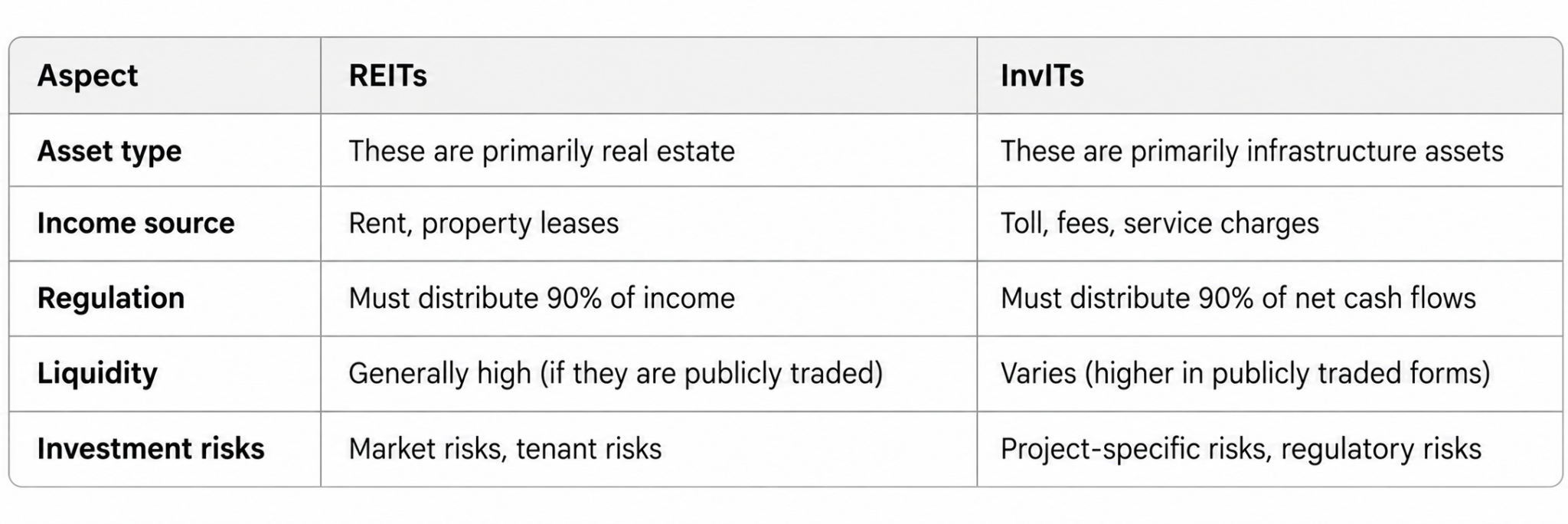
Infrastructure Investment Trusts (InvITs) Challenges
Infrastructure Investment Trusts (InvITs), despite their potential to strengthen infrastructure financing, face challenges related to market conditions, asset performance, liquidity and regulatory risks.
- Interest Rate Risk: An increase in interest rates can make bonds and other fixed-income instruments more attractive, potentially affecting InvIT valuations and investor demand.
- Revenue & Traffic Risk: Usage-based assets such as toll roads are vulnerable to fluctuations in traffic, demand and economic activity, affecting their revenue and cash flows.
- Liquidity Risk: Limited trading volumes in the secondary market may make it difficult for investors to sell their units quickly or at favourable prices.
- Regulatory & Policy Risk: Changes in tariffs, concession terms, taxation or sector-specific regulations may affect the projected revenues and returns of InvITs.
- Operational Risk: Maintenance requirements, asset downtime and operational disruptions can increase costs and reduce the cash flows available for distribution.
- Leverage & Refinancing Risk: Excessive borrowing can increase debt-servicing and refinancing burdens, particularly during periods of high interest rates or tighter financial conditions.
- Valuation Risk: Valuing long-term infrastructure assets involves uncertainty regarding future cash flows, traffic, tariffs, operating costs and asset life.
- Limited Retail Participation: High investment thresholds, limited awareness and the complexity of infrastructure-linked investments can constrain broader retail participation.
Infrastructure Investment Trusts (InvITs) Way Forward
The future of Infrastructure Investment Trusts (InvITs) lies in deepening the market while maintaining strong governance, investor protection and financially sustainable infrastructure financing.
- Deepen Institutional Participation: Encourage greater participation by pension funds, insurance companies, sovereign wealth funds and other long-term investors to provide stable capital.
- Improve Market Liquidity: Strengthen market-making, investor awareness and secondary-market trading to improve price discovery and exit opportunities.
- Diversify Asset Coverage: Expand InvIT participation in emerging infrastructure such as data centres, EV-charging networks and digital infrastructure, while deepening their presence in renewable energy.
- Strengthen Disclosure & Transparency: Ensure uniform and transparent reporting of cash flows, asset valuation, debt, ESG parameters and operational performance to build investor confidence.
- Promote Capital Recycling: Leverage InvITs under the National Monetisation Pipeline (NMP) to monetise mature public assets and reinvest the proceeds in new infrastructure projects.
- Strengthen Risk & Contract Management: Ensure prudent leverage, regular risk assessments and predictable concession terms, supported by time-bound dispute resolution mechanisms.
- Balance Growth with Investor Protection: Expand the InvIT market while strengthening SEBI supervision, governance standards and protection of unitholders' interests.
Infrastructure Investment Trusts (InvITs) UPSC PYQs
Q1. Consider the following statements (UPSC Prelims 2023)
Statement-I: Interest income from the deposits in Infrastructure Investment Trusts (InvITs) distributed to their investors is exempted from tax, but the dividend is taxable.
Statement-II: InvITs are recognized as borrowers under the ‘Securitization and Reconstruction of Financial Assets and Enforcement of Security Interest Act, 2002'.
Which one of the following is correct in respect of the above statements?
(a) Both Statement-I and Statement-II are correct and Statement-II is not the correct explanation for Statement-I
(b) Both Statement-I and Statement-II are correct and Statement-II is not the correct explanation for Statement-I
(c) Statement-I is Correct but Statement-II is incorrect
(d) Statement-I is incorrect but Statement-II is correct
Ans: (d)

 Last updated on Sep, 2026
→ UPSC 2027 Notification will be released on 13 January 2027 at upsconline.nic.in.
→ Asian Games 2026 are being held in Aichi-Nagoya, Japan, from 19 September to 4 October.
→ Check out the latest UPSC Syllabus here.
→ Download UPSC Model Answers for Mains 2026
→ UPSC Mains Question Paper 2026 is out now for Essay & GS Paper 1, 2, 3 & 4.
→ UPSC Calendar 2027 has been released.
→ Enroll in Vajiram & Ravi’s UPSC Mains Test Series 2027 for structured answer writing practice, expert evaluation, and exam-oriented feedback.
→ Join Vajiram & Ravi’s UPSC Mentorship Program 2027 for personalized guidance, strategy planning, and one-to-one support from experienced mentors.
→ Go through the UPSC Mains Previous Year Papers to enhance your preparation.
→ UPSC has released UPSC Toppers List 2025 with the Civil Services final result on its official website.
→ Also check Best UPSC Coaching in India
Infrastructure Investment Trusts (InvIT) FAQs
Q1. What is an infrastructure investment trust?+
Q2. Who regulates InvITs and REITs in India?+
Q3. Is InvIT debt or equity?+
Q4. What are InvIT regulations?+
Q5. Is InvIT tax-free?+
Tags: infrastructure investment trusts quest upsc economy notes