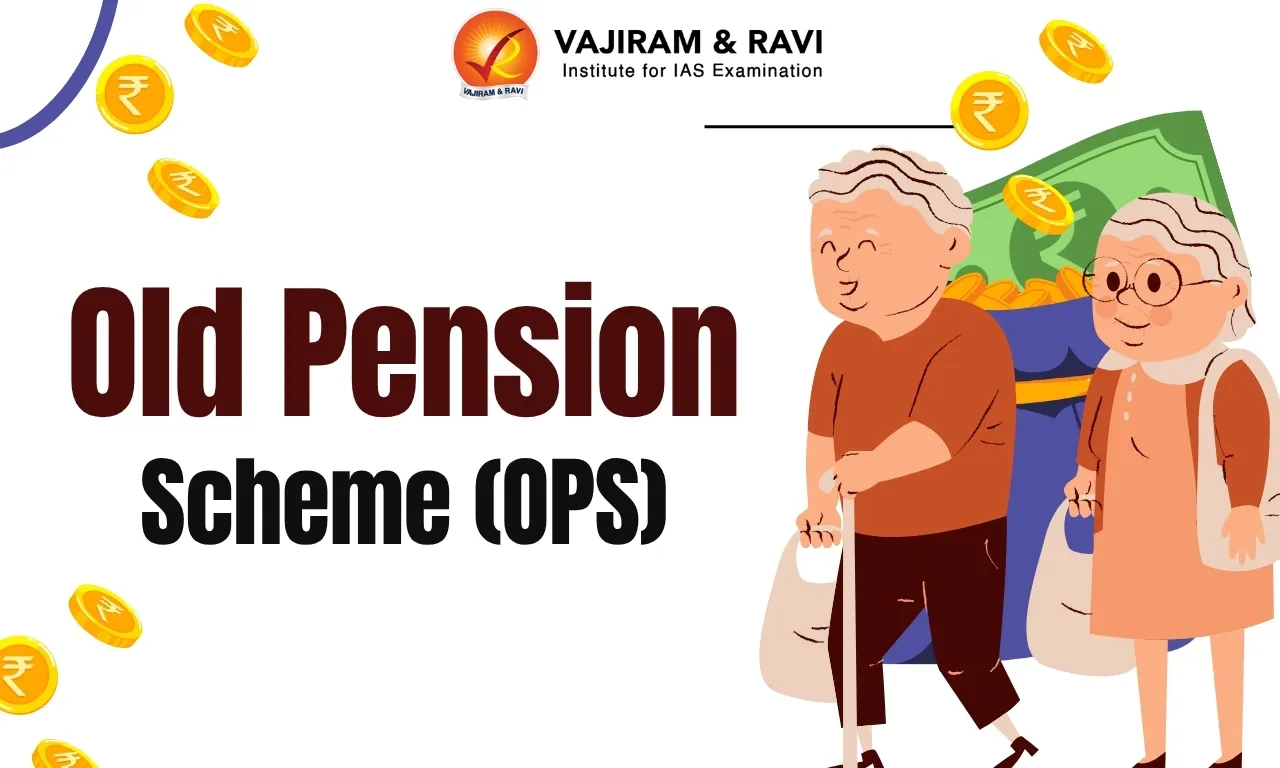
The Old Pension Scheme (OPS) is a defined-benefit pension framework that provided assured retirement income to eligible government employees, with pension liabilities largely financed through government revenues. Unlike the contributory National Pension System (NPS), the Old Pension Scheme does not depend on market-linked investment returns and offers greater certainty of post-retirement income. However, rising life expectancy, inflation-linked revisions and growing pension liabilities have raised concerns about its long-term fiscal sustainability.
The debate over the Old Pension Scheme has intensified, with some states reverting to it, while the introduction of the Unified Pension Scheme (UPS) seeks to balance pension assurance with contributory financing. Thus, the Old Pension Scheme debate reflects the broader challenge of balancing social security, fiscal prudence and intergenerational equity.
Old Pension Scheme Features
Under the Old Pension Scheme, the government bears the entire responsibility for financing pension benefits. The scheme guarantees a lifelong pension and provides several post-retirement benefits to employees.
- OPS is a defined-benefit scheme providing an assured pension based on prescribed salary and service criteria, independent of market performance.
- Pension is generally calculated at 50% of emoluments or average emoluments, subject to applicable rules and qualifying service.
- Employees are not required to make any contribution, as the pension is fully funded by the Government.
- Dearness Relief (DR) is periodically revised to protect pensioners against inflation.
- Family pension is payable to the eligible spouse or dependants after the death of the pensioner.
- The scheme is financed on an unfunded, pay-as-you-go basis through current government revenues without creating a dedicated investment corpus.
- Eligible Central Government employees covered under the old pension framework also receive retirement gratuity and are covered by General Provident Fund (GPF) provisions.
- Statutory framework: The CCS (Pension) Rules, 1972, governed the Central Government's old pension framework, but the current rules are the CCS (Pension) Rules, 2021.
OPS vs NPS vs UPS
The Unified Pension Scheme (UPS), National Pension System (NPS), and Old Pension Scheme (OPS) are India's three primary government retirement models, differing mainly in how they are funded, whether payouts are guaranteed, and how risk is managed.
| Aspect | OPS | NPS | UPS |
|
Nature |
Defined-benefit |
Defined-contribution |
Assured-payout framework under NPS |
|
Pension Security |
Assured pension |
Market-linked retirement benefit |
Assured pension subject to prescribed conditions |
|
Funding |
Primarily government funded |
Employee + government/employer contributions, as applicable |
Contributory framework with government contribution |
|
Market Risk |
No direct market risk |
Investment returns are market-linked. |
Provides an assured benefit subject to scheme conditions |
|
Fiscal Impact |
Higher long-term government liability |
More predictable pension expenditure |
Seeks to balance pension assurance with contributory financing |
|
Retirement Corpus |
No individual funded pension corpus |
Accumulated and invested corpus |
Operates within the NPS framework |
|
Objective |
Income assurance |
Retirement savings and fiscal sustainability |
Greater pension assurance while retaining a contributory framework |


Old Pension Scheme Advantages
Despite its fiscal challenges, the Old Pension Scheme provides significant social security and retirement-income benefits to employees.
- Income Security: Provides an assured pension, reducing uncertainty after retirement.
- Inflation Protection: Dearness Relief helps protect pension income against inflation.
- No Market Risk: Pension benefits are not dependent on fluctuations in financial markets.
- Predictable Retirement Planning: Employees can estimate their post-retirement income with greater certainty.
- Family Protection: Eligible family members receive a family pension after the pensioner's death.
- Social Security: Provides stronger income protection for employees who may have limited capacity or willingness to undertake investment risks.
Old Pension Scheme State-level Reversion
The debate over the Old Pension Scheme has resurfaced as some states have announced a return to the old defined-benefit pension framework.
- Reasons cited by States: Greater pension security, employee demand and political commitment to assured retirement income.
- Fiscal concern: Reverting to OPS can increase long-term pension liabilities because the government assumes the future pension burden.
- Intergenerational Impact: Current pension commitments may impose higher financial obligations on future taxpayers.
- NPS Corpus Issue: States reverting to OPS face challenges regarding the treatment of accumulated NPS funds, as the existing legal framework does not provide for a refund of the accumulated NPS corpus to state governments.
- Policy Divergence: Different approaches among states have created variation in pension frameworks across India.
- Need for Assessment: Pension reversions should be evaluated through long-term actuarial and fiscal sustainability assessments.
Old Pension Scheme Issues
The Old Pension Scheme provides assured pension benefits but raises significant concerns regarding fiscal sustainability and long-term public finances. These issues can be understood as reasons to transition from the old pension scheme to the new.
- Unfunded Pension Liability: The Old Pension Scheme is financed through current government revenues without creating a dedicated pension corpus, resulting in large unfunded liabilities.
- High Fiscal Burden: The Reserve Bank of India estimated that if all states reverted to OPS, the additional annual pension burden could rise to around 0.9% of GDP by 2060.
- Crowding Out Development Expenditure: Rising pension obligations reduce the fiscal space available for capital expenditure on infrastructure, health, education, and other developmental priorities.
- Intergenerational Inequity: OPS shifts the financial burden of current pension commitments to future taxpayers without creating corresponding financial assets.
- Limited Capital-Market Mobilisation: Unlike NPS, OPS does not create a funded pension corpus that can be invested in financial assets, limiting its direct role in mobilising long-term pension savings for capital markets.
- Policy Uncertainty: Reversion to OPS by some states has created policy divergence and uncertainty in India's long-term pension reform agenda.
- Long-term Fiscal Sustainability: Rising life expectancy, inflation-linked pension revisions and expanding pension liabilities place increasing pressure on government finances, raising concerns about the long-term fiscal sustainability of the Old Pension Scheme.
Old Pension Scheme Way Forward
India needs a balanced and sustainable pension architecture that protects retirement income without creating excessive fiscal liabilities.
- Actuarial Assessment: Evaluate the long-term fiscal implications of OPS, NPS and UPS using demographic and actuarial projections.
- Strengthen NPS: Improve transparency, investment choices, grievance redressal and subscriber awareness.
- Evaluate UPS: Monitor its fiscal implications and pension adequacy before making further policy changes.
- Assured Minimum Protection: Explore mechanisms that provide a reasonable pension floor while retaining contributory financing.
- Protect Intergenerational Equity: Avoid pension commitments that disproportionately burden future taxpayers.
- Improve Pension Literacy: Enhance awareness about retirement planning, investment risks and available pension choices.
- Centre-State Coordination: Develop clearer guidelines for pension transitions and treatment of accumulated NPS assets.
- Targeted Social Security: Strengthen pension support for vulnerable and low-income workers outside formal employment.
- Periodic Review: Regularly review pension schemes based on life expectancy, inflation, fiscal capacity and demographic trends.

 Last updated on Sep, 2026
→ UPSC 2027 Notification will be released on 13 January 2027 at upsconline.nic.in.
→ Asian Games 2026 are being held in Aichi-Nagoya, Japan, from 19 September to 4 October.
→ Check out the latest UPSC Syllabus here.
→ Download UPSC Model Answers for Mains 2026
→ UPSC Mains Question Paper 2026 is out now for Essay & GS Paper 1, 2, 3 & 4.
→ UPSC Calendar 2027 has been released.
→ Enroll in Vajiram & Ravi’s UPSC Mains Test Series 2027 for structured answer writing practice, expert evaluation, and exam-oriented feedback.
→ Join Vajiram & Ravi’s UPSC Mentorship Program 2027 for personalized guidance, strategy planning, and one-to-one support from experienced mentors.
→ Go through the UPSC Mains Previous Year Papers to enhance your preparation.
→ UPSC has released UPSC Toppers List 2025 with the Civil Services final result on its official website.
→ Also check Best UPSC Coaching in India
Old Pension Scheme FAQs
Q1. What is an old pension scheme?+
Q2. Who is eligible for OPS in India today?+
Q3. Which is better, OPS or NPS?+
Q4. How to check Old Pension Scheme status?+
Q5. What is the new pension scheme in 2026?+
Tags: old pension scheme quest upsc economy notes