Ayushman Bharat Scheme is a flagship healthcare initiative of the Government of India, launched on 23 September 2018, with the objective of advancing Universal Health Coverage (UHC) and ensuring accessible, affordable and quality healthcare. It marks a shift from a fragmented, disease-specific approach towards an integrated continuum-of-care model covering primary, secondary and tertiary healthcare.
The Ayushman Bharat scheme combines health promotion, preventive care, financial protection, health infrastructure and digital health through interconnected initiatives. Its major components include Ayushman Arogya Mandirs, Pradhan Mantri Jan Arogya Yojana (PM-JAY), PM-Ayushman Bharat Health Infrastructure Mission (PM-ABHIM), and Ayushman Bharat Digital Mission (ABDM). With further expansion to cover all citizens aged 70 years and above, it has emerged as a significant pillar of India’s healthcare and social protection architecture.
Ayushman Bharat Scheme Details
The Ayushman Bharat Scheme is designed as an integrated healthcare framework that combines primary healthcare, health assurance and system strengthening under a continuum-of-care approach. It seeks to move India from a fragmented, scheme-based model towards comprehensive, need-based and accessible healthcare.
- Launch: The Ayushman Bharat Scheme was formally launched on 23 September 2018 at Ranchi, Jharkhand, with the launch of PM-JAY; the initiative was conceived to advance the goal of Universal Health Coverage (UHC).
- Nodal Ministry: The Ayushman Bharat Scheme operates under the Ministry of Health and Family Welfare (MoHFW), with the National Health Authority (NHA) serving as the apex implementation agency for PM-JAY.
- Guiding Approach: The Ayushman Bharat Scheme follows a continuum-of-care approach, connecting healthcare delivery across primary, secondary and tertiary levels.
- Core Objective: It aims to improve access to quality healthcare, reduce out-of-pocket expenditure (OOPE) and provide greater financial protection against major healthcare costs.
- Integrated Architecture: The framework combines Ayushman Arogya Mandirs, PM-JAY, PM-ABHIM and ABDM, covering primary care, hospitalisation, health infrastructure and digital health.
- Implementation Model: The Ayushman Bharat Scheme represents a convergent health-system architecture, combining preventive and primary care with financial protection, infrastructure development and digital integration.
Ayushman Bharat Sub Schemes
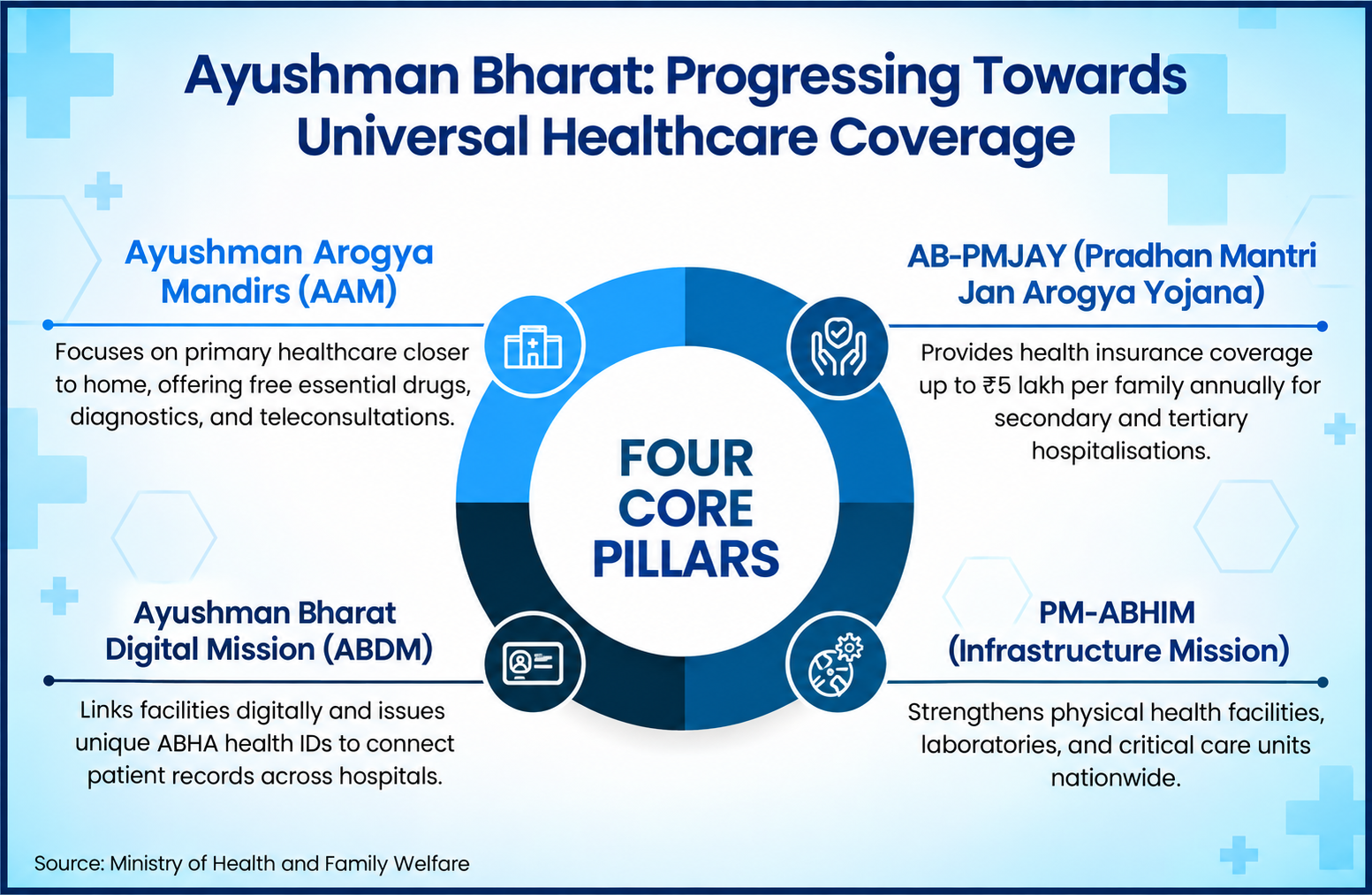
Ayushman Bharat Scheme operates through a set of interconnected sub-schemes covering primary healthcare, financial protection, health infrastructure and digital health. Together, these components follow a continuum-of-care approach and strengthen India’s healthcare system from the community level to tertiary care.
Ayushman Arogya Mandir (AAM)
Ayushman Arogya Mandirs (AAMs), formerly known as Health and Wellness Centres, form the primary healthcare foundation of the Ayushman Bharat Scheme. They bring comprehensive and preventive healthcare closer to communities and households.
- Primary Healthcare: AAMs provide accessible and comprehensive primary healthcare services at the community level, including maternal and child health.
- Preventive Care: They focus on screening, early detection, health promotion and disease prevention, particularly for non-communicable diseases.
- Screening and management of conditions such as hypertension, diabetes and common cancers are important components of their service delivery.
- Community-Based Care: AAMs reduce dependence on higher-level facilities by addressing basic healthcare needs closer to people’s homes.
- Continuum of Care: They act as the entry point into the wider healthcare system, enabling referral and linkage with secondary and tertiary facilities.
- Digital Access: Telemedicine and digital health tools help connect community-level facilities with doctors and specialists where available.
Pradhan Mantri Jan Arogya Yojana (PM-JAY)
PM-JAY constitutes the financial protection and health assurance pillar of the Ayushman Bharat Scheme. It provides cashless and paperless hospitalisation cover to eligible beneficiaries and protects households from catastrophic medical expenditure.
- Health Assurance: PM-JAY provides ₹5 lakh per family per year for secondary and tertiary hospitalisation.
- Beneficiaries can access treatment on a cashless and paperless basis at empanelled hospitals.
- Portability: The scheme follows national portability, allowing beneficiaries to obtain treatment at any empanelled hospital across India.
- Wide Treatment Coverage: It covers a broad range of hospitalisation procedures and treatment packages across medical and surgical specialities.
- Financial Protection: PM-JAY aims to reduce catastrophic health expenditure and out-of-pocket spending among vulnerable households.
- Women’s Access: Women constitute a substantial share of beneficiaries and authorised hospital admissions, reflecting broad access to financial protection.
- Senior Citizens: The scheme has been expanded to provide ₹5 lakh annual health cover to all citizens aged 70 years and above, irrespective of income, through the Ayushman Vay Vandana Card.
- Frontline Workers: ASHA workers, Anganwadi Workers and Anganwadi Helpers have also been brought under PM-JAY coverage.
Pradhan Mantri Ayushman Bharat Health Infrastructure Mission (PM-ABHIM)
PM-ABHIM strengthens the health infrastructure and public health capacity needed to support the delivery of quality healthcare across India. It complements Ayushman Bharat's service-delivery and financial-protection components.
- Infrastructure Strengthening: PM-ABHIM focuses on strengthening health infrastructure across primary, secondary and tertiary levels.
- Public Health Facilities: It supports the development and upgrading of critical care blocks, public health laboratories and block-level public health units.
- Disease Surveillance: The mission strengthens surveillance systems and public health preparedness for emerging diseases and outbreaks.
- Pandemic Preparedness: It improves the health system’s capacity to respond to future pandemics and public health emergencies.
- Integrated Health System: The scheme seeks to address infrastructure gaps while creating a more resilient and coordinated healthcare ecosystem.
Ayushman Bharat Digital Mission (ABDM)
ABDM provides the digital backbone of India's health system, enabling interoperability and portability of health information. It seeks to connect patients, healthcare providers and health institutions through a common digital ecosystem.
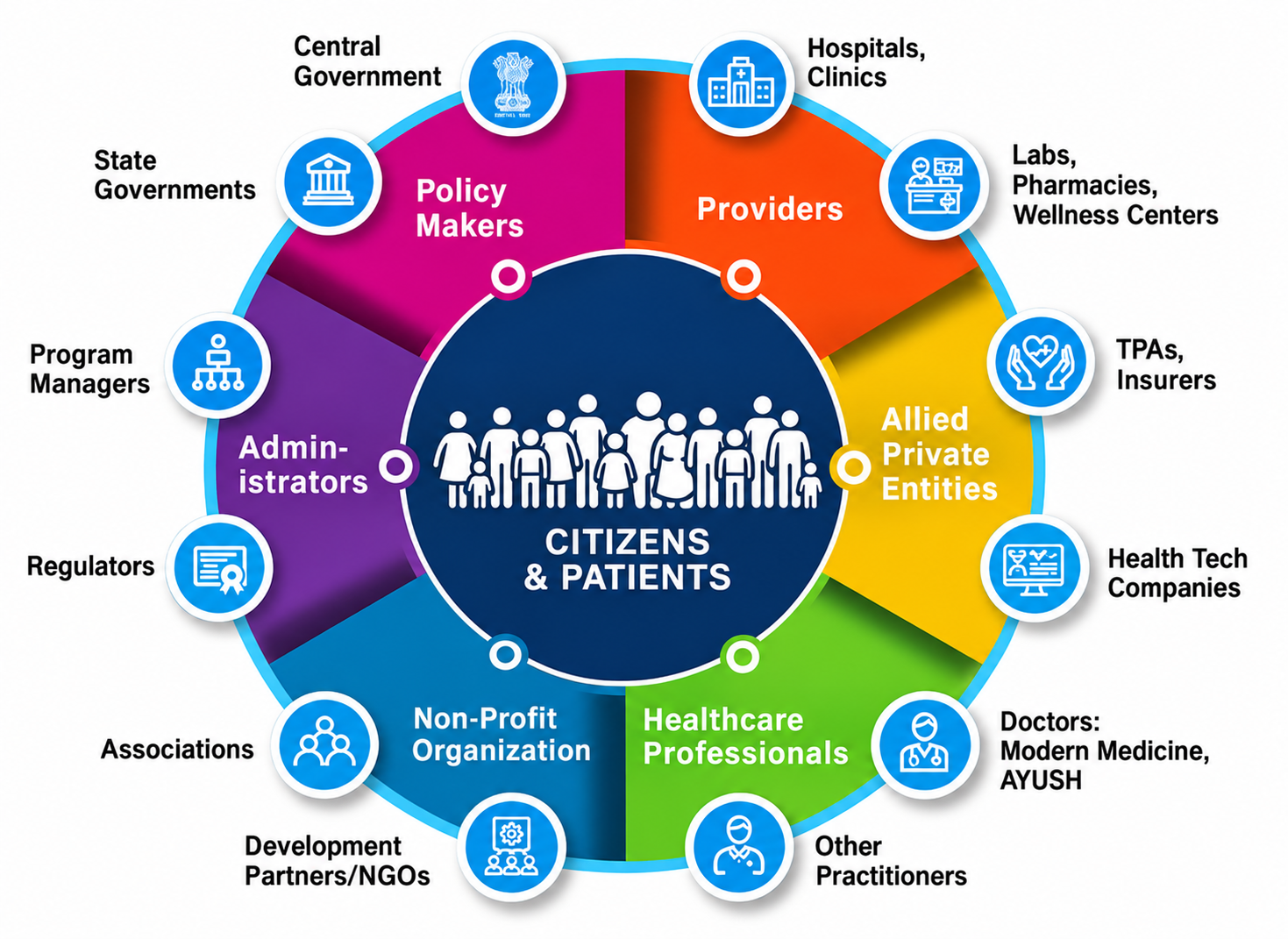
- Digital Health Infrastructure: ABDM creates an integrated digital framework connecting different stakeholders across the healthcare ecosystem.
- ABHA ID: It enables the creation of Ayushman Bharat Health Accounts (ABHA) for individuals to digitally identify themselves within the health ecosystem.
- Electronic Health Records: ABDM facilitates the linking and exchange of digital health records with patient consent.
- Portability: Digital records can support continuity of care across different hospitals, facilities and states.
- Interoperability: The mission promotes common digital standards for seamless exchange of health information.
- Patient-Centred Care: It enables individuals to participate more actively in managing and accessing their health information.
- System Integration: ABDM connects health facilities, healthcare professionals, health-tech systems and patients within a unified digital ecosystem.


Ayushman Bharat Scheme Benefits
Ayushman Bharat Scheme combines financial protection, primary healthcare, infrastructure development and digital integration, making it broader than a conventional health insurance programme.
- Financial Protection: PM-JAY provides cashless hospitalisation coverage of ₹5 lakh per family per year, helping reduce catastrophic health expenditure.
- Accessible Primary Care: AAMs bring preventive, promotive and basic curative services closer to communities.
- Universal Senior-Citizen Protection: The 70+ expansion extends health assurance beyond income-based targeting.
- Infrastructure Development: PM-ABHIM strengthens public health infrastructure, laboratories, critical-care capacity and disease surveillance.
- Digital Continuity of Care: ABDM promotes interoperable health records and digitally enabled healthcare delivery.
- National Portability: PM-JAY enables beneficiaries to access treatment at empanelled hospitals across the country.
- Women’s Access: Strong participation of women among beneficiaries and authorised admissions supports greater gender equity in healthcare access.
- Employment and Skilling: The programme has also created roles such as Pradhan Mantri Aarogya Mitras (PMAMs) who facilitate beneficiaries at empanelled hospitals.
- Health System Resilience: The combined focus on infrastructure, primary care and surveillance strengthens preparedness for health emergencies.
Ayushman Bharat Scheme Impact
The impact of the Ayushman Bharat Scheme can be assessed through its expanding beneficiary base, hospital network, financial protection, digital integration and healthcare access.
- Ayushman Cards: Around 43.52 crore Ayushman cards as of 28 February 2026 had been issued.
- Beneficiary Base: PM-JAY covers approximately 12 crore families under its original beneficiary framework, alongside later expansions.
- Hospital Admissions: Around 11.69 crore hospital admissions has been authorised as of February 2026.
- Empanelled Hospitals: The network included around 36,229 hospitals, including approximately 16,746 private hospitals.
- National Coverage: Ayushman Bharat has achieved participation across all 36 states and union territories.
- OOPE Reduction: Government statements have indicated a decline in out-of-pocket expenditure from around 64.2% in 2013–14 to 43.4% in 2022–23, measured as a share of total health expenditure.
- Gender Inclusion: Women account for approximately 49% of cards created and 48% of authorised hospital admissions.
- Senior Citizens: More than 86 lakh senior citizens had enrolled under the 70+ expansion by October 2025.
- Frontline Workers: Around 37 lakh ASHA, AWW and AWH workers were brought under AB-PMJAY from February 2024.
- Digital Health: Around 86.64 crore ABHA IDs had been created, and 90.70 crore electronic health records were linked as of 11 March 2026.
- Global Significance: PM-JAY is officially described by the Government as the world's largest publicly funded health assurance scheme.
Ayushman Bharat Scheme Challenges
Despite expanding access to hospitalisation and improving financial protection, the Ayushman Bharat Scheme faces several implementation challenges. Gaps in healthcare infrastructure, regional inequalities, human resource shortages and limitations in financial coverage continue to constrain its effectiveness.
- Limited Financial Protection: PM-JAY primarily covers eligible hospitalisation, leaving outpatient consultations, medicines, diagnostics and long-term chronic disease management as significant sources of out-of-pocket expenditure.
- Uneven Healthcare Infrastructure: Shortages of empanelled hospitals, specialists and advanced medical facilities in rural, tribal and remote areas limit beneficiaries’ ability to access treatment.
- Implementation Gaps: Delays in claim settlement, administrative bottlenecks and variations in implementation capacity across states can affect service delivery.
- Beneficiary Exclusion: Limited awareness, documentation issues and difficulties in identifying eligible beneficiaries may prevent vulnerable households from accessing benefits.
- Quality of Healthcare: Uneven treatment standards, inadequate monitoring and potential instances of unnecessary procedures can undermine the quality and effectiveness of care.
- Regional Disparities: Differences in state capacity, public health infrastructure and private hospital participation lead to unequal utilisation of scheme benefits.
- Human Resource Constraints: Shortages of doctors, nurses and specialists, particularly in underserved areas, weaken healthcare delivery despite financial coverage.
- Accountability and Transparency: Weak monitoring, fraudulent claims and irregularities in hospital empanelment or treatment authorisation can undermine public trust.
Ayushman Bharat Scheme Way Forward
Strengthening the Ayushman Bharat Scheme requires a shift from merely expanding coverage to ensuring equitable access, quality healthcare and sustainable financial protection. Greater investment in primary healthcare, improved accountability, stronger digital safeguards and outcome-based monitoring can help advance universal health coverage in India.
- Expand Financial Protection: Strengthen primary healthcare and explore complementary support for essential outpatient consultations, medicines, diagnostics and chronic disease management.
- Strengthen Healthcare Infrastructure: Improve public hospitals, diagnostic facilities and critical-care services, particularly in rural, tribal and remote regions.
- Improve Implementation Efficiency: Ensure timely claim settlement, simplify beneficiary verification and strengthen coordination between the National Health Authority and State Health Agencies.
- Enhance Beneficiary Awareness: Use local-language campaigns, community health workers and digital as well as offline channels to improve awareness and facilitate enrolment.
- Ensure Quality and Patient Safety: Strengthen hospital accreditation, clinical audits, treatment protocols, patient feedback and grievance-redressal mechanisms.
- Promote Equitable Access: Encourage adequate hospital empanelment in underserved areas and strengthen referral linkages between Ayushman Arogya Mandirs, secondary hospitals and tertiary-care institutions.
- Address Human Resource Gaps: Invest in medical education, specialist training, rural recruitment and retention, and better working conditions for healthcare personnel.
- Strengthen Transparency and Accountability: Use risk-based audits, data analytics and effective vigilance to detect fraudulent claims, unnecessary procedures and irregularities.
- Leverage Digital Health: Improve interoperability under the Ayushman Bharat Digital Mission while ensuring informed consent, data privacy, cybersecurity and alternatives for digitally excluded beneficiaries.
- Adopt Outcome-Based Monitoring: Evaluate the scheme not only through cards issued and hospital admissions, but also through treatment outcomes, patient satisfaction, reduced financial hardship and equitable access.
Ayushman Bharat Scheme UPSC PYQs
Q1. With reference to Ayushman Bharat Digital Mission, consider the following statements: (UPSC Prelims 2022)
- Private and public hospitals must adopt it.
- As it aims to achieve universal health coverage, every citizen of India should be part of it ultimately.
- It has seamless portability across the country.
Which of the statements given above is/are correct?
(a) 1 and 2 only
(b) 3 only
(c) 1 and 3 only
(d) 1, 2 and 3
Ans: (b)

 Last updated on Oct, 2026
→ UPSC 2027 Notification will be released on 13 January 2027 at upsconline.nic.in.
→ Check Nobel Prize 2026 Winners List here.
→ Download PIB PRiSM Monthly Magazine 2026 here.
→ Check UPSC Monthly Current Affairs Magazine The Recitals here.
→ Check out the latest UPSC Syllabus here.
→ Download UPSC Model Answers for Mains 2026
→ UPSC Mains Question Paper 2026 is out now for Essay & GS Paper 1, 2, 3 & 4.
→ UPSC Calendar 2027 has been released.
→ Enroll in Vajiram & Ravi’s UPSC Mains Test Series 2027 for structured answer writing practice, expert evaluation, and exam-oriented feedback.
→ Join Vajiram & Ravi’s UPSC Mentorship Program 2027 for personalized guidance, strategy planning, and one-to-one support from experienced mentors.
→ Go through the UPSC Mains Previous Year Papers to enhance your preparation.
→ UPSC has released UPSC Toppers List 2025 with the Civil Services final result on its official website.
→ Also check Best UPSC Coaching in India
Ayushman Bharat FAQs
Q1. Ayushman Bharat FAQs+
Q2. What is an ABHA card?+
Q3. Is ABHA the same as an Ayushman insurance card?+
Q4. Who is an 'Ayushman Mitra'?+
Q5. Does the Ayushman Card expire?+
Tags: ayushman bharat scheme quest UPSC Social Justice Notes