Ayushman Bharat Pradhan Mantri Jan Arogya Yojana (AB PMJAY) is a flagship Government of India initiative aimed at advancing Universal Health Coverage (UHC) through financial protection and improved access to healthcare. AB PMJAY was launched on 23 September 2018 in Ranchi, Jharkhand; the scheme emerged from the National Health Policy, 2017, which emphasised universal access to affordable and quality healthcare, consistent with SDG 3.8.
AB PMJAY provides cashless and paperless hospitalisation cover to economically vulnerable households and, from 2024, extends coverage to all citizens aged 70 years and above, irrespective of income. It forms one component of the broader Ayushman Bharat architecture, complemented by Ayushman Arogya Mandirs, the Ayushman Bharat Digital Mission and PM-ABHIM. Together, these pillars seek to strengthen primary care, hospitalisation, digital health and health-system resilience.
Ayushman Bharat Background
Ayushman Bharat adopts a continuum-of-care approach, linking primary healthcare, hospitalisation, digital health infrastructure and health-system preparedness rather than treating them as isolated interventions.
- Ayushman Bharat was launched by the Prime Minister on 23 September 2018 in Ranchi, Jharkhand, and reflects the objectives of the National Health Policy, 2017, and the global commitment to Universal Health Coverage under SDG Target 3.8.
- Ayushman Arogya Mandirs (AAMs): Formerly known as Health and Wellness Centres, AAMs strengthen comprehensive primary healthcare close to communities by providing services including NCD screening, maternal and child healthcare, mental health, ophthalmic and ENT care, oral healthcare, palliative and rehabilitative services, emergency first response, free medicines and diagnostics, and teleconsultation.
- AB-PMJAY: PMJAY provides cashless and paperless secondary and tertiary hospitalisation cover of up to ₹5 lakh per family per year, thereby protecting vulnerable households against catastrophic medical expenditure.
- Ayushman Bharat Digital Mission (ABDM): It provides the digital backbone of the health ecosystem through ABHA accounts, Health Facility Registry (HFR) and Healthcare Professionals Registry (HPR), supporting interoperability and continuity of care.
- PM-Ayushman Bharat Health Infrastructure Mission (PM-ABHIM): It was launched in October 2021; it strengthens public-health infrastructure through critical-care facilities, laboratories, surveillance systems and block-level public-health units, with an approved outlay of approximately ₹64,180 crore for 2021–22 to 2025–26.
PMJAY Features
PMJAY is designed as an entitlement-based health-assurance scheme, focusing on financial protection for vulnerable households and portability of benefits across India.
- Nature of the scheme: PMJAY is a centrally sponsored scheme and is entitlement-based rather than dependent on voluntary enrolment.
- Coverage: PMJAY provides ₹5 lakh per family per year on a family-floater basis for secondary and tertiary hospitalisation, with no restriction on family size or age under the original beneficiary framework.
- Beneficiary identification: Originally, eligibility was largely based on SECC 2011 deprivation and occupational criteria covering rural and urban households.
- Cashless and paperless treatment: Beneficiaries can receive treatment without making upfront payments at empanelled hospitals, subject to scheme rules and package eligibility.
- Nationwide portability: A beneficiary can avail treatment at any empanelled hospital across India, making the scheme particularly important for inter-State migrant workers and mobile populations.
- Funding pattern: The Centre and States generally share costs in a 60:40 ratio, while a 90:10 ratio applies to specified Northeastern and Himalayan States; eligible Union Territories without legislatures receive full central funding.
- Implementation: The National Health Authority (NHA) administers the scheme at the national level, while State Health Agencies (SHAs) implement it within States.
- Implementation models: States can adopt the trust, insurance or mixed/hybrid model depending on their administrative and institutional arrangements.
- Ayushman Vay Vandana: Since October 2024, all citizens aged 70 years and above in families already covered by PMJAY, irrespective of income, are eligible for the additional ₹5 lakh health cover under the senior-citizen expansion.
- Federal flexibility: PMJAY allows states to adapt implementation arrangements while operating within a common national framework.


PMJAY Benefits
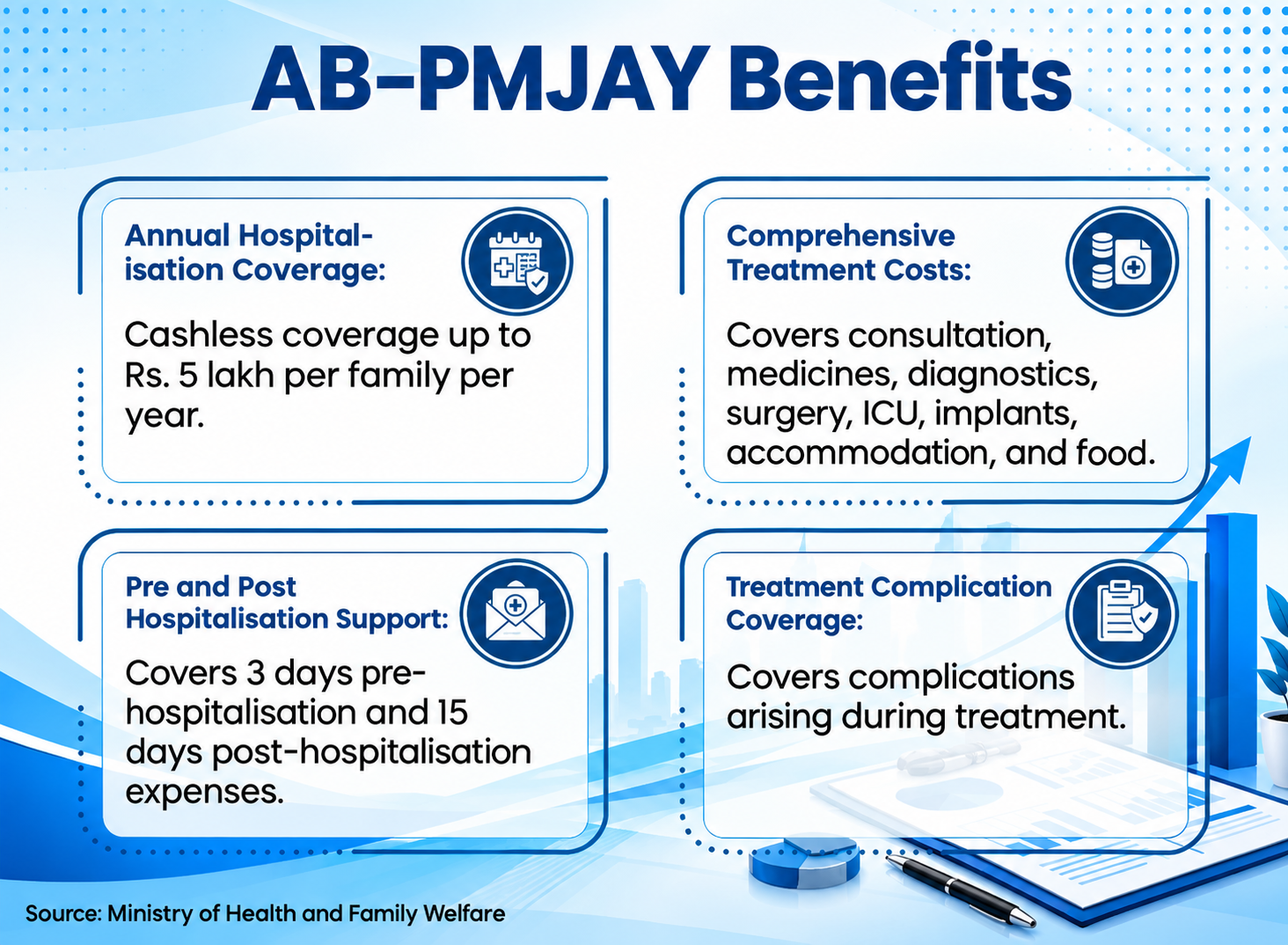
AB-PMJAY focuses primarily on hospitalisation-related expenditure, particularly procedures that could otherwise impose catastrophic financial burdens on households.
- Hospitalisation: PMJAY covers eligible expenses related to secondary and tertiary hospitalisation, including specified pre-hospitalisation and post-hospitalisation expenses.
- Pre- and post-hospitalisation: Eligible packages generally include 3 days of pre-hospitalisation and 15 days of post-hospitalisation expenses.
- Medical and surgical treatment: Coverage includes specified diagnostics, medicines, surgeries, ICU/ICCU charges and implants under approved packages.
- Ambulance services: Eligible ambulance expenses are covered according to applicable package provisions.
- Pre-existing diseases: Pre-existing conditions are covered from Day 1, avoiding exclusion based on prior illness.
- Health Benefit Packages: Treatment is organised through Health Benefit Packages (HBPs), which specify procedures, services and corresponding reimbursement rates.
- Public-sector preference for selected procedures: Certain procedures are reserved for public hospitals to strengthen utilisation of government healthcare facilities and prevent inappropriate private-sector concentration.
PMJAY Impact
AB-PMJAY has significantly expanded health-insurance coverage, hospital access and financial-risk protection, although its impact must also be assessed through utilisation, quality and sustainability.
- Ayushman Cards: More than 45.5 crore Ayushman Cards had been issued by August 2026, indicating substantial expansion of beneficiary identification and scheme reach.
- Beneficiary base: The original framework targeted over 10.74 crore poor and vulnerable families, translating to approximately 50 crore individual beneficiaries.
- As of August 31, 2026, AB PMJAY Enables 13.25 Crore Cashless Hospital Admissions Worth ₹2.03 Lakh Crore, Reducing Out-of-Pocket Expenditure
- Senior citizens: More than 1.36 crore senior citizens had been enrolled under the Ayushman Vay Vandana expansion as of 21 September 2026.
- Hospital network: More than 38000 public and private hospitals were empanelled, expanding the available treatment network.
- Financial protection: The Economic Survey 2024–25 estimated household out-of-pocket savings of approximately ₹1.25 lakh crore since the scheme's launch, highlighting its potential role in reducing catastrophic health expenditure.
- Primary-care convergence: Ayushman Arogya Mandirs recorded more than 39.61 crore teleconsultations by September 2025, strengthening access to specialist advice in primary-care settings.
- Digital health expansion: Approximately 100 crore ABHA accounts had been created by May 2026, reflecting rapid expansion of India's digital-health ecosystem.
- Budgetary support: The Union Budget 2026–27 allocated ₹9,500 crore to the Pradhan Mantri Jan Arogya Yojana (PMJAY).
- High-utilisation specialities: General Medicine, Ophthalmology, Medical Oncology, Obstetrics and Gynaecology and General Surgery account for significant claim volumes, while Cardiology and Orthopaedics generate disproportionately high claim values, reflecting the concentration of expenditure in costly tertiary procedures.
PMJAY Significance
AB-PMJAY is significant not merely as an insurance programme but as an instrument for advancing financial protection, equity and Universal Health Coverage.
- Financial risk protection: By covering major hospitalisation expenses, AB PMJAY seeks to protect vulnerable households from catastrophic health expenditure and medical impoverishment.
- Equity in healthcare: The scheme explicitly targets economically and socially vulnerable households, including populations that may lack access to employer-linked health insurance.
- Portability for migrants: Nationwide portability enables beneficiaries to access treatment outside their home state, which is particularly relevant for interstate migrant workers.
- Cooperative federalism: As health is primarily a State responsibility under the Constitution, AB PMJAY provides a framework for Centre–State collaboration in financing and healthcare delivery.
- Universal Health Coverage: The scheme contributes to SDG 3.8 by combining financial protection with access to essential healthcare services.
- Response to demographic transition: The extension to all citizens aged 70 years and above addresses the healthcare needs of India's ageing population.
- Digital transformation: ABDM provides the technological foundation for portable health records, interoperability and continuity of care across providers.
- Strengthening public healthcare: The broader Ayushman Bharat architecture connects insurance with primary healthcare and health-system infrastructure, helping move beyond a purely hospital-centric model.
PMJAY Challenges
Despite its scale, AB PMJAY faces challenges related to fraud control, provider participation, coverage gaps, quality, fiscal sustainability and access to outpatient care.
- CAG audit findings: The CAG Performance Audit of PM-JAY, tabled in Parliament in August 2023, identified significant irregularities in beneficiary databases and claims, raising concerns about data validation and internal controls.
- Claims involving deceased beneficiaries: The audit reported payments of approximately ₹6.97 crore for treatment involving 3,446 patients recorded as deceased, associated with thousands of potentially fraudulent claims, indicating weaknesses in verification and claim controls.
- Invalid mobile numbers: Nearly 7.5 lakh beneficiaries were linked to a single mobile number, 9999999999, highlighting weaknesses in beneficiary-data validation.
- Duplicate identities and claims: The audit also identified instances involving duplicate or invalid Aadhaar linkages, simultaneous hospitalisation of the same patient at multiple facilities and claims exceeding declared hospital capacity.
- Procedural violations: Instances were reported where private hospitals performed procedures that were reserved for public hospitals under applicable Health Benefit Package provisions.
- IT and audit weakness: CAG highlighted the need for stronger real-time validation, automated audit trails and claim-processing controls.
- Inter-state variation: Differences in state-level implementation and convergence arrangements can create variations in beneficiary access and portability.
- Uneven hospital distribution: Empanelled hospitals are unevenly distributed, with some regions having limited access to private or specialised facilities.
- OPD exclusion: AB PMJAY primarily covers hospitalisation, leaving routine outpatient consultations, medicines and many diagnostic expenses outside the core insurance package, despite their major contribution to household health expenditure.
- Delayed reimbursements: Some private hospitals have reportedly withdrawn or suspended participation because of delayed claim settlements and concerns regarding reimbursement rates. It discourages private participation and affects the credibility of the scheme.
- Package-rate concerns: Fixed package rates may not always adequately reflect treatment complexity, comorbidities or variations in actual treatment costs, particularly for specialised tertiary care.
- Provider sustainability: If reimbursement rates remain below sustainable treatment costs, private hospitals may reduce participation, potentially limiting beneficiaries' access to specialised care.
- Low public health spending: India's overall public health expenditure remains below the National Health Policy, 2017 target of 2.5% of GDP, creating broader fiscal constraints for health programmes.
PMJAY Way Forward
AB PMJAY must now evolve beyond expanding beneficiary coverage to ensure quality, accessibility, accountability, and long-term financial sustainability in healthcare delivery. The focus should be on strengthening the entire continuum of care, from primary healthcare to specialised hospitalisation.
- Strengthen fraud detection: Introduce real-time beneficiary verification, AI/ML-based anomaly detection and periodic independent audits to prevent fraudulent claims.
- Rationalise package rates: Regularly revise Health Benefit Package rates based on actual treatment costs, clinical complexity and comorbidities.
- Ensure timely reimbursements: Establish strict timelines for claim settlement to improve hospital participation and maintain the credibility of the scheme.
- Integrate primary and hospital care: Strengthen convergence between AB PMJAY and Ayushman Arogya Mandirs to create a seamless continuum from prevention and primary care to hospitalisation and follow-up.
- Update beneficiary databases: Periodically revise eligibility criteria beyond the outdated SECC 2011 database to capture newly vulnerable households.
- Improve quality assurance: Link hospital empanelment and continued participation with measurable quality standards, accreditation and regular performance monitoring.
- Expand public healthcare capacity: Strengthen government hospitals, diagnostic facilities and specialist services so that insurance coverage is supported by adequate treatment infrastructure.
- Increase public health investment: Move towards the 2.5% of GDP public-health expenditure target under the National Health Policy, 2017, ensuring sustainable financing for AB PMJAY and the wider health system.

 Last updated on Oct, 2026
→ UPSC 2027 Notification will be released on 13 January 2027 at upsconline.nic.in.
→ Check Nobel Prize 2026 Winners List here.
→ Download PIB PRiSM Monthly Magazine 2026 here.
→ Check UPSC Monthly Current Affairs Magazine The Recitals here.
→ Check out the latest UPSC Syllabus here.
→ Download UPSC Model Answers for Mains 2026
→ UPSC Mains Question Paper 2026 is out now for Essay & GS Paper 1, 2, 3 & 4.
→ UPSC Calendar 2027 has been released.
→ Enroll in Vajiram & Ravi’s UPSC Mains Test Series 2027 for structured answer writing practice, expert evaluation, and exam-oriented feedback.
→ Join Vajiram & Ravi’s UPSC Mentorship Program 2027 for personalized guidance, strategy planning, and one-to-one support from experienced mentors.
→ Go through the UPSC Mains Previous Year Papers to enhance your preparation.
→ UPSC has released UPSC Toppers List 2025 with the Civil Services final result on its official website.
→ Also check Best UPSC Coaching in India
PMJAY FAQs
Q1. What is PMJAY?+
Q2. What are the eligibility criteria for PMJAY?+
Q3. What is Ayushman Bharat?+
Q4. What is the objective of PMJAY?+
Q5. What are the benefits of PMJAY?+
Tags: pmjay quest UPSC Social Justice Notes