PM Dhan Dhaanya Krishi Yojana (PMDDKY) is a district-focused agricultural development programme announced in the Union Budget 2025-26 to address persistent gaps in farm productivity and infrastructure. Approved by the Union Cabinet in July 2025, the scheme will operate for six years from 2025-26 with an annual outlay of ₹24,000 crore. It covers 100 selected agricultural districts and is expected to benefit around 1.7 crore farmers. PMDDKY follows a convergence-based approach by bringing together 36 existing schemes implemented through 11 ministries and departments.
The major priorities of PM Dhan Dhaanya Krishi Yojana include improving agricultural productivity, promoting crop diversification and sustainable farming, expanding irrigation and storage facilities, and strengthening institutional agricultural credit. The programme emphasises district-specific planning, coordination and outcome-based monitoring.
PM Dhan Dhaanya Krishi Yojana Overview
PM Dhan Dhaanya Krishi Yojana draws inspiration from the Aspirational Districts Programme but focuses specifically on agriculture and allied activities. Rather than creating an entirely new set of farmer benefits, PM Dhan Dhaanya Krishi Yojana seeks to improve the delivery and convergence of existing programmes. Key facts:
- Announcement: Union Budget 2025-26
- Cabinet approval: 16 July 2025
- Implementation period: Six years, beginning FY 2025-26
- Coverage: 100 agricultural districts
- Expected beneficiaries: Around 1.7 crore farmers
- Main focus: Productivity, crop diversification, sustainable agriculture, irrigation, storage and agricultural credit.
PM Dhan Dhaanya Krishi Yojana Features
PM Dhan Dhaanya Krishi Yojana combines district-focused planning, scheme convergence and targeted agricultural interventions to improve productivity and rural livelihoods.
- District-Focused Approach: Targets 100 districts with significant agricultural development gaps through localised, district-level agricultural plans.
- Scheme Convergence: Integrates 36 existing schemes across 11 ministries and departments to coordinate interventions and optimise resource utilisation.
- Six-Year Implementation: Implemented from FY 2025–26 for six years, with an annual financial outlay of ₹24,000 crore.
- Agriculture and Allied Sectors: Covers agriculture and allied activities, promoting crop diversification, sustainable farming practices and improved productivity.
- Agricultural Infrastructure: Addresses gaps in irrigation, panchayat- and block-level storage, post-harvest management and access to institutional agricultural credit.
- Value Addition and Livelihoods: PM Dhan Dhaanya Krishi Yojana supports improvements across agricultural value chains to reduce post-harvest losses and strengthen local livelihoods.
- Digital Monitoring: Uses a dashboard and defined performance indicators to track progress and assess outcomes.
- Multi-Level Governance: Involves district, state and national mechanisms for planning, implementation and monitoring.
- Private-Sector Participation: Encourages local partnerships with the private sector to supplement government interventions and support agricultural development.
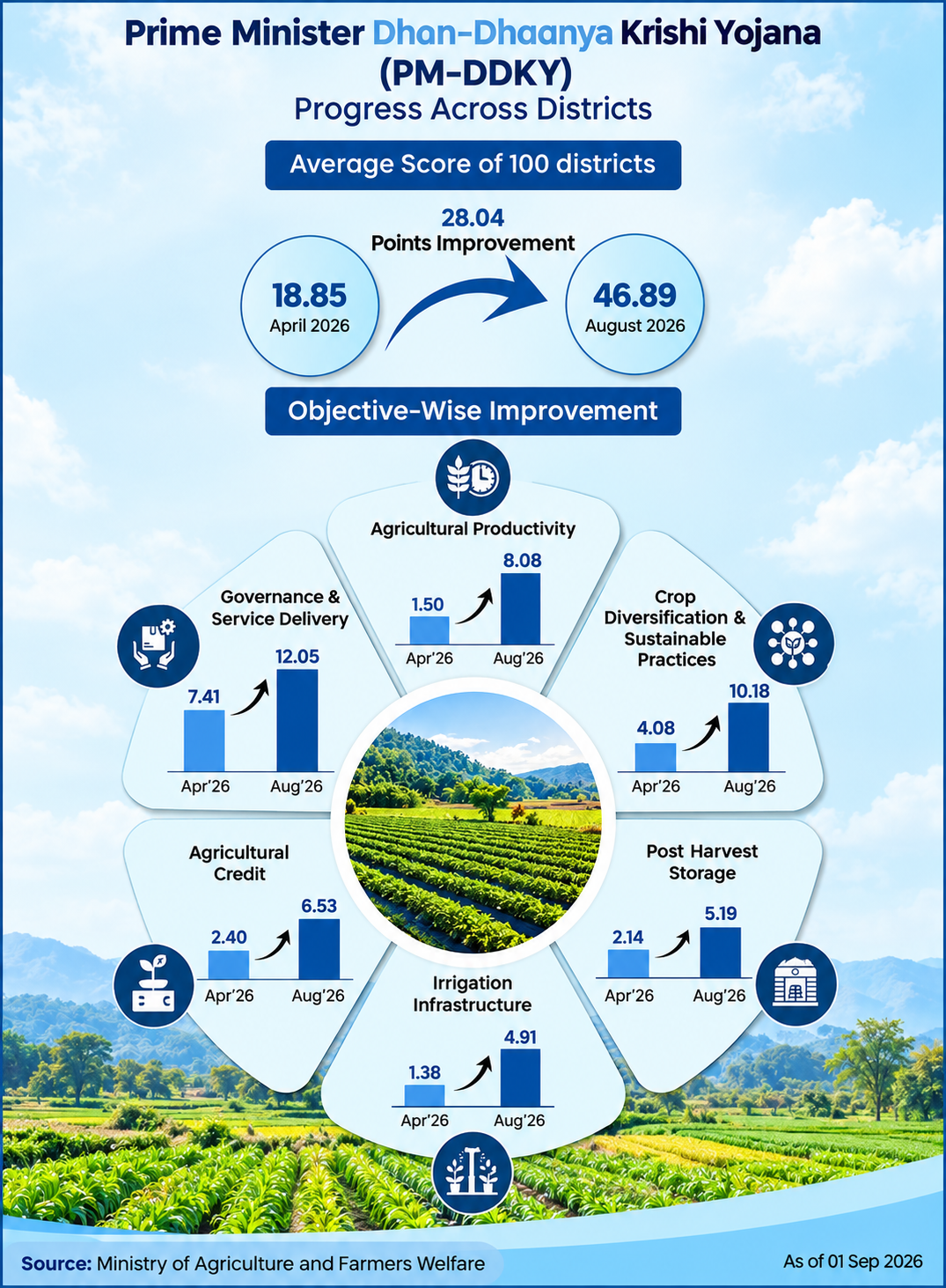
- Implementation Progress: According to the government’s October 2026 review, all 100 selected districts had prepared District Action Plans and were implementing them.
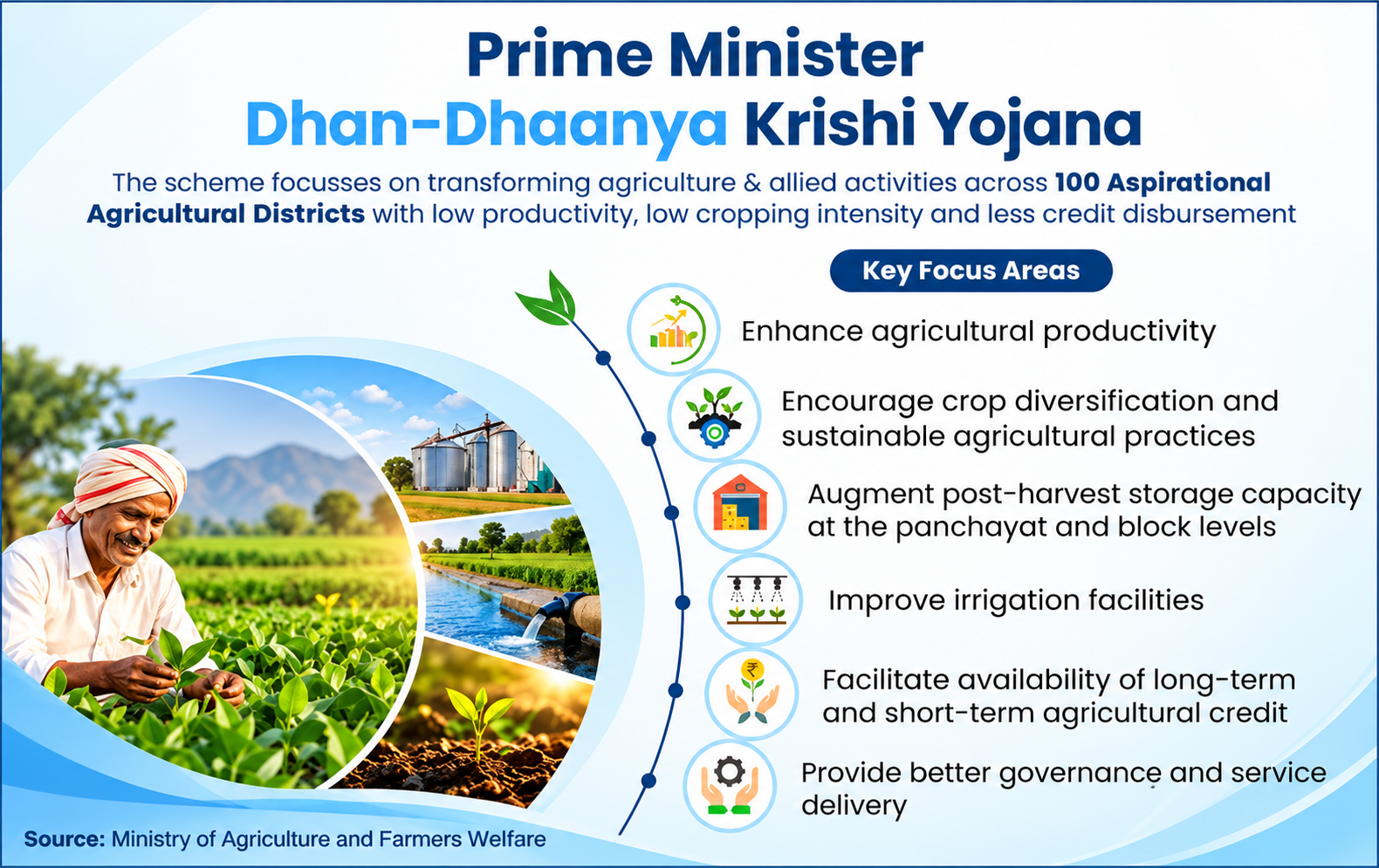


PM Dhan Dhaanya Krishi Yojana District Selection
PM Dhan Dhaanya Krishi Yojana district selection is based on countable agricultural weaknesses, with preference given to districts showing low output, low cropping intensity and inadequate credit disbursement.
- The three principal indicators for identifying districts are:
- Low agricultural productivity
- Low cropping intensity
- Less agricultural credit disbursement
- The allocation of districts among states and union territories is linked to their respective shares of net cropped area and operational holdings. At least one district is selected from every state, ensuring geographical representation.
PM Dhan Dhaanya Krishi Yojana Implementation Structure
Implementation of PM Dhan Dhaanya Krishi Yojana follows a multi-level institutional structure in which district plans are coordinated with state and national priorities and regularly monitored.
- District Level: The District Agriculture and Allied Activities Plan is created by a District Dhan-Dhaanya Samiti. Planning is informed by local agricultural needs because the group is composed of progressive farmers and pertinent district officials. The district plan is aligned with broader goals such as:
- Crop diversification
- Water conservation
- Soil-health improvement
- Self-sufficiency in agriculture and allied sectors
- Natural and organic farming
- State Level: State-level mechanisms coordinate the implementation of district plans and facilitate convergence with existing state schemes and programmes.
- National Level: At the national level, concerned ministries and departments provide policy direction and coordination.
- NITI Aayog reviews and guides district plans, while Central Nodal Officers are assigned to districts for regular review and field-level monitoring.
- Digital Monitoring: Progress is monitored through a digital dashboard using performance indicators.
- The Cabinet announcement referred to 117 key performance indicators, while the current official PMDDKY portal displays 121 monitoring indicators, reflecting its updated monitoring framework.
PM Dhan Dhaanya Krishi Yojana Benefits
Benefits of PM Dhan Dhaanya Krishi Yojana are expected to emerge through higher productivity, improved agricultural infrastructure, diversified farming, better irrigation and easier access to institutional credit.
- Higher Agricultural Productivity: Targeting low-productivity districts allows public interventions to focus on areas where improvements in farming practices, inputs and infrastructure can generate significant gains.
- Crop Diversification: The programme promotes diversification so that farmers can reduce excessive dependence on particular crops and adopt more sustainable agricultural patterns.
- Better Irrigation: Improved irrigation facilities can increase water availability, reduce dependence on rainfall and support more stable agricultural production.
- Improved Storage: Additional post-harvest storage capacity at the panchayat and block levels can help address infrastructure gaps and reduce avoidable post-harvest losses.
- Better Access to Credit: The programme seeks to facilitate both short-term and long-term agricultural credit, helping farmers meet seasonal requirements as well as make productive investments.
- Sustainable Agriculture: District plans are expected to promote soil and water conservation, sustainable agricultural practices and greater adoption of natural and organic farming where appropriate.
- Rural Livelihood Creation: Higher agricultural productivity, value addition and stronger allied-sector activities can contribute to local employment and livelihood opportunities.
- Contribution to Self-Reliance: Improving productivity and agricultural value chains can strengthen domestic production and contribute to the broader objective of Atmanirbhar Bharat.
PM Dhan Dhaanya Krishi Yojana Expected Impact
The expected impact of the PM Dhan Dhaanya Krishi Yojana lies in transforming selected agricultural districts through coordinated interventions rather than isolated implementation of individual schemes.
- Expected to benefit around 1.7 crore farmers, its district-focused model can improve agricultural outcomes by concentrating resources on identified gaps in productivity, cropping intensity, credit, irrigation and post-harvest infrastructure.
- IMPRI highlights that the programme seeks to revitalise underdeveloped agricultural districts by combining productivity enhancement, rural infrastructure, financial access and sustainable farming practices.
PM Dhan Dhaanya Krishi Yojana Challenges
Challenges of PM Dhan Dhaanya Krishi Yojana include coordinating multiple schemes, ensuring effective district-level execution, addressing regional differences and translating convergence into measurable farm-level outcomes.
- Complex convergence: Coordinating 36 schemes across 11 ministries can create administrative complexity.
- Inter-departmental coordination: Effective implementation requires continuous cooperation between Central, State and district authorities.
- District-level capacity: Selected districts may differ considerably in administrative and technical capacity.
- Local diversity: Soil, climate, cropping patterns and irrigation conditions vary substantially, requiring genuinely localised planning.
- Infrastructure gaps: Storage, irrigation and processing facilities require sustained investment and timely execution.
- Credit accessibility: Merely increasing credit availability may not be sufficient where farmers face documentation, collateral or institutional-access barriers.
- Monitoring quality: Digital indicators need to reflect actual improvements in farm productivity and farmer livelihoods rather than only administrative progress.
- Last-mile delivery: Convergence will succeed only when intended interventions reach farmers and agricultural enterprises at the local level.
PM Dhan-Dhaanya Krishi Yojana Way Forward
PM Dhan Dhaanya Krishi Yojana should focus on stronger district planning, outcome-based monitoring, farmer participation, infrastructure convergence and efficient delivery of agricultural services.
- Strengthen district-specific planning based on local soil, water, climate and cropping conditions.
- Deepen farmer participation in identifying agricultural constraints and designing district interventions.
- Improve convergence mechanisms so that multiple schemes complement rather than duplicate one another.
- Strengthen agricultural infrastructure, including warehouses, cold storage, processing facilities and irrigation systems.
- Promote climate-resilient agriculture through efficient water use, diversification and sustainable farming practices.
- Improve institutional credit delivery by simplifying access and strengthening awareness among eligible farmers.
- Use digital dashboards effectively to track outcomes as well as expenditure and implementation milestones.
- Strengthen partnerships with agricultural universities, FPOs, cooperatives, private-sector actors and local institutions.
- Prioritise measurable farmer-level outcomes, including productivity, value addition, income opportunities and reduction in post-harvest losses.

 Last updated on Oct, 2026
→ UPSC 2027 Notification will be released on 13 January 2027 at upsconline.nic.in.
→ Check Nobel Prize 2026 Winners List here.
→ Download PIB PRiSM Monthly Magazine 2026 here.
→ Check UPSC Monthly Current Affairs Magazine The Recitals here.
→ Check out the latest UPSC Syllabus here.
→ Download UPSC Model Answers for Mains 2026
→ UPSC Mains Question Paper 2026 is out now for Essay & GS Paper 1, 2, 3 & 4.
→ UPSC Calendar 2027 has been released.
→ Enroll in Vajiram & Ravi’s UPSC Mains Test Series 2027 for structured answer writing practice, expert evaluation, and exam-oriented feedback.
→ Join Vajiram & Ravi’s UPSC Mentorship Program 2027 for personalized guidance, strategy planning, and one-to-one support from experienced mentors.
→ Go through the UPSC Mains Previous Year Papers to enhance your preparation.
→ UPSC has released UPSC Toppers List 2025 with the Civil Services final result on its official website.
→ Also check Best UPSC Coaching in India
PM Dhan Dhaanya Krishi Yojana FAQs
Q1. What is PM Dhan Dhaanya Krishi Yojana?+
Q2. When was the PM Dhan-Dhaanya Krishi Yojana announced?+
Q3. How many districts are covered under PMDDKY?+
Q4. How many schemes are converged under PMDDKY?+
Q5. What is the role of NITI Aayog in PMDDKY?+
Tags: pm dhan dhaanya krishi yojana quest UPSC Agriculture Notes