
The Pradhan Mantri Fasal Bima Yojana, or PMFBY, was launched in 2016 by the Government of India to protect farmers against financial losses caused by specified crop failures. Administered by the Ministry of Agriculture and Farmers Welfare, the scheme provides subsidised crop insurance for notified food crops, oilseeds and eligible commercial and horticultural crops.
PMFBY covers specified risks arising from natural calamities, pests and diseases, including eligible losses during sowing, crop growth and the post-harvest period. By offering affordable premiums and technology-based crop-loss assessment, PMFBY aims to stabilise farm incomes, support agricultural credit and strengthen farmers’ resilience. However, timely claim settlement, accurate loss assessment and greater farmer awareness remain essential for improving its effectiveness.
PMFBY Overview
The Pradhan Mantri Fasal Bima Yojana, or PMFBY, combines affordable farmer contributions with government premium subsidies and a structured system for assessing crop losses in notified areas.
- Launch: 2016.
- Nodal ministry: Ministry of Agriculture and Farmers Welfare, Government of India.
- Nature: Central Sector Scheme providing subsidised crop insurance.
- Coverage: Notified food crops, oilseeds and eligible annual commercial or horticultural crops, depending on state and season notifications.
- Implementation: Selected insurance companies work with state governments and other designated agencies.
- Insurance assessment: Widespread yield losses are generally assessed using an area-based approach, supported by Crop Cutting Experiments (CCEs) and, where applicable, technology-based yield estimation.
- Claim payment: Eligible claims are transferred to farmers through the prescribed payment process, generally into their bank accounts.
PMFBY Need
Crop insurance is important in India because agricultural production is exposed to weather fluctuations, biological threats and other risks that can reduce yields and weaken farmers’ financial stability.
- Dependence on the monsoon: Irregular rainfall, droughts and dry spells can affect sowing, crop growth and final yields.
- Increasing climate-related uncertainty: Floods, cyclones, hailstorms and unseasonal rainfall can damage crops and increase the unpredictability of farm incomes.
- Pest and disease outbreaks: Crop infestations and plant diseases can cause substantial losses even when farmers follow normal cultivation practices.
- High cultivation costs: Farmers invest in seeds, fertilisers, labour, irrigation and machinery before knowing the final harvest outcome.
- Income instability: A poor harvest may reduce household earnings and make it difficult to repay agricultural loans or finance the next cropping season.
- Limited capacity to absorb losses: Small and marginal farmers may have fewer savings and less access to alternative sources of income after crop failure.
- Need to sustain agricultural credit: Crop insurance can help reduce production-related risks and support continuity in agricultural lending.
- Food and livelihood security: Reducing the financial impact of crop losses can help protect farm households and support a more stable food supply.


PMFBY Objectives
PMFBY seeks to reduce the financial consequences of crop failure while supporting continuity and resilience in agricultural production.
- Provide financial protection: Compensate insured farmers for eligible crop losses caused by specified unforeseen events.
- Stabilise farm income: Reduce the severity of income shocks following crop damage.
- Support continuity in farming: Help farmers manage financial losses and prepare for subsequent cropping seasons.
- Encourage modern agriculture: Reduce some production-related financial risks associated with adopting improved farming practices.
- Strengthen agricultural credit: Help sustain the flow of institutional credit to agriculture by reducing exposure to crop-production risks.
- Improve risk management: Build a structured insurance mechanism for agricultural losses linked to natural hazards, pests and diseases.
PMFBY Features
PMFBY combines subsidised premiums, defined insurance coverage and technology-assisted loss assessment to make crop insurance more accessible to farmers.
- Affordable Premium Rates: The farmer’s maximum premium contribution for notified crops is generally capped as follows:
- Kharif food crops and oilseeds: 2% of the sum insured, or the actuarial premium rate, whichever is lower.
- Rabi food crops and oilseeds: 1.5% of the sum insured, or the actuarial premium rate, whichever is lower.
- Annual commercial and horticultural crops: 5% of the sum insured, or the actuarial premium rate, whichever is lower.
- The remaining admissible premium is subsidised by the government according to the applicable cost-sharing rules.
- Voluntary Enrolment: Farmers can choose whether to participate. From Kharif 2020, enrolment became voluntary even for farmers with crop loans, while non-loanee farmers can also enrol voluntarily.
- Coverage Across Crop Stages: Subject to the scheme’s conditions, insurance may cover prevented sowing, losses to standing crops, specified localised calamities and eligible post-harvest damage.
- Area-Based Yield Assessment: For widespread crop losses, claims are generally calculated using yield shortfalls in the notified insurance unit, with the applicable threshold yield and reported actual yield forming part of the assessment.
- Individual-farm assessment applies to specified localised and post-harvest losses.
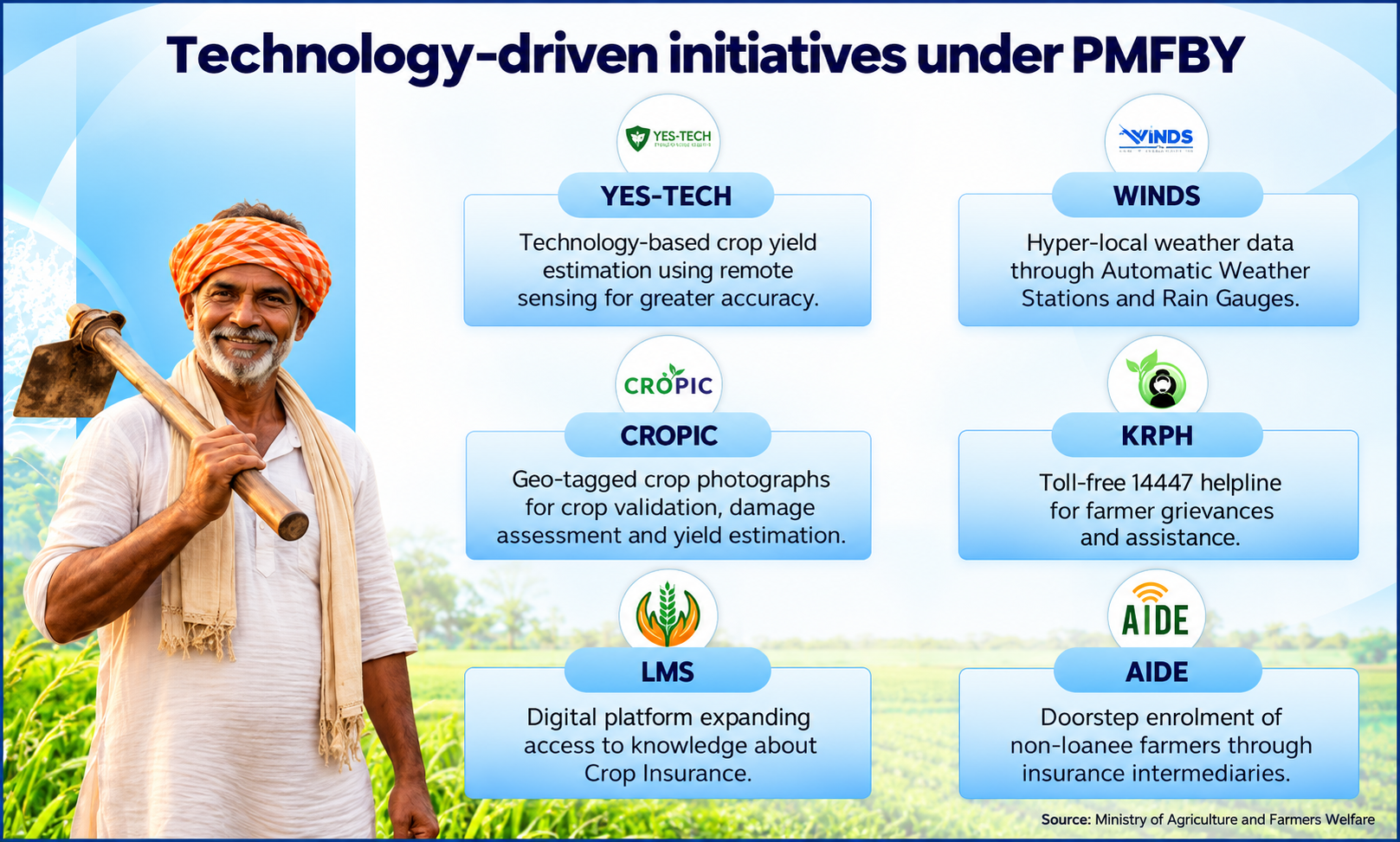
- Technology in Crop Insurance: The scheme increasingly uses digital platforms, mobile applications, remote sensing and technology-based yield estimation to improve data collection, monitoring and claim processing.
- These include the National Crop Insurance Portal, CCE-Agri App, YES-TECH and the Crop Loss Assessment Platform (CLAP).
- Government Support for Premiums: Government premium subsidies reduce the amount paid directly by insured farmers.
- The applicable subsidy-sharing arrangement depends on the scheme rules and the state or Union Territory concerned.
- Standard States and Union Territories: 50:50 split between the Central Government and the State/UT Government.
- North-Eastern States (NER): 90:10 split between the Central Government and the State Government (revised starting from Kharif 2020).
- Claim and Grievance Support: Farmers can use the official PMFBY portal to access enrolment and claim-related information. The portal also lists the Krishi Rakshak Portal and Helpline (14447) for reporting crop losses and grievances.
PMFBY Benefits
PMFBY can help farmers manage agricultural uncertainty by transferring specified production risks to an insurance mechanism.
- Financial protection: Eligible insurance claims help offset losses caused by covered events.
- Premium caps make participation more accessible than paying the full actuarial premium.
- Compensation can reduce the financial shock associated with a poor harvest.
- Support for future cultivation: Claim payments may help insured farmers meet some of the costs of the next crop cycle.
- Credit continuity: Crop insurance can complement institutional agricultural lending by addressing certain production risks.
- Support for vulnerable farmers: Small and marginal farmers may benefit from reduced exposure to severe crop-loss shocks.
- Improved agricultural risk management: Insurance encourages a more systematic approach to managing weather and production uncertainty.
- Digital access: Online enrolment, tracking and grievance channels can improve access to scheme-related information.
- Broader agricultural resilience: By cushioning eligible losses, the scheme can contribute to the stability of farming households and agricultural production.
- Support food security in India: Help protect agricultural production and the livelihoods of farming households.
PMFBY Risks Coverage
PMFBY provides coverage for specified risks at different stages of crop production. The precise protection depends on the notified crop, area, season and applicable scheme guidelines.
- Prevented Sowing or Planting: When adverse weather prevents the majority of insured farmers in a notified area from sowing or planting the insured crop despite having intended to do so and having incurred eligible expenditure, compensation may be available under the scheme’s conditions.
- The applicable guidelines provide for a maximum payout of up to 25% of the sum insured for this category.
- Standing Crop Losses: Eligible yield losses arising from specified non-preventable risks may be covered, including:
- Drought and dry spells.
- Floods and inundation.
- Hailstorms and storms.
- Cyclones and related severe weather events.
- Landslides.
- Natural fire and lightning.
- Pest attacks and crop diseases.
- Widespread losses are generally assessed using the scheme’s area-based yield methodology.
- Localised Calamities: Specified events that damage an individual insured farm may qualify for individual assessment.
- These can include notified instances of hailstorm, landslide, inundation, cloudburst or natural fire due to lightning, subject to the applicable operational guidelines and state notification.
- Post-Harvest Losses: Coverage may be available for specified damage after harvesting when the crop is left in the field in the prescribed cut-and-spread condition for drying.
- The scheme provides protection for eligible events such as cyclonic or unseasonal rainfall, subject to the applicable rules and reporting requirements.
- The relevant coverage period is generally up to 14 days after harvest under the guidelines.
PMFBY Eligibility
PMFBY is available to farmers cultivating eligible notified crops in areas where the scheme has been implemented for the relevant season. Eligible categories generally include:
- Owner-cultivators: Farmers with an insurable interest in the notified crop and land.
- Tenant farmers and sharecroppers: Where permitted, provided they meet the prescribed eligibility and documentation requirements.
- Loanee farmers: Farmers who have agricultural crop loans may voluntarily opt into the scheme under the current framework.
- Non-loanee farmers: Farmers who are not taking crop loans may also apply voluntarily.
General Conditions for Enrolment
- Cultivate a crop notified for insurance in the relevant area and season.
- Have an eligible insurable interest in the crop.
- Provide the required land, cultivation, identity and bank-account details.
- Complete enrolment and premium payment within the prescribed deadline.
- Follow the applicable procedure for reporting crop losses and submitting supporting information.
- The list of notified crops, insurance units, enrolment deadlines and documentary requirements should be checked through the official portal or the relevant state notification for the particular season.
PMFBY Crop Coverage
The scheme covers eligible crops notified by state and Union Territory governments, with coverage determined by the crop, insurance unit and season. The principal crop categories are:
- Food crops: Cereals, millets and pulses, where notified.
- Oilseeds: Eligible oilseed crops included in the seasonal notification.
- Annual commercial crops: Specified commercial crops for which the required historical yield data and crop-cutting arrangements are available.
- Annual horticultural crops: Eligible horticultural crops notified under PMFBY.
PMFBY Exclusions
PMFBY does not cover every type of agricultural loss. Its exclusions help define the limits of the insurance protection. The general exclusions under the operational guidelines include:
- War and related risks: Losses arising from war and associated hostilities are excluded.
- Nuclear risks: Damage arising from nuclear-related hazards is excluded.
- Riots and malicious damage: Losses caused by specified intentional or malicious acts are generally outside the coverage.
- Theft: Theft-related losses are excluded.
- Damage by animals: Crops grazed or destroyed by domestic or wild animals are generally excluded under the cited guidelines.
- Preventable risks: Losses arising from other preventable causes are excluded.
- Ineligible post-harvest conditions: Under the cited guidelines, post-harvest losses are not covered when the harvested crop has already been bundled and heaped at a place before threshing.
PMFBY and Impact on Indian Agriculture
PMFBY has expanded India's crop-insurance framework and provided financial protection against specified production risks. Its impact can be assessed through the following indicators:
- Expansion of Insurance Participation: Farmer enrolment increased from 3.17 crore in 2022–23 to 4.19 crore in 2024–25, a rise of 32%. In 2024–25, over 15.23 crore farmer applications were insured, covering more than 623 lakh hectares.
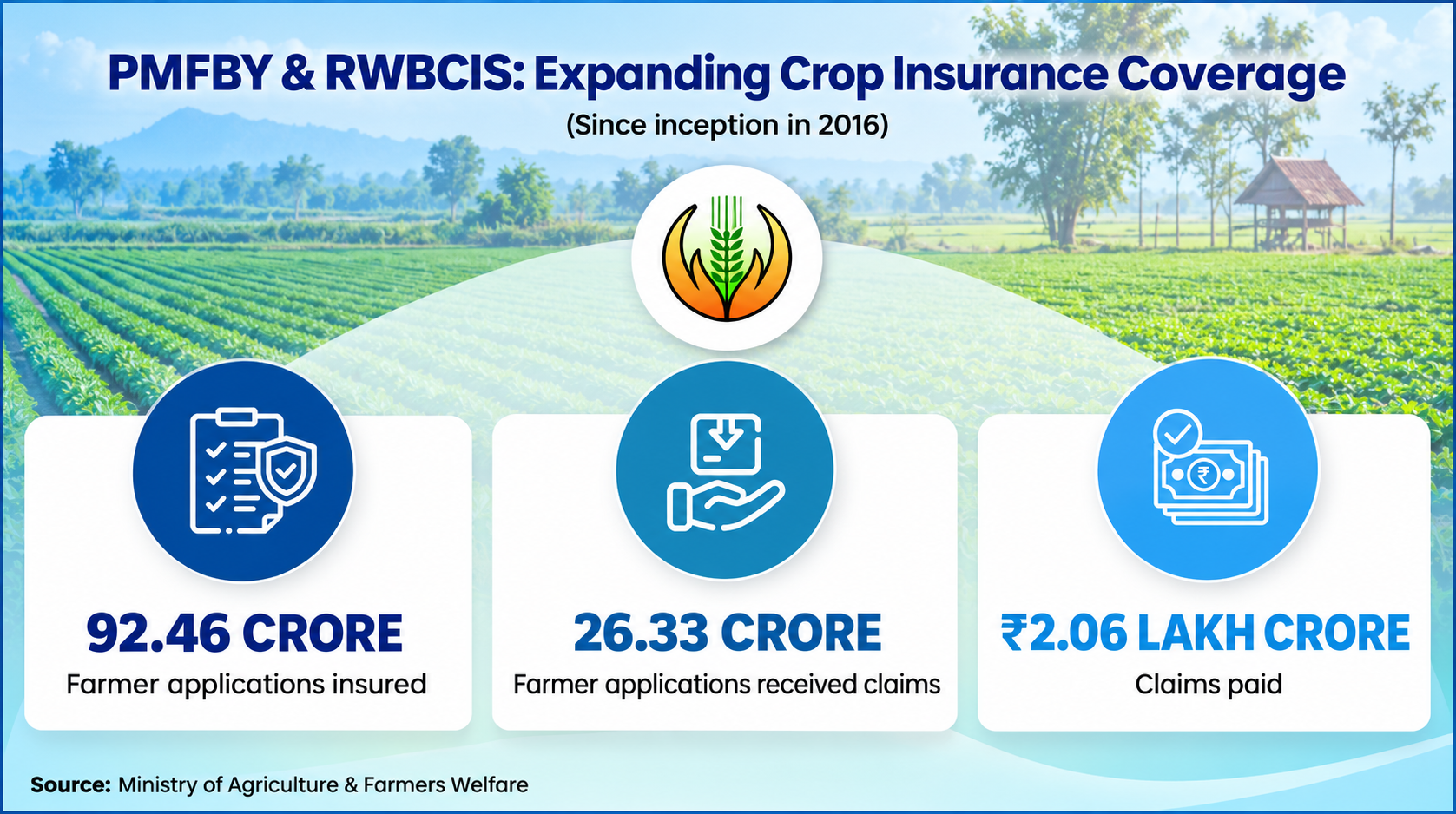
- Financial Risk Protection: By August 2026, cumulative claims under PMFBY had exceeded ₹2.06 lakh crore, benefiting more than 26.33 crore farmer applications since inception.
- This demonstrates the scheme's role in compensating eligible farmers for covered crop losses.
- Support for Agricultural Continuity: Compensation can help insured farmers manage production shocks, repay agricultural loans and finance the next sowing season. However, the extent of relief depends on eligibility, assessed losses and claim settlement.
- Wider Crop and Risk Coverage: The scheme covers specified risks at different stages of cultivation, including prevented sowing, standing-crop losses, localised calamities and certain post-harvest losses, subject to notified conditions.
- Greater Use of Technology: YES-TECH, DigiClaim and digital crop-loss assessment tools aim to improve yield estimation, transparency and claim processing. The Krishi Rakshak Portal and Helpline (14447) had resolved 26.12 lakh grievances, with a reported resolution rate of 99.66%, by August 2026.
- Continuing Gaps in Coverage: Historical official data show that the Kharif insured area under the combined PMFBY–RWBCIS framework declined from 318.01 lakh hectares in 2018 to 278.12 lakh hectares in 2026.
- This highlights the importance of tracking insured area and the share of cropped land covered, rather than relying on enrolment figures alone.
PMFBY Way Forward
Improving PMFBY requires a combination of better administration, reliable data, farmer awareness and technology that makes insurance more responsive to actual agricultural risks.
- Ensure Timely Release of Subsidies: Central and state authorities should follow the prescribed funding schedules and strengthen monitoring of premium-subsidy payments. This can help reduce avoidable delays in processing eligible claims.
- Improve Crop-Loss Assessment: Greater use of remote sensing, satellite imagery, digital field records and technology-assisted yield estimation can complement conventional crop-cutting experiments. Such systems should be validated and supported by transparent assessment standards.
- Strengthen Farmer Awareness: Agricultural extension workers, banks, Common Service Centres and local institutions should explain premium rates, notified crops, coverage limits, enrolment deadlines and claim-reporting procedures in local languages.
- Make Claim Procedures More Transparent: Farmers should be able to track enrolment and claim status, understand why a claim has been approved or rejected, and access an effective grievance-redressal mechanism.
- Improve Localised Damage Assessment: Individual-farm assessment should be carried out promptly for eligible localised calamities and post-harvest losses. Digital tools such as the Crop Loss Assessment Platform can support more systematic reporting and documentation.
- Strengthen Data Quality: Accurate land records, correct farmer details, timely premium remittance and reliable crop-yield data are essential. Integrating relevant databases can help reduce errors and disputes.
- Tailor Coverage to Regional Risks: State governments should use local cropping patterns, climatic conditions and loss histories to determine appropriate notified crops and additional risk covers under the scheme's rules.
- Evaluate Outcomes Beyond Enrolment: Performance reviews should examine the number and profile of farmers insured, area covered, claims paid, time taken for settlement, grievance resolution and farmer satisfaction.
- This would provide a more complete assessment of whether the scheme is reaching its intended beneficiaries.
- Strengthen Accountability: Clear responsibility for delays, transparent claim calculations and effective monitoring of insurers and implementing authorities can improve accountability and reinforce farmer confidence.
PMFBY UPSC PYQs
Q1. Given the vulnerability of Indian agriculture to vagaries of nature, discuss the need for crop insurance and bring out the salient features of the Pradhan Mantri Fasal Bima Yojana (PMFBY). (UPSC Mains 2016)
Q2. With reference to ‘Pradhan Mantri Fasal Bima Yojana’, consider the following statements (UPSC Prelims 2016)
- Under this scheme, farmers will have to pay a uniform premium of two percent for any crop they cultivate for any reason of the year.
- This scheme covers post harvest losses arising out of cyclones and unseasonal rains.
Which of the statements given above is/are correct?
(a) 1 only
(b) 2 only
(c) Both 1 and 2
(d) Neither 1 nor 2
Ans: (b)

 Last updated on Oct, 2026
→ UPSC 2027 Notification will be released on 13 January 2027 at upsconline.nic.in.
→ Check Nobel Prize 2026 Winners List here.
→ Download PIB PRiSM Monthly Magazine 2026 here.
→ Check UPSC Monthly Current Affairs Magazine The Recitals here.
→ Check out the latest UPSC Syllabus here.
→ Download UPSC Model Answers for Mains 2026
→ UPSC Mains Question Paper 2026 is out now for Essay & GS Paper 1, 2, 3 & 4.
→ UPSC Calendar 2027 has been released.
→ Enroll in Vajiram & Ravi’s UPSC Mains Test Series 2027 for structured answer writing practice, expert evaluation, and exam-oriented feedback.
→ Join Vajiram & Ravi’s UPSC Mentorship Program 2027 for personalized guidance, strategy planning, and one-to-one support from experienced mentors.
→ Go through the UPSC Mains Previous Year Papers to enhance your preparation.
→ UPSC has released UPSC Toppers List 2025 with the Civil Services final result on its official website.
→ Also check Best UPSC Coaching in India
PMFBY FAQs
Q1. What is the main objective of PMFBY?+
Q2. Which ministry implements PMFBY?+
Q3. Is PMFBY compulsory for farmers?+
Q4. What is the premium rate under PMFBY?+
Q5. Does PMFBY cover post-harvest crop losses?+
Tags: pmfby quest UPSC Agriculture Notes