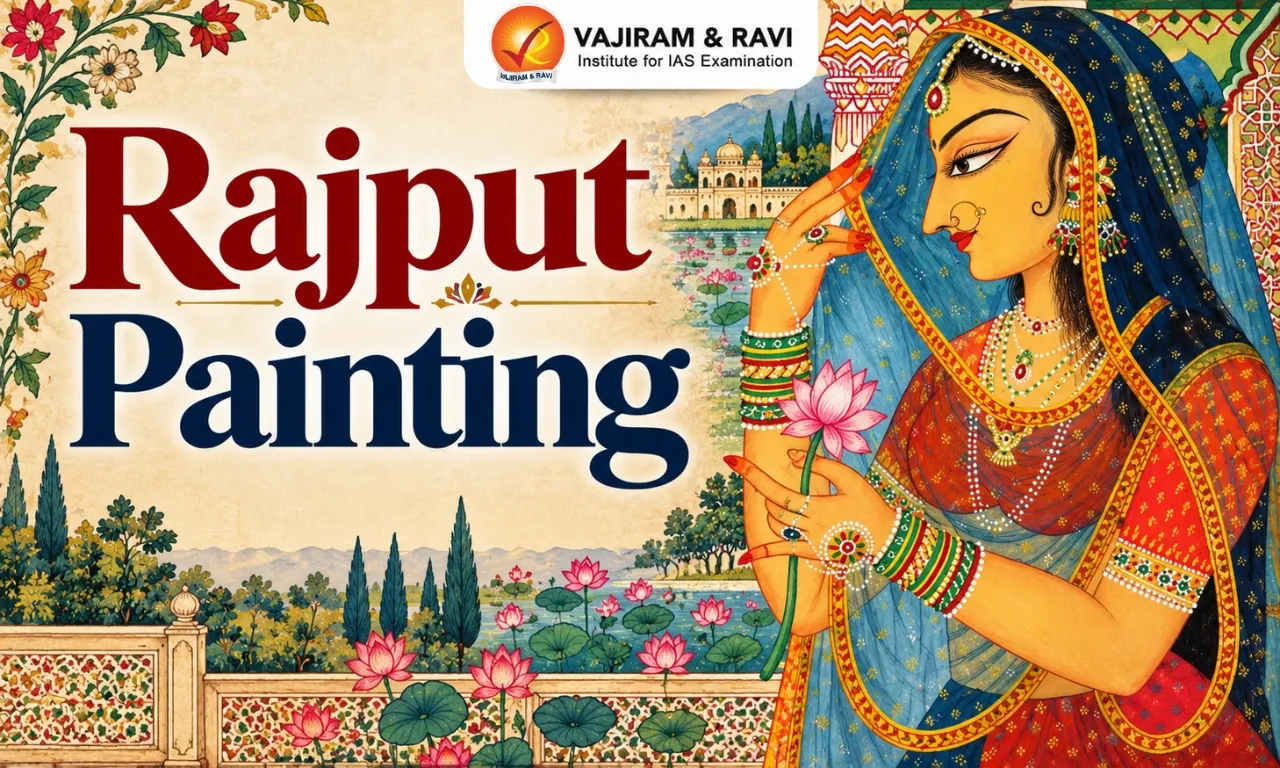
Rajput painting, also known as the Rajasthani School of painting, is the style of miniature painting that developed mainly in the state of Rajasthan in western India in the 16th–19th centuries. It evolved from Western Indian manuscript illustrations, though Mughal influence became evident in the later years of its Development.
Over time, Rajput painting schools such as Mewar, Marwar, Bundi-Kotah, Bikaner, Kishangarh, and Malwa, after going through the evolutionary phase, developed their own iconographic features with some overlap, which was always a marked feature of these schools.
Rajput Painting History
Rajput painting developed under the patronage of regional rulers in Rajasthan and neighbouring areas, particularly between the 16th and early 19th centuries. It evolved into several regional schools, combining indigenous Indian artistic traditions with influences from Mughal painting.
- Terminology note: The term Rajput painting was popularised by art historian Ananda K. Coomaraswamy in 1916. Modern art history generally uses more specific classifications, such as Rajasthani and Pahari schools.
- Early Development: Rajasthani painting drew upon earlier Indian manuscript traditions, including Jain and western Indian painting styles. Mewar is considered an important early centre of its development.
- Emergence of Regional Schools: From the late 16th and early 17th centuries, distinct schools flourished under regional courts. Major centres included Mewar, Marwar (Jodhpur), Bundi, Kota, Bikaner, Jaipur and Kishangarh, each developing its own artistic characteristics.
- Mughal Influence: From the 16th century, contact between Rajput rulers and the Mughal court influenced portraiture, court scenes and artistic techniques. However, indigenous traditions continued to shape the paintings of different regions.
- Development under Royal Patronage: During the 17th century, rulers supported illustrated manuscripts, religious paintings, and the Ragamala series.
- In Mewar, artists such as Sahibdin produced important works, including illustrations of the Ragamala, Bhagavata Purana and Ramayana.
Rajput Painting Features
The term ‘Rajasthani Schools of Painting’ refers to the schools of painting that prevailed in the princely kingdoms and thikanas of what roughly constitutes Rajasthan and parts of Madhya Pradesh between the sixteenth and early nineteenth centuries.
Use of Colours in the Rajput School of Miniature Paintings
Colour pigments were predominantly obtained from minerals and precious metals like gold and silver that were mixed with glue as the binding medium.
Core Themes of Rajput Paintings
Rajput paintings depicted a wide range of religious, literary, and courtly subjects. Gita Govinda, a Sanskrit poem by Jayadeva, portrayed the divine love of Radha and Krishna through shringara rasa.
- Rasamanjari explored aesthetic emotions and the classification of heroes (nayakas) and heroines (nayikas), while Rasikapriya, a Brajbhasha work by Keshav Das, examined different emotional states of love through Radha-Krishna themes.
- Ragamala paintings visually represented ragas and raginis associated with Indian classical music.
- Other popular subjects included the Ramayana, Bhagavata Purana, Mahabharata and Devi Mahatmya, along with royal court scenes, hunting expeditions, battles, victories and portraits of kings.
Materials & Techniques Used in Rajput Paintings
Paintings were painted on wasli, layered, thin sheets of handmade paper glued together to get the desired thickness. The outline was sketched on wasli in black or brown, followed by colours fixed therein by brief notations or sample patches.


Rajput Painting Major Schools
The important schools of Rajput paintings are Malwa, Mewar, Bundi- Kotah, AmberJaipur, Bikaner, Marwar, and Kishangarh. Each school of painting has its distinct facial type, costume, landscape, and colour scheme.
Malwa School of Painting
The Malwa School flourished between 1600 and 1700 CE and is most representative of the Hindu Rajput courts. The Malwa School lacks a precise place of origin and is linked to a broad region of Central India, with occasional mentions of sites like Mandu, Nusratgarh, and Narsinghgarh.
- From the Chaurpanchashika manuscript paintings to the Jain texts, their two-dimensional, straightforward language seems to be the pinnacle of stylistic development.
- The lack of depictions of patron kings and royal portraits indicates that the Datia rulers likely acquired these artworks from itinerant artists, who specialised in popular themes such as the Ramayana, Bhagavata Purana, Rasikapriya, and Baramasa.
- Example: Ragamala painting by Madho Das in 1680 CE; Series of the Rasikapriya (1634 A.D.) and a series of the Amaru Sataka.
Mewar School of Painting
The emergence of the Mewar School is widely associated with an early-dated set of Ragamala paintings painted at Chawand in 1605 by an artist named Nisardin. The set reflects a pre-17th-century style with direct expression, simple composition, minimal decoration, and vibrant colours.
- Features:
- Prefer a bright colour palette with prominent reds and yellows.
- Painting in the 18th century increasingly shifted away from textual representations to courtly activities and the pastime of the royals.
- Large backdrops called pichhwais were painted on cloth for the deity, Shrinathji, for several festive occasions.
- The Mewar paintings' style and vocabulary gained new life under the reign of Jagat Singh I (1628–1652), when virtuoso artists Sahibdin and Manohar reformed pictorial aesthetics.
- Sahibdin painted the Ragamala (1628), Rasikapriya, Bhagavata Purana (1648), and the Yuddha Kanda of Ramayana (1652).
- Manohar’s most significant work is the Bal Kanda of the Ramayana (1649).
Bundi School of Painting
A prolific and distinct school of painting flourished in Bundi in the seventeenth century. Bundi Ragamala, dated 1591, is assigned to the earliest and formative phase of Bundi painting.
- Blossomed under the patronage of two rulers: Rao Chattar Sal (1631–1659) and his son Rao Bhao Singh (1659–1682).
- Popular theme: Baramasa, an atmospheric description of the 12 months by Keshav Das.
- Colours: Unblemished colour sense and excellent formal design.
- Bundi paintings from the eighteenth century seem to have embraced Deccani aesthetics, including a fondness for brilliant, bright colours.
- At the top, the text is displayed in black on a yellow backdrop.
- Depiction of water bodies, hills, dense rainforests, and a beautiful landscape with a variety of plants, animals, and birds.
- Examples: Raginis Khambavati, Bilaval, Malashri, Bhairavi, Patmanjari, etc.
Kota School of Painting
Kota, a town close to Bundi, also saw a flourishing painting style in the late 18th and early 19th centuries that was remarkably similar to the Bundi style. After its separation from Bundi, Kota had its own school, commencing around the 1660s in the reign of Jagat Singh (1658–1683).
- Themes of tiger and bear hunts were very popular. Most of the space is occupied by the hilly jungle, which has been rendered with a unique charm.
- Characteristically spontaneous, calligraphic in execution, and with emphasis on marked shading, especially the double–lid eye.
Bikaner School of Painting
Bikaner developed a distinctive language of painting that was influenced by the Mughal art and architecture's elegance and subdued colour palette.
- A prevailing practice in Bikaner was to set up studios called Mandi, where a group of artists worked under the supervision of a master artist. Ruknuddin, Ibrahim, and Nathu managed some of these professional studios.
- A unique custom was having portraits of artists. The name of the master artist was inscribed on the works of his pupils.
Kishangarh School of Painting
In the mid-18th century, the Kishangarh School of Rajasthani painting flourished under Raja Savant Singh (1748–1757), a patron and poet devoted to Krishna.
- Features: Distinguished by their exquisite sophistication and distinct facial type, exemplified by arched eyebrows, lotus petal-shaped eyes slightly tinged with pink, drooping eyelids, a sharp, slender nose, and thin lips.
- Krishna Lila themes represented a major portion of their court art.
- They favoured an elongated human form, lavish use of green, and panoramic landscapes.
- Example: Artist Nihal Chand composed paintings on Sawant Singh’s poetry that portrayed the theme of divine lovers-Radha and Krishna- in courtly surroundings.
Jodhpur School of Painting
The Jodhpur School, also known as the Marwar School of Painting, developed under the patronage of the rulers of Marwar. It retained a strong indigenous folk-art tradition while absorbing selected Mughal influences, particularly in portraiture and depictions of court life.
- Indigenous Artistic Tradition: Despite Mughal influence from the sixteenth century, the school retained a strong folk-inspired local style, which remained prominent in many illustrated manuscripts.
- Patronage of Jaswant Singh: Maharaja Jaswant Singh (1638–1678) encouraged painting from around 1640. Portraits and depictions of court life became important, alongside religious themes.
- Religious Themes: The school frequently illustrated stories related to Lord Krishna, particularly the Bhagavata Purana, reflecting the rulers’ association with the Vallabha tradition of Shrinathji.
- Literary Works: Under Maharaja Man Singh (1803–1843), important illustrated sets included the Ramayana (1804), Panchatantra (1804), Dhola-Maru and Shiva Purana.
- Depiction of Local Culture: Paintings incorporated regional architecture, costumes, bazaars, lanes and gateways.
Jaipur School of Painting
The Jaipur School of Painting is an important branch of Rajasthani miniature painting that originated in Amer and developed under the patronage of Jaipur’s rulers. It reflects a blend of Mughal artistic influences and indigenous Rajasthani traditions.
- Origin and Development: The school originated at Amer, the former capital of Jaipur. It developed into an independent and well-defined style under Sawai Jai Singh (1699–1743), who founded Jaipur in 1727.
- Religious Themes: Paintings frequently depicted Radha and Krishna, inspired by Vaishnavism. Popular subjects included Gita Govinda, Rasikapriya, Bhagavata Purana, and Ragamala.
- Royal Portraits: Portrait painting was prominent, with royal figures often shown in elaborate costumes and courtly settings. Some paintings portrayed the king in the likeness of the hero in literary works.
- Sawai Pratap Singh’s Patronage: During his reign (1779–1803), the school experienced another flourishing phase. He employed around 50 artists and encouraged religious, literary, and royal themes.
- Artistic Features: Jaipur paintings increasingly combined Mughal and indigenous styles. The school favoured large-format paintings, life-size portraits and, by the early nineteenth century, lavish use of gold.
Famous Rajput Style Paintings
Rajput painting flourished under the patronage of Rajput rulers in Rajasthan. It is known for its religious themes, musical representations, royal life, and romantic narratives.
- Bani Thani: Belonging to the Kishangarh School, this painting was created by Nihal Chand. It depicts Bani Thani as an idealised Radha, characterised by elongated lotus-shaped eyes, arched eyebrows, a pointed nose, and thin lips.
- Maru Ragini: It was painted by Sahibdin in 1628 CE; this work belongs to the Mewar School. It depicts Dhola and Maru escaping together on a camel and represents the Ragamala tradition, which associates paintings with musical modes.
- Chaugan Players: It was created by Dana in 1810 CE, this painting belongs to the Jodhpur School. It depicts a princess playing polo (chaugan) with companions and reflects Mughal, Deccani, Bundi and Kishangarh artistic influences.
- Krishna Swinging and Radha in Sad Mood: It was painted by Nuruddin in 1683 CE; this work belongs to the Bikaner School and is based on Rasikapriya. It depicts Krishna with a Gopi while Radha, hurt by his actions, withdraws into the countryside.
- Rama Meets His Family at Chitrakut: It was created by Guman between 1740 and 1750 CE, this painting belongs to the Jodhpur School.
- It depicts Bharata and the royal family meeting Rama during his exile and uses the continuous narrative technique to present successive events in a single composition.
Differences Between Mughal and Rajput Painting
Mughal and Rajput paintings flourished in India under different royal traditions. While Mughal paintings emphasised court life, realism and Persian influences, Rajput painting focused more on religious devotion, regional traditions and Indian epics.
| Basis | Mughal Painting | Rajput Painting |
|
Origin |
It was developed under Mughal emperors, especially Akbar. |
It was developed under Rajput rulers across Rajasthan and neighbouring regions. |
|
Themes |
Court scenes, royal portraits, battles, hunting, and historical events. |
Hindu mythology, Radha-Krishna themes, epics, Ragamala and romantic stories. |
|
Religious Influence |
Generally secular and court-oriented, though religious subjects also appeared. |
Strongly influenced by Hindu devotional traditions, particularly Vaishnavism. |
|
Colour and Style |
Often featured refined detailing, naturalistic colours and realistic representation. |
Frequently used vibrant colours, bold compositions and stylised figures. |
|
Human Figures |
Emphasised individual likeness, facial features and realistic portraits. |
Often used expressive, idealised figures with distinctive regional features. |
|
Nature and Landscape |
Depicted gardens, animals and landscapes with close attention to natural detail. |
Used symbolic landscapes, stylised trees, hills and settings to express emotions or religious themes. |
|
Major Centres |
Delhi, Agra, Fatehpur Sikri and Lahore. |
Mewar, Marwar (Jodhpur), Bundi, Kota, Jaipur, Bikaner and Kishangarh. |
|
Famous Examples |
Akbar-Nama illustrations and Jahangir preferring a Sufi Shaikh to Kings. |
Bani Thani, Maru Ragini and Chaugan Players. |
Similarities and Dissimilarities Between Rajput and Pahari Painting
Rajput and Pahari paintings are important traditions of Indian miniature art. Both developed under regional royal patronage and shared religious and romantic themes, but differed in their geographical centres, artistic styles, and treatment of nature.
Similarities Between Rajput and Pahari Paintings
Both traditions flourished under the patronage of regional rulers, who supported artists and commissioned paintings for courts and manuscripts.
- Religious and Romantic Themes: Both depicted Hindu mythology, particularly Radha-Krishna, along with themes of love, devotion, and literary works such as Gita Govinda and Ragamala.
- Miniature Format: Both traditions produced miniature paintings and illustrated manuscripts, using fine brushwork, decorative details, and mineral-based pigments.
- Regional Diversity: Both developed distinct regional styles. Rajput centres included Mewar, Marwar and Kishangarh, while Pahari centres included Basohli, Guler and Kangra.
- Use of Nature and Colours: Both incorporated landscapes, trees, flowers and vibrant colours to convey moods, emotions and religious ideas.
Dissimilarities Between Rajput and Pahari Paintings
Rajput and Pahari paintings are important traditions of Indian miniature art. Although both share religious and literary themes, they differ in geographical origin, artistic style, depiction of nature and regional characteristics.
- Geographical Origin: Rajput painting developed mainly in Rajasthan, with centres such as Mewar, Marwar, Bundi and Kishangarh. Pahari painting developed in the Himalayan foothills, particularly Basohli, Guler, Kangra and Chamba.
- Artistic Style: Rajput paintings often feature bold compositions, strong outlines and vibrant colours. Pahari paintings range from the bold, intense Basohli style to the delicate and lyrical Kangra style.
- Human Figures: Rajput paintings commonly depict stylised figures with distinctive facial features and elaborate costumes. Kangra paintings are particularly known for graceful figures, delicate facial features,s and expressive gestures.
- Themes: Rajput paintings include royal portraits, court ceremonies, hunting scenes, Hindu mythology, and devotional subjects. Pahari paintings are especially renowned for Radha-Krishna themes, romantic poetry, and devotional narratives.
- Mughal Influence: Mughal influence is evident in Rajput portraiture and court scenes. In Pahari painting, Mughal naturalism influenced the development of some regional styles, particularly Guler and Kangra.
- Major Centres: Important Rajput painting centres include Mewar, Marwar, Bundi, Kota, Jaipur, Bikaner and Kishangarh. Major Pahari centres include Basohli, Guler, Kangra, Chamba, Mandi and Nurpur.
Ragamala Painting of Medieval India
Ragamala paintings are a distinctive tradition of Indian miniature art that visually represent Ragas and Raginis, the melodic modes of Indian classical music. Developed during the medieval period, they combine music, poetry, emotions, and visual storytelling.
- Meaning: The term Ragamala means “garland of Ragas”. These paintings depict musical modes as human figures, divine characters, or scenes associated with particular emotions and situations.
- Origin and Development: Ragamala painting flourished from around the 16th century under the patronage of regional rulers and developed across several schools of Indian miniature painting.
- Organisation: Ragamala series were traditionally arranged as albums, often containing 36 or 42 folios. The paintings followed a family-based classification, with a principal male Raga associated with six female counterparts known as Raginis.
- Six Principal Ragas: The traditional classification identifies six major Ragas: Bhairava, Malkos, Hindol, Dipak, Megha, and Shri. Each was associated with particular Raginis and distinctive artistic representations.
- Association with Seasons and Time: Different Ragas were traditionally associated with particular seasons, times of day, and emotional states. These associations influenced the subjects and settings of the paintings.
- Artistic Features: Ragamala paintings use vibrant colours, stylised human figures, decorative landscapes and symbolic elements to convey the mood of a musical mode.
Rajput Painting Significance
Rajput paintings hold significance as an important regional tradition of Indian miniature painting, reflecting the cultural, religious, and courtly life of Rajasthan and adjoining regions.
- Cultural Heritage: Rajput paintings preserve the cultural traditions, customs, and lifestyles of the Rajput courts and regional communities through visual art.
- Religious Expression: Themes from the Ramayana, Mahabharata, Bhagavata Purana, and Radha-Krishna traditions made painting an important medium for expressing religious and devotional ideas.
- Historical Documentation: Court scenes, portraits, festivals, hunting scenes, and social activities provide visual evidence of the political and social life of different Rajput states.
- Cultural Synthesis: Rajput painting absorbed elements of Mughal painting while retaining strong regional and indigenous themes, illustrating interaction between different artistic traditions.
- Literary Connection: Paintings based on works such as Gitagovinda, Ragamala, and Bhagavata Purana show the close relationship between literature, music, religion, and visual art.

 Last updated on Oct, 2026
→ UPSC 2027 Notification will be released on 13 January 2027 at upsconline.nic.in.
→ Check Nobel Prize 2026 Winners List here.
→ Download PIB PRiSM Monthly Magazine 2026 here.
→ Check UPSC Monthly Current Affairs Magazine The Recitals here.
→ Check out the latest UPSC Syllabus here.
→ Download UPSC Model Answers for Mains 2026
→ UPSC Mains Question Paper 2026 is out now for Essay & GS Paper 1, 2, 3 & 4.
→ UPSC Calendar 2027 has been released.
→ Enroll in Vajiram & Ravi’s UPSC Mains Test Series 2027 for structured answer writing practice, expert evaluation, and exam-oriented feedback.
→ Join Vajiram & Ravi’s UPSC Mentorship Program 2027 for personalized guidance, strategy planning, and one-to-one support from experienced mentors.
→ Go through the UPSC Mains Previous Year Papers to enhance your preparation.
→ UPSC has released UPSC Toppers List 2025 with the Civil Services final result on its official website.
→ Also check Best UPSC Coaching in India
Rajput Painting FAQs
Q1. Who wrote Rajput painting?+
Q2. What is Rajput painting?+
Q3. Which School is a part of Rajput painting?+
Q4. Which painting is famous in Rajasthan?+
Q5. Who is called the father of Indian painting?+
Tags: quest rajput painting UPSC Art and Culture Notes