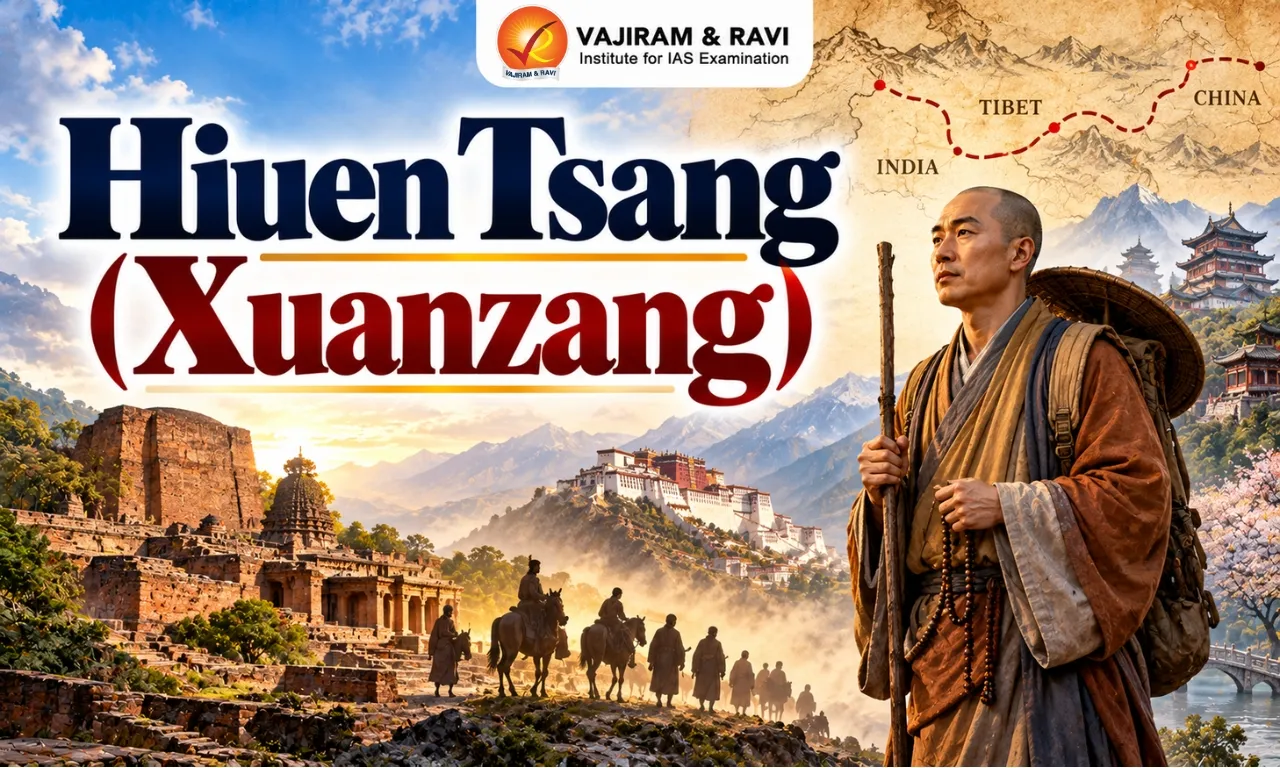
Hiuen Tsang (Xuanzang) was a renowned Chinese Buddhist monk, scholar, traveller and translator who visited India in the 7th century CE. He travelled extensively to study Buddhism, collect authentic scriptures and learn from Indian scholars. During his journey, he visited important centres such as Nalanda, Kannauj, Pataliputra, Bodh Gaya and Kanchi, and interacted with Harshavardhana.
The Hiuen Tsang travel account provides valuable information on the political, religious, social, economic, and cultural conditions of 7th-century India. He also collected Buddhist manuscripts and translated numerous Sanskrit texts into Chinese, contributing to Buddhist scholarship and historical knowledge.
Hiuen Tsang (Xuanzang) History
Hiuen Tsang, or Xuanzang, was one of the foreign travellers who visited India in the Ancient period. He was a Chinese Buddhist monk, scholar, and translator of the 7th century CE. His journey to India was driven by his quest for authentic Buddhist scriptures and knowledge. His detailed observations provide an important source for understanding 7th-century Indian history, particularly during the reign of Harshavardhana.
Hiuen Tsang Early Life
Hiuen Tsang (Xuanzang) deep engagement with Buddhist philosophy and his search for authentic scriptures eventually inspired his journey to India.
- Early background: Born around 602 CE in Henan, China, into a scholarly family and initially educated in Confucian and classical learning.
- Turn to Buddhism: He entered Buddhist monastic life as a novice around 615 CE and received full ordination in 622 CE.
- Scholarly pursuit: He studied Buddhist scriptures and philosophy under various teachers, developing a particular interest in Yogachara/Vijnanavada.
- Quest for authentic knowledge: Differences and inconsistencies in Buddhist texts available in China led him to seek original scriptures and authoritative teachers in India.


Hiuen Tsang's Journey to India
Hiuen Tsang travelled to India to study Buddhist philosophy, visit sacred sites, and collect Buddhist scriptures. His journey and observations provide valuable evidence about the kingdoms, religious institutions, and cultural practices of the period.
- Beginning of the Journey: He left China in 629 CE, despite restrictions on foreign travel under the Tang dynasty, and returned to China in 645 CE.
- Route: He travelled through Central Asia, including regions around Turfan, Tashkent and Samarkand, crossed the Pamir region and visited Afghanistan before entering the Indian subcontinent.
- Important Buddhist Centres: He visited Buddhist centres such as Bamiyan and Nava Vihara in Afghanistan, recording their monasteries and religious traditions.
- Indian Destinations: His travels included Gandhara, Taxila, Kashmir, Mathura, Kannauj, Ayodhya, Sarnath, Pataliputra, Bodh Gaya, Kamarupa (Assam) and Kanchi, among other places. He visited numerous kingdoms and documented their political, religious, social, and economic conditions.
- Collection of Texts: On his return, he carried Buddhist manuscripts, relics, and images to China, contributing to the preservation and transmission of Indian Buddhist knowledge.
Hiuen Tsang Visit to Nalanda University
Nalanda was one of the most renowned Buddhist learning centres of seventh-century India. Hiuen Tsang’s account provides valuable information about its curriculum, scholars, monastic life, and financial support.
- Duration of Study: He spent approximately five years studying at Nalanda under the guidance of the renowned Buddhist scholar Śīlabhadra.
- Subjects Studied: His studies included Sanskrit, grammar, logic, and Buddhist philosophy, particularly the Yogachara or Vijnanavada tradition.
- Number of Students: He reported that around 10,000 monks studied at Nalanda. However, this figure is not fully corroborated by archaeological evidence.
- Financial Support: According to his account, the monastery received revenues from approximately 100 villages, which helped sustain its residential and educational activities.
- Academic Environment: He described Nalanda as a prestigious institution known for advanced learning, philosophical debates, and the study of Buddhist scriptures.
Hiuen Tsang Visit to Assam
Hiuen Tsang visited Kamarupa (present-day Assam) during the reign of Bhaskaravarman, providing valuable information about the region’s political and cultural conditions.
- Meeting with Bhaskaravarman: He visited the court of Bhaskaravarman, the ruler of Kamarupa, who maintained friendly relations with Harshavardhana.
- Political Relations: Bhaskaravarman participated in the religious assembly organised by Harsha at Kannauj, reflecting the political and diplomatic connections between the two kingdoms.
- Regional Observations: Hiuen Tsang recorded information about Kamarupa’s geography, people, customs, and religious traditions.
Hiuen Tsang and Harsha
Hiuen Tsang visited India during the reign of Harshavardhana (606–647 CE) and spent considerable time in his kingdom. His account provides insights into Harsha’s administration, religious patronage, political relations, and court life.
- Harsha’s Administration: Hiuen Tsang portrayed Harsha as an active ruler who supported scholars, religious institutions, and charitable activities.
- Religious Patronage: He described Harsha as a major patron of Buddhism, although the king also extended support to other religious traditions.
- Kannauj Assembly: Harsha organised a grand religious assembly at Kannauj to promote Mahayana Buddhism. According to Hiuen Tsang, it was attended by Bhaskaravarman, rulers of 21 kingdoms, and thousands of religious participants. The gathering featured elaborate arrangements and a golden image of the Buddha.
- Alleged Conspiracy: Hiuen Tsang recounted an alleged plot against himself and an attempt to assassinate Harsha during the assembly. He claimed that Harsha punished those accused, including through executions and banishment. These details should be treated as his account rather than independent facts.
- Prayaga Assembly: He described another religious gathering at Prayaga, where Harsha distributed extensive donations. According to Hiuen Tsang, the king’s generosity extended to giving away almost all his possessions except his personal clothing.
Military Strength of Harsha
Hiuen Tsang’s account provides information about the scale of Harsha’s military establishment and the importance of military power in maintaining his kingdom.
- Army Composition: According to Hiuen Tsang, Harsha maintained an army comprising approximately 60,000 elephants, 50,000 cavalry and 100,000 infantry.
- Military Organisation: These figures highlight the importance of elephants, cavalry and infantry in accounts of Harsha’s military strength.
Hiuen Tsang Book – Si-Yu-Ki
Hiuen Tsang’s travel account, Si-Yu-Ki, also known as The Great Tang Records on the Western Regions, documents his observations during his travels through India and other regions.
- Contents: The book describes the kingdoms, rulers, and geographical features he encountered, along with religious beliefs, Buddhist monasteries, pilgrimage centres, administration, agriculture, trade, social customs, and everyday life.
- Important Places: It provides accounts of major centres such as Nalanda, Kannauj, Pataliputra and Bodh Gaya.
- Historical Significance: It is an important source for understanding seventh-century India, particularly Harshavardhana’s reign, Buddhism, education, administrative practices and contemporary social conditions.
Hiuen Tsang Accounts of India
Hiuen Tsang’s accounts provide valuable insights into seventh-century Indian society, religion, administration and economy. His observations cover the condition of Buddhism, changing political and economic centres, land grants, revenue arrangements, caste divisions and social customs, making his travelogue an important historical source for understanding Harsha’s period.
Hsuan Tsang on Buddhism
Hiuen Tsang’s account highlights the condition of Buddhism, the importance of Nalanda as a centre of learning, and the role of royal patronage in supporting Buddhist institutions.
- Nalanda University: He described Nalanda as a leading centre of Buddhist learning, where he studied Mahayana philosophy.
- Condition of Buddhism: He noted that Buddhism comprised 18 sects and that some older Buddhist centres were declining, although Nalanda remained a prominent centre of learning.
- Kanishka’s Patronage: He described a magnificent multi-storeyed stupa at Peshawar, associated with Kanishka and believed to house a relic of the Buddha, reflecting the region’s Buddhist heritage.
- Harsha’s Patronage: Hiuen Tsang portrayed Harsha as a major patron of Buddhism, although the king also supported other religious traditions.
Hsuan Tsang on Feudalism
Hiuen Tsang’s observations on urban decline, land grants and revenue distribution are used by historians to examine changing patterns of political authority and economic organisation in early medieval India.
- Decline of Older Cities: He observed that Pataliputra had declined from its former prominence, while Vaishali had also lost importance. Kannauj and Prayaga, meanwhile, emerged as significant political and religious centres.
- Division of State Revenue: According to Hiuen Tsang, Harsha divided state revenue into four parts: royal expenses, support for scholars, maintenance and rewards for officials, and religious purposes.
- Land Grants: He reported that ministers and senior officials received land as remuneration for their services. This indicates the growing importance of land grants in administrative and economic relations.
- Feudalism and Decentralisation: Historians have used these observations to support arguments about the growth of feudal tendencies and the decentralisation of political authority. The relative scarcity of coins from Harsha’s reign is also discussed in this context, although neither factor alone proves the existence of a uniform feudal system.
Hsuan Tsang on Caste System
Hiuen-Tsang’s account provides insights into caste hierarchies, occupational practices and the social exclusion of marginalised communities in seventh-century India.
- Brahmins and Kshatriyas: He described these groups as generally leading simple lives, although kings, nobles, and influential Brahmin priests often enjoyed considerable luxury, reflecting differences in wealth and social status.
- Occupational Diversity: He observed that Brahmins, Kshatriyas, and Shudras engaged in agriculture. This suggests that actual occupations did not always conform to the duties prescribed in traditional religious texts.
- Untouchability: He reported that groups such as executioners and scavengers lived outside settlements and were required to announce their arrival so that others could avoid contact with them. He also recorded dietary practices, including the consumption of onions and garlic.
- Social Exclusion: These observations reveal how caste status influenced residential patterns, social interaction, and everyday life, particularly for communities regarded as untouchable.
Hiuen Tsang's Contribution
Hiuen-Tsang contributed significantly to Buddhist scholarship and the study of Indian history through his writings and travels. His accounts provide valuable insights into seventh-century India’s religious, social, and cultural conditions.
Hiuen Tsang's Contribution to Buddhism
Hiuen-Tsang helped preserve and spread Indian Buddhist philosophy in China through the collection and translation of Buddhist scriptures, strengthening intellectual and religious exchanges between the two countries.
- Collection of Buddhist Texts: During his travels, Hiuen Tsang collected around 657 Buddhist manuscripts and brought Buddhist texts, relics, and images back to China.
- Translation of Scriptures: He translated more than 75 Sanskrit Buddhist texts into Chinese, helping preserve Buddhist literature and making Indian Buddhist philosophy accessible to Chinese scholars.
- Promotion of Buddhist Philosophy: He played an important role in developing the Yogachara or Vijnanavada tradition of Buddhism through his studies, translations, and teachings.
- Preservation of Buddhist Knowledge: His efforts strengthened intellectual and religious exchanges between India and China and contributed to the transmission of Indian Buddhist thought across Asia.
Hiuen Tsang’s Account Limitations
Hiuen-Tsang’s account is valuable for understanding 7th-century India, but it has certain limitations due to the nature and purpose of his journey.
- Religious focus: As a Buddhist monk, his observations give considerable emphasis to Buddhism, monasteries and pilgrimage centres, while other aspects receive comparatively less attention.
- Selective coverage: He travelled through particular regions and therefore did not provide an equally detailed picture of all parts of India.
- Subjective observations: Some descriptions reflect his personal perceptions and experiences and should therefore be assessed critically.
- Possible exaggeration: Certain details, particularly military figures and descriptions of grandeur, may represent estimates or impressions rather than independently verified facts.
- Need for corroboration: His account is best used alongside inscriptions, archaeological evidence, and other literary sources to develop a balanced understanding of the period.

 Last updated on Oct, 2026
→ UPSC 2027 Notification will be released on 13 January 2027 at upsconline.nic.in.
→ Check Nobel Prize 2026 Winners List here.
→ Download PIB PRiSM Monthly Magazine 2026 here.
→ Check UPSC Monthly Current Affairs Magazine The Recitals here.
→ Check out the latest UPSC Syllabus here.
→ Download UPSC Model Answers for Mains 2026
→ UPSC Mains Question Paper 2026 is out now for Essay & GS Paper 1, 2, 3 & 4.
→ UPSC Calendar 2027 has been released.
→ Enroll in Vajiram & Ravi’s UPSC Mains Test Series 2027 for structured answer writing practice, expert evaluation, and exam-oriented feedback.
→ Join Vajiram & Ravi’s UPSC Mentorship Program 2027 for personalized guidance, strategy planning, and one-to-one support from experienced mentors.
→ Go through the UPSC Mains Previous Year Papers to enhance your preparation.
→ UPSC has released UPSC Toppers List 2025 with the Civil Services final result on its official website.
→ Also check Best UPSC Coaching in India
Hiuen Tsang FAQs
Q1. Who was Hiuen Tsang? +
Q2. When did Hiuen Tsang come to India? +
Q3. Why is Hiuen Tsang famous? +
Q4. Whose court was visited by Hiuen Tsang, the Chinese traveller? +
Q5. Are Hiuen Tsang and Xuanzang the same? +
Tags: hiuen tsang quest upsc ancient history notes