The Smart Cities Mission (SCM) was launched on 25 June 2015 by the Government of India to promote sustainable, inclusive and citizen-centric urban development. Implemented by the Ministry of Housing and Urban Affairs (MoHUA), the mission covered 100 selected cities through a competitive selection process. It adopted two major approaches: Area-Based Development (ABD), focusing on the transformation of selected urban areas, and Pan-City solutions, using technology to improve city-wide services.
The Smart Cities Mission (SCM) aimed to strengthen core infrastructure, improve quality of life, enhance urban governance and promote environmental sustainability. Although the mission period concluded on 31 March 2025, completing residual projects, maintaining created assets and ensuring long-term benefits remain important priorities for Indian cities.
Smart Cities Mission Overview
The Smart Cities Mission aimed to make Indian cities more liveable, inclusive and sustainable. It combined focused area development with technology-enabled city services and a model designed for replication.
- The Ministry of Housing and Urban Affairs (MoHUA) implemented the Smart Cities Mission as a Centrally Sponsored Scheme.
- One hundred cities were selected through a competitive process between January 2016 and June 2018.
- The Smart Cities Mission aimed to improve core infrastructure and quality of life while encouraging efficient governance, citizen participation and sustainable urban development.
Smart Cities Mission Key Facts
- Launch date: 25 June 2015
- Main approaches: Area-Based Development (ABD) and Pan-City solutions
- Total Union budget allocation: ₹47,652 crore (frequently cited around ₹48,000 crore in initial planning releases).
- Mission closure: 31 March 2025
- While the official funding and mission period have closed, state and city administrations continue to wrap up a small percentage of pending works, figure out long-term maintenance, and transition the created Special Purpose Vehicles (SPVs).
Smart Cities Mission Objectives
The Smart Cities Mission objectives focused on improving essential urban services, creating a cleaner environment and using technology to make city administration more effective and responsive, reflecting the mission’s three broad pillars identified by UN-Habitat: liveability, economic-ability and sustainability. Its major objectives were:
- Improve quality of life: Provide reliable basic services and better public spaces for urban residents.
- Strengthen core infrastructure: Improve water supply, electricity, sanitation, solid-waste management, mobility, public transport, health and education.
- Promote inclusive development: Support affordable housing, safer public spaces and services that address the needs of women, children, older persons and disadvantaged groups.
- Use smart solutions: Apply information technology, data and digital systems to improve service delivery and city management.
- Improve urban governance: Encourage e-governance, interdepartmental coordination and citizen participation.
- Support environmental sustainability: Promote efficient resource use, cleaner urban services and environmentally responsible development.
- Create replicable models: Develop successful local solutions that other cities can adapt to their own needs.


Smart Cities Mission Features
The Smart Cities Mission combined Area-Based Development (ABD) for targeted urban transformation with pan-city solutions for technology-driven improvements in city-wide services, supported by dedicated institutions and diverse funding sources.
Area-Based Development (ABD)
The area-based development approach focused investment on a defined area within each selected city. The aim was to create a demonstrative model of improved infrastructure and urban services that can inform development elsewhere. ABD included three approaches:
- Retrofitting: Improving existing built-up areas by upgrading infrastructure and services while retaining much of the existing urban structure.
- Redevelopment: Restructuring selected areas to create better-planned urban spaces and infrastructure.
- Greenfield development: Developing new areas with planned infrastructure and urban services.
Pan-City smart solutions
Pan-City projects used technology-based interventions across wider parts of a city.
- Examples: intelligent traffic management, digital systems for public services and integrated monitoring of urban infrastructure.
Core infrastructure and essential services
The mission’s infrastructure priorities extended beyond digital technology. They included:
- Adequate water and electricity supply.
- Sanitation and scientific solid-waste management.
- Efficient urban mobility and public transport.
- Affordable housing, especially for the urban poor.
- Reliable IT connectivity and digitalisation.
- Good governance and citizen participation.
- A sustainable environment and safer public spaces.
- Better access to health and education services.
Institutional framework
The mission used national, state and city-level arrangements to approve, coordinate and implement projects.
- National level: An Apex Committee headed by the Secretary, MoHUA looked at proposals, progress and funding.
- State level: A high-powered steering committee, led by the chief secretary, guides implementation at the state level.
- City level: A Special Purpose Vehicle (SPV) registered under the Companies Act, 2013, with a 50:50 equity shareholding between the State/UT and the ULB is responsible for project implementation. A Smart City Advisory Forum provides a platform for representatives, technical experts and local stakeholders to contribute and coordinate.
Funding and Convergence
The original mission framework provided for central financial assistance alongside matching contributions from states and Urban Local Bodies (ULBs).
- Cities were encouraged to mobilise additional funds through their own resources, municipal bonds, private investment and other government programmes.
- The mission also promoted convergence with programmes such as AMRUT, the Swachh Bharat Mission, Digital India and housing initiatives, enabling projects to connect infrastructure, social services and urban governance.
Smart Cities Mission Achievements
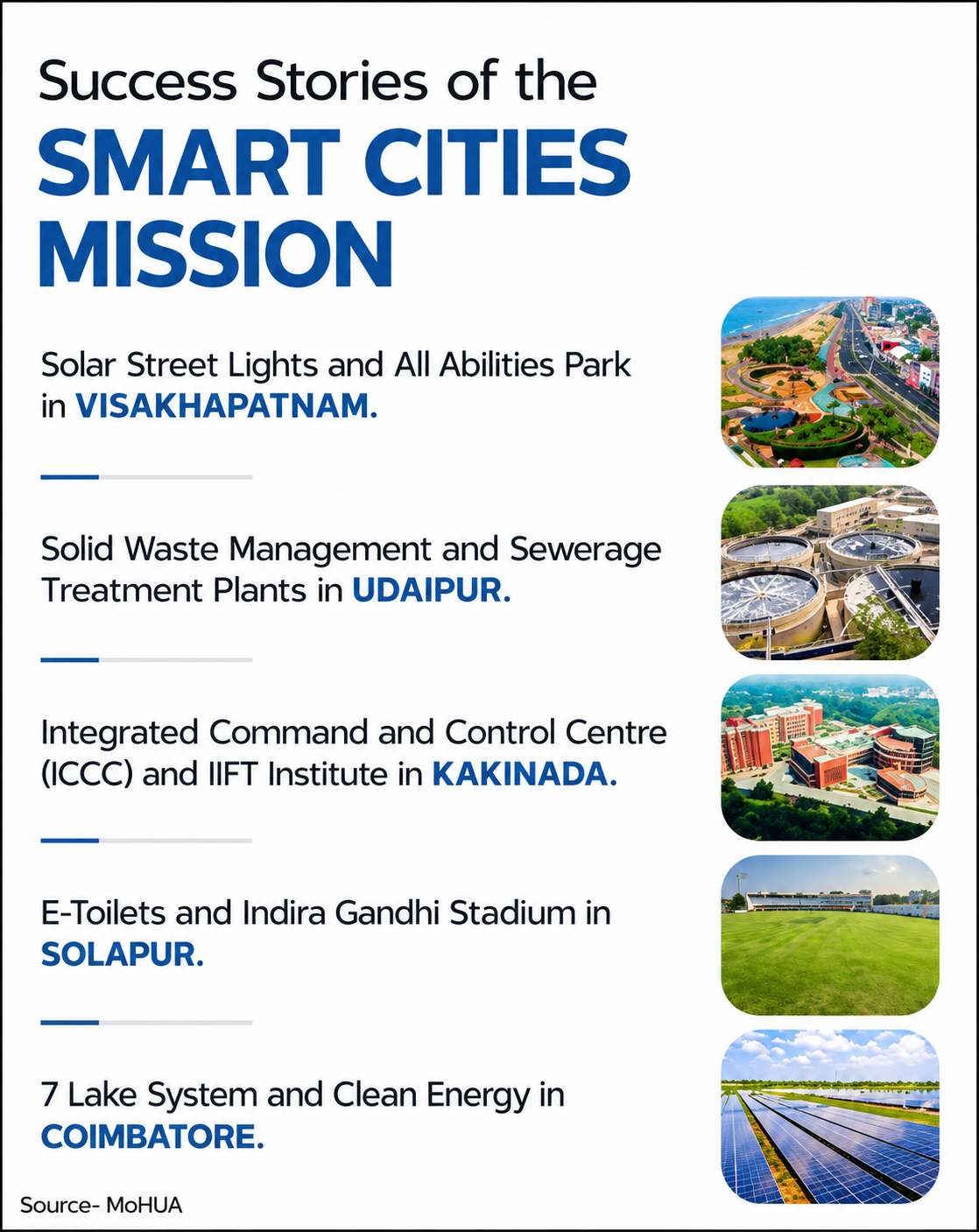
The Smart Cities Mission has advanced urban infrastructure, digital governance, public safety and essential services. Government reports also highlight its contribution to heritage conservation and sustainable development.
- Project completion: Out of 8,064 total projects worth ₹1,64,811 crore, 7,790 projects (97%) valued at ₹1,56,257 crore had been completed as of 31 March 2026.
- Digital governance and safety: All 100 Smart Cities established Integrated Command and Control Centres (ICCCs); over 83,000 CCTV cameras supported urban surveillance and public safety.
- Water and waste management: Over 17,000 km of water-supply networks were monitored using SCADA systems, while more than 66 cities used technology-enabled waste-management solutions, including RFID tracking.
- Mobility and public spaces: More than 1,700 km of smart roads and 1,300 public-space projects were completed; 484 heritage sites were conserved, and market redevelopment initiatives covered 58 cities.
- Education and healthcare: By March 2025, the mission had supported 9,433 smart classrooms in 71 cities, 41 digital libraries, 172 e-health centres and clinics, and 152 health ATMs.
- Sustainable development: UN-Habitat mapped the mission’s contribution to 15 of the 17 SDGs, linking its pillars (liveability, economic-ability and sustainability) to 213 output-outcome indicators across 51 out of 169 SDG targets.
Smart Cities Mission Limitations
Despite progress in urban infrastructure and service delivery, the Smart Cities Mission faced limitations in inclusive development, financial sustainability, technology integration, and citizen-centric urban governance.
- Area-Based Development (ABD) Bias: Roughly 80% of the mission's funding was concentrated in Area-Based Development projects, which covered only about 3% to 7% of an average city's area and about 9% of its population.
- Weak ULB Capacity: Only around 25% of Urban Local Bodies possessed trained urban planning staff, leading to poor operational alignment and coordination gaps.
- Digital Divide: Lower internet penetration and digital literacy in smaller urban centres (around 45%) limited public access to smart e-governance services.
- Post-mission maintenance: The corporate entities created Special Purpose Vehicles (SPVs) to fast-track these projects, which were built for rapid execution, not for multi-decade municipal operations.
- As the mission officially closes, a massive funding and accountability gap emerges.
- Without dedicated revenue models, cash-strapped Urban Local Bodies (ULBs) struggle to afford the high licensing, operation, and maintenance (O&M) costs of advanced systems.
- Financial sustainability: Reliance on additional funding from State/ULB resources, municipal borrowing and other sources made local financial capacity important for continuing services and maintaining assets.
- Local suitability and citizen use: A technology-led project may not succeed unless it fits mobility patterns and residents’ preferences.
- Example: A cycle-track project was considered unsuitable in its original form because cycling was not widely accepted as transport, leading to repurposing. This is a city-level lesson, not evidence of a mission-wide failure.
Smart Cities Mission Way Forward
There is a need to preserve the mission’s completed assets, finish residual projects and extend successful local innovations. Stronger municipal capacity, inclusive planning and transparent performance monitoring are essential for lasting urban transformation.
- Complete residual projects: State governments, ULBs and SPVs should ensure that ongoing works are completed and handed over with clear operational responsibilities.
- Secure long-term maintenance: Each asset should have an operation-and-maintenance plan, identified funding and a responsible department or agency.
- Scale successful models: Use evidence from ABD projects to replicate useful approaches in other neighbourhoods, while adapting them to local conditions.
- Strengthen urban local bodies: Improve municipal technical expertise, planning capacity, own-source revenue and ability to maintain infrastructure.
- Promote neighbourhood-led planning: Involve residents, vulnerable groups, local businesses and community organisations in prioritising needs and evaluating outcomes. UN-Habitat emphasises neighbourhood-led planning and decentralised governance as valuable lessons from India’s urban transformation initiatives.
- Ensure sustainable digital governance: Keep Integrated Command and Control Centres (ICCCs) operational beyond the mission period through sustainable business and maintenance plans, robust cybersecurity, responsible data governance, system interoperability and trained personnel.
- Use the ICCC Maturity Assessment Framework (IMAF 2.0) to assess operational maturity and identify improvements.
- Use outcome-based evaluation: Assess projects through service quality, accessibility, safety, environmental performance and user experience, not only money spent or projects completed.
Smart Cities Mission UPSC PYQs
Q1. How does smart city in India address the issues of urban poverty and distributive justice? (Mains 2025)
Q2. What are ‘Smart Cities’? Examine their relevance for urban development in India. Will it increase rural-urban differences? Give arguments for ‘Smart Villages’ in the light of PURA and RURBAN Mission. (Mains 2016)
Q3. Which of the following statements is/are correct regarding Smart India Hackathon 2017? (Prelims 2017)
- It is a centrally sponsored scheme for developing every city of our country into Smart Cities in a decade.
- It is an initiative to identify new digital technology innovations for solving the many problems faced by our country.
- It is a programme aimed at making all the financial transactions in our country completely digital in a decade.
Select the correct answer using the code given below:
(a) 1 and 3 only
(b) 2 only
(c) 3 only
(d) 2 and 3 only
Ans: (b)

 Last updated on Oct, 2026
→ UPSC 2027 Notification will be released on 13 January 2027 at upsconline.nic.in.
→ Check Nobel Prize 2026 Winners List here.
→ Download PIB PRiSM Monthly Magazine 2026 here.
→ Check UPSC Monthly Current Affairs Magazine The Recitals here.
→ Check out the latest UPSC Syllabus here.
→ Download UPSC Model Answers for Mains 2026
→ UPSC Mains Question Paper 2026 is out now for Essay & GS Paper 1, 2, 3 & 4.
→ UPSC Calendar 2027 has been released.
→ Enroll in Vajiram & Ravi’s UPSC Mains Test Series 2027 for structured answer writing practice, expert evaluation, and exam-oriented feedback.
→ Join Vajiram & Ravi’s UPSC Mentorship Program 2027 for personalized guidance, strategy planning, and one-to-one support from experienced mentors.
→ Go through the UPSC Mains Previous Year Papers to enhance your preparation.
→ UPSC has released UPSC Toppers List 2025 with the Civil Services final result on its official website.
→ Also check Best UPSC Coaching in India
Smart Cities Mission FAQs
Q1. When was the Smart Cities Mission launched?+
Q2. Which ministry implemented the Smart Cities Mission?+
Q3. How many cities were selected under the Smart Cities Mission?+
Q4. When did the Smart Cities Mission formally conclude?+
Q5. How does the Smart Cities Mission contribute to the SDGs?+
Tags: quest smart cities mission UPSC Indian Society Notes