E-Governance refers to the application of Information and Communication Technology (ICT) to improve government functioning, public service delivery and citizen participation. It aims to make governance more transparent, efficient, accountable, accessible and responsive to public needs. In India, e-governance has evolved from the computerisation of government offices to integrated digital platforms that facilitate service delivery, interdepartmental coordination and citizen engagement. Initiatives such as Digital India, DigiLocker, UMANG and Common Service Centres have expanded access to digital public services.
However, challenges such as the digital divide, inadequate infrastructure, cybersecurity threats, privacy concerns and limited digital literacy continue to affect its effectiveness. Strengthening inclusive, secure and citizen-centric digital systems are essential for improving governance and achieving efficient public administration.
E-Governance Meaning
E-governance is the short form of 'electronic governance'. Governance encompasses the processes, systems, and mechanisms through which an organisation or society is organised, makes decisions, and implements them to conduct its affairs.
- While 'e-governance' broadly denotes governing any organisation electronically through Information and Communication Technology (ICT), the term is now specifically used to describe the performance of a country's government functions via ICT.
- In these processes, ICT plays a significant role in shaping how governance services are delivered, how people access them, and how citizens participate.
E-Governance Origin
E-Governance emerged from the growing use of information technology in public administration and the need for governments to respond more effectively to changing citizen expectations.
- The expansion of internet-based communication made digital interaction increasingly practical.
- The supplied material identifies the early 1990s, particularly the emergence of the user-friendly World Wide Web (WWW), as an important phase in the wider adoption of ICT in governance through the convergence of technological change, administrative reform and the demand for more participatory governance.
Gartner's Model of e-Governance
E-Governance has progressed from simply posting government information online to offering full digital transaction services and merging government operations. Gartner's model, presented in 2000, describes this progression through four phases, illustrating increasing digital maturity.
- Information: Government websites publish information about departments, services, rules and procedures, improving public access and transparency.
- Interaction: Citizens and government communicate through digital interfaces. Users may download forms, submit information and enquire about service status.
- Transaction: Complete transactions, such as payments and applications, are conducted electronically, reducing the need for physical visits.
- Transformation: Government processes and service delivery are integrated and reorganised, enabling more seamless, coordinated and citizen-oriented administration.
E-Governance Need
The need for e-governance arises from the limitations of traditional administration, including procedural delays, excessive paperwork, weak coordination and limited public access to information. Digital systems offer ways to make government more accessible and responsive. The major reasons for adopting e-governance are the following:
- Administrative efficiency: Automate routine processes and reduce dependence on manual paperwork.
- Citizen convenience: Enable access to information, applications and public services without repeated visits to government offices.
- Transparency: Make government information and procedures more accessible to the public.
- Accountability: Improve traceability of administrative processes and the responsibility of officials.
- Democratic participation: Provide opportunities for citizens to express views and contribute to public decision-making.
- Administrative coordination: Involves enabling communication and sharing of information among various departments and different levels of government.
- Inclusive development: Extend access to public services to rural communities and groups that face barriers in conventional service delivery.


E-Governance Principles
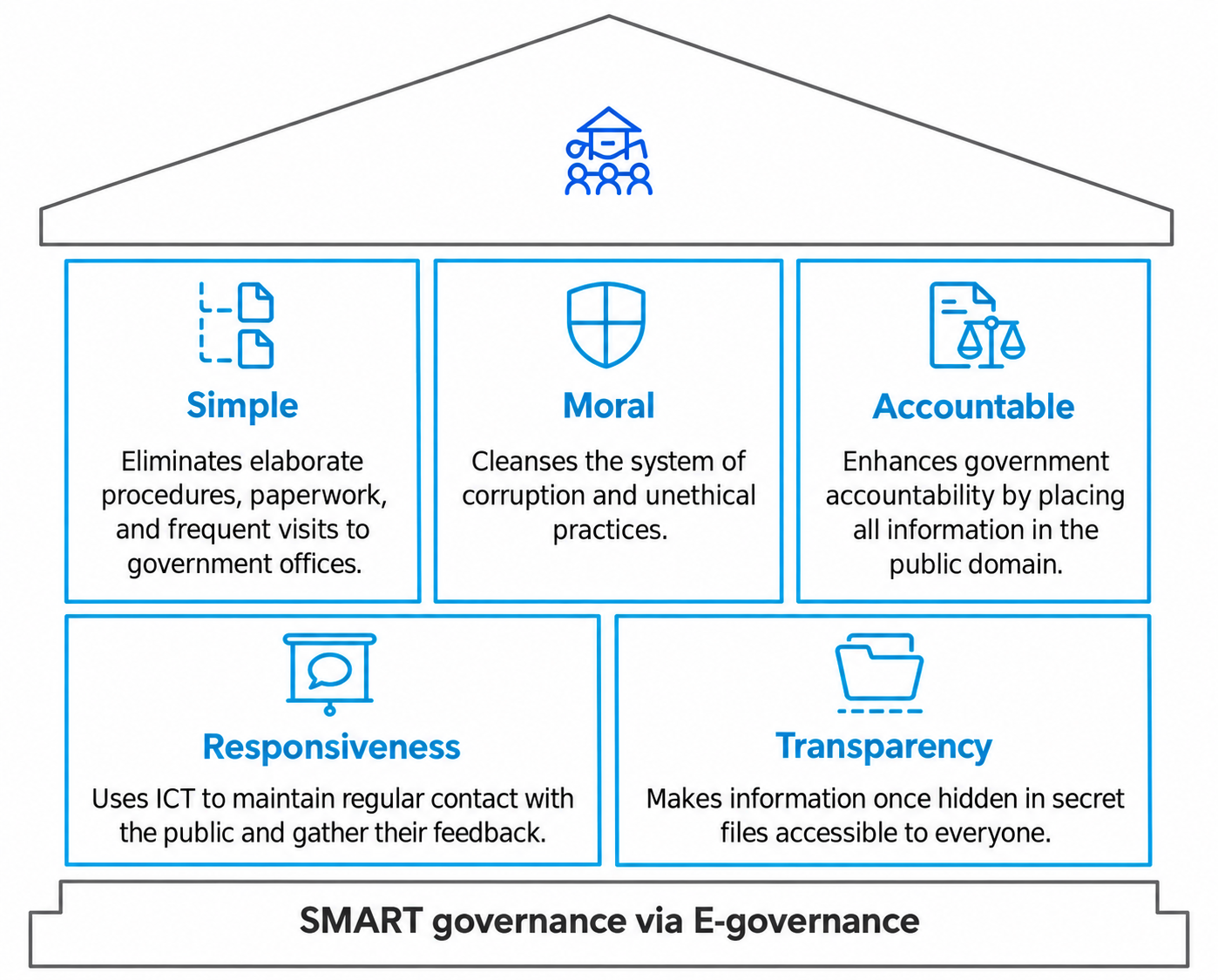
The objectives of e-governance extend beyond computerisation. They focus on improving service delivery, strengthening democratic engagement and making public institutions more efficient, transparent and accountable.
- Simplification: Reduce complicated procedures, paperwork and unnecessary visits to government offices.
- Efficiency: Improve the speed and coordination of administrative processes.
- Transparency: Increase public access to government information and decisions.
- Accountability: Strengthen responsibility for administrative actions and service delivery.
- Responsiveness: Enable government agencies to receive feedback and respond to public needs.
- Inclusivity & Accessibility: Ensure digital platforms work for all groups, including rural and marginalised communities, by bridging the digital divide.
- Interoperability: Connecting different government departments digitally so citizens do not have to carry the same paperwork or repeat information across offices.
- Better policy-making: Facilitate consultation and the exchange of information among government and stakeholders.
- Effective resource utilisation: Reduce avoidable administrative costs and improve the use of public resources.
- Security & Privacy: Protecting sensitive personal data and building cyber-resilience against online threats.
E-Governance Models
E-Governance rests on digital infrastructure, accessible services, institutional coordination and meaningful citizen participation. The five models describe the principal relationships through which e-governance operates and describe who interacts with whom.
- Government-to-Citizen (G2C): Connects government with citizens through public information, online applications, services, grievance-related communication and feedback.
- Government-to-Government (G2G): Facilitates information exchange, instructions and coordination among ministries, departments and different levels of government.
- Government-to-Business (G2B): Improves communication and coordination between government and businesses, including the exchange of policies, information and administrative requirements.
- Government-to-Employee (G2E): Supports communication between government institutions and their employees, who are essential to administrative functioning.
- Government-to-Society (G2S): Enables interaction with civil society organisations, NGOs, trade unions and other social groups.
E-Governance and Emerging Technologies
Emerging technologies are expanding e-governance from basic online services to more integrated, data-driven administration. Artificial Intelligence (AI), big data analytics and digital public infrastructure are important elements of this transition.
- Artificial Intelligence (AI): AI can aid in making automated decisions, delivering public services, and analysing administrative data. Its use requires safeguards against bias and opaque decisions.
- Big data analytics: Helps administrators analyse information, identify patterns and support policy decisions.
- Digital Public Infrastructure (DPI): Platforms such as Aadhaar, UPI and DigiLocker are infrastructure supporting digital identity, payments and document services.
- Interoperable platforms: Facilitate secure information exchange and coordination between systems.
- Real-time dashboards: Help administrators monitor programme outcomes and identify potential leakages.
- Multilingual digital services: Can make online public services more accessible to citizens with different linguistic needs.
E-Governance Significance
The significance of e-governance lies in its potential to improve public-service delivery while strengthening transparency & accountability and citizen participation. It can reduce administrative friction and make government institutions more accessible to the people they serve.
- Faster service delivery: Online access to information and applications reduces waiting time and repeated visits.
- Reduced red tape: Digital processes can simplify administrative procedures and limit avoidable delays.
- Greater transparency: Public access to information makes administrative functioning more visible.
- Improved accountability: Digitally recorded processes can help identify responsibility for delays and decisions.
- Lower transaction costs: Citizens can save time, travel expenses and effort when services are available remotely.
- Better coordination: Digital links between departments support the flow of information and more integrated services.
- Citizen participation: Online consultations and feedback mechanisms enable wider involvement in public affairs.
- Efficient resource utilisation: Automation can reduce repetitive work and support more effective use of administrative resources.
- Improved access to information: Digital platforms help citizens obtain information about government policies, programmes and services.
E-Governance In India
India’s e-governance journey has progressed from the computerisation of government offices to the digital delivery of public services. Over the years, the government has developed digital infrastructure, introduced technology-enabled administrative systems and created platforms to improve transparency, efficiency and citizen participation.
E-Governance Evolution in India
The evolution of e-governance in India can be broadly divided into two phases: the establishment of IT-based institutions and infrastructure during the 1970s-1990s, followed by the expansion of digital governance through software, legal frameworks and citizen-centric platforms.
1. Early Phase (1970s to 1990s): Establishment of IT Infrastructure: This phase laid the foundation for the use of information technology in government administration.
- 1970 - Department of Electronics (DoE): Established by the Government of India to support the development and application of electronics technology.
- 1976 - National Informatics Centre (NIC): Established to promote the use of informatics in government administration and support technology-enabled governance.
- Late 1970s - 1980s - Computerisation of government offices: Computers were initially used mainly for word processing. Their use gradually expanded to database management, payroll processing and inventory management.
- 1987 - Launch of NICNET: The National Informatics Centre Network (NICNET) introduced satellite-based computer connectivity to support communication and information exchange between government offices.
- DISNIC programme: The District Information System of the National Informatics Centre (DISNIC) programme aimed to computerise district offices and improve administrative efficiency, with hardware and software support provided to state governments.
- By 1990 - Expansion of NICNET: The network was extended through state capitals to district headquarters, strengthening digital connectivity within government administration.
- During this period, several state and central government departments began using computers for services such as land-record management and utility payments. However, many initiatives operated independently, limiting coordination and integration.
2. Expansion Phase (1990s Onwards): Digital Services and Institutional Development: From the 1990s onwards, improvements in telecommunications, internet connectivity and software capabilities expanded the scope of e-governance. The focus gradually shifted from basic computerisation towards integrated systems and citizen-oriented public services.
- 1999: Ministry of Information Technology created
- 2006: National e-Governance Plan (NeGP) launched
- 2009: National e-Governance Division (NeGD) established
- 2014: e-Kranti approved as NeGP 2.0
- 2015: Digital India launched
E-Governance Initiatives in India
E-Governance initiatives in India aim to make public services easier to access, improve administrative coordination and use digital platforms for information, transactions and citizen engagement.
- National Informatics Centre (NIC): Supports the use of information technology in government departments and the development of digital governance infrastructure.
- NIC Network and District Information System of the NIC: Helped establish connectivity between government offices and supported the computerisation of district-level administration.
- National e-Governance Service Delivery Gateway (NSDG): Designed to facilitate interoperability and improve the tracking of electronic transactions across government systems.
- MeghRaj (GI Cloud): Promotes the use of cloud computing infrastructure for government applications, helping departments utilise shared digital resources.
- Mobile Seva: Supports the delivery of government services through mobile-based channels, making digital services accessible beyond conventional computer-based platforms.
- Digital India Mission: It was explicitly designed for and heavily focused on e-governance. Launched on July 1, 2015, the Digital India Programme was introduced as a flagship campaign to transform India into a "digitally empowered society and knowledge economy."
- Rather than starting from scratch, it actively integrated, revamped, and accelerated earlier electronic governance frameworks like the National e-Governance Plan (NeGP)
- Passport Seva Project: Implemented by the Ministry of External Affairs in a public-private partnership with Tata Consultancy Services as the service partner.
- It uses a networked system connecting Passport Seva Kendras, passport offices and relevant external stakeholders to streamline passport-related services.
- e-Kranti: Aimed at transforming governance through integrated, interoperable and citizen-centric electronic services. It promotes digital delivery of services in sectors such as education, healthcare, agriculture, financial inclusion and justice, guided by principles like Mobile First and Transformation, not Translation.
- DigiLocker: Enables digital issuance, storage and verification of documents and certificates.
- PMGDiShA (Gramin Digital Saksharta Abhiyan): Supports digital literacy among eligible rural households. It has officially completed its target of training rural households.
- e-Granthalaya: Supports library automation and related digital library services.
- Unified Mobile Application for New Age Governance (UMANG): Provides a common digital interface for accessing government services.
- Technology Development for Indian Languages (TDIL): Supports technology development for Indian languages.
- National Knowledge Network (NKN): Provides advanced networking connectivity for participating knowledge and research institutions.
- MyGov: Enables citizens to participate in public contests and contribute views relevant to policy formulation.
- Common Service Centres (CSCs): Assisted-access points that help citizens, especially in rural and underserved areas, access digital public services.
- Digital Public Infrastructure (DPI): Platforms such as Aadhaar, UPI and DigiLocker support digital identity, payments and document services.
E-Governance Core Legislative & Regulatory Acts
India’s e-governance legislative framework is built on a combination of foundational information technology laws, data protection statutes, transparency mandates, and digital public infrastructure initiatives.
- Information Technology Act, 2000 (and 2008 Amendments):
- Information Technology Act, 2000 (amended in 2008)
- Provides the foundational legal framework for electronic transactions and cyber activities in India, drawing on principles of the UNCITRAL Model Law on Electronic Commerce, 1996.
- Sections 4–7 provide for legal recognition of electronic records, electronic signatures, electronic filing and retention, subject to statutory conditions.
- Section 6 addresses the use of electronic records and electronic signatures in government and its agencies, including electronic filing and the issue of licences and approvals.
- Section 8 provides for electronic publication of rules, regulations and other matters in the Electronic Gazette.
- Section 10A recognises the validity of contracts formed through electronic means, subject to other applicable legal requirements.
- Right to Information (RTI) Act, 2005:
- Empowers citizens to request and access government-held records in both physical and digital formats.
- Promotes administrative transparency and accountability.
- Aadhaar (Targeted Delivery of Financial and Other Subsidies, Benefits and Services) Act, 2016:
- Establishes a trusted, biometric-based digital identity framework for targeted service delivery and authentication.
- Digital Personal Data Protection Act (DPDPA), 2023:
- Regulates the processing of digital personal data, balancing individual privacy rights with the lawful requirements of the state for e-governance service delivery.
- Bharatiya Sakshya Adhiniyam, 2023, particularly Sections 61–63, which address electronic or digital records and their admissibility.
E-Governance Achievements in India
India’s e-Governance initiatives have improved the scale, transparency, accessibility and efficiency of public service delivery through digital payments, online platforms, paperless administration and technology-enabled grievance redressal.
- Direct Benefit Transfer (DBT) and reduced leakages: Cumulative DBT transfers exceeded ₹52.89 lakh crore across 320 schemes and 56 ministries as of 10 August 2026.
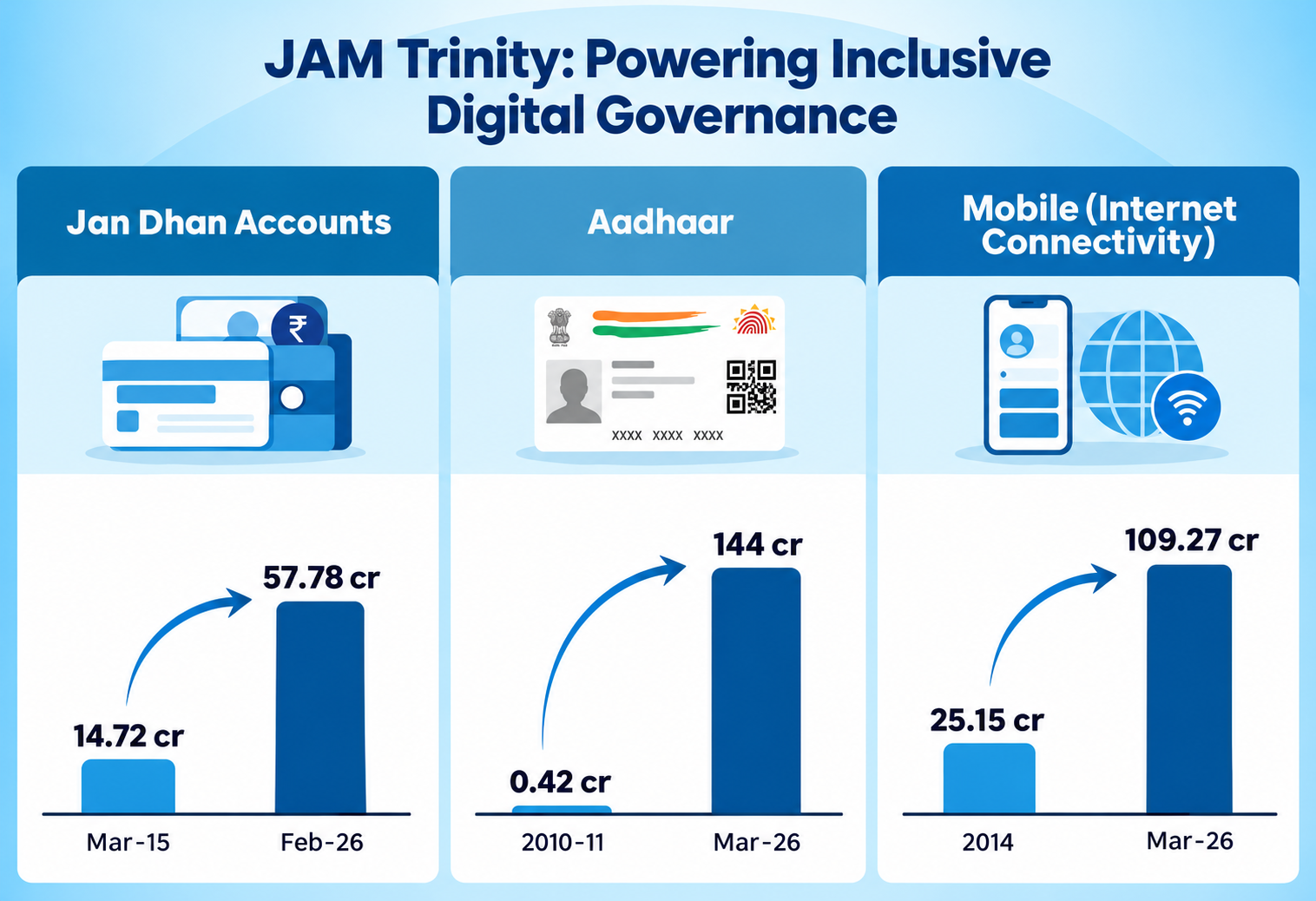
- The JAM Trinity (Jan Dhan-Aadhaar-Mobile) supports direct, more transparent welfare delivery. The government has also reported estimated prevented leakages of about ₹4.3 lakh crore.
- Transparent public procurement: The Government e-Marketplace (GeM) recorded cumulative procurement worth over ₹20 lakh crore through more than 3.78 crore orders by August 2026.
- An IIT Delhi study estimated ₹1.76 lakh crore in net social savings through price and process efficiencies during FY 2023-24 to FY 2025-26.
- Digital payments at scale: UPI processed over 24,162 crore transactions worth approximately ₹314 lakh crore in FY 2025-26. It accounted for about 85% of India’s digital payments, strengthening low-friction transactions and digital financial inclusion.
- Paperless and faster administration: Under e-Office, 93.78% of files created in February 2026 were e-files, and 95.30% of receipts were e-receipts.
- The average number of transaction levels for active files fell from 7.19 in 2021 to 4.13 in February 2026, supporting faster decision-making and improved file tracking.
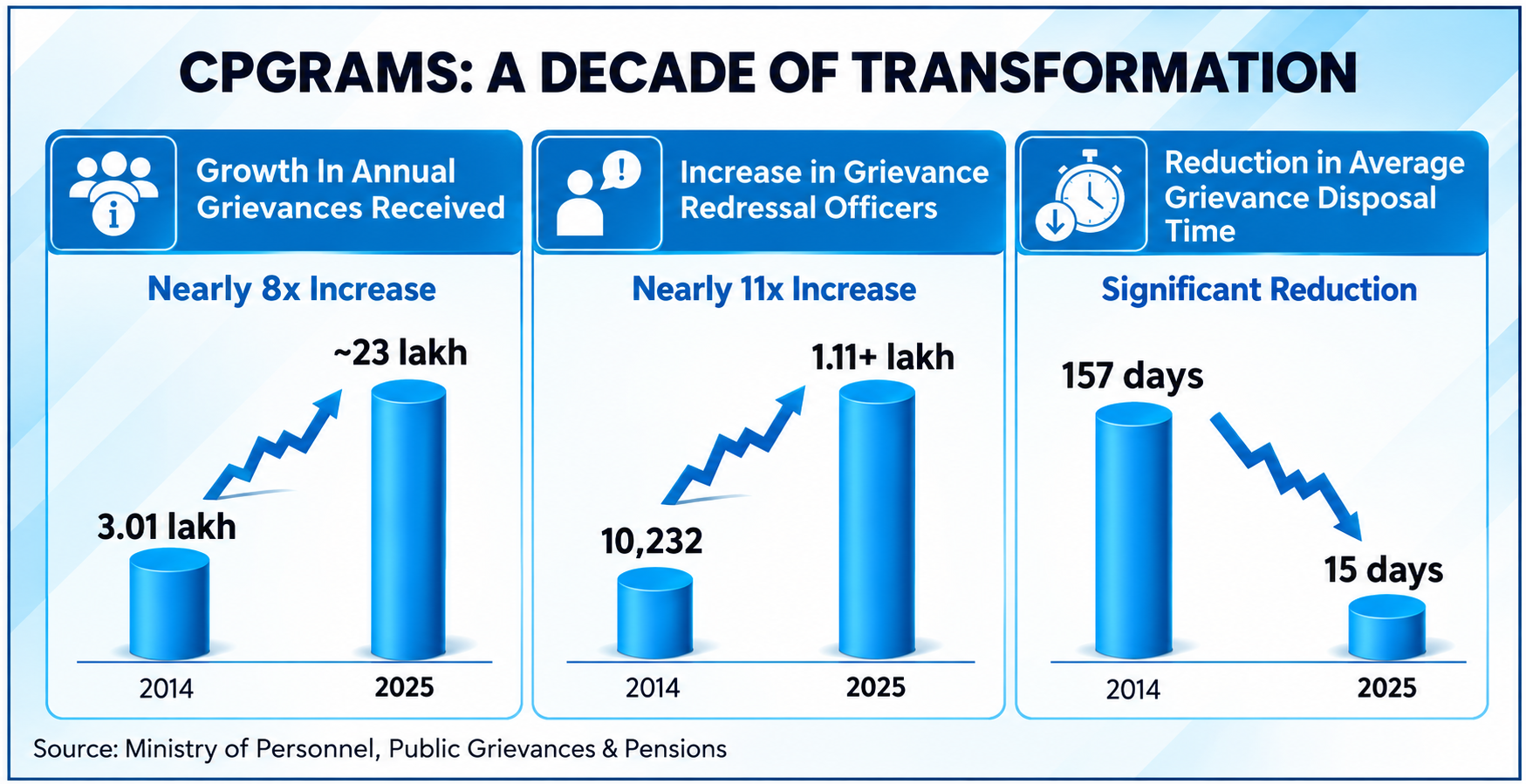
- Improved grievance redressal: CPGRAMS enables citizens to lodge and track public grievances online, reducing the average disposal time for grievances handled by Central Government ministries and departments to 15 days in 2025.
- The platform’s integration with Common Service Centres also expands access to grievance registration beyond digitally confident users.
- Digital document access and single-window services: As of 31 July 2026, DigiLocker had more than 72.43 crore registered users, while UMANG had over 11.66 crore registered users and offered approx. 2,575 government services. These platforms reduce dependence on physical documents and multiple departmental portals.
- Last-mile digital service delivery: By May 2026, 5.01 lakh Common Service Centres (CSCs) were functional across rural and urban India, including 3.91 lakh at Gram Panchayat level. They provide more than 800 government and business services, helping people access digital governance through assisted service delivery.
- Expanded digital connectivity: By June 2026, approx. 2.21 lakh Gram Panchayats had been made service-ready under BharatNet. Internet subscribers reached 109.27 crore in March 2026, strengthening the infrastructure needed for online government services, especially in rural and remote areas.
E-Governance Challenges
Despite its benefits, e-governance faces technological, administrative and social barriers. Digital services cannot achieve universal access or public trust unless governments address unequal connectivity, limited technical capacity, data security and the needs of diverse users.
- Digital literacy barriers: Unequal access to digital devices, connectivity and digital skills can exclude sections of society from online services.
- Inadequate infrastructure: Weak connectivity and limited technical capacity can obstruct implementation, especially in underserved areas.
- Privacy and data protection: Poor data governance and inadequate safeguards can expose personal information and undermine public trust.
- Cybersecurity risks: Digital systems require effective protection against cyber threats and unauthorised access.
- Algorithmic bias: Automated decisions may reproduce social biases if systems are opaque or inadequately audited.
- Institutional coordination: Fragmented departments and incompatible systems can obstruct information sharing and integrated service delivery.
- Uneven regional development: E-governance initiatives have been concentrated in certain states, potentially widening regional disparities.
- Implementation constraints: Limited budgets, technical expertise and administrative capacity can delay or weaken projects.
- Trust deficit: Citizens may hesitate to use digital services if they are concerned about privacy, security, reliability or the fairness of automated decisions.
E-Governance Way Forward
The way forward for e-governance is to combine technological innovation with inclusive access, secure data practices and accountable administration. Digital transformation should make public services easier to use while preserving citizen trust and meaningful participation.
- Bridge the digital divide: Improve access to connectivity, public internet facilities and digital services for underserved communities.
- Strengthen digital literacy: Help citizens develop the skills needed to access government platforms independently.
- Adopt citizen-centric design: Build simple, accessible and multilingual interfaces that respond to users' needs.
- Improve interoperability: Enable secure information exchange and coordination among government departments.
- Strengthen cybersecurity: Protect digital infrastructure and public information through appropriate security measures.
- Ensure privacy by design: Integrate data protection and purpose limitation into the design and operation of digital services.
- Promote responsible AI: Make automated systems more transparent, explainable and accountable, with safeguards against algorithmic bias.
- Improve institutional capacity: Address shortages in technical expertise, implementation capacity and financial resources.
- Expand citizen participation: Strengthen online consultation, feedback and other mechanisms for public engagement.
- Reduce regional disparities: Encourage wider adoption of effective digital governance practices across states and local institutions.
E-Governance UPSC PYQs
Q1. E-governance projects have a built-in bias towards technology and back-end integration than user-centric designs. Examine. (Mains 2025)
Q2. E-governance is not just about the routine application of digital technology in service delivery process. It is as much about multifarious interactions for ensuring transparency and accountability. In this context evaluate the role of the 'Interactive Service Model' of e-governance. (Mains 2024)
Q3. E-governance, as a critical tool of governance, has ushered in effectiveness, transparency and accountability in governments. What inadequacies hamper the enhancement of these features? (Mains 2023)
Q4. Has digital illiteracy, particularly in rural areas, coupled with lack of Information and Communication Technology (ICT) accessibility hindered socio-economic development? Examine with justification. (Mains 2021)
Q5. Regarding 'DigiLocker', sometimes seen in the news, which of the following statements is/are correct? (Prelims 2016)
- It is a digital locker system offered by the Government under Digital India Programme.
- It allows you to access your e-documents irrespective of your physical location.
Select the correct answer using the code given below.
(a) 1 only
(b) 2 only
(c) Both 1 and 2
(d) Neither 1 nor 2
Ans: (c)

 Last updated on Oct, 2026
→ UPSC 2027 Notification will be released on 13 January 2027 at upsconline.nic.in.
→ Check Nobel Prize 2026 Winners List here.
→ Download PIB PRiSM Monthly Magazine 2026 here.
→ Check UPSC Monthly Current Affairs Magazine The Recitals here.
→ Check out the latest UPSC Syllabus here.
→ Download UPSC Model Answers for Mains 2026
→ UPSC Mains Question Paper 2026 is out now for Essay & GS Paper 1, 2, 3 & 4.
→ UPSC Calendar 2027 has been released.
→ Enroll in Vajiram & Ravi’s UPSC Mains Test Series 2027 for structured answer writing practice, expert evaluation, and exam-oriented feedback.
→ Join Vajiram & Ravi’s UPSC Mentorship Program 2027 for personalized guidance, strategy planning, and one-to-one support from experienced mentors.
→ Go through the UPSC Mains Previous Year Papers to enhance your preparation.
→ UPSC has released UPSC Toppers List 2025 with the Civil Services final result on its official website.
→ Also check Best UPSC Coaching in India
E-Governance FAQs
Q1. What do you mean by e-governance?+
Q2. What are the five major components of e-governance?+
Q3. What is the difference between e-government and e-governance?+
Q4. What are the four stages of e-governance?+
Q5. What are the key platforms of e-governance in India?+
Tags: e-governance quest UPSC Governance Notes