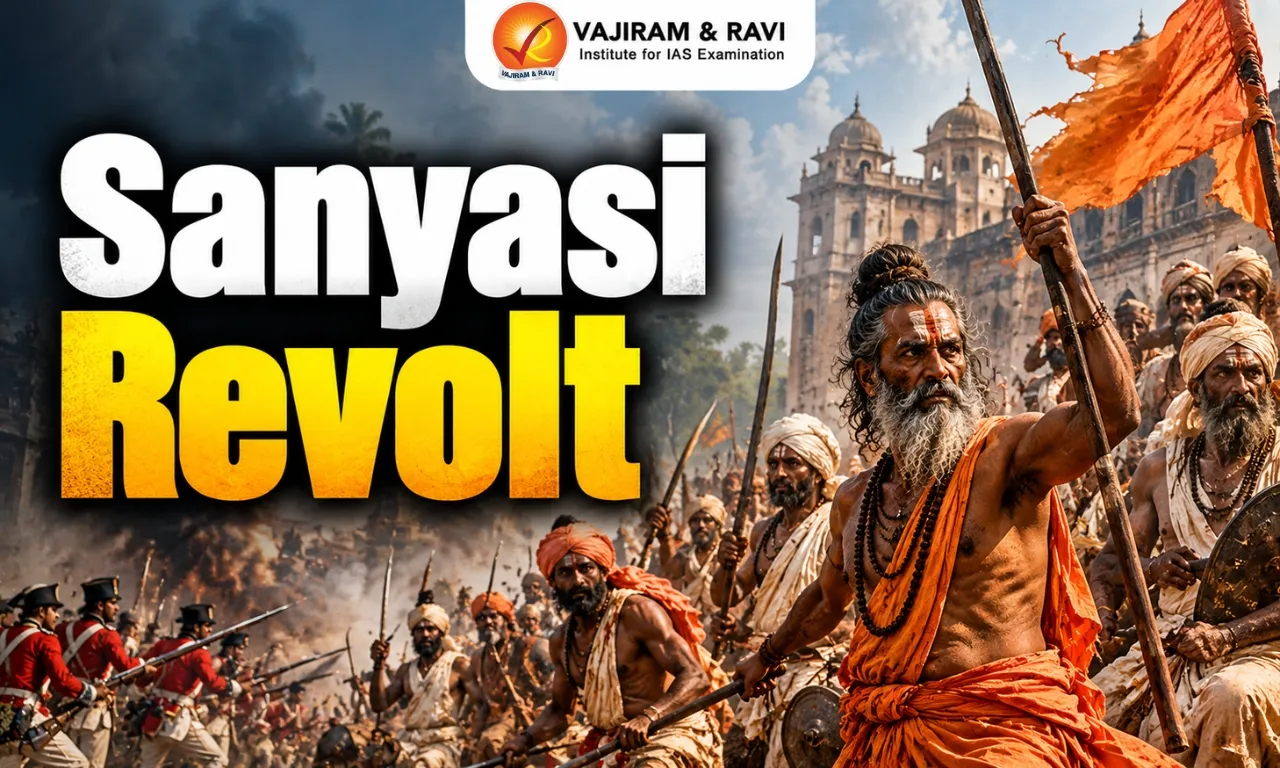
The Sanyasi Revolt, also known as the Sanyasi Rebellion, was an early resistance to East India Company rule in Bengal and adjoining areas of Bihar. Led by Hindu Sanyasis and Muslim Fakirs, the movement emerged amid revenue pressures, rural distress, restrictions on traditional practices, and the Bengal Famine of 1770.
Though ultimately suppressed, the Sanyasi Rebellion represented an important early challenge to colonial authority. The participation of Sanyasis, Fakirs, peasants and other distressed groups reflected cross-community resistance and formed part of the broader pattern of pre-1857 resistance to British rule.
Sanyasi Revolt About
The Sanyasi Revolt was not a single battle or a centrally coordinated movement. It consisted of recurring confrontations between mobile groups of ascetics, their local supporters, and the East India Company. These groups challenged Company authority through raids, attacks on revenue establishments, and resistance to restrictions on their activities.
- Before the company rule expanded, sanyasis and fakirs travelled through Bengal for pilgrimage, religious activity, and customary collections from local communities and landholders.
- Company regulations disrupted these arrangements. Officials treated organised collections as unauthorised exactions, creating conflict over livelihood, authority, and established practices.
Sanyasi Revolt Time Period
The Sanyasi Revolt is commonly dated from 1763 to around 1800, although clashes and related resistance activities continued into the early nineteenth century in some accounts. The movement developed in the decades following the Battle of Plassey in 1757, with growing momentum to 1763, and some later activity around 1800.
Sanyasi Revolt Objectives
Sanyasi Revolt arose as a response to colonial restrictions that disrupted the traditional livelihoods, movements, and practices of Sanyasis and Fakirs. Their resistance also reflected growing opposition to Company revenue policies and expanding colonial authority. The principal objectives included:
- Protect Traditional Livelihoods: Defend established systems of patronage, alms and economic support on which many mendicants depended.
- Oppose Revenue Pressure: Resist rising land-revenue demands and Company revenue policies that intensified economic hardship.
- Resistance to Local Intermediaries: Challenge the authority of certain revenue collectors and zamindars associated with Company rule.
- Preservation of Customary Rights: Defend established religious and social practices disrupted by the expanding colonial administration.
Sanyasi Rebellion Causes
Sanyasi Rebellion emerged from a combination of economic hardship, revenue exploitation, and restrictions on traditional practices. The Bengal Famine of 1770 further intensified rural distress and expanded participation in the movement.
- Expansion of East India Company Rule: The expansion of Company authority altered relationships between rulers, landholders, peasants, and travelling religious groups. The Company’s acquisition of Diwani rights in 1765 strengthened its revenue-collecting position and increased pressure on existing arrangements of support and payment.
- Restrictions on Movement: Sanyasis and fakirs traditionally collected alms and contributions during their journeys. The British East India Company regarded organised collections as unauthorised impositions and attempted to prohibit them.
- Bengal Famine of 1770: The Bengal Famine devastated rural society and deepened poverty and insecurity. Starving and distressed peasants joined ascetic groups, expanding the social base of resistance.
- The famine intensified existing grievances and increased the number of people willing to challenge Company authority.
- Disruption of Traditional Social Networks: Company regulations weakened established connections among religious institutions, local patrons, landholders, and rural communities. The resulting social dislocation helped bring groups with different immediate concerns into a common struggle.
- Rural Economic Distress: Revenue pressures, famine, and the erosion of local support systems placed considerable strain on peasants and affected landholders. Their participation gave the rebellion a broader economic character beyond disputes involving religious groups alone.


Sanyasi Rebellion Leader
Sanyasi Revolt leaders included several Hindu Sanyasis and Muslim Fakirs who led and organised resistance against the East India Company in Bengal and Bihar.
- Majnu Shah: A prominent Madari Fakir leader who organised guerrilla resistance and mobilised fighters across northern Bengal and Bihar.
- Pandit Bhabani Charan Pathak: A prominent Hindu Sanyasi leader associated with resistance from forested regions and support for distressed local groups.
- Musa Shah: Associated with the continuation of the resistance after Majnu Shah, particularly during the 1780s.
- Chirag Ali: A prominent Fakir leader who continued armed resistance against Company forces.
- Debi Chaudhurani: A legendary figure associated with the rebellion, particularly through Bankim Chandra Chattopadhyay’s literary portrayal; her status as a historical leader is less certain.
Sanyasi Revolt Course of Events
The Sanyasi Revolt developed through repeated local confrontations rather than a single, uninterrupted military campaign. Its course reflected changing economic conditions, leadership networks, and Company responses.
| Period | Major developments |
|
Early 1760s |
Resistance emerged against Company restrictions and interference with customary practices. Armed confrontations gained momentum across parts of Bengal. |
|
1768–1770 |
Rebels targeted revenue offices in districts including Rajshahi, Dinajpur, Rangpur, and Purnea. |
|
Following the 1770 famine |
Rural distress encouraged greater peasant participation. |
|
1770s–1780s |
Regional leaders sustained raids and resistance against Company establishments. After Majnu Shah’s death in 1787, Musa Shah and other leaders continued the movement. |
|
Late 1790s and around 1800 |
Suppression and leadership losses weakened organised resistance, though some activity continued later. |
Sanyasi Rebellion Significance
Sanyasi Rebellion was significant through its impact on the British East India Company, its place in historical discourse, and its portrayal in literature.
- Early Resistance to British Rule in India: It demonstrated resistance to the Company’s expanding political and economic control soon after its consolidation in Bengal.
- Popular Participation: The movement extended beyond religious mendicants to include peasants, dispossessed zamindars, and disbanded soldiers.
- Economic Resistance: Rebels targeted government treasuries, grain stocks, and officials, reflecting opposition to colonial revenue and economic policies.
- Hindu-Muslim Participation: The joint participation of Sanyasis and Fakirs reflected an important element of cross-religious resistance.
- Literary Influence: Bankim Chandra Chatterjee’s Anandamath (1882) drew upon the Sanyasi rebellion and later became associated with nationalist imagination.
- Historical Significance: The rebellion inspired later uprisings, including the Fakir Rebellion and several tribal revolts in eastern India.
Sanyasi Rebellion Reasons for Failure
The Sanyasi Rebellion failed to displace Company rule. Its limitations can be understood through its decentralised organisation, regional character, and the sustained pressure exerted by colonial authorities.
- Lack of Centralised Leadership: The rebellion consisted of dispersed groups rather than a unified command structure.
- Limited Military Resources: The rebels lacked the organised military resources and firepower available to the Company.
- Fragmented Objectives: Different participating groups had varied economic, social, and livelihood-related grievances.
- British Military Suppression: The Company deployed sustained military operations against rebel groups across Bengal and Bihar.
- Declining Support: As the Company strengthened its administrative and revenue-control mechanisms, the rebels found it increasingly difficult to sustain their activities.
- Limited Territorial Reach: Despite establishing temporary zones of influence, the movement could not establish a durable alternative political authority across the region.

 Last updated on Oct, 2026
→ UPSC 2027 Notification will be released on 13 January 2027 at upsconline.nic.in.
→ Check Nobel Prize 2026 Winners List here.
→ Download PIB PRiSM Monthly Magazine 2026 here.
→ Check UPSC Monthly Current Affairs Magazine The Recitals here.
→ Check out the latest UPSC Syllabus here.
→ Download UPSC Model Answers for Mains 2026
→ UPSC Mains Question Paper 2026 is out now for Essay & GS Paper 1, 2, 3 & 4.
→ UPSC Calendar 2027 has been released.
→ Enroll in Vajiram & Ravi’s UPSC Mains Test Series 2027 for structured answer writing practice, expert evaluation, and exam-oriented feedback.
→ Join Vajiram & Ravi’s UPSC Mentorship Program 2027 for personalized guidance, strategy planning, and one-to-one support from experienced mentors.
→ Go through the UPSC Mains Previous Year Papers to enhance your preparation.
→ UPSC has released UPSC Toppers List 2025 with the Civil Services final result on its official website.
→ Also check Best UPSC Coaching in India
Sanyasi Revolt UPSC
Q1. Who first used the term “Sanyasi Revolt”?+
Q2. Who were the leaders of the Sanyasi Revolt?+
Q3. Where did the Sanyasi-Fakir Rebellion first begin?+
Q4. Why did the Sanyasi-Fakir Rebellion fail?+
Q5. Who was killed in the Sanyasi uprising?+
Tags: quest sanyasi revolt upsc modern history notes