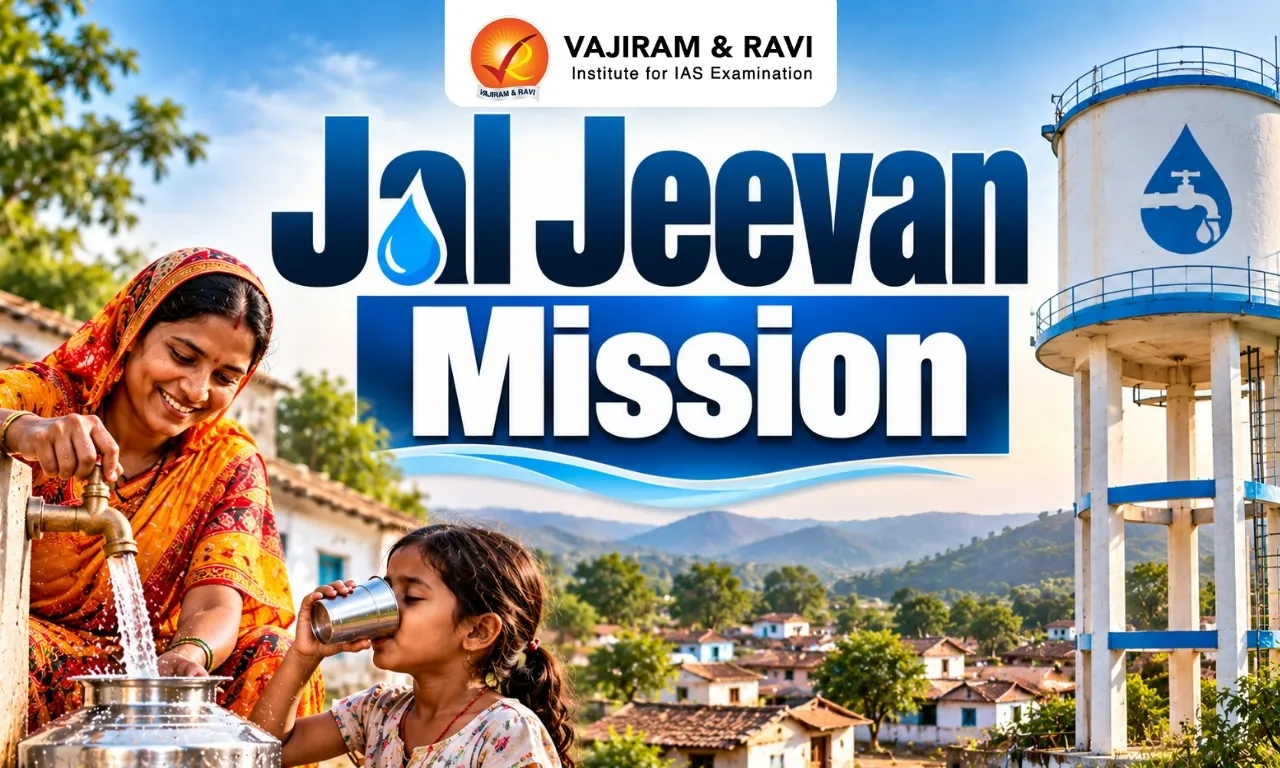
Jal Jeevan Mission (JJM) is a flagship Government of India programme launched on 15 August 2019, aimed at providing safe drinking water to rural households through functional tap connections by 2024. Initially targeted for completion by 2024, the mission has been extended to December 2028 under Jal Jeevan Mission 2.0 (JJM 2.0). The revised framework places greater emphasis on reliable service delivery, sustainable water sources and community-led management.
To build a truly robust system, the mission absorbed the structural strengths of the erstwhile National Rural Drinking Water Programme (NRDWP). Key initiatives like Swajal, the National Water Quality Sub-Mission, and low-income state projects are now seamlessly integrated alongside dedicated quality monitoring, surveillance, and community support activities to secure India's water future.
Jal Jeevan Mission Need
The Jal Jeevan Mission is necessary due to the difficulties faced in providing clean drinking water in rural areas, the unequal distribution of water resources, the issue of water contamination, and the significant amount of time families spend fetching water. The mission seeks to address these concerns through household-level piped supply. Its need can be understood through the following dimensions:
- Access to drinking water: Household tap connections aim to reduce dependence on distant water sources and make drinking water more accessible in rural areas.
- Public health: Safe drinking water can reduce exposure to waterborne diseases. However, installing a tap alone does not guarantee that its water is safe to drink.
- Gender equality: Women and girls often bear a disproportionate burden of water collection. Reliable household supply can free up time for education, employment and other activities.
- Regional inequalities: Water availability varies across drought-prone, desert, groundwater-dependent and difficult-terrain regions. Rural supply systems therefore need to reflect local conditions.
- Water security: Household connections must be supported by reliable sources, water conservation and adequate maintenance to avoid interruptions.
- Rural development: Drinking-water access supports sanitation, hygiene, education and improved living standards.
- Attaining SDGs: The Jal Jeevan Mission (JJM) is directly tied to attaining Sustainable Development Goal 6 (SDG 6), specifically Target 6.1, which aims to achieve universal and equitable access to safe and affordable drinking water for all by 2030.
- Beyond clean water, the mission creates a multiplier effect that helps achieve several broader SDGs such as 1, 3, 5, 8, 11 and 13.
Jal Jeevan Mission Objectives
Jal Jeevan Mission aims to achieve universal household tap water coverage across rural India while building decentralised, community-owned, and source-sustainable water supply systems. The broad objectives of the Jal Jeevan Mission include:
- To provide every rural household with a Functional Household Tap Connection (FHTC) delivering adequate quantities of prescribed-quality drinking water on a regular and long-term basis.
- Giving priority to areas where water quality is poor, regions prone to drought, desert areas, and villages under the Sansad Adarsh Gram Yojana (SAGY) for FHTC.
- Guaranteeing functional tap connections in schools, Anganwadi centres, gram panchayat offices, health and wellness centres, and community buildings.
- Regularly checking the working condition of tap connections to ensure they remain functional.
- Encouraging the local community to take ownership of the initiative through voluntary contributions in cash, goods, or through unpaid labour (shramdaan).
- Making sure that water supply systems are sustainable by maintaining water sources, infrastructure, and funding for ongoing operations and repairs.
- Training and developing human resources in the water sector, including skills in construction, plumbing, electrical work, water quality management, water treatment, catchment protection, and more.
- Creating awareness about the importance of safe drinking water and involving all stakeholders to make water a shared responsibility.


Jal Jeevan Mission Features
The Jal Jeevan Mission (JJM) combines household tap-water access with prescribed quality and quantity standards, sustainable water sources, community participation and technology-enabled monitoring. Its key features are:
- Priority coverage: Priority is given to quality-affected areas, drought-prone and desert regions, and villages covered under the Sansad Adarsh Gram Yojana (SAGY). Schools, Anganwadi centres, Gram Panchayat buildings, health centres and community buildings are also covered under the mission's objectives.
- Decentralised, community-managed implementation: Gram Panchayats and their subcommittees, including Village Water and Sanitation Committees (VWSCs) and Paani Samitis, participate in planning, implementation, operation and maintenance of village water-supply systems.
- Community ownership and women's participation: The mission encourages voluntary contributions in cash, kind or labour (shramdaan). VWSCs/Paani Samitis include women's participation and representation of marginalised communities. Women are also trained to test water samples using Field Test Kits (FTKs).
- Mandatory attention to source sustainability: The mission supports the development and augmentation of reliable drinking-water sources, groundwater recharge, rainwater harvesting and catchment protection. It also encourages greywater treatment and reuse, including convergence with other relevant schemes.
- Retrofitting existing schemes: Ongoing and completed rural water-supply schemes can be upgraded to provide Functional Household Tap Connections (FHTCs) at the prescribed service level of 55 LPCD.
- Water-quality monitoring and treatment: The mission supports water-quality laboratories, Field Test Kits, community surveillance and technological interventions to remove contaminants. Priority is given to habitations affected by chemical contaminants such as arsenic and fluoride.
- Digital monitoring and quality assurance: The mission uses the JJM dashboard, mobile applications, geo-tagging of assets and sensor-based Internet of Things (IoT) solutions in selected applications. Third-party inspections help verify construction quality before payments are made.
- Financial convergence: JJM encourages pooling resources from different programmes and funding sources, including Finance Commission-tied grants for rural water and sanitation activities, subject to applicable guidelines.
- Capacity building and technical support: Information, Education and Communication (IEC), Human Resource Development (HRD), training, research, community capacity building and water-utility development support sustainable service delivery.
Jal Jeevan Mission Components
The components of the Jal Jeevan Mission include the following:
- JJM encourages pooling resources from different programmes and funding sources, including Finance Commission -tied grants for rural water and sanitation activities, subject to applicable guidelines.
- Development of in-village piped water supply infrastructure to provide tap water connections to every rural household.
- Development of reliable drinking water sources and/or augmentation of existing sources to ensure the long-term sustainability of the water supply system.
- Where necessary, bulk water transfer, treatment plants, and distribution networks should be established to cater to every rural household.
- Technological interventions should be implemented to remove contaminants when water quality is a concern.
- Retrofitting of completed and ongoing schemes to provide functional household tap connections (FHTCs) at a minimum service level of 55 litres per capita per day (LPCD).
- Greywater management systems should be promoted.
- Support activities such as information, education, and communication (IEC), human resource development (HRD), training, development of local utilities, water quality laboratories, water quality testing and surveillance, research and development (R&D), knowledge centres, and capacity building of communities should be undertaken.
- Flexi-fund provisions, where applicable, may be used to address eligible unforeseen challenges arising from natural disasters or other circumstances, in accordance with the relevant guidelines and the revised implementation framework.
Jal Jeevan Mission 2.0 (JJM 2.0)
Jal Jeevan Mission 2.0 restructures the rural drinking-water programme from infrastructure creation to reliable, sustainable service delivery, ensuring safe and adequate tap water for every rural household.
- Extension: Approved by the Union Cabinet on 10 March 2026; the mission is extended until December 2028.
- Financial outlay: ₹8.69 lakh crore, including ₹3.59 lakh crore in central assistance.
- Universal coverage: Targets tap-water connections for all 19.36 crore rural households and certification of all Gram Panchayats as Har Ghar Jal by December 2028.
- Key reforms:
- Sujalam Bharat: Unique IDs and digital mapping of village water-supply systems from source to tap.
- Jal Arpan: Formal handover of completed schemes to Gram Panchayats and Village Water and Sanitation Committees (VWSCs).
- Jal Seva Aankalan: Community-led assessment of water-service delivery and citizen feedback.
- Jal Utsav: Annual, community-led review and maintenance initiative.
- Sustainability: Focuses on conserving sources, monitoring water quality, operating and maintaining systems at the village level, and ensuring community ownership.
- Accountability: Reform-linked agreements with States/UTs, scheme validation, digital expenditure tracking and performance monitoring strengthen transparency.
Jal Jeevan Mission Implementation
Jal Jeevan Mission implementation relies on a four-tier institutional architecture and a bottom-up planning process that places the village community at the centre of decision-making.
- Four-Tier Institutional Mechanism: Execution is coordinated across four levels
- the National Jal Jeevan Mission (NJJM) at the Centre,
- the State Water and Sanitation Mission (SWSM) at the State level,
- the District Water and Sanitation Mission (DWSM) at the District level,
- and the Paani Samiti at the village level.
- Paani Samiti Composition and Mandate: As a sub-committee of the Gram Panchayat, the Village Water and Sanitation Committee (VWSC) or Paani Samiti comprises 10 to 15 members.
- Its composition mandates at least 50% women members, up to 25% elected Panchayat representatives, and proportionate representation from Scheduled Castes (SC) and Scheduled Tribes (ST) within the remaining 25%.
- Village Action Plan (VAP) and ISAs: Assisted by Implementation Support Agencies (ISAs), each village assesses its existing water infrastructure and prepares a comprehensive Village Action Plan (VAP) that feeds into the State Action Plan (SAP).
- Three-Stage Har Ghar Jal Certification Process: Under the Jal Jeevan Mission Integrated Management Information System (IMIS) Dashboard, a village progresses through three verification stages:
- Stage 1 (100% Tap-water Coverage Noted): Every household provided with a tap connection is entered into the JJM-IMIS after verifying the identity details of the head of the household.
- Stage 2 (Har Ghar Jal Reported): The State/UT water supply department officially confirms that water is flowing through taps to all households, schools, and Anganwadi centres.
- Stage 3 (Har Ghar Jal Certified): The Gram Sabha and Gram Panchayat formally certify the village as "Har Ghar Jal" after confirming functional water supply and established in-village operation and maintenance (O&M) arrangements.
- Separate MoUs and Whole-of-Government Approach: Under JJM 2.0, the Centre signs separate Memoranda of Understanding (MoUs) with States and UTs to enforce strict timelines, source sustainability, and cross-departmental convergence.
Jal Jeevan Mission Steps Taken By The Government
The government has adopted financial, technical, administrative and community-based measures to address JJM’s implementation challenges, strengthen local capacity, ensure water-source sustainability and improve rural drinking-water service delivery.
- Financial support: 50-year interest-free loans under Special Assistance to States for Capital Expenditure.
- Faster clearances: Nodal officers to coordinate with Central ministries and agencies.
- Capacity building: State Programme Management Units (SPMUs), District Programme Management Units (DPMUs) and the Nal Jal Mitra Programme to strengthen local technical skills.
- Source sustainability: Borewell recharge structures, rainwater harvesting, rejuvenation of water bodies and greywater reuse converged with schemes such as Viksit Bharat — Guarantee for Rozgar & Ajeevika Mission (Gramin).
- Community participation: Jal Shakti Abhiyan: Catch the Rain, promoting grassroots water conservation and community-led action.
Jal Jeevan Mission Achievements
Jal Jeevan Mission has rapidly expanded rural household tap-water access, strengthened village-level water governance and improved water-quality monitoring, with increasing emphasis on reliable service delivery and long-term sustainability. Its major achievements are:
- Rapid expansion of tap-water coverage: As of 11 October 2026, over 15.97 crore rural households (82.52%) had tap-water connections, up from 3.23 crore households (16.72%) at the mission's launch in 2019. More than 12.68 crore additional households have been connected.
- Progress towards ‘Har Ghar Jal’: 188 districts, 1,090 blocks, 1.01 lakh Gram Panchayats and 2.04 lakh villages had been certified as Har Ghar Jal by August 2026. Certification indicates verification of reported household tap-water coverage.
- Institutional water access: As of August 2026, 9.34 lakh schools (90.86%) and 9.73 lakh Anganwadi centres (86.21%) had tap-water connections, supporting water access in educational and child-care institutions.
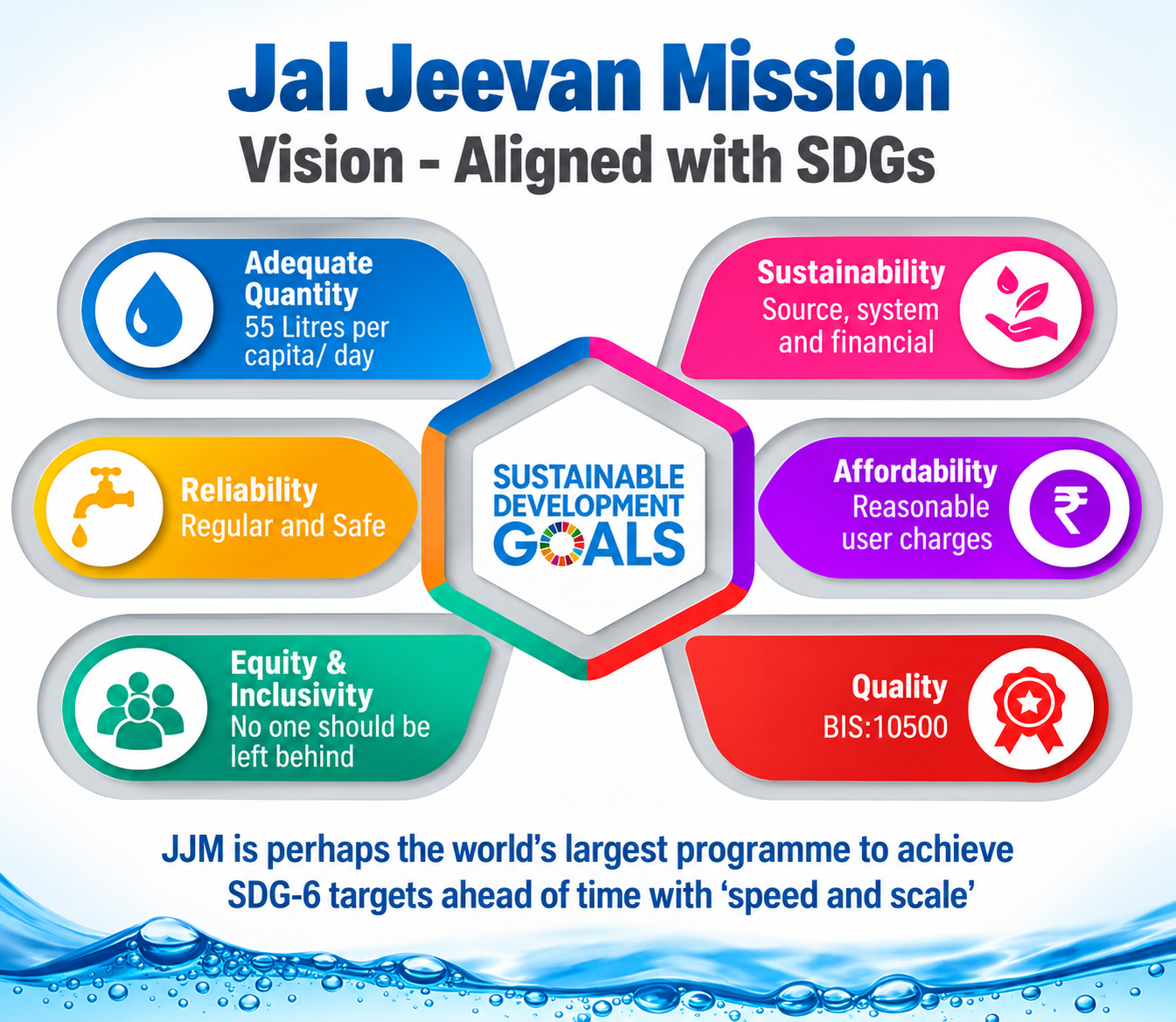
- Improved service-delivery standards: The Jal Jeevan Mission has shifted rural drinking-water provision from habitation-level coverage towards Functional Household Tap Connections (FHTCs), with a service benchmark of 55 litres per capita per day (LPCD) and prescribed water quality under BIS:10500.
- Strengthened water-quality monitoring: As of October 2025, 2,843 water-testing laboratories had tested 38.78 lakh water samples across 4,49,961 villages. This strengthens surveillance and helps identify contamination risks.
- Women’s participation in water surveillance: By October 2025, 24.80 lakh women had been trained to test water quality using Field Testing Kits (FTKs) in 5.07 lakh villages, increasing community-level monitoring and women’s participation in local water governance.
- Reduced drudgery for women and girls: The Jal Jeevan Mission has reduced dependence on distant water sources, freeing time for education, livelihoods and productive activities.
- SBI Research reported an 8.3% point decline in households fetching water from outside and a 7.4% point increase in women’s participation in agriculture and allied activities.
- Potential health benefits: WHO estimates that universal coverage with safely managed drinking water could help avert nearly 4 lakh diarrhoeal deaths and 14 million disability-adjusted life years (DALYs) in India.
- Employment-generation potential: An assessment by IIM Bangalore and the International Labour Organisation (ILO) estimates that JJM could generate nearly 3 crore person-years of employment during its build-out.
- Community-led water governance: Gram Panchayats, Village Water and Sanitation Committees (VWSCs), Self Help Groups and local communities are increasingly involved in operating and maintaining schemes.
- In Mhapan village, Maharashtra, a women’s SHG manages the local scheme and reported 100% water-bill collection, illustrating community-led sustainability.
- Greater focus on source sustainability: Alongside connections, the Mission promotes groundwater recharge, rainwater harvesting, greywater management, water conservation and village-level water security planning.
- The Jal Sanchay Jan Bhagidari: Catch the Rain 2026 initiative, launched on 1 June 2026, further emphasises community-driven rainwater harvesting and long-term water security.
Jal Jeevan Mission Challenges
The Jal Jeevan Mission faces geographical, financial, technical and institutional constraints that affect the sustainable provision of safe, adequate and regular rural drinking water.
- Source Sustainability and Water Scarcity: Groundwater depletion, seasonal variability, droughts and unreliable source yields threaten the long-term availability of drinking water, particularly in water-stressed and desert regions.
- Water Quality: Geogenic contaminants, including arsenic and fluoride in affected areas, necessitate regular testing, appropriate treatment and sustained water-quality monitoring.
- Geographical Constraints and Rising Costs: Difficult terrain, remote settlements and scattered habitations increase infrastructure and distribution costs, while rising raw-material prices further increase implementation and maintenance expenditure.
- Financial Constraints: Delays in releasing funds, including the matching state share in some states, can slow project implementation and affect timely completion.
- Operation and Maintenance (O&M): Inadequate funding, shortages of trained personnel, unreliable electricity supply and limited access to spare parts can undermine the long-term functioning of rural water-supply systems.
- Functional Reliability: Household tap-connection coverage does not necessarily guarantee a continuous, safe and adequate water supply, highlighting the need to monitor actual service delivery and functionality.
- Technical and Institutional Capacity: Limited technical, financial and managerial capacity among implementing agencies, Gram Panchayats and Village Water and Sanitation Committees (VWSCs) can hinder planning, monitoring and effective operation of water-supply schemes.
- Administrative and Centre–State Coordination Issues: Delays in statutory clearances, administrative approvals, fund releases and intergovernmental coordination can impede implementation.
- Greywater Management: Increased household water access generates more wastewater, requiring effective village-level systems for its safe disposal, treatment and reuse.
Jal Jeevan Mission Way Forward
A sustainable approach to JJM requires strengthening water-source security, ensuring reliable service delivery, improving local capacity and promoting community ownership.
- Ensure Water-Source Sustainability: Promote rainwater harvesting, groundwater recharge, rejuvenation of traditional water bodies and watershed management. Converge JJM with schemes such as the Viksit Bharat–Guarantee for Rozgar and Ajeevika Mission (Gramin) to support water conservation and source sustainability.
- Strengthen Water-Quality Monitoring: Institutionalise regular water testing, expand access to local testing facilities and train community members to identify contamination. Ensure timely treatment and remedial action in affected areas.
- Improve Operation and Maintenance: Establish dedicated maintenance funds, train local technicians and ensure the availability of electricity, spare parts and repair services to sustain water-supply infrastructure.
- Shift Focus to Reliable Service Delivery: Monitor actual functionality, water quality, quantity and regularity of supply alongside household tap-connection coverage. Strengthen accountability through community feedback and periodic performance assessments.
- Enhance Financial and Administrative Efficiency: Ensure timely fund releases and State contributions, streamline statutory clearances and strengthen coordination between Central ministries, State departments and implementing agencies.
- Use available financial-support mechanisms, including 50-year interest-free loans under the Special Assistance to States for Capital Expenditure, where applicable.
- Build Local Technical Capacity: Strengthen State Programme Management Units (SPMUs) and District Programme Management Units (DPMUs), expand the Nal Jal Mitra Programme to train local technicians, and equip Gram Panchayats and Village Water and Sanitation Committees (VWSCs) to manage water-supply systems effectively.
- Adopt Region-Specific Solutions: Design decentralised and cost-effective water-supply systems suited to local hydrology, terrain and settlement patterns, particularly in remote, drought-prone and water-stressed regions.
- Strengthen Community Participation: Promote community-led water conservation through the Jal Shakti Abhiyan: Catch the Rain, while involving Gram Panchayats and VWSCs in planning, monitoring, maintenance and responsible water use.
- Promote Scientific Greywater Management: Develop decentralised wastewater treatment, soak pits, drainage systems and reuse mechanisms to manage household wastewater safely and reduce environmental contamination.
- Scaling Up Scientific Aquifer Recharge: Converging VB G RAM G, 15th Finance Commission grants, and the Jal Sanchay Jan Bhagidari campaign are essential to build scientifically designed recharge structures and protect local watersheds.
Jal Jeevan Mission UPSC PYQs
Q1. What are the salient features of the Jal Shakti Abhiyan launched by the Government of India for water conservation and water security? (Mains 2020)
Q2. Suggest measures to improve water storage and irrigation system to make its judicious use under depleting scenarios. (Mains 2020)

 Last updated on Oct, 2026
→ UPSC 2027 Notification will be released on 13 January 2027 at upsconline.nic.in.
→ Check Nobel Prize 2026 Winners List here.
→ Download PIB PRiSM Monthly Magazine 2026 here.
→ Check UPSC Monthly Current Affairs Magazine The Recitals here.
→ Check out the latest UPSC Syllabus here.
→ Download UPSC Model Answers for Mains 2026
→ UPSC Mains Question Paper 2026 is out now for Essay & GS Paper 1, 2, 3 & 4.
→ UPSC Calendar 2027 has been released.
→ Enroll in Vajiram & Ravi’s UPSC Mains Test Series 2027 for structured answer writing practice, expert evaluation, and exam-oriented feedback.
→ Join Vajiram & Ravi’s UPSC Mentorship Program 2027 for personalized guidance, strategy planning, and one-to-one support from experienced mentors.
→ Go through the UPSC Mains Previous Year Papers to enhance your preparation.
→ UPSC has released UPSC Toppers List 2025 with the Civil Services final result on its official website.
→ Also check Best UPSC Coaching in India
Jal Jeevan Mission FAQs
Q1. What is Jal Jeevan Mission?+
Q2. When was Jal Jeevan Mission launched?+
Q3. What is FHTC in the Jal Jeevan Mission?+
Q4. Which ministry implements the Jal Jeevan Mission?+
Q5. Has Jal Jeevan Mission been extended beyond 2024?+
Tags: jal jeevan mission quest UPSC Social Justice Notes