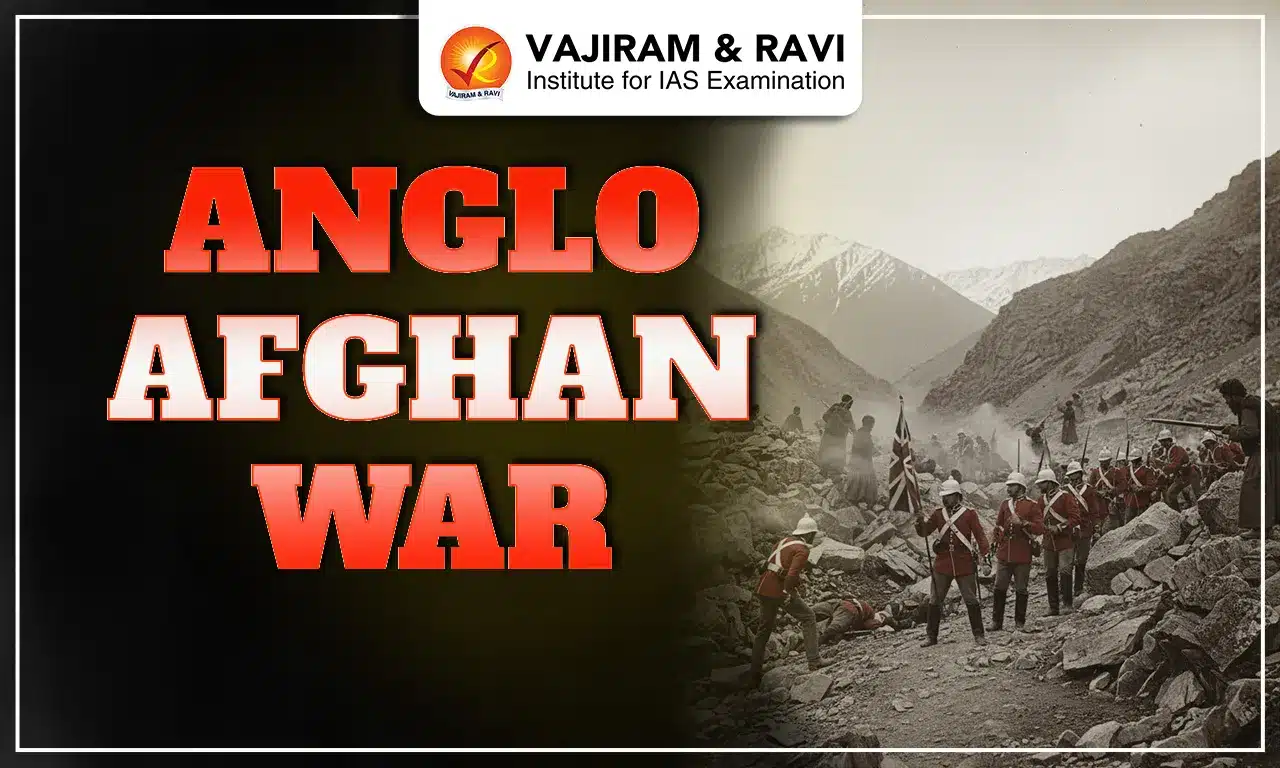
The Anglo-Afghan Wars were a series of three conflicts between Britain and Afghanistan, shaped by British efforts to protect British India and counter Russian influence in Central Asia. The First War ended in a disastrous British retreat, while the Second War strengthened British influence over Afghan foreign affairs.
The Third War under Amir Amanullah Khan challenged British control over Afghanistan’s external relations. It ended with Afghanistan gaining control of its foreign affairs, marking a decisive assertion of Afghan sovereignty and the decline of British influence in the region.
Anglo Afghan Wars Background
Anglo-Afghan relations were shaped by Afghanistan’s strategic location between British India and Central Asia. To understand the Anglo-Afghan Wars, it is necessary to examine the political and strategic importance of Afghanistan during the nineteenth century.
- Strategic Location: Afghanistan occupies a strategically important position between South Asia, Central Asia and the Iranian plateau. Its geographical location made it significant for any power seeking influence over the northwestern approaches to India.
- Expansion of the British Empire: During the nineteenth century, the British East India Company expanded its control across the Indian subcontinent. Following the expansion into northwestern India, British policymakers became increasingly concerned about the security of their frontier.
- Rise of Dost Mohammad Khan: Dost Mohammad Khan emerged as the ruler of Kabul in the aftermath of the decline of the Durrani Empire and the political fragmentation of Afghanistan.
- Dost Mohammad also attempted to maintain diplomatic relations with different regional powers. His dealings with Russia and Persia generated concern among British officials.
- Russian Expansion: Russia expanded its influence into Central Asia during the nineteenth century. British officials feared that Russian advances could eventually threaten the northwestern frontier of India.
- This concern became particularly intense during the 1830s, when developments involving Persia, Herat and Afghanistan heightened British strategic anxieties.
Anglo-Afghan Wars and the Great Game
The Great Game refers to the strategic rivalry between Britain and Russia for influence in Central Asia and its neighbouring regions. Britain sought to protect India, while Russian expansion generated concern about the security of the approaches to the subcontinent. Afghanistan lay between these competing imperial interests.
- British policymakers feared Russian influence in Kabul and hostile alliances in Afghanistan. They prioritized controlling strategic trade routes to India's north-western frontier and monitoring Persian developments, especially regarding Herat.
- Afghan rulers, however, were not merely passive participants. They attempted to use diplomacy with competing powers to protect their autonomy and strengthen their position. British attempts to prevent such independent diplomacy contributed directly to the first two wars.
Lord Auckland and the Forward Policy
Lord Auckland, Governor-General of India from 1836 to 1842, adopted an interventionist approach towards Afghanistan. This Forward Policy aimed to secure the frontier by establishing a friendly government beyond British India rather than relying only on defensive arrangements within Indian territory.
- Auckland supported replacing Dost Mohammad with Shah Shuja, a former Afghan ruler living in exile. The assumption was that a ruler restored with British assistance would protect British strategic interests.
- However, this underestimated both opposition to Shah Shuja and resentment of foreign occupation.
Tripartite Treaty, 1838
The Tripartite Treaty involved the British East India Company, Maharaja Ranjit Singh, and Shah Shuja. Its central purpose was to support Shah Shuja’s restoration to the Afghan throne.
- Shah Shuja also accepted restrictions on independent foreign relations and recognised Sikh territorial claims.
- Although the immediate diplomatic situation subsequently changed, the British proceeded with intervention. The decision transformed an attempt to secure India’s frontier into a costly effort to influence Afghanistan’s internal political order.
First Anglo-Afghan War (1839–1842)
The First Anglo-Afghan War was fought between British Rule in India and the Afghan rulers amid British fears of Russian and Persian influence. Britain deposed Dost Mohammad Khan and restored Shah Shuja, but Afghan resistance eventually forced British withdrawal.
Causes of the First Anglo-Afghan War
The principal causes were:
- British fear of Russian influence in Afghanistan.
- Distrust of Dost Mohammad’s diplomatic contacts.
- Auckland’s commitment to the Forward Policy.
- The decision to restore Shah Shuja through outside military support.
Course of the 1st Anglo-Afghan War
British-led forces initially achieved military success, occupying important centres and installing Shah Shuja in Kabul. However, these victories did not establish a stable political settlement. Opposition to the restored ruler and foreign presence intensified.
- British Invasion: Under Governor-General Lord Auckland, the Army of the Indus entered Afghanistan in 1839, captured Kandahar and Ghazni, and occupied Kabul.
- Restoration of Shah Shuja: Shah Shuja was restored as ruler, while Dost Mohammad Khan surrendered and was exiled to India.
- Afghan Resistance: An uprising in Kabul in November 1841 led to the deaths of British officials, including Alexander Burnes and William Macnaghten, followed by the disastrous British retreat in January 1842.
- Retreat from Kabul, 1842: In January 1842, the Kabul force began withdrawing towards Jalalabad. Attacks, severe winter conditions, and the collapse of supplies turned the retreat into a military disaster involving soldiers and camp followers.
Outcome of the 1st Anglo-Afghan War
British forces subsequently returned to Kabul in a punitive expedition, but they did not maintain a permanent occupation. They withdrew, and Dost Mohammad later returned to power. The war demonstrated that capturing Afghan cities did not guarantee control over the country or acceptance of a British-backed ruler.


Second Anglo-Afghan War (1878-1880)
The Second Anglo-Afghan War occurred under Viceroy Lord Lytton. Renewed concern about Russian influence and a dispute over diplomatic representation in Kabul triggered another British invasion.
Causes of Second Anglo-Afghan War
In 1878, a Russian mission reached Kabul. Britain demanded that Amir Sher Ali also receive a British mission. When the British mission was prevented from entering Afghanistan, Lytton treated this as grounds for military action.
Course of Second Anglo-Afghan War
British-led forces invaded Afghanistan in November 1878 in three columns (via the Khyber, Kurram, and Bolan passes). Emir Sher Ali Khan fled Kabul and died in Mazar-e Sharif; his son, Mohammad Yaqub Khan, took power.
- Treaty of Gandamak, 1879: After Sher Ali’s departure and death, his son Yakub Khan concluded the Treaty of Gandamak in May 1879. Under the settlement:
- Afghan foreign relations came under British control.
- A British representative was to reside in Kabul.
- Britain offered support to the Amir.
- Britain obtained important frontier concessions.
- Renewed Fighting: The settlement broke down after British representative Louis Cavagnari and members of his mission were killed in Kabul in September 1879. British forces returned to Kabul, and further fighting followed.
- Battle of Maiwand, 1880: The Battle of Maiwand was fought on 27 July 1880 between Afghan forces led by Ayub Khan and a British-led force. The Afghan victory became an important symbol of resistance to British military intervention.
- Battle of Kandahar, 1880: British forces later regrouped, and General Frederick Roberts led a successful march from Kabul to Kandahar.
Outcome of the 2nd Anglo-Afghan War
Abdur Rahman Khan was recognised as Amir. The resulting arrangement preserved Afghanistan’s internal autonomy while retaining British influence over its foreign relations. Under Lord Ripon, Britain moved away from prolonged occupation and maintained Afghanistan as a buffer state.
Third Anglo-Afghan War (1919)
The Third Anglo-Afghan War was fought in 1919 during Amanullah Khan’s rule. Unlike the first two wars, its immediate context was Afghanistan’s attempt to end British control over its external relations.
Causes of 3rd Anglo-Afghan War
Amanullah Khan became ruler of Afghanistan following the assassination of Habibullah Khan in February 1919. He sought to end the restrictions imposed on Afghanistan's foreign relations and establish the country as a fully independent state.
- Impact of the First World War: The First World War altered the international balance of power. Britain had faced significant wartime pressures, while developments in Russia created new diplomatic possibilities for Afghanistan. Amanullah saw an opportunity to challenge the existing relationship with Britain.
- Afghan Nationalism: Afghan rulers and political groups increasingly resented British influence over the country's foreign affairs. The demand for independence reflected a wider determination to protect Afghanistan's political sovereignty.
Course of the 3rd Anglo-Afghan War
Amanullah rejected the restrictions associated with the earlier Anglo-Afghan settlement. Fighting began along the frontier in May 1919, leading to a short conflict between Afghan and British-Indian forces. British forces also used aircraft during the campaign. A ceasefire followed in June 1919, leading to negotiations at Rawalpindi.
Outcome - Treaty of Rawalpindi, 1919
The Treaty of Rawalpindi, signed on 8 August 1919, ended the war. It recognised Afghanistan’s freedom to conduct its foreign affairs, ending the British restriction on its external sovereignty. British subsidies were discontinued.
- The Anglo-Afghan Treaty, signed at Kabul on 22 November 1921, subsequently developed the relationship further and affirmed the independence of both parties. Afghanistan had not previously been formally annexed to British India; the key change in 1919 concerned its external independence.
Anglo Afghan Wars Impacts
Anglo-Afghan campaigns significantly influenced British India’s northwestern frontier policy, military strategy, and perception of the Russian threat.
- Military Burden: Repeated Afghan campaigns required considerable deployment of the British Indian Army and financial resources.
- Changes in Frontier Strategy: The First War exposed the dangers of installing a ruler through invasion. The Second produced a different arrangement: British influence over Afghan external relations without permanent direct administration. These experiences encouraged reliance on a buffer-state strategy rather than outright annexation.
- Political Disruption in Afghanistan: The wars affected Afghanistan’s sovereignty, leadership, and relationship with neighbouring powers. The Second War produced a settlement limiting Afghanistan’s external freedom.
- Reorganisation of External Relations: The 1919 settlement ended Britain’s control over Afghan foreign affairs. British India consequently had to deal with Afghanistan as a neighbouring state able to conduct its own external diplomacy.
Anglo-Afghan Wars Related British Policies
British policy towards Afghanistan changed according to the perceived threat from Russia, developments within Afghanistan and the strategic priorities of British India. The principal approaches included the Forward Policy, non-intervention, Masterly Inactivity, Proud Reserve and the use of Afghanistan as a buffer state.
Lord Auckland and the Forward Policy
The Forward Policy aimed to extend British influence beyond India's immediate frontier to prevent rival powers from establishing a strategic foothold near British India. It is particularly associated with Lord Auckland's intervention in Afghanistan during the First Anglo-Afghan War and Lord Lytton's approach before the Second Anglo-Afghan War.
- Main Features:
- Active intervention in neighbouring territories.
- Establishment of friendly governments.
- Military expeditions to secure strategic objectives.
- Attempts to limit Russian influence.
- Greater involvement in Afghanistan's foreign affairs.
- Limitations: The policy underestimated local resistance, the difficulties of occupation and the financial costs of prolonged military intervention.
Policy of Strategic Non-Intervention
Policy of Strategic Non-Intervention Strategic non-intervention involved avoiding unnecessary military intervention in Afghanistan's internal affairs while maintaining vigilance over developments that might threaten British India.
- The policy recognised that Afghanistan's difficult terrain, political complexity and resistance to foreign domination made direct control expensive and potentially counterproductive.
- Under this approach, Britain could rely more heavily on diplomacy and friendly relations with the Afghan ruler rather than attempting to occupy the country.
Policy of Masterly Inactivity
The Policy of Masterly Inactivity is associated particularly with Lord Lawrence, who served as Viceroy of India from 1864 to 1869. It advocated restraint in Afghanistan's internal affairs and opposed unnecessary intervention in Afghan succession disputes or domestic politics. The policy emerged partly from the lessons of the First Anglo-Afghan War, which demonstrated the dangers of attempting to impose a ruler through military force.
- Main Features:
- Avoidance of unnecessary military intervention.
- Respect for Afghanistan's internal political arrangements.
- Greater reliance on diplomacy.
- Caution in responding to perceived Russian threats.
- Recognition that direct occupation could weaken rather than strengthen British security.
- Significance: The policy represented an alternative to aggressive frontier expansion and emphasised that Afghanistan's independence could serve British interests if the country remained outside the control of hostile powers.
Policy of Proud Reserve
The Policy of Proud Reserve is associated with Lord Lytton’s assertive approach towards Afghanistan. It emphasised British prestige, strategic frontiers, and preventing rival influence. In practice, Lytton’s demand for a British mission and his response to its rejection marked a departure from the earlier policy of restraint. This approach contributed to the Second Anglo-Afghan War.

 Last updated on Oct, 2026
→ UPSC 2027 Notification will be released on 13 January 2027 at upsconline.nic.in.
→ Check Nobel Prize 2026 Winners List here.
→ Download PIB PRiSM Monthly Magazine 2026 here.
→ Check UPSC Monthly Current Affairs Magazine The Recitals here.
→ Check out the latest UPSC Syllabus here.
→ Download UPSC Model Answers for Mains 2026
→ UPSC Mains Question Paper 2026 is out now for Essay & GS Paper 1, 2, 3 & 4.
→ UPSC Calendar 2027 has been released.
→ Enroll in Vajiram & Ravi’s UPSC Mains Test Series 2027 for structured answer writing practice, expert evaluation, and exam-oriented feedback.
→ Join Vajiram & Ravi’s UPSC Mentorship Program 2027 for personalized guidance, strategy planning, and one-to-one support from experienced mentors.
→ Go through the UPSC Mains Previous Year Papers to enhance your preparation.
→ UPSC has released UPSC Toppers List 2025 with the Civil Services final result on its official website.
→ Also check Best UPSC Coaching in India
Anglo-Afghan War UPSC
Q1. Who won the Anglo-Afghan Wars?+
Q2. What caused the Anglo-Afghan Wars?+
Q3. Who won the Third Anglo-Afghan War?+
Q4. Who fought the First Anglo-Afghan War?+
Q5. Who defeated Afghans in India?+
Tags: anglo-afghan wars quest upsc modern history notes