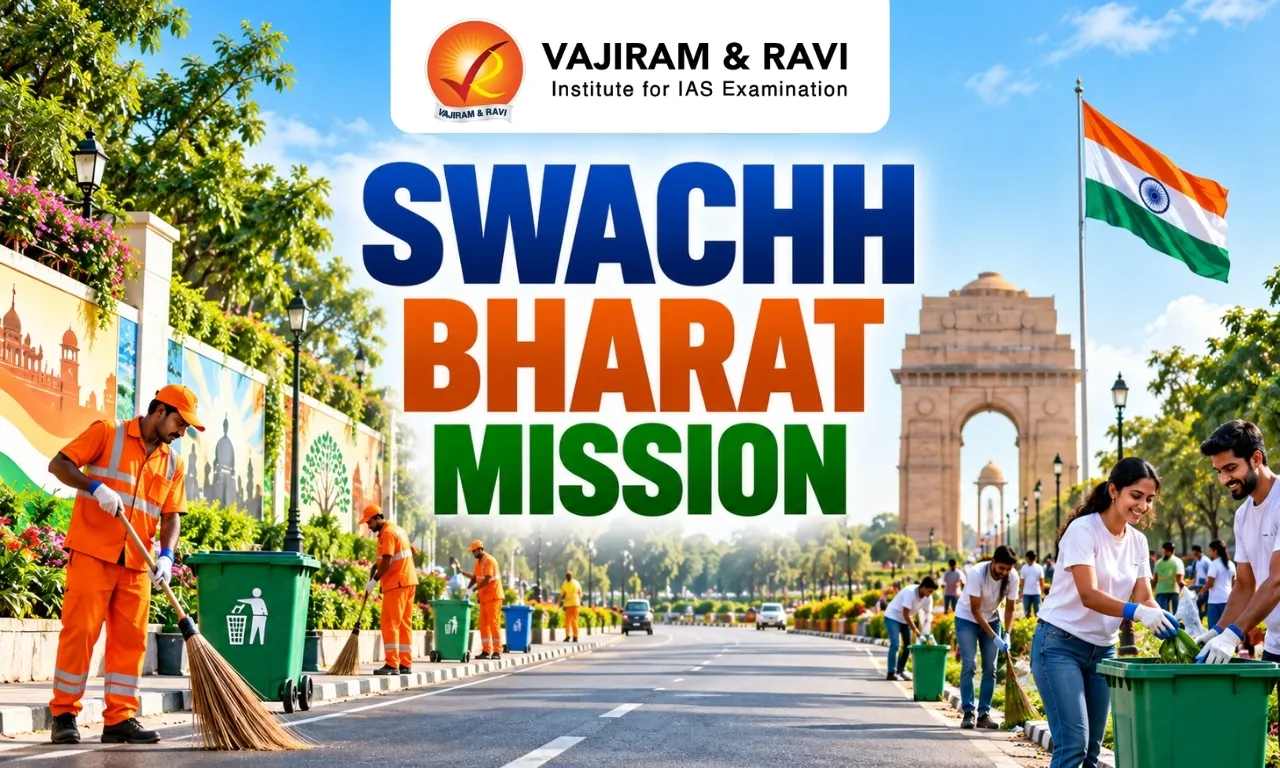
Swachh Bharat Mission (SBM) was launched on 2nd October 2014 by the Prime Minister of India as a transformative national campaign to eliminate open defecation and revolutionise sanitation across the nation, with a 5-year target to achieve an Open Defecation Free (ODF) India by 2 October 2019, as a tribute to Mahatma Gandhi on his 150th birth anniversary. The mission lifted rural sanitation coverage from 38.7% in 2014 to 100% in 2019 through a community-driven behavioural change movement (Jan Andolan).
Over the past decade, the mission has transitioned from achieving basic Open Defecation Free (ODF) status to institutionalising Sampoorn Swachhata (complete cleanliness), scientific solid and liquid waste management, and circular economy practices across both rural and urban India.
Swachh Bharat Mission Overview
Swachh Bharat Mission encompasses the foundational structure, nodal ministries, budget outlays, and overarching scope of India's flagship sanitation programme across rural and urban landscapes.
- Although ‘Sanitation’ is a state subject under the 7th Schedule of the Indian Constitution, the Government of India launched this Centrally Sponsored Scheme to provide policy direction, technical assistance, and financial support to states and Union Territories.
| Aspects | Details |
|
Launch Date |
|
|
Sub-Missions |
|
|
Scheme Nature |
SBM Grameen:
SBM-U 2.0:
|
|
Nodal Ministry (Rural) |
|
|
Nodal Ministry (Urban) |
|
|
|
|
Outlay (SBM-G Phase II) |
|
|
Outlay (SBM-U 1.0 and 2.0) |
|
Swachh Bharat Mission Objectives
The Swachh Bharat Mission aims to eradicate open defecation, achieve universal sanitation coverage, and build sustainable solid and liquid waste management systems across rural and urban India. The core objectives of the Swachh Bharat Mission include:
- Eliminating Open Defecation: The Swachh Bharat Mission aims to ensure access to and use of safe sanitation facilities, including Individual Household Latrines (IHHLs), Community Sanitary Complexes (CSCs) and public toilets.
- Help Eradicate Manual Scavenging: End the manual cleaning of human excreta and convert insanitary latrines into pour-flush toilets.
- Scientific Waste Management: The Swachh Bharat Mission aims to ensure 100% collection, source segregation, scientific processing, disposal, and recycling of municipal solid waste (MSW).
- Behavioural Change (Jan Bhagidari): Fostering sustained social and behavioural change to embed hygiene, safe sanitation, and collective civic ownership into everyday cultural practices.
- Public Health Awareness: The Swachh Bharat Mission aims to educate citizens on the direct links between clean surroundings, personal sanitation, and reduced disease rates.
- Institutional Sanitation: The Swachh Bharat Mission aims to provide dedicated toilet facilities for boys and girls in all schools, as well as functional sanitation in Anganwadis and public institutions.
- Capacity Enhancement: Augment the functional and administrative capacity of Urban Local Bodies (ULBs) and rural panchayats to operate and maintain sanitation infrastructure.
- Private Sector Engagement: The Swachh Bharat Mission aims to create an enabling environment for private sector participation in capital expenditure and operation-and-maintenance (O&M) costs.


Swachh Bharat Mission Features
Swachh Bharat Mission features highlight its unique implementation mechanisms, combining citizen-led Jan Andolan campaigns, digital governance tools, competitive federalism, and multi-ministerial financial convergence. Key features of the Swachh Bharat Mission include:
- People-Driven Jan Andolan: Unlike earlier supply-driven schemes, SBM relies on grassroots community mobilisation, grassroots Swachhagrahis, and annual campaigns like Swachhata Hi Seva and Safai Apnao Bimaari Bhagao.
- Competitive Federalism and Ranking Enablers: The Swachh Bharat Mission utilises annual rankings and certifications such as Swachh Survekshan (the world’s largest urban cleanliness survey), Garbage Free City (GFC) Star Ratings, and the Swachhata Green Leaf Rating to foster healthy competition among local bodies.
- Digital Monitoring and Grievance Redressal: Real-time physical and financial tracking is maintained through the online Integrated Management Information System (IMIS) associated with SBM-G, the Swachhatam Portal, and citizen-centric mobile interfaces like the Swachhata App used for citizen reporting in urban sanitation.
- Institutional and Peer Learning: Initiatives like Swachh Shehar Jodi (mentoring of cities), the Light House Initiative, and the Dr Syama Prasad Mookerjee National Institute of Water and Sanitation (SPM-NIWAS) in Kolkata drive capacity building and technical training.
- Financial and Inter-Sectoral Convergence: The Swachh Bharat Mission integrates funds and APIs across ministries, aligning with MGNREGA (VB-G RAM G now), the Ministry of Panchayati Raj (MoPR), 15th Finance Commission grants, and Corporate Social Responsibility (CSR) projects.
Swachh Bharat Mission Stages
The phases of the Swachh Bharat Mission reflect the chronological evolution of India's sanitation policy from basic toilet infrastructure creation in Phase I to comprehensive waste management in Phase II.
Phase I (2014 to 2019/2021) – Achieving ODF India
- Launched on 2nd October 2014, Phase I focused on eliminating open defecation through mass awareness and the construction of household and community toilets for poor and marginalised households.
- Rural India and all States/UTs declared themselves Open Defecation Free (ODF) on 2nd October 2019, five years ahead of the SDG 6.2 deadline.
Phase II (2020-2021 to 2026-27) – Sampoorn Swachhata and Garbage-Free India:
- SBM-Grameen Phase II: Implemented from 2020-21 to 2026-27 with an outlay of ₹1,40,881 crore to sustain ODF habits, ensure "No One Left Behind" for new households, and equip every village with Solid and Liquid Waste Management (SLWM) to attain ODF Plus status with 3 Progressive ODF Plus Tiers:
- Aspiring: sustaining ODF + either SWM or LWM
- Rising: sustaining ODF + both SWM and LWM
- Model: sustaining ODF + both SWM and LWM + visual cleanliness with minimal litter/stagnant water + Information, Education, and Communication (IEC) messaging.
- SBM-Urban 2.0: Launched on 1st October 2021 for five years (2021-2026) with an outlay of ₹1,41,600 crore. It focuses on achieving Garbage-Free status for all cities, remediating legacy waste dumpsites, and advancing cities across standardised ODF+, ODF++, and Water+ certification protocols.
Swachh Bharat Mission Components
Swachh Bharat Mission components are bifurcated into rural (Grameen) and urban verticals, supplemented by nationwide participatory campaigns to address distinct demographic and waste management requirements.
SBM Gramin Phase II Components
SBM Gramin Phase II components focus on sustaining open defecation-free (ODF) status. Free behaviour while establishing decentralised rural infrastructure for solid and liquid waste management. The major components of SBM Gramin Phase II include:
- Sustaining ODF and Toilet Access: Providing financial assistance for constructing Individual Household Latrines (IHHLs) for newly emerging or left-out households and building Community Sanitary Complexes (CSCs) in public spaces.
- Assistance is provided to eligible households under applicable scheme guidelines.
- Solid Waste Management (SWM): Establishing village-level waste segregation sheds, community composting pits, and Plastic Waste Management Units (PWMUs) linked with urban Material Recovery Facilities (MRFs).
- Solid Waste Management Rules, 2026 (effective 1 April 2026): mandating four-stream source segregation (wet, dry, sanitary, and special care waste)
- Extended Bulk Waste Generator Responsibility (EBWGR) for entities ≥20,000 sq m floor area, ≥40,000 L/day water use, or ≥100 kg/day waste (accounting for ~30% of urban waste)
- mandatory industrial substitution of solid fuel with Refuse Derived Fuel (RDF) rising from 5% to 15% over 6 years
- higher landfill fees for unsegregated waste and CPCB online portal tracking.
- GOBARdhan (Galvanising Organic Bio-Agro Resources Dhan): Converting biodegradable cattle dung and organic rural waste into biogas, Compressed Bio-Gas (CBG), and organic manure to promote a circular rural economy ("Waste to Wealth").
- Liquid Waste Management (LWM) and FSM: Managing greywater through soak pits and leach pits, alongside Faecal Sludge Management (FSM) infrastructure and Gram Panchayat-level resolutions for mechanised desludging.
SBM Urban 2.0 Components
SBM Urban 2.0 components target scientific municipal waste processing, used water management, legacy dumpsite remediation, and standardised sanitation protocols across Urban Local Bodies (ULBs). The core components of SBM Urban 2.0 are the following:
- Sustainable Sanitation (Toilets 2.0): Construction and maintenance of IHHLs, Community Toilets (CTs), and Public Toilets (PTs), leading to progressive certifications:
- ODF+: Zero open defecation/urination with functional, well-maintained community and public toilets.
- ODF++: Safe management and treatment of faecal sludge, septage, and sewage with zero open discharge or dumping into drains or water bodies.
- Used Water Management (Water+): Collecting, treating, and reusing domestic used water and septage from households and commercial establishments before sustainably releasing excess treated effluent.
- Municipal Solid Waste (MSW) Management: Enforcing the Solid Waste Management Rules, 2026, four-way source segregation, 100% door-to-door collection, Material Recovery Facilities (MRFs), Waste-to-Electricity, Waste-to-CBG plants, and Secondary Collection Centres for Construction and Demolition (C&D) waste.
- Legacy Waste Dumpsite Remediation: Bio-mining and scientific remediation of historical dumpsites (primarily targeting dumpsites with legacy waste ≥1,000 MT) to reclaim urban land.
- Citizen Interface and 3R Ecosystem: Establishing RRR (Reduce, Reuse, Recycle) Centres across cities and running behaviour change frameworks like Meri LiFE, Mera Swachh Shehar and Swachh Aadat Se Swachh Bharat.
Swachhata Hi Seva 2026
Swachhata Hi Seva 2026 is the annual fortnight-long national cleanliness campaign observed from 17th September to 17th October 2026 to mobilise collective citizen action. Initiated in 2017, the 2026 edition was jointly driven by the Ministry of Jal Shakti (Department of Drinking Water and Sanitation), MoHUA, and the Ministry of Panchayati Raj under the theme “Swachhata Mein Sahbhag; Swachh Bharat, Viksit Bharat”. Building upon SHS 2024 (Swabhav Swachhata, Sanskaar Swachhata) and SHS 2025 (Swachhotsav), the key pillars of Swachhata Hi Seva 2026 include:
- Transformation of Cleanliness Target Units (CTUs) and Public Places: Identifying, mapping, and beautifying neglected garbage points ("black spots") via the Swachhata App, while assessing public and community toilets on FACES (Functional, Accessible, Clean, Eco-friendly, and Safe) parameters.
- Swachh Paathshala - Yuva for Swachhata: Engaging students from Classes 6 to 12 in Swachhata Gyan Yatras (exposure visits to waste processing and sanitation plants) and school discussions on menstrual hygiene, handwashing, and water conservation.
- SafaiMitra Suraksha Seva Evam Samman Shivirs: Organising dedicated welfare camps for sanitation workers and their families to provide health check-ups, safety gear, and social security linkages.
- Jan Bhagidari for Swachhata: Conducting public demonstrations on four-way source segregation, raising awareness on the Solid Waste Management (SWM) Rules, 2026, promoting home composting, and holding collection drives against single-use plastics.
- Swachhata se Samriddhi: Conducting flagship circular economy sub-initiatives (Kabaad Se Jugaad and Kabaad Se Kala), the eco-festival drive (Swachh Parv, Harit Parv), the 1 October 2026 simultaneous shramdaan, and the 2 October 2026 Special Gram Sabhas/ULB Council Meetings.
Swachh Bharat Mission Achievements
Swachh Bharat Mission achievements demonstrate a massive statistical and social transformation across India’s rural villages and urban cities since its inception in 2014:
- Universal Household Toilet Coverage: Over 10 crore (100 million) IHHLs were built during Phase I (2014-2019), declaring more than 6 lakh villages ODF. Cumulatively, 12.22 crore individual household toilets have been constructed at the village household level.
- ODF Plus Rural Milestones: India has achieved over 5.69 lakh ODF Plus villages, out of which more than 5.25 lakh villages have attained the highest ODF Plus Model status.
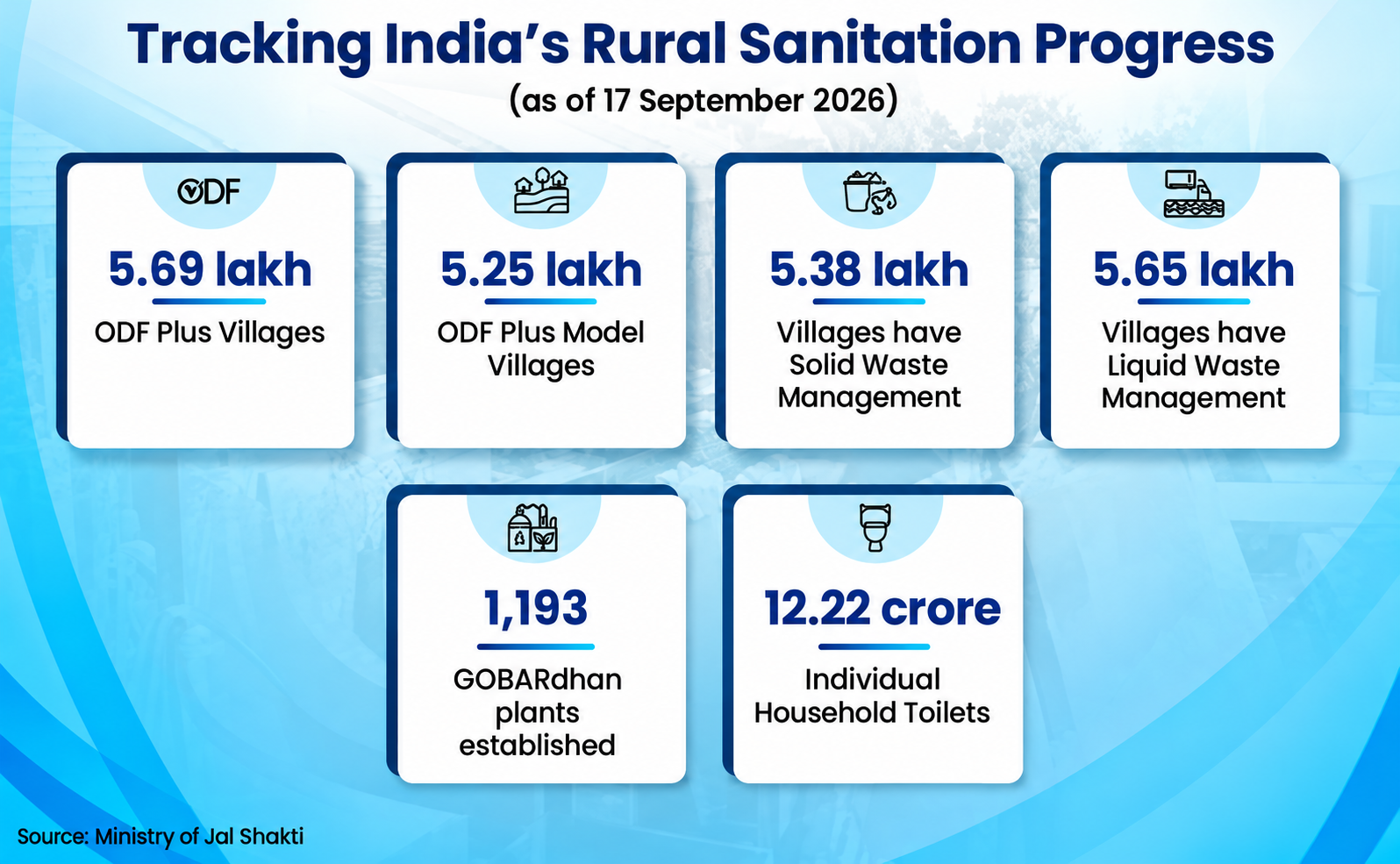
- Rural Waste Management Expansion: Over 5.38 lakh villages have functional solid waste management arrangements, and more than 5.65 lakh villages have established liquid waste management systems.
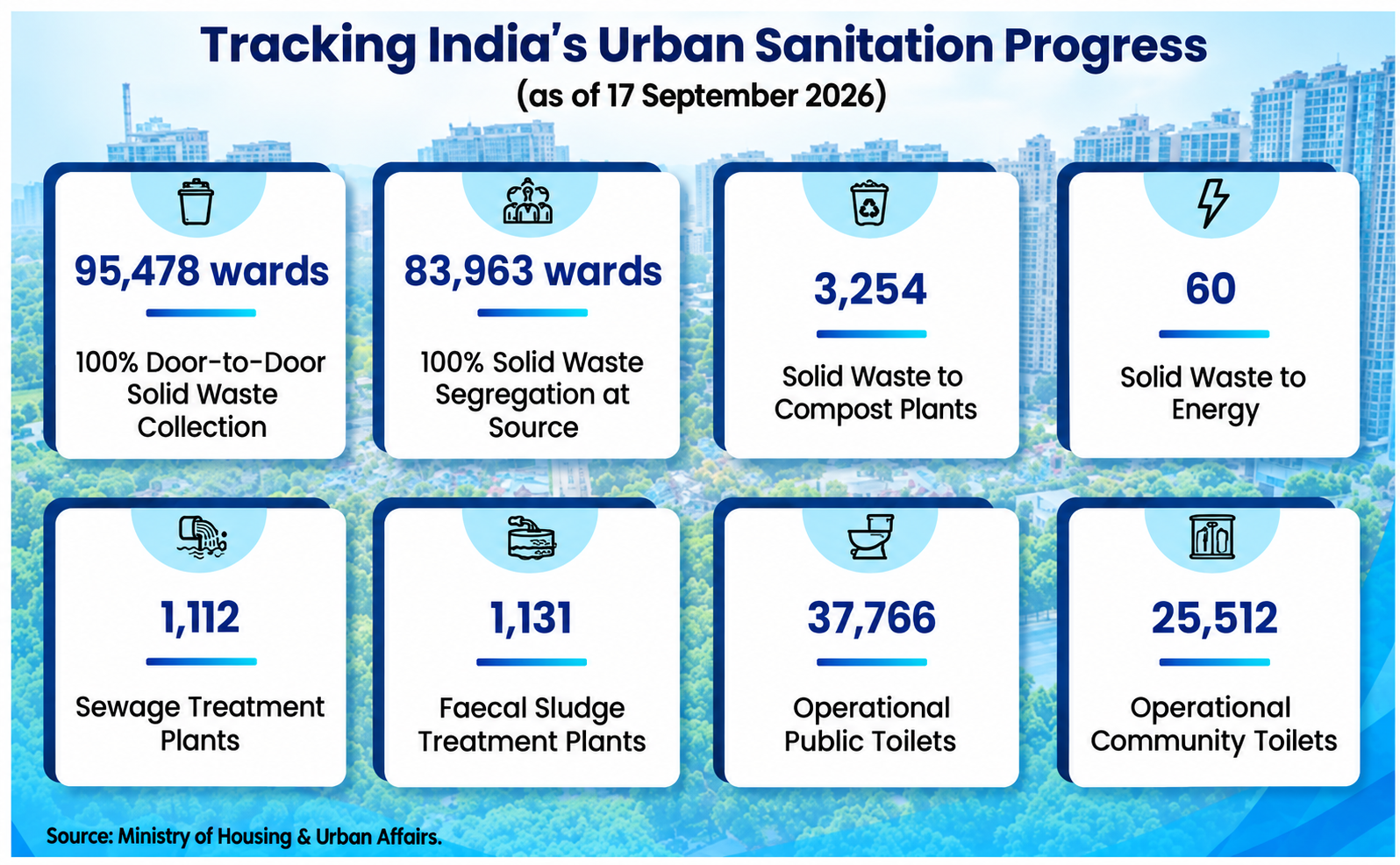
- GOBARdhan Infrastructure: A total of 1,193 GOBARdhan plants have been established under SBM-G (62 during Phase I and 1,131 during Phase II) to convert bio-waste into clean energy.
- Urban ODF and Water+ Certifications: Under SBM-Urban, 4,692 cities are certified ODF, 4,314 cities have achieved ODF+ status, 1,973 cities are certified ODF++, and 214 cities have attained the prestigious Water+ certification.
- SafaiMitra Surakshit Shehar: A total of 3,158 cities have been declared SafaiMitra Surakshit Shehar, achieving adequacy in mechanised sewer and septic tank cleaning equipment and worker safety protocols.
Swachh Bharat Mission Challenges
Challenges of Swachh Bharat Mission involve bridging the gap between physical infrastructure creation and long-term behavioural sustainability, waste processing capacity, and local institutional efficiency.
- Sustaining Behavioural Change: Overcoming centuries-old cultural habits and preventing slip-backs into open defecation require continuous community nudging beyond one-time toilet construction.
- Massive Legacy Waste Burden: Urban India still grapples with mountains of historical garbage, with approx. 1,116 Lakh Metric Tonnes (MT) of legacy waste yet to be remediated across major dumpsites requiring scientific remediation.
- Inconsistent Source Segregation: While door-to-door collection has expanded, ensuring strict household-level compliance with four-way source segregation (wet waste, dry waste, sanitary waste, and special care waste (paint cans, bulbs, mercury thermometers, medicines) remains a hurdle for downstream recycling and Waste-to-Energy plants.
- Neglected Black Spots and Toilet Maintenance: Difficult-to-clean garbage points (Cleanliness Target Units) often face recurring littering after episodic cleanliness drives, while public toilets require continuous water supply and upkeep to meet FACES parameters.
- Rural-Urban Waste Linkage and ULB Capacity: Panchayati Raj Institutions (PRIs) and smaller Urban Local Bodies often face technical deficits, operation and maintenance (O&M) funding gaps, and weak market off-take for treated sewage sludge and compost.
Swachh Bharat Mission Way Forward
The Swachh Bharat Mission requires transitioning sanitation from an episodic government campaign into a permanent, self-sustaining civic culture backed by circular economy principles and institutional accountability:
- Enforcing SWM Rules 2026 and Four-Way Segregation: Strictly implementing the Solid Waste Management Rules, 2026 through household-level four-way segregation, decentralised home composting, and bulk waste generator accountability.
- Scaling the Circular Economy (Waste to Wealth): Accelerating the establishment of CBG plants, GOBARdhan units, Material Recovery Facilities (MRFs), and utilising waste plastic in bituminous road construction to make sanitation financially viable.
- Empowering PRIs and ULBs: Strengthening the technical and financial capacities of Gram Panchayats and municipal bodies through convergence, standardised Model RFPs, and regular social audits by Gram Sabhas.
- Institutionalising FACES and CTU Maintenance: Assigning clear institutional ownership and digital monitoring via the Swachhata App to ensure that transformed Cleanliness Target Units (CTUs) do not revert to garbage dumps and public toilets remain functional, accessible, and safe.
- Embedding Youth-Led Behavioural Change: Sustaining Swachh Paathshala initiatives and Swachhata Gyan Yatras so that younger generations internalise Swabhav Swachhata, Sanskaar Swachhata as an everyday way of life.
Swachh Bharat Mission UPSC PYQs
Q1. What are the challenges to solid waste management in India? Discuss the governmental policy framework on solid waste management. Discuss the success/failure cases of Delhi and Indore cities, highlighting the salient features of their solid waste management initiatives. (Mains 2026)
Q2. What are the impediments in disposing the huge quantities of discarded solid waste which are continuously being generated? How do we remove safely the toxic wastes that have been accumulating in our habitable environment? (Mains 2018)
Q3. “To ensure effective implementation of policies addressing the water, sanitation and hygiene needs, the identification of the beneficiary segments is to be synchronized with anticipated outcomes.” Examine the statement in the context of the WASH scheme. (Mains 2017)
Q4. As per the Solid Waste Management Rules, 2016 in India, which one of the following statements is correct?
(a) Waste generator has to segregate waste into five categories.
(b) The Rules are applicable to notified urban local bodies, notified towns and all industrial townships only.
(c) The Rules provide for exact and elaborate criteria for the identification of sites for landfills and waste processing facilities.
(d) It is mandatory on the part of the waste generator that the waste generated in one district cannot be moved to another district.
Ans: (c)

 Last updated on Oct, 2026
→ UPSC 2027 Notification will be released on 13 January 2027 at upsconline.nic.in.
→ Check Nobel Prize 2026 Winners List here.
→ Download PIB PRiSM Monthly Magazine 2026 here.
→ Check UPSC Monthly Current Affairs Magazine The Recitals here.
→ Check out the latest UPSC Syllabus here.
→ Download UPSC Model Answers for Mains 2026
→ UPSC Mains Question Paper 2026 is out now for Essay & GS Paper 1, 2, 3 & 4.
→ UPSC Calendar 2027 has been released.
→ Enroll in Vajiram & Ravi’s UPSC Mains Test Series 2027 for structured answer writing practice, expert evaluation, and exam-oriented feedback.
→ Join Vajiram & Ravi’s UPSC Mentorship Program 2027 for personalized guidance, strategy planning, and one-to-one support from experienced mentors.
→ Go through the UPSC Mains Previous Year Papers to enhance your preparation.
→ UPSC has released UPSC Toppers List 2025 with the Civil Services final result on its official website.
→ Also check Best UPSC Coaching in India
Swachh Bharat Mission FAQs
Q1. When was the Swachh Bharat Mission launched and what is its primary aim?+
Q2. Which ministries implement SBM-Gramin and SBM-Urban?+
Q3. What is an ODF Plus village?+
Q4. What is the difference between ODF, ODF+ and ODF++?+
Q5. How is SBM linked to the circular economy?+
Tags: quest swachh bharat mission UPSC Social Justice Notes