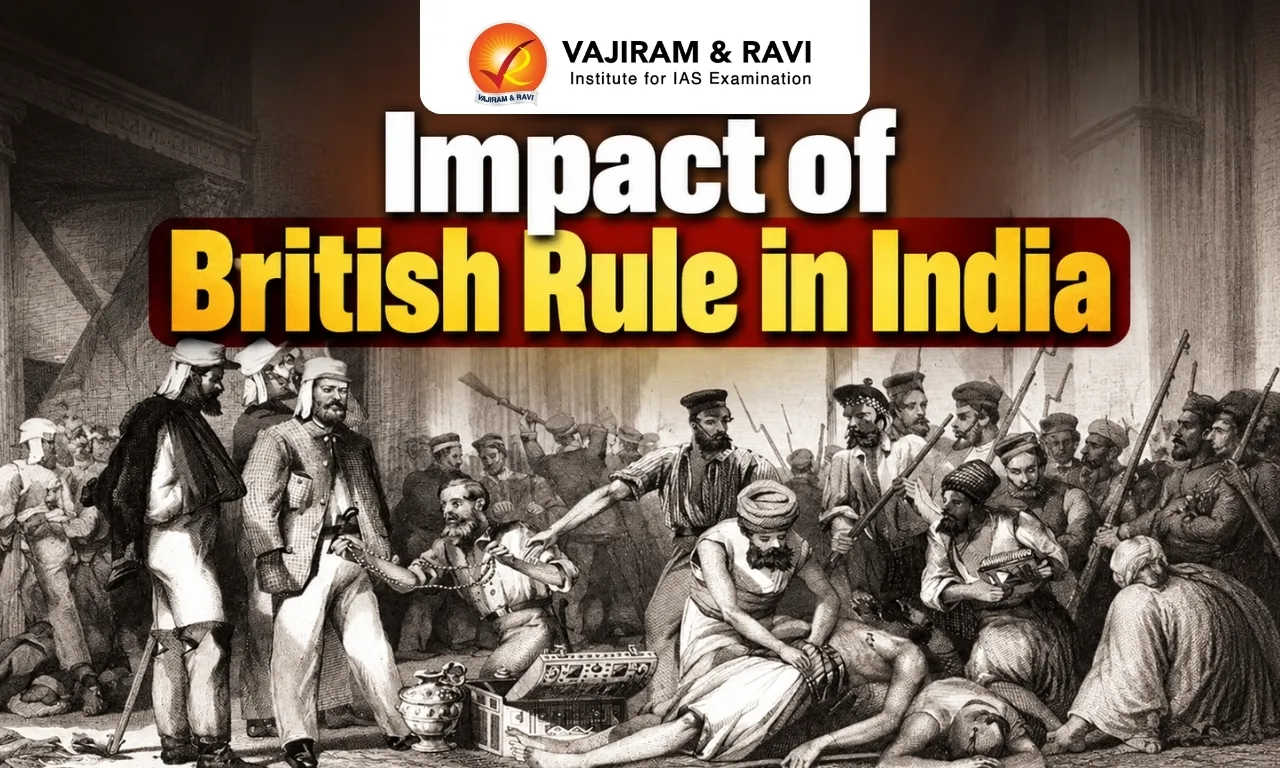
The impact of British rule in India marked a major transformation of India’s political, economic, social, and cultural spheres. British territorial expansion, administrative restructuring and economic policies integrated India into the colonial system while affecting agriculture, industries, trade, education and traditional institutions.
Although colonial rule primarily served British imperial interests, it also left institutional legacies such as modern education, administrative systems, transport and legislative institutions. At the same time, economic exploitation, political subordination and cultural disruption generated resistance, political awareness and nationalism, shaping India’s transition towards independence.
Impact of British Rule in India Overview
The impact of British rule in India marked a major turning point, transforming the country’s political, economic, social, and cultural life. The British initially came as traders but gradually established political dominance through wars, alliances and annexations, with the Battle of Plassey (1757) marking a major stage in this process.
The major consequences of British rule can be classified into the following categories:
| Dimension | Major Changes | Main Consequences |
|
Economic |
Changes in trade, land revenue and agricultural production |
Decline of many crafts, rural indebtedness and transfer of wealth to Britain |
|
Political |
Territorial expansion and centralised administration |
Loss of sovereignty and restrictions on Indian participation |
|
Social |
New professions, education and reform movements |
Emergence of a middle class and challenges to discriminatory practices |
|
Cultural |
English education, print and new intellectual exchanges |
Cultural tensions, literary developments and national consciousness |
|
Infrastructure |
Expansion of railways and communication |
Stronger colonial control alongside greater movement of people and ideas |
Economic impact of British rule in India
The economic impact of British rule in India involved the restructuring of the Indian economy to serve British industrial and commercial interests, making India a supplier of raw materials and a market for British manufactured goods.
Decline of Handicrafts and Traditional Industries
Indian textiles had established markets in Asia, Africa and Europe. However, machine-made British textiles increasingly entered Indian markets at prices that many local producers could not match. Trade policies also favoured British manufacturers and restricted the competitiveness of Indian goods. Its effects included:
- Loss of employment among weavers and other artisans.
- Declining demand for locally manufactured products.
- Reduced patronage following the displacement of Indian rulers.
- Movement of displaced craft workers into agricultural labour.
Changes in Trade
Colonial trade increasingly connected Indian production to British industrial needs. Raw cotton and other commodities were exported, while manufactured goods were imported from Britain. This change reduced opportunities for many Indian producers to retain the benefits of manufacturing.
Exploitative Land Revenue Systems
The British introduced different revenue arrangements to secure income for administration, military expenditure and territorial expansion.
| Revenue system | Main Feature | Impact on Cultivators |
|
Zamindars paid a fixed revenue demand to the government. |
Cultivators faced pressure from landlords seeking rent. |
|
|
Revenue was assessed directly on individual cultivators. |
High assessments placed financial pressure on peasants. |
|
|
Revenue responsibility rested collectively with a village or estate. |
Communities faced substantial government demands. |
Commercialisation of Agriculture
Agriculture became more closely linked to commercial markets. Crops such as indigo, cotton, opium, tea and jute were produced to meet trading and industrial requirements. In some sectors, producers faced coercion, unfavourable contracts and dependence on traders or intermediaries. The consequences varied by region and crop, but the colonial emphasis on export-oriented production often conflicted with the needs of subsistence cultivators.
Drain of Wealth
The drain of wealth theory became an important criticism of colonial economic policy. Indian nationalist thinkers, particularly Dadabhai Naoroji, argued that substantial resources generated in India were transferred to Britain without an equivalent return to the Indian economy.
- Such transfers included certain administrative expenses paid in Britain, pensions, remittances, profits and payments associated with colonial governance.
- Naoroji developed this argument in his work Poverty and Un-British Rule in India. According to the drain theory, these transfers reduced the resources available for domestic investment and contributed to India's economic impoverishment.
Development of Railways and Transport
The British introduced railway networks, expanded roads and developed port facilities during the nineteenth and twentieth centuries.
- The first passenger railway service in India operated between Bombay and Thane in 1853.
- Railways facilitated the movement of raw materials, manufactured goods, troops and passengers. They also helped connect previously distant markets and contributed to the growth of commercial agriculture.
- However, railway development was strongly influenced by colonial priorities, including military mobility, export trade and the movement of resources towards ports.
Rural Indebtedness and Land Alienation
Revenue deadlines and low farm revenues encouraged borrowing from moneylenders. High loan rates and predatory lending practices frequently made repayment difficult. When cultivators are unable to fulfil their debts, the land may fall to creditors. This increased the number of landless workers and damaged the economic security of rural households.


Political impact of British rule in India
The political impact of British rule in India was characterised by the progressive extension of British territorial control and the subordination of Indian states through conquest, diplomacy, alliances and annexation
Expansion of British Political Control
The British East India Company gradually transformed itself from a trading organisation into a territorial power. The Battle of Plassey in 1757 marked a major turning point in the Company's political expansion in Bengal. The Battle of Buxar in 1764 further strengthened its position.
Loss of Sovereignty
The British East India Company expanded its authority through wars, treaties and annexations. Indian rulers increasingly lost control over military affairs, external relations and territory. Under the Subsidiary Alliance system, participating rulers accepted restrictions on their independence and maintained British forces. Annexation policies further weakened regional political authority.
Centralisation of Administration
British rule established increasingly centralised administrative institutions. The colonial state developed a bureaucracy responsible for revenue collection, policing, judicial administration and governance. The Indian Civil Service became a key institution in administering British India.
- Although these arrangements introduced administrative uniformity in many areas, the system remained colonial and excluded most Indians from the highest levels of decision-making for much of its history.
Changes in the Judicial System
The British constructed a hierarchy of civil and criminal courts and sought to codify laws. These reforms resulted in new legal procedures and structures. However, access to justice has remained uneven. The unfamiliar legal system could disadvantage poorer people, and legal procedures could occasionally strengthen the power of landlords and moneylenders over cultivators.
Growth of Political Awareness
English education, newspapers and intellectual exchanges exposed sections of Indian society to debates about liberty, equality, rights and self-government. Indians increasingly compared these principles with their own exclusion under colonial rule. This contradiction helped generate political criticism and contributed to the growth of national consciousness.
Social Impact of British Rule in India
The social consequences of British rule in India included changes in occupational groups, educational opportunities, reform movements, and public engagement. These advancements were unequal and frequently centred in metropolitan and relatively wealthy areas.
Social Reform Movements
Indian reformers opposed customs such as sati, child marriage, prohibitions on widow remarriage, and caste prejudice. Raja Rammohan Roy and Ishwar Chandra Vidyasagar were among those who contributed significantly to these endeavours. Important examples include:
- Abolition of Sati (1829): Governor-General Lord William Bentinck prohibited the practice of sati in the Bengal Presidency. The measure followed sustained opposition from Indian reformers, particularly Raja Ram Mohan Roy.
- Hindu Widows' Remarriage Act (1856): The legislation legalised widow remarriage among Hindus and was strongly associated with the reform efforts of Ishwar Chandra Vidyasagar.
- Socio-Religious Reform Movements: Brahmo Samaj, Arya Samaj, Prarthana Samaj, the Aligarh Movement, and Anti-caste movements led by Jyotirao Phule and other reformers.
Emergence of a New Middle Class
Colonial administration, courts and commercial organisations created opportunities for educated Indians. Teachers, lawyers, clerks and other professionals formed part of a growing middle class. Over time, educated Indians also used their knowledge and professional networks to question discrimination, support reform and participate in political activity.
Expansion of Modern Education
Western-style education expanded during British rule through schools, colleges and universities. The universities of Calcutta, Bombay and Madras were established in 1857.
- English education introduced Indian students to new intellectual traditions, including liberalism, constitutionalism, modern science and political ideas.
- However, educational access remained unequal, and the colonial education system did not provide universal education to the population.
- Indian educators and reformers also established institutions to promote modern learning while preserving or reinterpreting Indian intellectual traditions.
Cultural Impact of British Rule in India
The cultural impact of British rule in India combined intellectual exchange with unequal relations of power. Indian languages, literature, education and cultural institutions all experienced change.
Spread of English Education
The colonial government encouraged English education partly to create a workforce for administration. Policies such as Wood’s Despatch of 1854 contributed to the development of educational institutions. English also became a means of communication among educated Indians from different regions.
Influence of Western Ideas
Indian intellectuals encountered European ideas concerning liberty, equality, rationalism, constitutional government and nationalism. These ideas influenced political debates and social reform movements. Indian thinkers did not simply accept Western ideas without question. They adapted, challenged and combined them with Indian philosophical, religious and political traditions.
Press & Literature
Newspapers and journals provided forums for discussing public grievances, social practices, and political issues. Literature, theatre, poetry, and songs all became ways of expressing resistance. These modes of communication helped people identify common concerns while also encouraging self-esteem, public knowledge, and national cohesion.
Study of Indian Heritage
Institutions like the Asiatic Society encouraged research into Indian languages, writings, and history. Translations introduced some Indian literary works to a larger audience. However, colonial scholarship also served administrative purposes. Its cultural contribution must therefore be weighed against the unequal political connection in which it emerged.
Positive impact of British rule in India
Positive impact of British rule in India should be presented carefully: many such developments were introduced primarily for colonial administrative and economic purposes, but some had lasting consequences for Indian society and the post-Independence state.
- Modern Education: English education introduced Indians to Western political, scientific, and social ideas, contributing to intellectual and political awareness.
- Constitutional Development: Legislative institutions evolved through measures such as the Indian Councils Acts of 1861, 1892, 1909, 1919 and 1935, providing a gradual institutional basis for representative politics.
- Administrative Institutions: The development of the Indian Civil Service, systematic record-keeping and modern administration left an institutional legacy for independent India.
- Development of Railways: Railways connected major cities, commercial centres and many rural areas. Following independence, the railway network became an important component of India's economic and social infrastructure.
- Development of Postal and Telegraph Networks: Postal services and telegraph lines improved communication across substantial parts of British India. These networks supported administrative communication, commercial activity and the transmission of political information.
- Social Reform & Modern Ideas: Western education and new intellectual currents strengthened debates around social customs, women’s education and reform, alongside the efforts of Indian reformers.
- Growth of National Consciousness: Exposure to modern political ideas and the experience of colonial rule contributed to political awareness and the development of nationalism.
Negative Impact of British Rule in India
Negative impact of British rule in India extended beyond economic exploitation to political subordination, social disruption, and cultural-psychological consequences. Colonial policies were designed primarily to sustain British authority and interests.
- Political Subordination: Conquest, annexation, and systems such as the Subsidiary Alliance and Doctrine of Lapse weakened the sovereignty of Indian states.
- Economic Exploitation: Colonial policies promoted deindustrialisation, commercialisation of agriculture, and an unequal trade structure, weakening indigenous economic activity.
- Famines and Poverty: Repeated famines caused enormous suffering during the colonial period. Droughts and crop failures were important triggers, but poverty, unequal access to food, inadequate purchasing power and failures of relief policy also shaped the severity of particular crises.
- Divide-and-Rule Policies: Colonial policies of community categorisation and divide-and-rule, especially after the Revolt of 1857, deepened communal divisions and tensions.
- Racial Discrimination: British colonial society was marked by racial hierarchies. Indians faced discrimination in employment, public life and political participation, while the colonial state frequently treated British and Indian subjects unequally.
- Unequal Educational Opportunities: The colonial state did not establish universal education for all Indians. Consequently, many people remained excluded from educational opportunities and the benefits associated with professional employment.
Impact of British Rule in India UPSC PYQs
Q1: Why did the armies of the British East India Company – mostly composed of Indian soldiers - win consistently against the more numerous and better equipped armies of the then Indian rulers? Give reasons. (UPSC Mains 2022)
Q2: Clarify how mid-eighteenth-century India was beset with the spectre of a fragmented polity. ( UPSC Mains 2017)
Q3: Examine critically the various facets of economic policies of the British in India from the mid-eighteenth century till Independence. (UPSC Mains 2014)

 Last updated on Oct, 2026
→ UPSC 2027 Notification will be released on 13 January 2027 at upsconline.nic.in.
→ Check Nobel Prize 2026 Winners List here.
→ Download PIB PRiSM Monthly Magazine 2026 here.
→ Check UPSC Monthly Current Affairs Magazine The Recitals here.
→ Check out the latest UPSC Syllabus here.
→ Download UPSC Model Answers for Mains 2026
→ UPSC Mains Question Paper 2026 is out now for Essay & GS Paper 1, 2, 3 & 4.
→ UPSC Calendar 2027 has been released.
→ Enroll in Vajiram & Ravi’s UPSC Mains Test Series 2027 for structured answer writing practice, expert evaluation, and exam-oriented feedback.
→ Join Vajiram & Ravi’s UPSC Mentorship Program 2027 for personalized guidance, strategy planning, and one-to-one support from experienced mentors.
→ Go through the UPSC Mains Previous Year Papers to enhance your preparation.
→ UPSC has released UPSC Toppers List 2025 with the Civil Services final result on its official website.
→ Also check Best UPSC Coaching in India
Impact of British Rule in India FAQs
Q1. What are the effects of British rule?+
Q2. What was the impact of British rule on the Indian economy?+
Q3. What were the negative effects of British rule in India?+
Q4. What were the impact of British rule on India?+
Q5. Did India benefit from British rule?+
Tags: impact of british rule in india quest upsc modern history notes