Digital Public Infrastructure (DPI) refers to interoperable and scalable digital systems that enable essential services at population scale. In India, DPI combines digital identity, payments and data exchange with supporting infrastructure and service-delivery platforms to improve access to public and private services. Initiatives such as Aadhaar, the Unified Payments Interface (UPI), Direct Benefit Transfer (DBT), DigiLocker and UMANG illustrate its applications across financial inclusion, welfare delivery, healthcare, education and governance.
Digital Public Infrastructure can reduce transaction costs, improve transparency, encourage innovation and extend services to underserved communities. However, the digital divide, cybersecurity threats, data privacy concerns and authentication failures remain significant challenges. Its success depends on inclusive access, interoperability, robust safeguards and accountable governance.
Digital Public Infrastructure Meaning
Digital Public Infrastructure (DPI) refers to interoperable and scalable digital systems that enable essential services at population scale. It combines foundational technology with institutional arrangements and governance safeguards.
- DPI provides the digital foundations on which governments, businesses and other service providers can build and deliver services securely and efficiently.
- Unlike a standalone application, DPI enables multiple systems to interact through shared standards and interfaces.
Digital Public Infrastructure Features
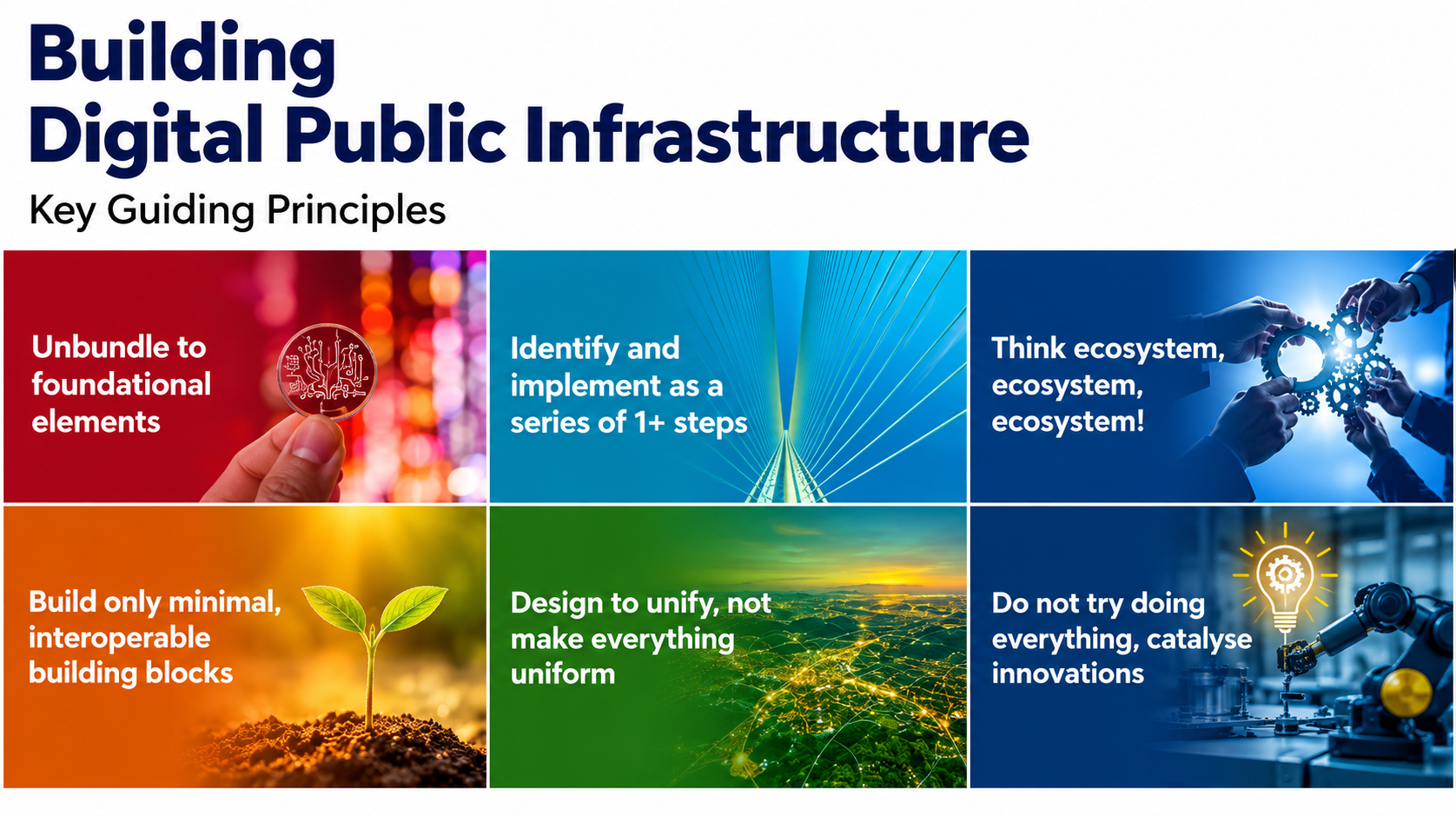
Digital Public Infrastructure features distinguish DPI from standalone applications: it uses interoperable, reusable building blocks at a population scale, supported by inclusive design and accountable governance.
- Interoperability and open standards: Common protocols and APIs allow different systems to communicate and exchange information securely, reducing dependence on isolated platforms.
- Scalability: Digital Public Infrastructure is designed to support large-scale adoption, handling millions or billions of users and transactions.
- Modularity and reusability: Standardised digital building blocks can be combined or adapted for different sectors, reducing duplication and enabling new services.
- Inclusivity: Digital Public Infrastructure aims to provide broad access to individuals, businesses and governments, including underserved communities.
- Public-interest governance: Dedicated operating entities, institutional accountability and regulatory oversight help ensure reliability and alignment with public objectives.
- Privacy and security by design: Appropriate legal safeguards, consent-based data sharing and security measures help build trust in digital transactions and services.
- Innovation without platform lock-in: Shared digital foundations allow multiple public and private providers to build services, encourage competition and lower barriers to innovation.


Digital Public Infrastructure Core Components
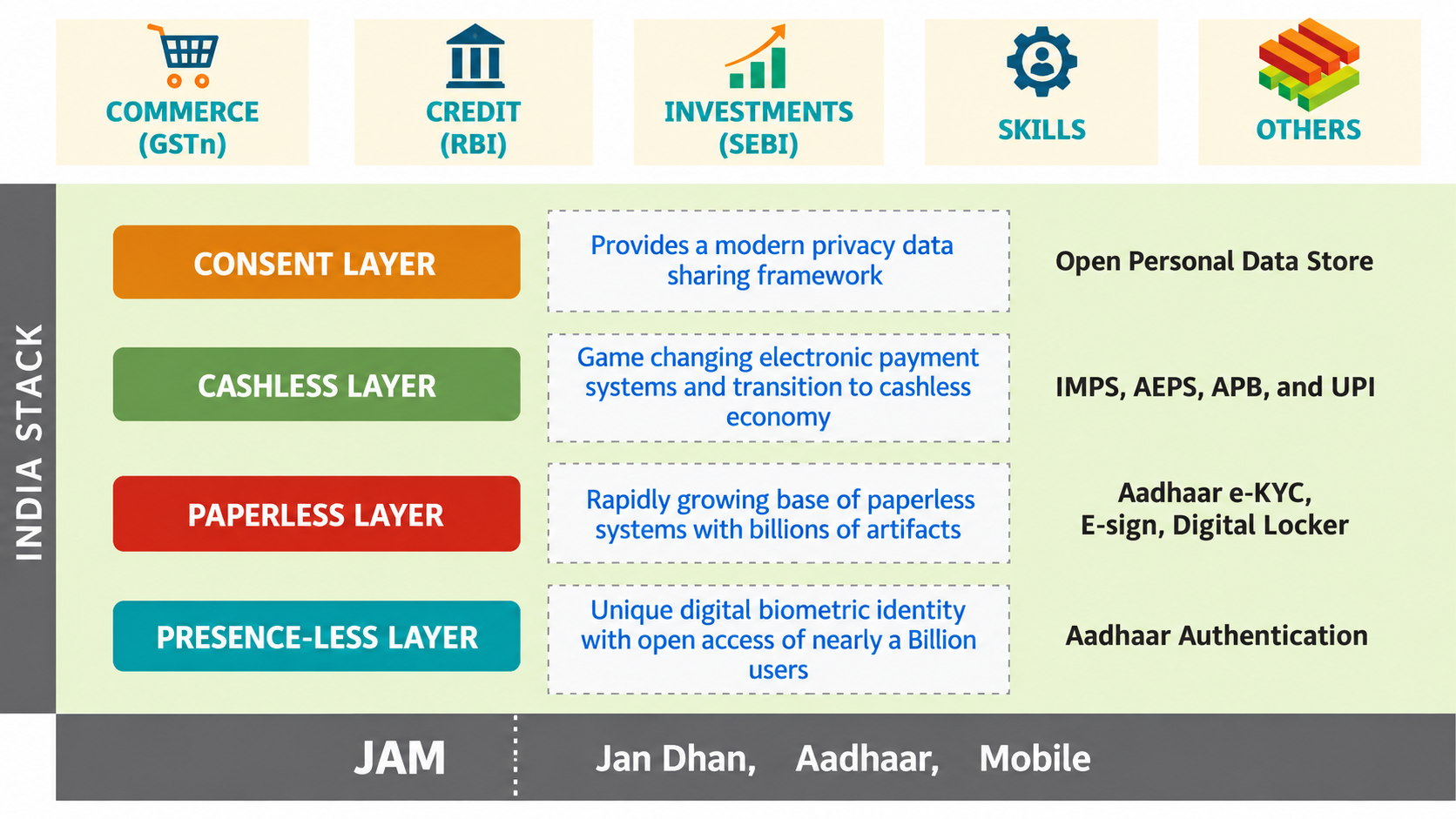
India's Digital Public Infrastructure (DPI) ecosystem rests on shared digital capabilities for identity, payments and data exchange. Supporting platforms, connectivity and delivery channels extend these capabilities to government services, financial transactions and other sectors. India’s DPI model is built around the India Stack, which operates in distinct, hierarchical layers.
Foundational Digital Building Blocks (Core DPI)
These are the core identity, data, and payment layers that serve as the foundation for the entire ecosystem.
- Aadhaar: Foundational digital identity infrastructure for services across government and the economy.
- UPI (Unified Payments Interface): Core real-time payment infrastructure enabling interoperable and digital payments between individuals, businesses and merchants through participating banks and applications.
Data Exchange & Consent Layer
They act as the secure connective tissue, translating foundational identity and data into useful, permission-based information for applications.
- DigiLocker: Digital document storage and verification platform.
- API Setu: System integration platform facilitating data exchange between different government departments.
- Account Aggregator (AA): Financial data-sharing network operating on explicit, user-controlled consent.
Service-Delivery Applications & Platforms
These are the customer-facing applications and operational frameworks built on top of the foundational blocks to deliver specific public services.
- UMANG: A unified mobile application aggregating various government services.
- DBT (Direct Benefit Transfer): A delivery mechanism/framework to transfer subsidies directly to beneficiaries' bank accounts, supporting targeted and traceable payments.
Enabling Infrastructure & Access Channels
These components provide the physical connectivity and assisted access needed to ensure the digital services reach citizens.
- BharatNet: Broadband connectivity infrastructure linking rural local governments (Gram Panchayats).
- CSCs (Common Services Centres): Physical, assisted-access kiosks providing digital services to rural and digitally disconnected citizens.
Digital Public Infrastructure Significance
Digital Public Infrastructure (DPI) improves financial inclusion, welfare delivery, connectivity and access to essential services. India's experience shows how shared digital platforms can support citizens, businesses and public institutions at population scale.
- Financial Inclusion through JAM Trinity: The integration of Jan Dhan bank accounts, Aadhaar and Mobile Connectivity (JAM) connects citizens to formal finance and digital services.
- Jan Dhan: 59.59 crore accounts had been opened by 14 October 2026, out of which women held 33.23 crore Jan Dhan accounts.
- Aadhaar: Over 144 crore Aadhaar numbers had been generated by 30 June 2026.
- Mobile Connectivity: 130 crore wireless telephone subscribers were reported in September 2026, while 5G services covered 99.9% of districts.
- Efficient Welfare Delivery and Reduced Leakages: Direct Benefit Transfer (DBT) enables welfare payments directly into beneficiaries' bank accounts, reducing intermediaries and improving traceability.
- Funds transferred: As per the DBT Bharat dashboard, cumulative transfers of approx. ₹54.14 lakh crore as of 26 October 2026 rose from ₹49.47 lakh crore as of March 2026.
- Estimated gains: The cumulative savings rose from ₹4.31 lakh crore in March 2024 to ₹5.14 lakh crore as of October 2026 across 320 schemes of 56 ministries.
- Public expenditure monitoring: The Public Financial Management System (PFMS) supports end-to-end monitoring of government funds and electronic payments.
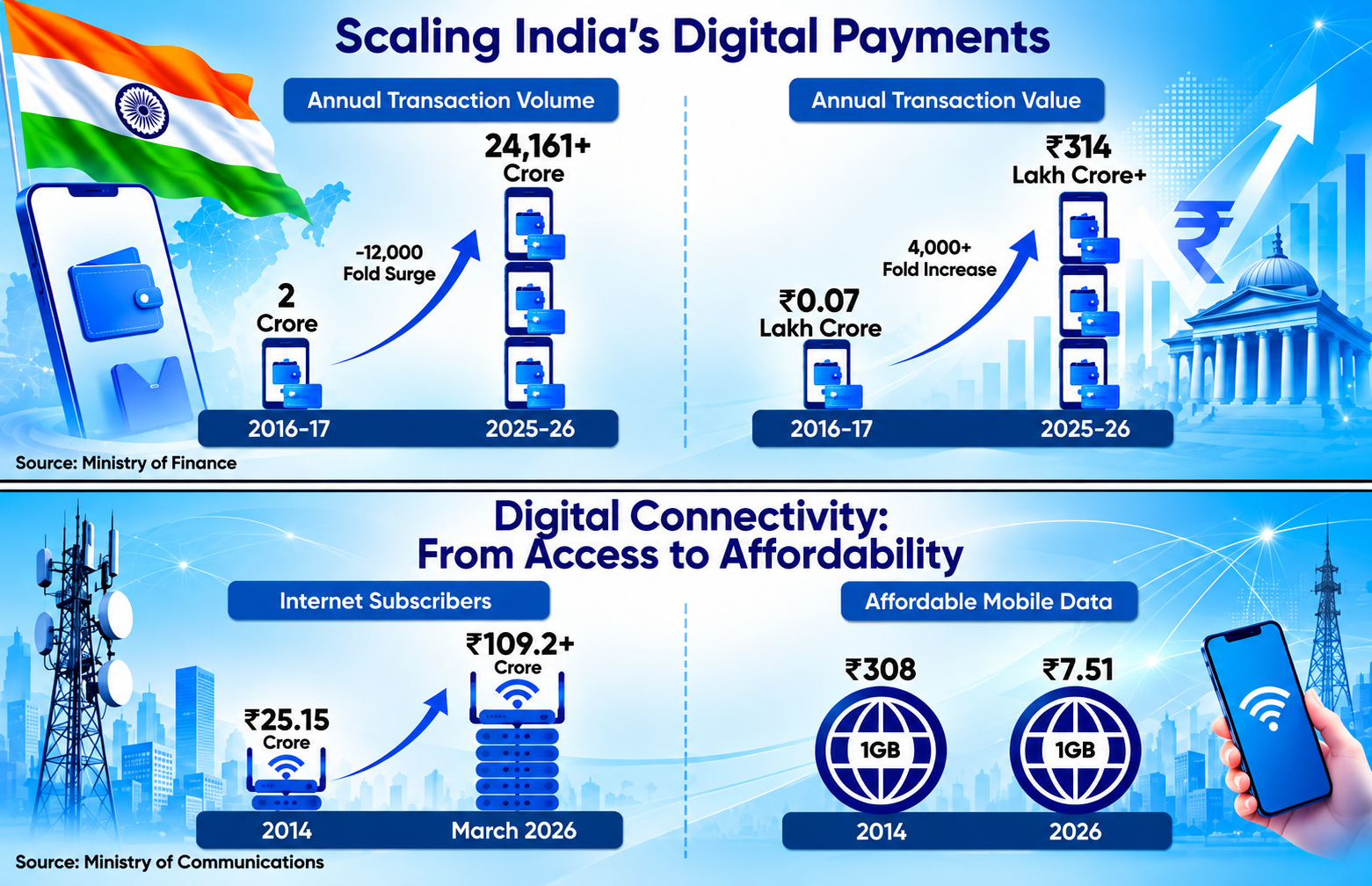
- Expansion of Digital Payments: UPI has made interoperable, real-time payments accessible to individuals, merchants and small businesses.
- In August 2026, UPI processed 24.51 billion transactions worth ₹29.8 lakh crore, connecting 691 banks.
- According to the IMF's June 2025 report, UPI was the world's largest retail fast-payment system by transaction volume.
- Rural Digital Connectivity and Last-Mile Access: Digital Public Infrastructure can reach remote communities only when reliable connectivity and assisted service delivery are available.
- BharatNet: Around 2.21 lakh Gram Panchayats were service-ready under the programme as of June 2026.
- Internet access: Internet subscribers increased from 25.15 crore in March 2014 to 109.27 crore in March 2026.
- Affordable access: Mobile data costs fell from ₹269 per GB in 2014 to roughly ₹8-10 per GB in 2025-26. More than 5.01 lakh Common Services Centres were functional as of May 2026, extending digital services to rural and urban communities.
- Women's Financial and Economic Empowerment: Digital Public Infrastructure supports women's access to bank accounts, maternity benefits and digital financial services.
- Pradhan Mantri Matru Vandana Yojana (PMMVY): As of 30 September 2026, 5.13 crore beneficiaries had enrolled, 4.42 crore had been paid, and ₹20,811 crore had been disbursed through the scheme.
- Financial autonomy: Women held 33.23 crore Jan Dhan accounts as of 14 October 2026, widening access to formal savings and digital benefit transfers.
- Social Security for Elderly and Vulnerable Citizens: Digital payment infrastructure enables pensions and social assistance to reach eligible beneficiaries with greater traceability.
- On 14 October 2026, the government approved the continuation of the National Social Assistance Programme under the name Pradhan Mantri Samajik Sahayata Yojana, covering 3.20 crore beneficiaries across its components with an outlay of ₹53,428 crore.
- Pension payments are largely delivered through DBT. The old-age pension component is now named Pradhan Mantri Vridhavastha Pension Yojana.
- Child Health and Maternal Care: Digital health platforms support vaccination tracking, reminders, portable records and remote consultations.
- Universal Immunisation (U-WIN): As of March 2026, 11.87 crore children and 3.96 crore pregnant women were registered. The platform records vaccination events, tracks due doses and provides SMS reminders and QR-code certificates.
- eSanjeevani: Crossed over 50 crore teleconsultations in September 2026, with 57.14% women users, particularly in underserved areas.
- Digital Education and Skill Development: DPI extends learning opportunities beyond physical classrooms and supports teachers, students and administrators.
- DIKSHA: As of March 2026, the platform had delivered 566 crore learning sessions, with 2.11 crore registered users. Course enrolments stood at 18.52 crore.
- This supports digital learning access and the wider objective of reducing geographical barriers to education.
- Paperless and Convenient Public Services: Platforms such as DigiLocker and UMANG reduce dependence on physical documents and multiple departmental portals.
- DigiLocker: By March 2026, more than 950 crore documents were issued to a user base of 71.66 crore users.
- UMANG: As of June-July 2026, it had 10.25 crore registered users and 796.69 crore transactions, providing a common interface to more than 2,575 government services.
- Market Access and Entrepreneurship: Digital Public Infrastructure enables small sellers and enterprises to participate in digital markets without depending entirely on a single platform.
- Open Network for Digital Commerce (ONDC): The network promotes interoperability and reduces entry barriers for smaller businesses, recording 5 lakh sellers, 20+ crore buyers, and 1,000+ cities as of June 2026.
- Government e-Marketplace (GeM): Digitised procurement improves transparency and expands access to government contracts. By June 2026, its cumulative gross merchandise value (GMV) exceeded ₹18.4 lakh crore.
- Better Governance and Global Cooperation: Shared digital infrastructure can improve record management, service coordination and institutional accountability.
- e-Courts: Digital filing, online payments and digitisation of court records support more accessible and efficient judicial processes.
- International cooperation: India's experience with identity, payments and data exchange provides models that partner countries can adapt to their own institutional and regulatory contexts.
Digital Public Infrastructure Challenges
Despite its scale, India’s Digital Public Infrastructure faces challenges in ensuring that digital access translates into equitable outcomes. The concerns remain around scalability, data privacy and governance, while government data show the continuing need to strengthen connectivity and inclusion.
- Digital divide: Unequal access to reliable internet, devices and digital skills can exclude rural residents, low-income households, older persons and other vulnerable groups from essential services.
- Privacy and data protection: Large-scale collection and exchange of personal information create risks of unauthorised access, excessive data collection, misuse and inadequate control over how information is shared.
- Cybersecurity and fraud: Interconnected digital systems require strong safeguards against cyberattacks, identity theft, payment fraud and service disruptions that can erode public trust.
- Exclusion and authentication failures: Connectivity problems, technical errors or difficulties completing authentication can prevent eligible users from accessing digital payments and essential services.
- Interoperability gaps: Poorly integrated systems, incompatible standards and fragmented databases can create duplication, obstruct data exchange and undermine seamless service delivery.
- Governance and accountability: Unclear institutional responsibilities, weak oversight or excessive concentration of control can reduce transparency and leave citizens with limited avenues for grievance redressal.
- Language and accessibility barriers: Digital services that are difficult to navigate or unavailable in regional languages can disadvantage people with limited literacy or disabilities.
- Capacity and reliability: Sustaining DPI requires skilled personnel, resilient infrastructure, regular maintenance and coordination among government agencies, operators and private service providers.
Digital Public Infrastructure Way Forward
There is a need to make Digital Public Infrastructure more inclusive, secure and accountable without restricting innovation. The Five DPI Sutras (Citizen Agency and Privacy; Interoperability; Techno-Legal Regulation; Preventing Monopolisation; and Guarding Against Weaponisation) provide a useful governance framework for strengthening India's digital ecosystem.
- Citizen agency and privacy: Build consent-based data sharing, minimise unnecessary collection and give individuals clear information and meaningful control over how their personal data are used.
- Strengthen interoperability: Adopt open standards and compatible APIs so public and private systems can work together without locking users into particular platforms or providers.
- Embed techno-legal safeguards: Integrate legal compliance, privacy protection, cybersecurity and regulatory oversight into system design rather than treating them as afterthoughts.
- Prevent monopolisation: Preserve fair access to core digital infrastructure, encourage responsible competition and ensure that control over essential digital rails does not undermine the public interest.
- Guard against weaponisation: Establish checks against misuse of technology by state or corporate actors, with transparent oversight and safeguards for citizens' rights.
- Bridge the digital divide: Expand reliable rural connectivity, regional-language services, assisted access through CSCs and continuing digital literacy so people can use services confidently.
- Strengthen grievance redressal: Provide accessible complaint mechanisms, clear institutional responsibility and timely remedies when authentication errors, fraud or technical failures prevent access to services.
- Improve resilience and accountability: Regularly audit security, service availability and system performance; publish relevant indicators and ensure long-term maintenance and institutional capacity.
Digital Public Infrastructure UPSC PYQs
Q1. e-governance projects have a built-in bias towards technology and back-end integration than user-centric designs. Examine. (Mains 2025)
Q2. e-governance is not just about the routine application of digital technology in service delivery process. It is as much about multifarious interactions for ensuring transparency and accountability. In this context evaluate the role of the 'Interactive Service Model' of e-governance. (Mains 2024)
Q3. e-governance, as a critical tool of governance, has ushered in effectiveness, transparency and accountability in governments. What inadequacies hamper the enhancement of these features? (Mains 2023)
Q4. Has digital illiteracy, particularly in rural areas, coupled with lack of Information and Communication Technology (ICT) accessibility hindered socio-economic development? Examine with justification. (Mains 2021)
Q5. Which one of the following best describes the key objective of India's 'Open Network for Digital Commerce' (ONDC) initiative? (Prelims 2026)
a) To allow government control over all digital commerce transactions
b) To replace private e-commerce players
c) To break the dominance of large e-commerce platforms by enabling interoperability across networks
d) To mandate UPI-based payments for all online transactions
Ans: (c)

 Last updated on Oct, 2026
→ UPSC 2027 Notification will be released on 13 January 2027 at upsconline.nic.in.
→ Check Nobel Prize 2026 Winners List here.
→ Download PIB PRiSM Monthly Magazine 2026 here.
→ Check UPSC Monthly Current Affairs Magazine The Recitals here.
→ Check out the latest UPSC Syllabus here.
→ Download UPSC Model Answers for Mains 2026
→ UPSC Mains Question Paper 2026 is out now for Essay & GS Paper 1, 2, 3 & 4.
→ UPSC Calendar 2027 has been released.
→ Enroll in Vajiram & Ravi’s UPSC Mains Test Series 2027 for structured answer writing practice, expert evaluation, and exam-oriented feedback.
→ Join Vajiram & Ravi’s UPSC Mentorship Program 2027 for personalized guidance, strategy planning, and one-to-one support from experienced mentors.
→ Go through the UPSC Mains Previous Year Papers to enhance your preparation.
→ UPSC has released UPSC Toppers List 2025 with the Civil Services final result on its official website.
→ Also check Best UPSC Coaching in India
Digital Public Infrastructure FAQs
Q1. What is Digital Public Infrastructure (DPI)?+
Q2. What are the core components of India's DPI?+
Q3. What is the difference between DPI and a Digital Public Good?+
Q4. How does DPI promote financial inclusion?+
Q5. How can India make DPI more inclusive and secure?+
Tags: digital public infrastructure quest UPSC Governance Notes