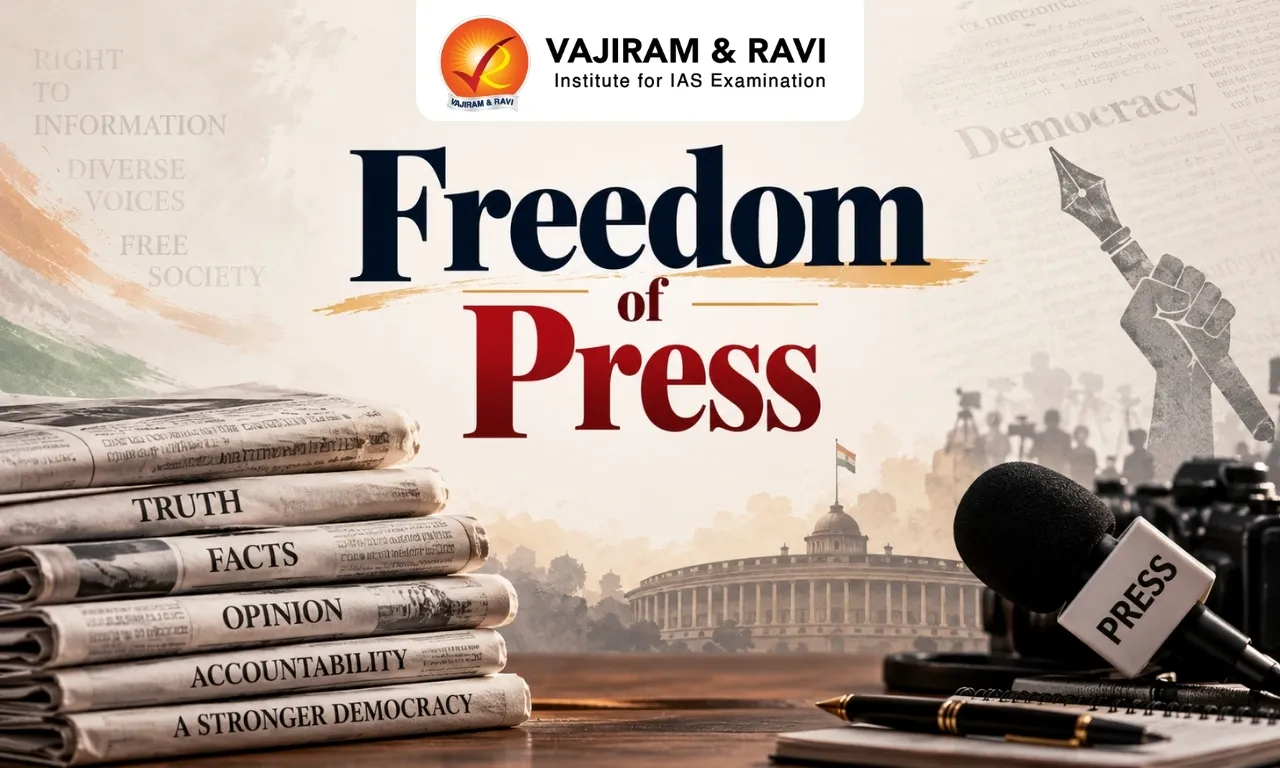
Freedom of Press is a cornerstone of democracy, enabling citizens to access information, express opinions and hold public authorities accountable. In India, it is constitutionally protected under Article 19(1)(a), which guarantees citizens the right to freedom of speech and expression, subject to reasonable restrictions under Article 19(2). Often regarded as the “fourth pillar of democracy", the press promotes transparency, exposes corruption, safeguards public interest and facilitates informed electoral choices.
However, political and corporate influence, media ownership concentration, restrictive legal measures, economic pressures and threats to journalists pose significant challenges. In the digital era, strengthening Freedom of Press is essential to preserve media pluralism, encourage responsible journalism and reinforce democratic accountability. Thus, Freedom of Press remains vital to a vibrant and inclusive democracy.
Freedom of Press Meaning
Freedom of Press means the freedom of newspapers, journalists and media organisations to gather, publish and disseminate information and opinions without undue interference.
- Freedom to Publish: It means that newspapers, journalists and media organisations have the liberty to publish news, information and opinions within the framework of law.
- Freedom to Disseminate: It includes the freedom to circulate and communicate information and ideas through print and other forms of media.
- Freedom from Prior Restraint: It generally protects the press against arbitrary restrictions or prior censorship on the publication of lawful content.
- Includes Editorial Freedom: It encompasses the ability of media organisations and journalists to choose, analyse and present news and opinions independently, subject to applicable legal and ethical standards.
Freedom of Press Constitutional and Legal Framework
- Article 19(1)(a): Guarantees citizens the right to freedom of speech and expression. Freedom of the press is implicit in this provision rather than separately enumerated.
- Not an Absolute Freedom: Freedom of the Press operates within the reasonable restrictions prescribed under Article 19(2) and is therefore subject to the law of the land.
- Article 361A: Provides a qualified constitutional protection concerning the publication of substantially true reports of proceedings of Parliament and State Legislatures, subject to the provision's conditions and exceptions. It is a useful supplementary point, although it is not the general constitutional source of press freedom.
- Right to Information Act, 2005: Supports access to public information and investigative journalism, subject to the Act's exemptions.
Freedom of Press Index
The World Press Freedom Index (WPFI) is published annually by Reporters Without Borders (RSF) to assess the level of freedom of press across 180 countries and territories. The 2026 Index highlights a broad global deterioration in the conditions in which journalism operates.
World Press Freedom Index Key Findings 2026
The key findings of the World Press Freedom Index 2026 are as below:
- Press freedom at a 25-year low: The global average score is at its lowest level since RSF began the Index, with 52.2% of countries falling in the “difficult” or “very serious” categories.
- Legal restrictions are worsening: Among the five assessment indicators, the legal indicator recorded the sharpest deterioration, declining in 110 out of 180 countries between 2025 and 2026.
- Criminalisation of journalism: The misuse of national-security laws, anti-terrorism provisions and other legal mechanisms is increasingly being used to restrict journalistic activity.
- Economic pressures on media: A weakening media economy and dependence on powerful political or business interests are increasingly affecting the independence and sustainability of journalism.
- Political and security threats: Hostile political discourse, violence, intimidation and conflicts continue to restrict journalists’ ability to work independently and safely.
World Press Freedom Index Assessment Indicators
Reporter Without Borders' post-2022 methodology assesses freedom of press through five broad indicators, covering the political, economic, legal, social and security environment in which journalism operates.
- Political Indicator: It assesses the extent to which political actors and institutions support, respect or interfere with independent journalism and media pluralism.
- Economic Indicator: It examines the economic conditions and pressures affecting media independence, including ownership concentration, financial sustainability and commercial or political influence.
- Legal Indicator: It evaluates the legal and judicial framework governing journalism, including restrictions, censorship, access to information and the protection available to journalists.
- Social Indicator: It considers the social and cultural environment for journalism, including societal attitudes, diversity, pluralism and pressures that affect the ability of journalists to report freely.
- Security Indicator: It measures the physical and psychological safety of journalists, including violence, threats, detention, harassment and impunity for attacks.


Freedom of Press India
India's position in the 2026 World Press Freedom Index is 157th out of 180 countries, with an overall score of 31.96, compared with 151st position and a 32.96 score in 2025.
- Political Indicator: India ranks 160th, with a score of 21.16, indicating significant concerns regarding the political environment surrounding journalism.
- Economic Indicator: India ranks 144th, with a score of 32.63, reflecting concerns relating to media ownership concentration and economic pressures on media organisations.
- Legal Indicator: India ranks 141st, with a score of 39.59. RSF notes that India's legal indicator deteriorated between 2025 and 2026 amid a broader global trend of increasing criminalisation of journalism.
- Social Indicator: India ranks 157th, with a score of 33.65, reflecting concerns regarding the social and cultural environment in which journalists operate.
- Security Indicator: India ranks 158th, with a score of 32.77, reflecting concerns over violence, threats, harassment and other risks faced by journalists.
Freedom of Press Significance
Freedom of Press is essential for the effective functioning of democracy, as it enables citizens to access information, scrutinise public authorities and participate meaningfully in public affairs. The Supreme Court has repeatedly recognised its importance in protecting democratic accountability and informed public discourse.
- Promotes Democratic Accountability: A free press acts as a watchdog over government, exposing facts, irregularities and misuse of power and enabling citizens to hold authorities accountable.
- Strengthens Right to Know: Press freedom facilitates citizens’ right to know about government actions and public affairs, strengthening transparency and the broader framework of the Right to Information.
- Enables Informed Electoral Choice: By providing diverse facts, perspectives and opinions, the press helps citizens make informed choices during elections and participate effectively in democracy.
- Protects Against Indirect Control: Press freedom extends beyond protection from direct censorship to safeguards against indirect economic and administrative pressures, including restrictions affecting newsprint, funding and distribution.
- Protects Dissent and Investigative Journalism: A free press provides space for critical voices, whistleblowers and investigative journalism, which are essential for exposing wrongdoing and strengthening accountability.
- Extends to the Digital Era: The principles of free expression apply to digital and online platforms, ensuring that technological changes do not undermine constitutional protection of free speech.
Freedom of Press Case Laws
Through landmark judgements such as Romesh Thapar v. State of Madras (1950), Brij Bhushan v. State of Delhi (1950), Indian Express Newspapers v. Union of India (1985) and R. Rajagopal v. State of Tamil Nadu (1994), the Supreme Court has strengthened freedom of press through protection against censorship, excessive financial burdens and unjustified restrictions on press freedom.
| Case | Principle/Significance |
|
Romesh Thapar v. State of Madras (1950) |
The Supreme Court struck down a restriction on the circulation of a journal, highlighting the constitutional protection of political discussion and the circulation of ideas. |
|
Brij Bhushan v. State of Delhi (1950) |
The Court struck down a pre-censorship order imposed on a newspaper under the law then in force, establishing an important early precedent against prior restraint. |
|
Indian Express Newspapers v. Union of India (1985) |
Recognised the importance of freedom of press when examining the constitutional validity of economic burdens imposed on newspapers, including customs duties on newsprint. |
|
R. Rajagopal v. State of Tamil Nadu (1994) |
Addressed freedom of press, privacy and publication concerning public officials, while recognising limits relating to privacy and lawful restrictions. |
|
Vinod Dua vs. Union of India (2021) |
The Supreme Court of India quashed the sedition and criminal charges against senior journalist Vinod Dua. The Supreme Court reaffirmed that every journalist is protected under the principles laid down in Kedar Nath Singh v. State of Bihar (1962) |
Freedom of Press Challenges
Despite constitutional protection under Article 19(1)(a), freedom of press faces challenges arising from political, economic, legal and security-related pressures. These challenges can affect media independence, pluralism and the ability of journalists to report freely.
- Concentration of Media Ownership: Concentration of media ownership among a few large business groups can reduce media pluralism and editorial independence.
- Political and Corporate Influence: Political influence and close links between media organisations and powerful business interests can encourage partisan reporting, editorial pressure and self-censorship.
- Restrictive Legal Environment: The use of defamation, national-security and anti-terror laws can create a restrictive environment and expose journalists to prolonged legal proceedings or intimidation.
- Economic Dependence: Heavy dependence on advertising revenue, particularly government advertising, can make media organisations vulnerable to financial pressure and influence editorial independence.
- Threats to Journalist Safety: Journalists may face violence, intimidation, online harassment, arbitrary detention and targeted hate campaigns, particularly while reporting on sensitive issues.
- Limited Media Diversity: Inadequate representation of women and diverse social groups in newsrooms can limit the range of perspectives reflected in media coverage.
- Challenges in Conflict Zones: Journalists reporting from conflict-affected and politically sensitive regions may face restrictions, harassment and difficulties in carrying out independent reporting.
- Concerns over Press-Freedom Rankings: India’s low position in international indices has also generated debate over the objectivity, transparency and methodology used to measure press freedom, as highlighted by NITI Aayog.
- Misinformation and declining public trust: Misinformation can undermine public confidence and increase pressure for regulation.
Freedom of Press Way Forward
Strengthening freedom of press requires a balance between media independence, responsible journalism and legitimate regulation. India needs institutional and legal reforms that protect journalists while ensuring transparency, pluralism and accountability in the media ecosystem.
- Undertake Legal Reforms: Review laws such as defamation and national-security/anti-terror provisions to ensure that they are not used disproportionately to intimidate or silence legitimate journalistic work.
- Ensure Media Pluralism: Introduce stronger cross-media ownership and disclosure norms to prevent excessive concentration of media ownership and protect editorial diversity.
- Strengthen Journalist Safety: Establish time-bound investigations into attacks on journalists and strengthen mechanisms to address physical threats, arbitrary detention and coordinated online harassment.
- Reduce Economic Dependence: Encourage diverse and sustainable revenue models, particularly for regional and local media, to reduce excessive dependence on government advertising.
- Strengthen Institutional Engagement: The Government, Press Council of India and other stakeholders should engage constructively with international organisations such as RSF and address methodological concerns through transparent dialogue.
- Develop Transparent Global Benchmarks: India can support the development of more transparent and methodologically robust international press-freedom indices, ensuring that assessments are based on verifiable and comparable evidence.
- Promote Ethical and Responsible Journalism: Greater emphasis on fact-checking, professional ethics, media literacy and accountability mechanisms can help balance press freedom with responsibility and public trust.
Freedom of Press UPSC PYQs
Q1. What do you understand by the concept "freedom of speech and expression"? Does it cover hate speech also? Why do the films in India stand on a slightly different plane from other forms of expression? Discuss. (UPSC Mains 2014)
Q2. Though 100 percent FDI is already allowed in non-news media like a trade publication and general entertainment channel, the government is mulling over the proposal for increased FDI in news media for quite some time. What difference would an increase in FDI make? Critically evaluate the pros and cons. (UPSC Mains 2014)

 Last updated on Oct, 2026
→ UPSC 2027 Notification will be released on 13 January 2027 at upsconline.nic.in.
→ Check Nobel Prize 2026 Winners List here.
→ Download PIB PRiSM Monthly Magazine 2026 here.
→ Check UPSC Monthly Current Affairs Magazine The Recitals here.
→ Check out the latest UPSC Syllabus here.
→ Download UPSC Model Answers for Mains 2026
→ UPSC Mains Question Paper 2026 is out now for Essay & GS Paper 1, 2, 3 & 4.
→ UPSC Calendar 2027 has been released.
→ Enroll in Vajiram & Ravi’s UPSC Mains Test Series 2027 for structured answer writing practice, expert evaluation, and exam-oriented feedback.
→ Join Vajiram & Ravi’s UPSC Mentorship Program 2027 for personalized guidance, strategy planning, and one-to-one support from experienced mentors.
→ Go through the UPSC Mains Previous Year Papers to enhance your preparation.
→ UPSC has released UPSC Toppers List 2025 with the Civil Services final result on its official website.
→ Also check Best UPSC Coaching in India
Freedom of Press FAQs
Q1. What is the rank of India in Freedom of Press?+
Q2. Which country has the most freedom of the press?+
Q3. Is Freedom of Press in India a fundamental right?+
Q4. What are the main restrictions on Freedom of Press in India?+
Q5. Who regulates print and broadcast media in India?+
Tags: freedom of press quest UPSC Polity Notes