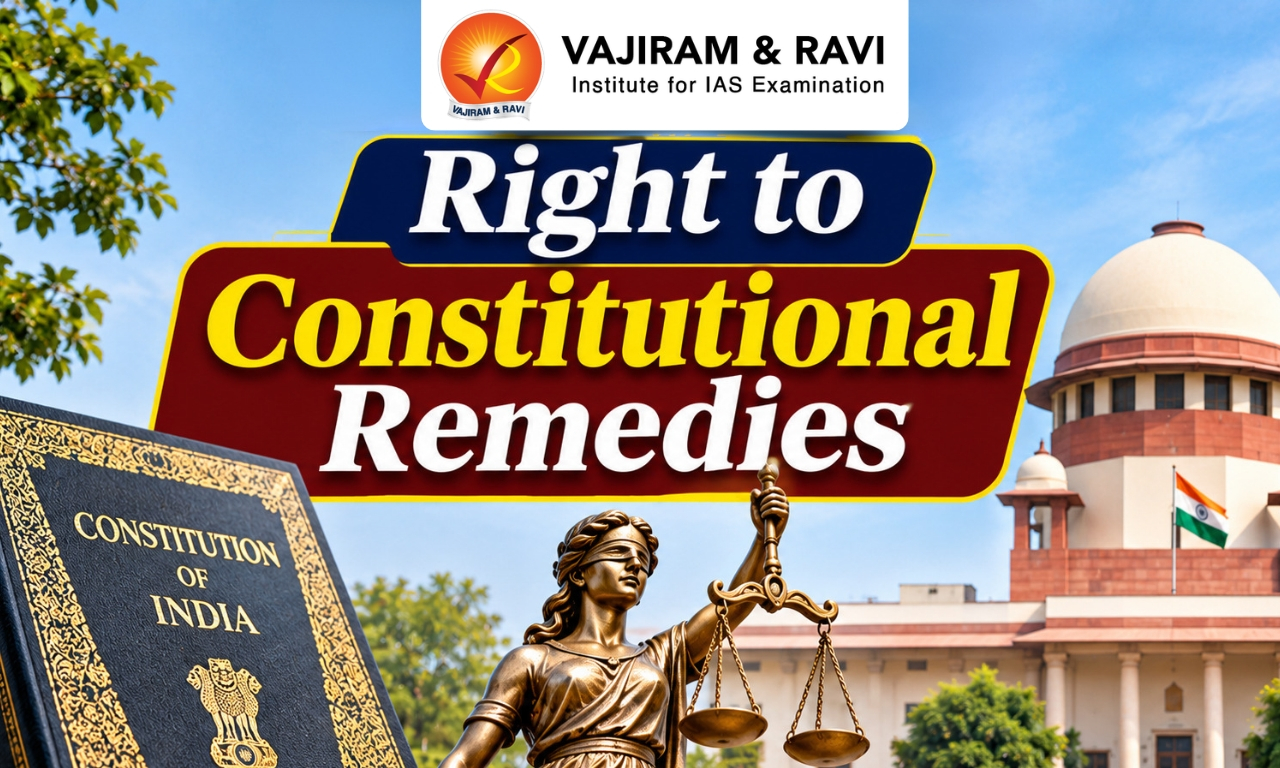
The Right to Constitutional Remedies is the legal safeguard that allows individuals to approach the Supreme Court or High Courts when their Fundamental Rights are violated. It is guaranteed under Article 32 of the Constitution and is often described as the “heart and soul” of the Constitution by Dr B.R. Ambedkar.
The Right to Constitutional Remedies ensures that Fundamental Rights are not merely declarations but are enforceable in practice. It empowers courts to issue writs, orders, and directions against the State or any authority acting in a public capacity. This right makes Fundamental Rights justiciable, meaning they can be enforced through courts. Without this remedy, rights such as equality, freedom, and protection against discrimination would remain theoretical rather than practical.
Right to Constitutional Remedies Meaning
The Right to Constitutional Remedies means the right of a person to seek judicial protection when their Fundamental Rights are infringed. It allows citizens to move the Supreme Court or High Courts for enforcement of rights guaranteed under Part III of the Constitution.
Right to Constitutional Remedies in India
In India, the Right to Constitutional Remedies is a Fundamental Right under Part III of the Constitution. It is enforced primarily through the writ jurisdiction of the Supreme Court of India under Article 32 and the High Courts under Article 226. The right to constitutional remedies is itself a Fundamental Right under Article 32. Article 226, on the other hand, provides a constitutional power to High Courts to exercise writ jurisdiction.


Right to Constitutional Remedies Article 32
Article 32 of the Indian Constitution guarantees the right to move the Supreme Court for enforcement of Fundamental Rights (Right to Constitutional Remedies). It empowers the Supreme Court to issue directions, orders, or writs for this purpose. Article 32 has four important clauses:
- Article 32(1): Guarantees the right to move the Supreme Court by appropriate proceedings for enforcement of Fundamental Rights.
- Article 32(2): Empowers the Supreme Court to issue directions, orders or writs for enforcing Fundamental Rights.
- Article 32(3): Allows Parliament to empower other courts to exercise, within their local jurisdiction, the powers exercisable by the Supreme Court under Article 32(2).
- Article 32(4): Provides that the right guaranteed by Article 32 cannot be suspended except as otherwise provided by the Constitution.
Key Features of Article 32 of the Indian Constitution
Article 32 is itself a Fundamental Right under Part III of the Constitution. It ensures that Fundamental Rights are enforceable and not merely theoretical promises.
- Direct Access to the Supreme Court: Individuals can directly approach the Supreme Court for the enforcement of their Fundamental Rights without first approaching a High Court.
- Writ Jurisdiction: The Supreme Court can issue five types of writs: Habeas Corpus, Mandamus, Prohibition, Certiorari and Quo-Warranto.
- Judicial Protection Against Arbitrary Action: Article 32 provides a constitutional remedy against violations of Fundamental Rights by the State and other authorities covered by the relevant constitutional provisions.
- Limited Scope: Article 32 is specifically concerned with the enforcement of Fundamental Rights. It is not a general remedy for every legal or administrative grievance. Under Article 32(3), Parliament may empower other courts to exercise the relevant writ powers within their local jurisdiction.
- Constitutional Limitations: The enforcement of specified Fundamental Rights through courts may be affected by Article 359 during a National Emergency, subject to constitutional restrictions. The rights under Articles 20 and 21 cannot be suspended through an order under Article 359.
Right to Constitutional Remedies High Court
High Courts also play a crucial role in enforcing the Right to Constitutional Remedies. Under Article 226, High Courts can issue writs for the enforcement of Fundamental Rights as well as for “any other purpose". This gives High Courts a wider scope than the Supreme Court, as they can issue writs not only for Fundamental Rights but also for other legal rights.
Article 226 of the Indian Constitution
Article 226 of the Indian Constitution empowers High Courts to issue writs for enforcing fundamental rights and other legal rights within their territorial jurisdiction. This provision offers broader scope and flexibility than Article 32, allowing High Courts to address various legal issues beyond fundamental rights.
- Territorial Jurisdiction: Article 226 empowers High Courts to issue writs within their territorial jurisdiction. The territorial limits are generally the boundaries of the state or union territory where the High Court is situated. However, the High Court may also issue orders beyond these limits if the cause of action, wholly or partially, arises within its jurisdiction.
- Broader Scope: Article 226 is broader than Article 32, allowing High Courts to issue writs for legal and fundamental rights. This broader scope enables High Courts to address issues beyond fundamental rights, such as statutory rights, common law rights, and other legal rights.
- Jurisdictional Flexibility: High Courts have the flexibility to entertain writ petitions in cases where legal rights are violated, providing a wider ambit for judicial intervention.
Key Differences Between Articles 32 and 226
Articles 32 and 226 of the Indian Constitution both provide for the issuance of writs to enforce rights. However, there are significant differences in their scope, jurisdiction, and application.
- Territorial Jurisdiction: Article 32 is confined to fundamental rights, while Article 226 extends to both fundamental and legal rights.
- Scope: Article 32 is confined to fundamental rights, while Article 226 extends to both fundamental and legal rights.
- Enforceability: Article 32 is enforceable as a matter of fundamental right, whereas Article 226 is discretionary and subject to judicial prudence. Article 226 is not a fundamental right but a constitutional right, empowering High Courts to issue writs.
Right to Constitutional Remedies Five Writs
Writs are legal instruments that empower the judiciary to enforce rights and ensure justice. The Indian Constitution recognises five types of writs: habeas corpus, mandamus, prohibition, certiorari, and quo-warranto. Each writ serves a specific purpose in safeguarding rights and upholding the rule of law.
These writs are derived from English law and are referred to as 'prerogative writs'. In England, they are known as 'fountains of justice' because they were issued under the King's prerogative. Later, the High Court began issuing these writs as extraordinary remedies to protect the rights and liberties of British citizens.
Habeas Corpus
Habeas Corpus is a Latin phrase that literally means 'to have the body of'. It is a court order directing a person who has detained another person to produce the latter's body before it. The court then considers the cause and legality of the detention. If the detention is determined to be illegal, the detainee will be released. Thus, this writ protects individual liberty against arbitrary detention.
- The writ of habeas corpus may be issued against both public authorities and private individuals.
- The writ, on the other hand, is not issued when (a) detention is lawful, (b) the proceeding is for contempt of a legislature or a court, (c) detention is by a competent court, and (d) detention is outside the jurisdiction of the court.
Mandamus
Mandamus is a Latin term meaning "we command". A writ issued by a court compels a public authority to perform its duty, ensuring accountability and adherence to legal obligations.
- It can also be issued against any public body, corporation, inferior court, tribunal, or government for the same reason.
- The writ of mandamus cannot be issued: (a) against a private individual or body; (b) to enforce departmental instructions that lack statutory authority; (c) when the duty is discretionary rather than mandatory; (d) to enforce a contractual obligation; (e) against the President of India or state governors; or (f) against the chief justice of a high court acting in judicial capacity.
Prohibition
Prohibition literally means 'to forbid'. It is issued by a higher court to a lower court or tribunal to prevent the latter from exceeding its jurisdiction or claiming jurisdiction that it does not have. Thus, unlike the mandamus, which directs activity, prohibition directs inactivity.
- It serves as a preventive measure to ensure the proper administration of justice. The writ of prohibition can only be issued against judicial or quasi-judicial authorities.
- It does not apply to administrative authorities, legislative bodies, or private individuals or organisations.
Certiorari
In the literal sense, 'certiorari' means ‘to be certified’ or ‘to be informed’. A certiorari is a writ issued by a superior court to quash the orders or decisions of an inferior court or tribunal. It serves as a corrective measure to rectify errors and ensure justice.
- A higher court issues it to a lower court or tribunal to either transfer a case pending with the latter to itself or to overturn the latter's order in a case. It is issued due to excess jurisdiction, a lack of jurisdiction, or a legal error. Unlike prohibition, which is solely preventive, certiorari is both preventive and curative.
- Previously, the writ of certiorari could only be used against judicial and quasi-judicial authorities, not administrative authorities. However, in 1991, the Supreme Court ruled that certiorari can be issued even against administrative authorities whose actions affect individual rights.
- Certiorari, like prohibition, is unavailable against legislative bodies and private individuals or bodies.
Quo-Warranto
In a literal sense, Quo Warranto means ‘by what authority or warrant’. It is issued by the court to determine the legality of a person's claim to a public office. As a result, it prevents an individual from illegally usurping public office.
- The writ can only be issued in the case of a substantive public office with a permanent character established by statute or the Constitution.
- It cannot be issued for ministerial or private offices. Unlike the other four writs, this can be sought by anyone, not just the aggrieved party.
Writ Jurisdiction of Supreme Court and High Court
The writ jurisdiction of the Supreme Court and High Courts is a vital aspect of the Indian judiciary, empowering them to safeguard fundamental rights and ensure justice. The writ jurisdiction of the Supreme Court differs from that of a high court in three respects.
- Scope: The Supreme Court can only issue writs to enforce fundamental rights, whereas a High Court can issue writs for any purpose. The phrase 'for any other purpose' refers to enforcing a basic legal right. Thus, the Supreme Court's writ jurisdiction is narrower than that of the High Court.
- Territorial Jurisdiction: The Supreme Court can issue writs against a person or government throughout India, whereas a high court can only issue writs against a person residing or against a government or authority located within its territorial jurisdiction or outside its territorial jurisdiction only if the cause of action arises within it.
- Thus, the Supreme Court's territorial jurisdiction for issuing writs is greater than that of a high court.
- Judicial Flexibility: A remedy under Article 32 is a Fundamental Right in and of itself, so the Supreme Court cannot refuse to exercise writ jurisdiction over it.
- However, because a remedy under Article 226 is discretionary, a high court may refuse to exercise its writ jurisdiction.
- Article 32 does not simply empower the Supreme Court, as Article 226 does for a high court, to issue writs for enforcing fundamental rights or other rights as part of its general jurisdiction. The Supreme Court is thus established as a defender and protector of fundamental rights.
Importance of Writs in the Indian Constitution
Writs are crucial in the Indian Constitution as they enforce fundamental rights and protect individual liberties. They ensure accountability of public authorities, uphold the rule of law, and promote justice by allowing individuals to seek redress for rights violations.
- Protection of Rights: Writs play a crucial role in enforcing fundamental rights, ensuring that individuals have legal remedies for violations. They safeguard personal liberty by preventing unlawful detention and ensuring due process.
- Ensuring Accountability: Writs ensure accountability by compelling public authorities to perform their duties and adhere to legal obligations. They also prevent abuse of power by public officials and ensure that they act within the scope of their authority.
- Judicial Oversight: Writs facilitate judicial oversight, allowing courts to intervene in cases of rights violations and uphold the rule of law. They empower the judiciary to act as the custodian of the Constitution, protecting individual rights and freedoms.
- Promoting Justice: Writs serve as corrective measures, rectifying errors and ensuring that justice is delivered. They provide a platform for individuals to address grievances and seek redressal for rights violations.
- Upholding Legal Standards: Writs uphold legal standards by ensuring that judicial proceedings are conducted fairly and impartially.
- Guardians of Democracy: Writs act as guardians of democracy by ensuring that the government operates within constitutional limits. They maintain the balance of power between the executive, legislative, and judicial branches, preventing arbitrary actions.
Right to Constitutional Remedies Case Laws
The Supreme Court of India has delivered several landmark judgments that have strengthened the scope and interpretation of the Right to Constitutional Remedies. Important case laws include:
- Romesh Thappar v. State of Madras (1950): The Supreme Court held that Article 32 of the Right to Constitutional Remedies is itself a Fundamental Right and that the Supreme Court has a duty to protect Fundamental Rights. This case established the foundational role of Article 32 in Indian constitutional law.
- Kesavananda Bharati v. State of Kerala (1973): This case established the basic structure doctrine, emphasising the inviolability of fundamental rights and the role of Article 32 in safeguarding them. The Supreme Court affirmed Article 32's importance as the cornerstone of the Constitution, ensuring the protection of individual rights.
- Maneka Gandhi v. Union of India (1978): The court expanded the scope of Article 21, linking it with Articles 14 and 19, and emphasised the role of Article 32 in protecting the right to life and personal liberty. The judgment highlighted the interdependence of fundamental rights and the crucial role of Article 32 in their enforcement.
- ADM Jabalpur v. Shivkant Shukla (1976): During the Emergency, the Supreme Court held that the right to constitutional remedies could be suspended. This judgment was later overruled in Puttaswamy v. Union of India (2017), restoring the primacy of Fundamental Rights.
- Vishaka v. State of Rajasthan (1997): The court laid down guidelines for preventing sexual harassment in the workplace, underscoring the role of Article 32 in enforcing gender justice. The case demonstrated the judiciary's proactive role in interpreting constitutional provisions to address emerging social issues.
- Skill Lotto Solutions Pvt Ltd. v. Union of India (2020): The Supreme Court held that the Right to Constitutional Remedies is an important and integral part of the basic structure of the Constitution. The Court emphasised that Article 32 ensures the observance of the rule of law and provides a potent mechanism for enforcing fundamental rights.
- Moin Faridullah Qureshi v. The State of Maharashtra (2020): In this case, the Supreme Court held that a judgment declared final under Article 32 cannot be disputed.
- Sharad Zaveri v. Union of India (2022): The Supreme Court ruled that not all conflicts involving places of worship could be taken before the Supreme Court under Article 32. This case highlighted the limitations of Article 32 in certain contexts
Right to Constitutional Remedies Supreme Court Role
The Supreme Court plays a central role in enforcing the Right to Constitutional Remedies. It acts as the guardian of Fundamental Rights and ensures that the State does not exceed its constitutional limits. The Court can issue writs, quash unconstitutional laws, and provide remedies for violations of Fundamental Rights. Its role is both protective and corrective, ensuring that the Constitution remains the supreme law of the land.
Right to Constitutional Remedies UPSC PYQs
Q1: With reference to the writs issued by the Courts in India, consider the following statements : (UPSC Prelims 2022)
- Mandamus will not lie against a private organisation unless it is entrusted with a public duty.
- Mandamus will not lie against a Company even though it may be a Government Company.
- Any public minded person can be a petitioner to move the Court to obtain the writ of Quo Warranto.
Which of the statements given above are correct?
(a) 1 and 2 only
(b) 2 and 3 only
(c) 1 and 3 only
(d) 1, 2 and 3
Ans: (d)
Q2: Who/which of the following is the Custodian of the Constitution of India? (UPSC Prelims 2015)
(a) The President of India
(b) The Prime Minister of India
(c) The Lok Sabha Secretariat
(d) The Supreme Court of India
Ans: (d)

 Last updated on Nov, 2026
→ UPSC Mains Result 2026 has been declared on 05 November 2026 at the official website at upsc.gov.in.
→ UPSC 2027 Notification will be released on 13 January 2027 at upsconline.nic.in.
→ Check Nobel Prize 2026 Winners List here.
→ Download PIB PRiSM Monthly Magazine 2026 here.
→ Check UPSC Monthly Current Affairs Magazine The Recitals here.
→ Check out the latest UPSC Syllabus here.
→ Download UPSC Model Answers for Mains 2026
→ UPSC Mains Question Paper 2026 is out now for Essay & GS Paper 1, 2, 3 & 4.
→ UPSC Calendar 2027 has been released.
→ Enroll in Vajiram & Ravi’s UPSC Mains Test Series 2027 for structured answer writing practice, expert evaluation, and exam-oriented feedback.
→ Join Vajiram & Ravi’s UPSC Mentorship Program 2027 for personalized guidance, strategy planning, and one-to-one support from experienced mentors.
→ Go through the UPSC Mains Previous Year Papers to enhance your preparation.
→ UPSC has released UPSC Toppers List 2025 with the Civil Services final result on its official website.
→ Also check Best UPSC Coaching in India
Right to Constitutional Remedies FAQs
Q1. What is the right to constitutional remedies?+
Q2. What are Articles 32 to 35 of the Indian Constitution?+
Q3. What did Dr. B. R. Ambedkar call the Right to Constitutional Remedies?+
Q4. What is another name for the right to constitutional remedies?+
Q5. What are the five writs of constitutional remedies?+
Tags: quest right to constitutional right to constitutional remedies UPSC Polity Notes