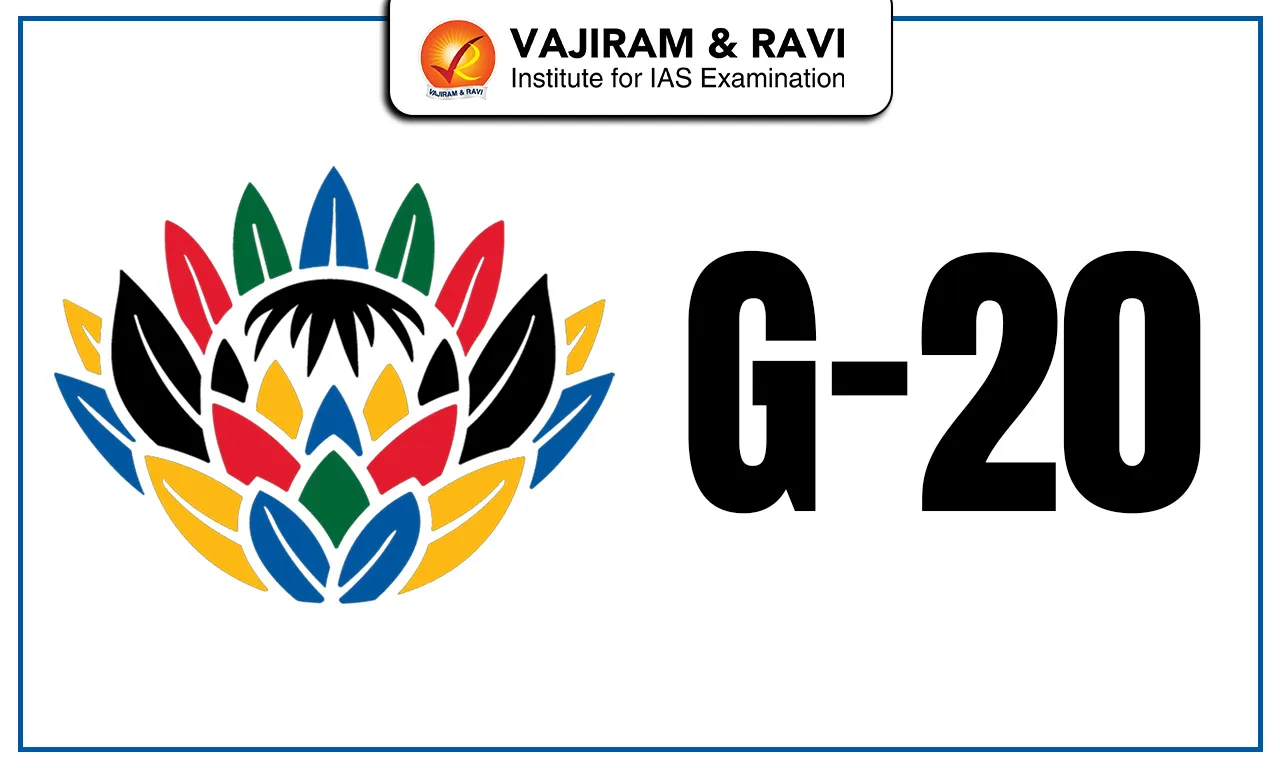
G20 is an international group of major developed and developing economies that works together to promote global economic and financial stability. It was created in 1999 after the Asian financial crisis as a forum for Finance Ministers and Central Bank Governors. In 2008, during the global financial crisis, it was upgraded to a leaders’ forum and declared the premier platform for international economic cooperation.
The G20 today includes 19 countries, the European Union, and the African Union, representing most of the world’s GDP, trade, and population. Over the years, its work has expanded from economic issues to climate change, digital cooperation, development, and global governance. In 2025, South Africa hosted the G20 Summit under the theme “Solidarity, Equality and Sustainability.”
G20 History
The G20 Group owes its origin to the Financial Crisis in 1997-98 of the Asian Tigers (Countries of East and Southeast Asia), which caused its establishment in 1999.
- It worked first as a forum for the Central Bank Governors and Finance Ministers of the major industrialised and developing economies to discuss global economic and financial stability.
- Elevation to Leader’s Level: After the 2008 global financial crisis, it was upgraded to the level of Heads of State or Government when it became clear that crisis coordination would be possible only at the highest political level.
- In 2009, it was declared as the “premier forum for international economic cooperation”.
- The G20 Leaders have met on a regular basis since then, and the G20 has emerged as the leading platform for global economic cooperation.
G20 Member Countries List
The G20 comprises 19 countries which are Argentina, Australia, Brazil, Canada, China, France, Germany, India, Indonesia, Italy, Japan, Republic of Korea, Mexico, Russia, Saudi Arabia, South Africa, Türkiye, the United Kingdom, and the United States
-
- G20 also comprises the European Union, and from 2023, the African Union.
- These members account for around 85% of the world GDP, 75% of the total International trade, and more than two-thirds of the global population.
- In addition to these member countries, the G20 each year invites guest countries and international organisations such as the United Nations, World Bank, IMF, OECD, ASEAN, etc. to participate in its meetings.


G20 Structure and Functioning
The G20 operates on the basis of annual meetings of Finance Ministers and Central Bank Governors, with a leaders' summit held once a year.
- The G20 consists of two parallel tracks called the Finance Track and the Sherpa Track.
- These two tracks play an active role in shaping ideas and priorities for the host presidency, while also guiding the intergovernmental negotiations carried out throughout the presidency.
| Structure of G20 | |
|
Sherpa Track |
- The Sherpas of member countries are the personal emissaries of the Leaders. - They concentrate on socio-economic issues such as agriculture, anti-corruption, climate, digital economy, education, employment, energy, environment, health, tourism, trade and investment. - They oversee all the negotiations over the year, discuss the agenda for the Summit and coordinate the substantive work of G20. |
|
Finance track |
- It is headed by the Finance Ministers and Central Bank Governors, who generally meet four times a year, with two meetings being held on the sidelines of World Bank /International Monetary Fund meetings. - Focus areas: Fiscal and Monetary policy issues such as global economy, infrastructure, financial regulation, financial inclusion, international financial architecture, and international taxation. |
- Troika: The G20 does not have a charter or a secretariat. The Presidency is supported by the Troika, which includes the previous, current, and incoming presidencies. The G20 Presidency hosts the Summit and directs the G20 agenda for a calendar year.
- A non-binding forum: Its decisions are not legally binding, and member countries are not required to implement them.
- Working with international organisations: The G20 members also work closely with international organisations such as the International Monetary Fund (IMF), the World Bank, and the World Trade Organization (WTO).
G20 Summit 2025
The G20 Summit 2025 was held on 21-23 November 2025 at the Johannesburg Expo Centre, marking the 20th meeting of the G20 and the first-ever summit hosted on the African continent.
- South Africa used this opportunity to highlight Africa’s development priorities, global equity, and South-South cooperation.
- The summit gained attention due to the absence of top leaders from major economies, including China’s Xi Jinping and U.S. President Donald Trump.
- Despite this, leaders focused on global economic recovery, climate resilience, and digital cooperation.
- The present G20 troika backing South Africa’s 2025 presidency includes South Africa (current chair), Brazil (previous chair), and the United States (next chair).
G20 Summit 2025 Theme
The theme for the G20 Summit of 2025 was “Solidarity, Equality and Sustainability”, reflecting the group’s original mission and values.
- The theme emphasised on
- collective action,
- fairness in global development, and
- long-term environmental responsibility.
- It aimed to strengthen unity among nations while promoting inclusive and sustainable growth worldwide.
G20 Summit 2025 Outcomes
The 2025 G20 Summit adopted the G20 declaration focused on delivering stronger commitments on global economic stability, climate financing, and digital cooperation under South Africa’s leadership.
- Emphasis on Critical Minerals Framework: The summit highlighted a new G20 Critical Minerals Framework aimed at using critical minerals to drive sustainable and inclusive growth.
- It also seeks to ensure that producing nations, especially in the Global South, gain maximum benefits from their resources.
- Need to scale up climate finance: The G20 declaration, endorsed alongside the COP30 deal, called for scaling up climate finance “from billions to trillions.”
- It highlighted global inequalities in energy access, especially in Africa and urged greater, more diverse investment in sustainable energy.
- It also stressed the need to strengthen early warning systems to protect communities vulnerable to climate-related disasters.
- Ukraine in focus on the sidelines: Although Ukraine appeared only once in the 30-page declaration under global conflicts, Western leaders kept the issue central in their sideline discussions.
- Peace in other regions: Beyond Ukraine, the declaration urges a “just, comprehensive, and lasting peace” in Sudan, the Democratic Republic of Congo, and the Occupied Palestinian Territory.
- Condemning terror: Among the key outcomes was a single-line condemnation of terrorism in all its forms and manifestations.
- Multilateralism and global cooperation: Reiterated commitment to the UN Charter, international law and peaceful settlement of disputes.
- Emphasised the African philosophy Ubuntu: “I am because we are.”
- UN Security Council (UNSC) reform: Called for “transformative reform” of UNSC. Sought increased representation for Africa, Asia-Pacific, Latin America & Caribbean.
- Women-led development: Reaffirmed commitment to empowerment of women and girls, removing socio-economic barriers, promoting women-led development, and recognising women as agents of peace.
- Other important outcomes: G20 agreed to,
- Take action to ensure debt sustainability for low-income countries,
- Strengthen multilateral development banks,
- Promote decent work amid rapid technological change,
- Advance international standards for trustworthy AI,
- Shared commitments to energy security, sustainable development, and the 2030 Agenda.
- Boost food security efforts and support smallholders and supply chains.
- Working together to enhance the International Financial Architecture and improve Debt Sustainability.
G20 Summit 2025 India’s Presence
In G20 Summit 2025, India pitched its vision for six new G20-led initiatives.
- A G20 Initiative on Countering the Drug-Terror Nexus.
- Creating a G20 Global Healthcare Response Team with trained medical professionals from member countries ready for deployment.
- G20 Africa-Skills Multiplier Initiative to facilitate the country's workforce transformation.
- Establishment of a Global Traditional Knowledge Repository.
- A G20 Open Satellite Data Partnership.
- The creation of a G20 Critical Minerals Circularity Initiative.
G20 Presidency of India 2023
India hosted the G20 Leaders' Summit in 2023 for the first time in history, with 43 Heads of Delegation attending the final New Delhi Summit in September 2023, the most ever in the G20.
- Theme of India’s G20 presidency: “Vasudhaiva Kutumbakam” or “One Earth - One Family - One Future”.
- Troika: During the presidency, the Troika consisted of Indonesia, India and Brazil.
- Invitees: Other than the members and multilateral institutions, nine countries have been invited - Bangladesh, Netherlands, Oman, Singapore, Nigeria, Spain and the United Arab Emirates, Egypt, and Mauritius.
- AU as permanent member: The African Union (AU) joined the G20 in September 2023, becoming a permanent member during the G20 summit hosted by India.
- India - Middle East - Europe Economic Corridor (IMEC): During the G20 Summit in New Delhi, a Memorandum of Understanding (MoU) was signed among the governments of India, the U.S., Saudi Arabia, the European Union, the UAE, France, Germany, and Italy to establish the IMEC Corridor.
G20 Importance
The importance of G20 as a group can be stated from the points below.
-
- Wider areas of cooperation: The agenda of the G20 has been expanding from a broad macroeconomic policy to include more areas of cooperation.
- The G20 summit in Hangzhou (China), 2016, saw the convergence of the US and China on the Paris Agreement.
- The G20 summit in Argentina, 2018 focused on fair and sustainable development.
- G20 summit in Germany, 2021 focused on the issues regarding money laundering, international tax havens, and corruption.
- G20 summit in Bali (Indonesia), 2022 focused on financial stability, humanitarian crisis, poverty, and aid to least developed nations among other things.
- Food security: The leaders promised to work together to address food security issues and praised the Black Sea grains initiative.
- Promoting gender equality: Recognize the importance of gender equality and commit to promoting it by increasing women's participation in the workforce, reducing the gender pay gap, and improving access to education and healthcare.
- Wider areas of cooperation: The agenda of the G20 has been expanding from a broad macroeconomic policy to include more areas of cooperation.
- Global balance of power: The G20 promotes a more equitable distribution of power among developed and developing countries than the earlier formed blocs such as G-7 and P-5 (UNSC), which helps to maintain a balance of power at the global level.
- Bringing adversaries on a common platform: The importance of the G20 lies in its ability to bring together countries with different ideologies, political systems, and economic interests onto a common platform to discuss and address global economic issues.
- Addressing climate change: The G20 has recognised the threat of climate change and has taken major initiatives to address it.
- Example: Tripling Renewable Energy Capacity, Global Biofuel Alliance, G20 Global Land Initiative, Promoting Sustainable Lifestyles, etc.
- Networking and collaboration: The G20 provides an opportunity for leaders from different countries to meet and exchange ideas, strengthening relationships and promoting collaboration on economic issues.
- Global economic cooperation: The G20 has played a critical role in responding to economic crises such as the 2008 global financial crisis, the Eurozone debt crisis, and the COVID-19 pandemic.
G20 Challenges
While the G20 has played an important role in shaping global economic policies, there are several challenges and limitations it faces:
- Difficulty in reaching consensus: Countries with a wide range of economic and political systems can make it difficult for them to reach a consensus on important issues.
- For example, during the 2008 global financial crisis, the G20 struggled to come up with a coordinated response.
- There has been friction within the group sometimes regarding the issue of climate change.
- Further, geopolitical tensions such as the Russia-Ukraine crisis also became the bone of contention in reaching the consensus, as observed in the Bali G20 summit as well as during India's G20 presidency.
- No Permanent Secretariat: The G20 does not have a permanent secretariat due to which monitoring becomes cumbersome and inefficient as discussions expand.
- Non-binding decisions: Member countries are not legally bound to implement the decisions made at G20 meetings.
- For example, the G20 countries had agreed to a set of guidelines for preventing the financing of terrorism, but there is no mechanism to enforce compliance with these guidelines.
G20 Way Forward
The G20 represents more than two-third population and around 85% of the world economy. Therefore its sustenance is important for development and global stability.
- Implementing existing frameworks: G20 members need to focus on the frameworks such as Entrepreneurship Action Plan to redouble their efforts to support a more innovative pattern of inclusive economic growth, with new engines of development and new pathways for job growth.
- Attaining climate goals: G20 needs to attain climate goals by accelerating climate finance and transitioning to net zero, tackling inequality through equitable policies, and establishing a global compact on the responsible use of technology like AI.
- Maintaining cooperation among members: There needs to be strong cooperation among members themselves for the success of global peace, development and economic stability.
- Example: Recent boycott of G20 Summit 2025 by the USA is not in the spirit of international cooperation.
G20 PYQs
Question 1: Consider the following statements about G-20:
- The G-20 group was originally established as a platform for the Finance Ministers and Central Bank Governors to discuss international economic and financial issues.
- Digital public infrastructure is one of India’s G-20 priorities.
Which of the statements given above is/are correct? (UPSC Prelims 2023)
(a) 1 only
(b) 2 only
(c) Both 1 and 2
(d) Neither 1 nor 2
Ans: (c)
Question 2: With reference to the “G20 Common Framework”, consider the following statements
- It is an initiative endorsed by the G20 together with the Paris Club.
- It is an initiative to support Low Income Countries with unsustainable debt.
Which of the statements given above is/are correct? (UPSC Prelims 2022)
(a) 1 only
(b) 2 only
(c) Both 1 and 2
(d) Neither 1 nor 2
Ans: (c)
Question 3: In which one of the following groups are all the four countries members of G20? (UPSC Prelims 2020)
(a) Argentina, Mexico, South Africa and Turkey
(b) Australia, Canada, Malaysia and New Zealand
(c) Brazil, Iran, Saudi Arabia and Vietnam
(d) Indonesia, Japan, Singapore and South Korea
Ans: (a)

 Last updated on Sep, 2026
→ UPSC 2027 Notification will be released on 13 January 2027 at upsconline.nic.in.
→ Asian Games 2026 are being held in Aichi-Nagoya, Japan, from 19 September to 4 October.
→ Check out the latest UPSC Syllabus here.
→ Download UPSC Model Answers for Mains 2026
→ UPSC Mains Question Paper 2026 is out now for Essay & GS Paper 1, 2, 3 & 4.
→ UPSC Calendar 2027 has been released.
→ Enroll in Vajiram & Ravi’s UPSC Mains Test Series 2027 for structured answer writing practice, expert evaluation, and exam-oriented feedback.
→ Join Vajiram & Ravi’s UPSC Mentorship Program 2027 for personalized guidance, strategy planning, and one-to-one support from experienced mentors.
→ Go through the UPSC Mains Previous Year Papers to enhance your preparation.
→ UPSC has released UPSC Toppers List 2025 with the Civil Services final result on its official website.
→ Also check Best UPSC Coaching in India
G20 FAQs
Q1. What is the G20?+
Q2. Where was the first summit of G20 held?+
Q3. G20 Summit 2025 was held in which country?+
Q4. Which country will host the G20 summit in 2026?+
Q5. What was the theme of G20 Summit 2025?+