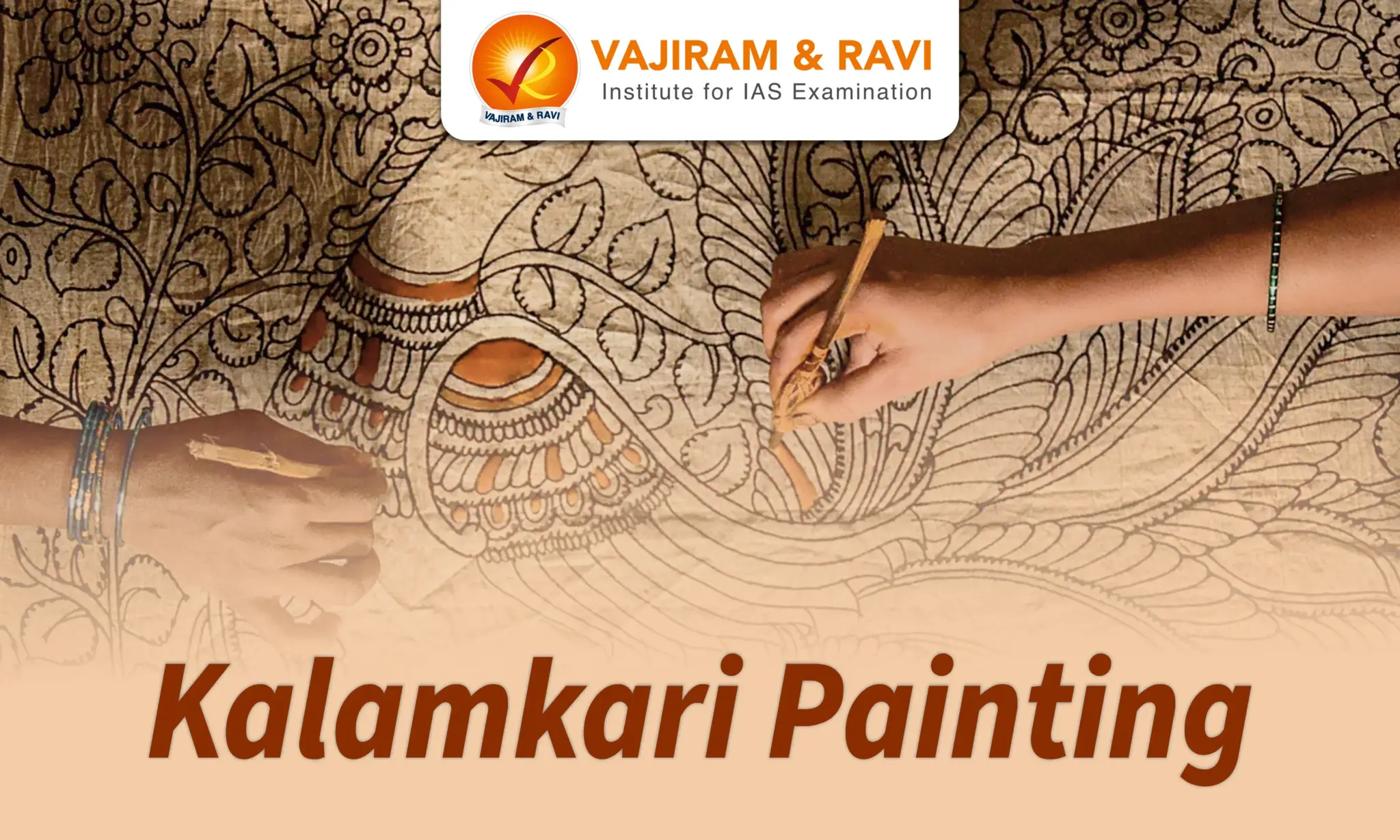
Kalamkari is a traditional Indian art form of hand-painted or block-printed cotton textiles. It originated in the Indian state of Andhra Pradesh around 3,000 years ago. Derived from the Persian words ‘kalam’ meaning pen and ‘kari’ meaning craftsmanship, it translates to "pen-work." It gained prominence in southern India during the reign of the Vijayanagara Empire, where it was widely used to depict religious stories and temple art.
This ancient art form is known for its intricate and vivid depiction of mythological stories, religious epics, and motifs from nature, all created using natural or organic dyes. Practised in Andhra Pradesh and parts of Tamil Nadu, Kalamkari has gained international recognition for its timeless beauty and craftsmanship.
Kalamkari Painting History
Kalamkari Originated in Machilipatnam and was initially used by musicians and painters, called chitrakars, who travelled between villages narrating Hindu mythological stories on large painted canvases. Often found in temples, these artworks depict mythological episodes and iconography, similar to Buddhist Thangka paintings.
- The Mughals, who patronized the craft in the Coromandel and Golconda regions, named the artisans "Qualamkars," from which the term "Kalamkari" evolved.
- Under the patronage of the Mughal and Golconda sultanate, the craft developed in the Pedana region near Machilipatnam and was influenced by Persian art during Islamic rule.
Kalamkari Painting Styles
Kalamkari painting is broadly divided into two distinct styles based on the regions where the art form developed—Srikalahasti and Machilipatnam. Each style is unique in its technique, motifs, and themes. Srikalahasti Kalamkari is known for its freehand drawing using a pen, often depicting mythological stories and religious motifs, while Machilipatnam Kalamkari uses block-printing techniques, focusing on floral and geometric designs.
- Despite their differences, both styles reflect the deep cultural and spiritual significance of Kalamkari and have been passed down through generations of artisans
Srikalahasti Kalamkari
The Srikalahasti style is practised in Srikalahasti of Tirupati district and is done entirely by hand using the kalam (pen). This form is characterized by freehand drawing and intricate detailing, which often portrays mythological figures and themes.
- Artisans use bamboo or date palm sticks with a woollen clothes a brush, and the outlines are drawn using black or red natural dyes.
- Srikalahasti Kalamkari primarily focuses on religious iconography, temple architecture, and Hindu deities.
Machilipatnam Kalamkari
Machilipatnam Kalamkari, also known as Pedana Kalamkari, developed in Pedana near Machilipatnam. It is deeply influenced by Persian art due to the patronage of the Mughals and the Golconda Sultanate.
- Unlike Srikalahasti, this style avoids religious Hindu motifs and instead focuses on Persian-inspired block-printed designs.
- Common motifs include intricate patterns of leaves, flowers, cartwheels, creepers, and birds like parrots and peacocks.
- Under Mughal rule, especially after Aurangzeb's conquest in 1687, the style expanded to include portraits of emperors and scenes depicting the grandeur of their courts.


Kalamkari Painting Techniques
The process of creating Kalamkari begins by soaking the fabric in a mixture of astringents and buffalo milk, followed by drying it in the sun. The outlines of the design in red, black, brown, and violet are drawn using a mordant, after which the cloth is dipped in an alizarin bath. Wax is then applied to the areas that remain undyed, and the fabric is immersed in indigo dye.
Once the wax is removed, the remaining areas are hand-painted. Artists use a bamboo or date palm stick with fine hair attached to create design contours, applying natural dyes extracted from roots, leaves, seeds, and minerals like iron and copper.
Government Efforts to Revive Kalamkari Painting
In 2013, the Kalamkari art form was officially recognized by the Government of India when the Pedana Kalamkari art form was registered under the Geographical Indications Registry (GIR), protecting its unique heritage. Additionally, the Andhra Pradesh government has designated Kalamkari as the 'One District One Product' for Krishna district to promote its production and cultural significance.
Despite these initiatives, the number of artisans involved in Kalamkari continues to decrease, highlighting the need for further efforts to preserve this traditional art form.

 Last updated on Sep, 2026
→ UPSC 2027 Notification will be released on 13 January 2027 at upsconline.nic.in.
→ Asian Games 2026 are being held in Aichi-Nagoya, Japan, from 19 September to 4 October.
→ Check out the latest UPSC Syllabus here.
→ Download UPSC Model Answers for Mains 2026
→ UPSC Mains Question Paper 2026 is out now for Essay & GS Paper 1, 2, 3 & 4.
→ UPSC Calendar 2027 has been released.
→ Enroll in Vajiram & Ravi’s UPSC Mains Test Series 2027 for structured answer writing practice, expert evaluation, and exam-oriented feedback.
→ Join Vajiram & Ravi’s UPSC Mentorship Program 2027 for personalized guidance, strategy planning, and one-to-one support from experienced mentors.
→ Go through the UPSC Mains Previous Year Papers to enhance your preparation.
→ UPSC has released UPSC Toppers List 2025 with the Civil Services final result on its official website.
→ Also check Best UPSC Coaching in India
Kalamkari Painting FAQs
Q1. Which state is famous for Kalamkari painting?+
Q2. What is a Kalamkari painting?+
Q3. Does Kalamkari have a GI tag?+
Q4. What are the two types of Kalamkari?+
Q5. How old is Kalamkari painting?+
Tags: kalamkari painting quest