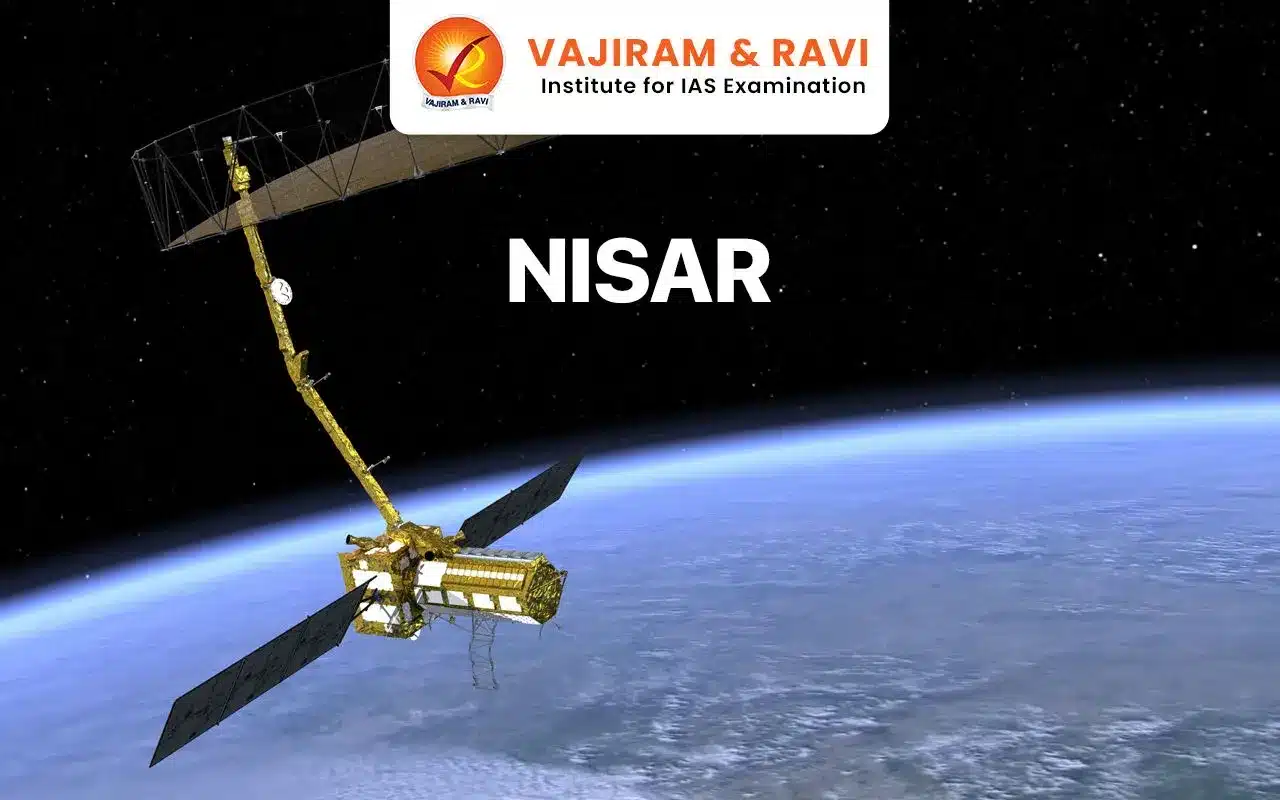
NISAR (NASA-ISRO Synthetic Aperture Radar) is a groundbreaking joint mission between NASA and ISRO. This collaborative effort aims to measure Earth’s dynamic surfaces, changing ecosystems, and ice masses. NISAR will provide crucial information about biomass, natural hazards, sea level rise, and groundwater.
By systematically mapping our planet using dual radar frequencies (L-band and S-band), NISAR can detect even tiny surface movements. It’s the first radar imaging satellite to achieve this feat. NISAR’s data will empower scientists, aid disaster management, and enhance our understanding of Earth’s crust and environmental changes.
About NISAR Mission
NISAR is a joint NASA-ISRO Earth observation satellite set to launch in early 2024. Its objectives are to study surface changes, monitor natural hazards, analyze climate patterns, and enhance our understanding of Earth's dynamic ecosystems from space, surveying the planet's land and ice every 12 days over its three-year mission life.
NISAR Mission Characteristics
| Category | - Earth observation satellites |
| Launch details |
- Launch date: March 2024 (planned) - Launch vehicle: GSLV Mk II - Launch site: Satish Dhawan Space Center, ISRO |
| Mission life | - 3 years |
| Repeat Cycle | - 12 days |
| Orbital details |
- Sun-synchronous orbit (LEO) - Altitude: 747 km |
| Wavelength |
- L-band: 24 cm - S-band: 9 cm |
| Radar Instruments |
- L-band Synthetic Aperture Radar (L-SAR) (by NASA) - S-band Synthetic Aperture Radar (S-SAR) (by ISRO) |
NISAR Payloads
The NISAR mission carries two primary payloads, which are the advanced radar instruments that will be used for Earth observation:
- L-band Synthetic Aperture Radar (L-SAR):
- Developed by NASA's Jet Propulsion Laboratory (JPL)
- Operates at a wavelength of approximately 24 cm
- Designed to penetrate through vegetation and surface materials
- Provides high-resolution imagery for studying solid Earth processes, ice sheet dynamics, and biomass changes
- S-band Synthetic Aperture Radar (S-SAR):
- Developed by the ISRO
- Operates at a wavelength of approximately 10 cm
- Optimized for studying surface deformation and changes in biomass
- Provides high-resolution imagery for monitoring natural hazards, such as earthquakes, volcanic activity, and landslides
Contributions from NASA and ISRO
| Country | Work Share |
| NASA |
- L-band synthetic aperture radar (SAR) - High-rate telecommunication subsystem for scientific data - GPS receivers - Solid-state recorder - Payload data subsystem |
| ISRO |
- S-band Synthetic Aperture Radar (S-SAR) - Satellite platform -Launch vehicle (GSLV Mk II) and launch services |
Significance of NISAR Mission
NISAR is a remarkable mission that combines cutting-edge radar technology, international collaboration, and a commitment to understanding our planet’s dynamic features:
- Earth observation and monitoring: NISAR will regularly monitor Earth's ecosystems, surface dynamics, and ice masses every 6 days for 3 years, providing critical data on biomass, natural hazards, sea level rise, and groundwater.
- Technological advancements: NISAR is the first satellite mission to utilize dual-band synthetic aperture radar (L-band and S-band), enabling high-resolution imaging and precise surface change measurements in all weather conditions.
- Revolutionizing Earth Science: NISAR's radar imagery will enable comprehensive monitoring and analysis of land surface changes, resource management, hazard preparedness, and ongoing crises across local and regional scales.
- International collaboration: NASA and ISRO's partnership on NISAR emphasizes international cooperation in space exploration and scientific research.
- All NISAR science data will be freely available to the public, promoting transparency and collaboration in Earth observation efforts.


 Last updated on Oct, 2026
→ UPSC 2027 Notification will be released on 13 January 2027 at upsconline.nic.in.
→ Check Nobel Prize 2026 Winners List here.
→ Download PIB PRiSM Monthly Magazine 2026 here.
→ Check UPSC Monthly Current Affairs Magazine The Recitals here.
→ Check out the latest UPSC Syllabus here.
→ Download UPSC Model Answers for Mains 2026
→ UPSC Mains Question Paper 2026 is out now for Essay & GS Paper 1, 2, 3 & 4.
→ UPSC Calendar 2027 has been released.
→ Enroll in Vajiram & Ravi’s UPSC Mains Test Series 2027 for structured answer writing practice, expert evaluation, and exam-oriented feedback.
→ Join Vajiram & Ravi’s UPSC Mentorship Program 2027 for personalized guidance, strategy planning, and one-to-one support from experienced mentors.
→ Go through the UPSC Mains Previous Year Papers to enhance your preparation.
→ UPSC has released UPSC Toppers List 2025 with the Civil Services final result on its official website.
→ Also check Best UPSC Coaching in India
NISAR Mission FAQs
Q1. What is the full form of NISAR?+
Q2. What is the purpose of NISAR?+
Q3. What is Synthetic Aperture Radar?+
Tags: nisar mission quest