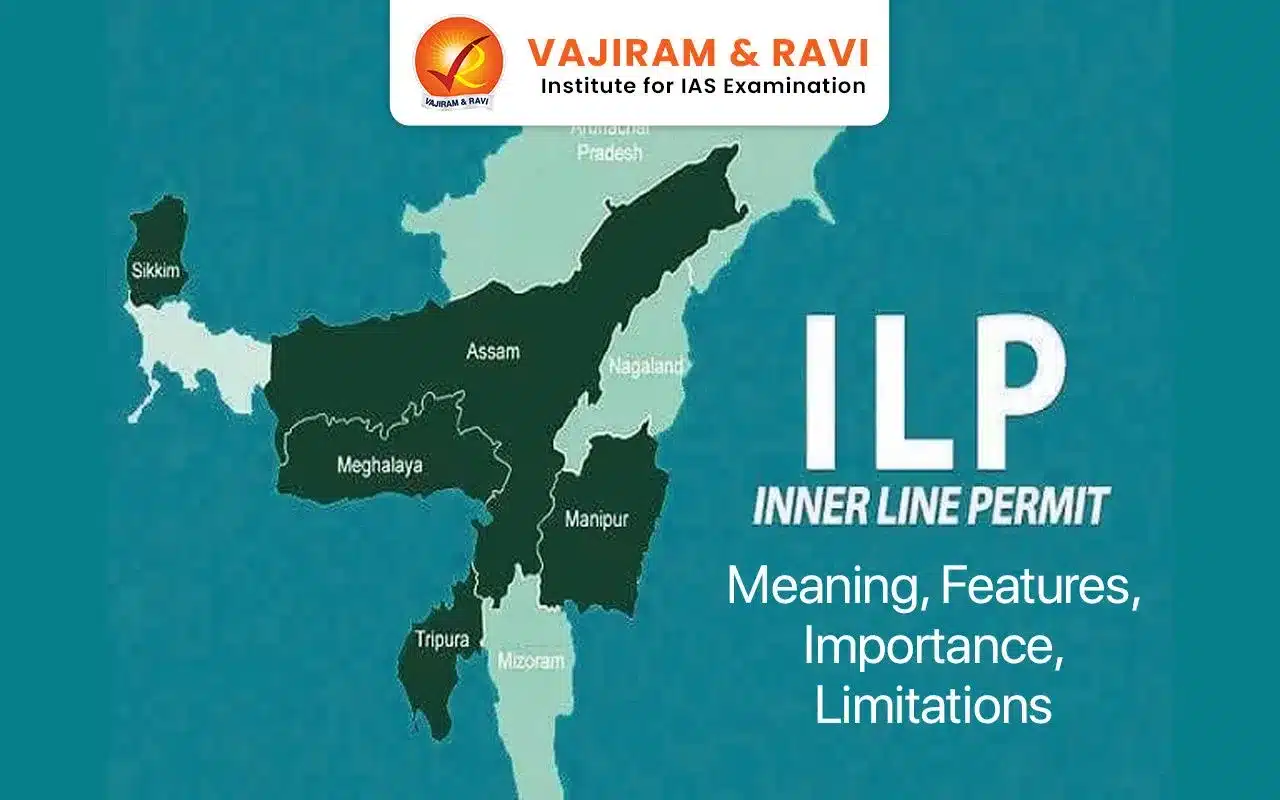
The Inner Line Permit (ILP) system is an offshoot of the Bengal Eastern Frontier Regulation, 1873, by which an “Inner Line” was prescribed for the tribal areas. It is an official document issued by the state governments of ILP states for visiting any restricted or protected areas of these states, as defined by the Foreigners (Protected Areas) Order of 1958. Currently, Arunachal Pradesh, Nagaland, Mizoram and Manipur are the ILP states.
ILP was introduced in India to protect the indigenous tribes from exploitation in the name of tourism and to preserve the rich heritage of their traditions and cultures.
ILP and the Foreigners (Protected Areas) Order
The Foreigners (Protected Areas) Order, 1958, to give effect to the Foreigners Act, 1946, defines the ‘Inner Line’ throughout India starting from Jammu and Kashmir to Mizoram. It is the last point, up to the international border, where a foreign traveller can visit on a visa and Indian citizens can visit without the requirement of any special permit. Beyond this point, the visitor needs to have the Special Permit.
- Protected and Restricted Areas:
- Under the Foreigners (Protected Areas) Order of 1958, all areas falling between the ‘Inner Line’ and the ‘International Border of the State’ have been declared as “Protected Areas,” whereas, areas falling between the ‘Inner Line’ and the ‘Territory occupied by indigenous tribes’ as “Restricted Areas”.
- Currently, Protected Areas are located in the following States/UT:
- Whole of Arunachal Pradesh
- Parts of Himachal Pradesh
- Parts of Jammu & Kashmir
- Parts of Rajasthan
- Whole of Sikkim(partly in Protected Areas and partly in Restricted Areas).
- Under the Foreigners (Restricted Areas) Order, 1963, Andaman & Nicobar Islands (Entire UT) and Sikkim (Part of the State) are included as ‘Restricted’ Areas.
- Inner Line Permit: The Inner Line Permit is the travel document that must be availed by domestic tourists to visit these Protected and Restricted Areas of the ILP states, for a limited period.
- ILP States: Arunachal Pradesh, Mizoram, Nagaland and Manipur.
- Protected Area Permit: For foreign tourists (except Bhutanese), the permit is known as the Protected Area Permit.
- Protected areas are broader than the Inner Line areas.
- Entry permit to Lakshadweep: According to the Laccadive, Minicoy and Amindivi Islands (Restriction on Entry and Residence) Rules, 1967, every person, who is not a native of these islands, shall have to obtain a permit from the Competent authority, to enter into and residing in these islands.
Inner Line Permit System Features
The concept of ILP goes back to the Bengal Eastern Frontier Regulation, also known as the Inner Line Regulation, 1873. It was the British's first administrative policy in the North East. After Independence, the Indian government replaced “British subjects” with “Citizens of India” in 1950 and brought the ILP system.
- Types of ILP: There are different types of ILPs, one for tourists and another for people who plan to stay for an extended period, often for work.
- Further Demands: The three states with the highest migration rates are Assam, Tripura, and Meghalaya, none of which have an ILP system.
- Demand for the overall implementation of the Inner Line Permit (ILP) exists in all NE states.


Inner Line Permit System Importance
The Inner Line Permit was created to preserve the indigenous character of all tribes living in the restricted areas of the country's northeastern regions.
- The influx of a large number of illegal migrants is one of the reasons for the introduction of this system.
- Other reasons for its introduction include the protection of their religious, social, and customary laws, the ownership and transfer of land, the administration of civil and criminal justice, and so on.
Inner Line Permit System Criticism
The British, following isolationist policy, established an inner line to preserve the strategic British stranglehold on areas, enable commercial purposes and acquisition of land for plantations. Despite its benefits, the system has been criticised for various reasons.
- Impact on Tourism: The permit creates a regulatory barrier to tourism. An instrument designed to protect tribals has inadvertently become a means of isolating them. The ILP system is detrimental to tourism, which is the primary economic activity of the region.
- Some states, such as Arunachal Pradesh, have devised novel solutions, such as granting an e-ILP, which streamlines the process.
- Impact on the economy: The ILP system is fundamentally opposed to the social integration, development and technological advancement of the region.
- ILP in a state bars people from other North-Eastern states also. This hampers labour and small traders' movement which is necessary for access to local markets, coal fields, and various types of work in the neighbouring states.
- Further, it hampers the investment in these regions.
- Illegal Migration: Even after the inner line permit is implemented, the menace of illegal migration has not stopped in northeastern states.

 Last updated on Oct, 2026
→ UPSC 2027 Notification will be released on 13 January 2027 at upsconline.nic.in.
→ Check Nobel Prize 2026 Winners List here.
→ Download PIB PRiSM Monthly Magazine 2026 here.
→ Check UPSC Monthly Current Affairs Magazine The Recitals here.
→ Check out the latest UPSC Syllabus here.
→ Download UPSC Model Answers for Mains 2026
→ UPSC Mains Question Paper 2026 is out now for Essay & GS Paper 1, 2, 3 & 4.
→ UPSC Calendar 2027 has been released.
→ Enroll in Vajiram & Ravi’s UPSC Mains Test Series 2027 for structured answer writing practice, expert evaluation, and exam-oriented feedback.
→ Join Vajiram & Ravi’s UPSC Mentorship Program 2027 for personalized guidance, strategy planning, and one-to-one support from experienced mentors.
→ Go through the UPSC Mains Previous Year Papers to enhance your preparation.
→ UPSC has released UPSC Toppers List 2025 with the Civil Services final result on its official website.
→ Also check Best UPSC Coaching in India
Inner Line Permit FAQs
Q1. What is the Inner Line Permit?+
Q2. Which states require an Inner Line Permit?+
Q3. Who is eligible for an Inner Line Permit?+
Q4. Who is not eligible for an Inner Line Permit?+
Tags: inner line permit quest