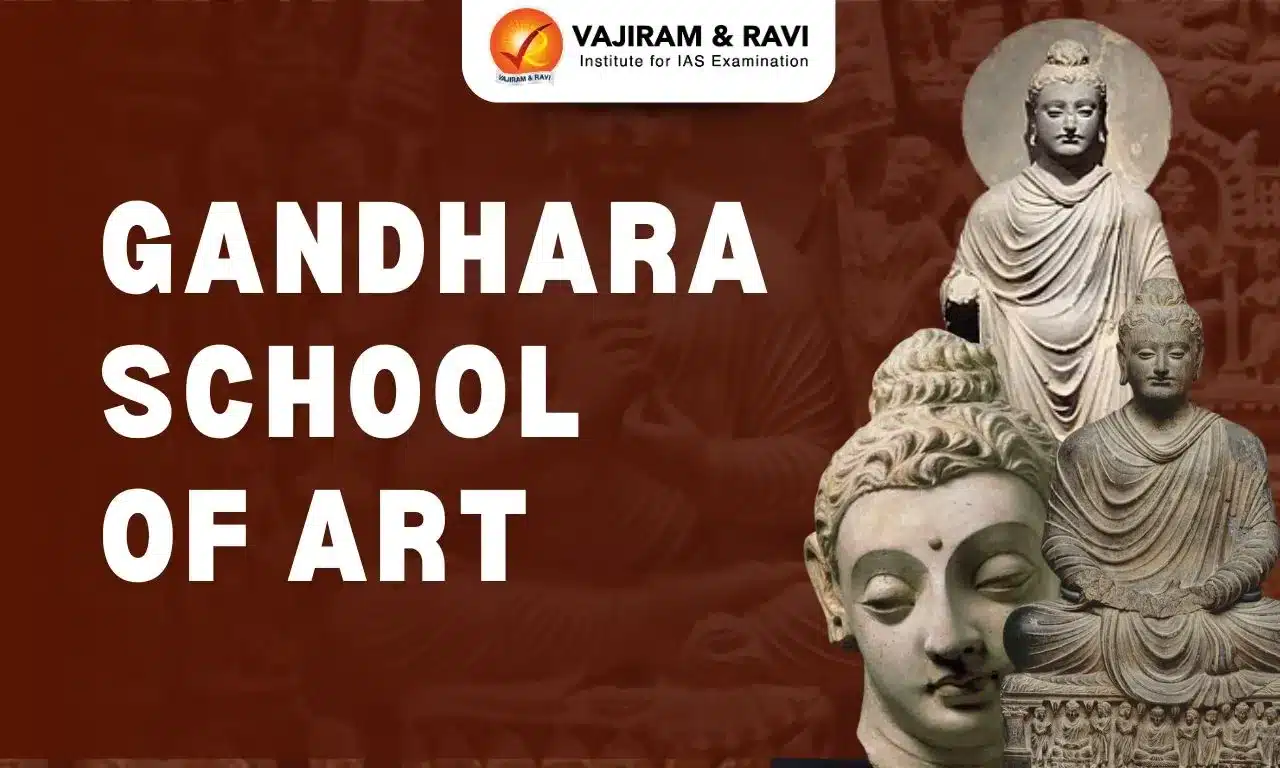
The Gandhara School of Art is one of the three most popular schools of art originating in the first century CE. It originated in Gandhara (now in Pakistan). Gandhara school of art was predominantly Buddhist. The Buddhist religion flourished under the patronage of Kushan emperors, and several images of the Buddha and Bodhisattvas were produced during their reign.
The Buddha in the symbolic form got a human form in the Mathura and Gandhara school of art. The sculptural tradition in Gandhara showed the confluence of Bactria, Parthia, and the local Gandhara tradition.
About Gandhara School of Art
In Ancient times Gandhara was a famous center of trade along the Silk Road for centuries. Gandhara had a strategic position that attracted many invaders such as the Greeks, Parthians, and Kushans, who brought with them diverse artistic conventions. The Gandhara School of Art originated in the Taxila Valley in the northwest region of India from the second century B.C. to the first century A.D.
- Major centres: The major locations were Taxila, Peshawar, Begram, and Bamiyan.
- Influence: Gandhara art was influenced by the conversion of the region to Buddhism by the Mauryan Emperor Ashoka. The origin of Gandhara art resulted from interactions between Greek, Roman, and Indian styles.
- Golden Age: The Gandhara art style flourished much during the Kushan dynasty, especially during the rule of the emperor Kaniska.
- Buddhist depictions: The first depiction related to Buddhism dates to the early first century A.D. in the Gandhara school of art. This style of art was associated with Mahayana Buddhism and hence the main theme was Buddha and Bodhisattvas.
- Giant Buddha sculptures: By the late fifth century A.D., the patronage of Buddhist monuments in Gandhara had begun to decline, but in Afghanistan, this artistic tradition flourished until about the eighth century A.D.
- It was during this late phase in Afghanistan that sculptures of Buddha reached truly monumental proportions, such as the famous Buddhas at Bamiyan.
- More Buddhist sculptures and architecture have been found in Greater Gandhara than in any other part of ancient South Asia.
Gandhara School of Art Features
The Gandhara School of Art represents a unique blend of Indian, Greek, and Roman artistic traditions. It primarily developed in the region of modern-day Afghanistan and Pakistan, particularly in the Gandhara region. Below are its key features:
- Blend of Indian and foreign traditions: The Gandhara school included many motifs and techniques from the Classical Roman style (such as vine scrolls, cherubs bearing garlands, tritons, and centaurs). The basic iconography, however, remained Indian.
- Materials: The materials used for Gandhara sculpture were green phyllite and gray-blue mica schist in the earlier phase. Whereas stucco was used increasingly after the 3rd century CE. The sculptures were also painted and gilded.
- Idealistic depiction: The Buddha was represented with a youthful and attractive Apollo-like face. Dress/garments resembled those seen on Roman imperial statues.
- Realistic and naturalistic style: A more realistic and naturalistic aesthetic made it possible to depict the human figure in greater detail. Whereas the older Buddhist art tended to be more abstract and symbolic.
- Secular sculpture: The Gandhara School was mainly tied to Buddhism, but it also featured some secular sculptures representing royal and aristocratic people as well as commonplace settings.
- General features of sculptures:
- The Buddha is shown with wavy hair, a long nose, and a slim oval face.
- The drape of his garment was bold recalling the togas of Hellenistic sculpture.
- The divine figure was sometimes shown with humanistic details such as jewelry and a mustache.
- Greek pantheon figures also appear alongside statues of the Buddha.
- The sculptures were adorned with flowers, fruit trees, and ropes of leaves. So the landscapes and flora of distant lands blended with Indian art.
- Non-Greek features: Many of the images represent Buddha as seated in the typically Indian Yogic posture, a feature completely unknown to the Hellenistic tradition of art.
- Mudras of Buddha: Mostly four types of mudras (hand gestures) are shown in this art. This include Abahaya mudra, Dhyana mudra, Dharmachakra mudra, and Bhumisparsha mudra.


Gandhara School of Art UPSC PYQs
Question 1: Gandhara sculpture owed as much to the Romans as to the Greeks. Explain. (UPSC Mains 2014)

 Last updated on Oct, 2026
→ UPSC 2027 Notification will be released on 13 January 2027 at upsconline.nic.in.
→ Check Nobel Prize 2026 Winners List here.
→ Download PIB PRiSM Monthly Magazine 2026 here.
→ Check UPSC Monthly Current Affairs Magazine The Recitals here.
→ Check out the latest UPSC Syllabus here.
→ Download UPSC Model Answers for Mains 2026
→ UPSC Mains Question Paper 2026 is out now for Essay & GS Paper 1, 2, 3 & 4.
→ UPSC Calendar 2027 has been released.
→ Enroll in Vajiram & Ravi’s UPSC Mains Test Series 2027 for structured answer writing practice, expert evaluation, and exam-oriented feedback.
→ Join Vajiram & Ravi’s UPSC Mentorship Program 2027 for personalized guidance, strategy planning, and one-to-one support from experienced mentors.
→ Go through the UPSC Mains Previous Year Papers to enhance your preparation.
→ UPSC has released UPSC Toppers List 2025 with the Civil Services final result on its official website.
→ Also check Best UPSC Coaching in India
Gandhara School of Art FAQs
Q1. What was the Gandhara School of Art?+
Q2. Who promoted the Gandhara School of Art?+
Q3. Who invented Gandhara art?+
Q4. What is the difference between Mathura and Gandhara?+
Q5. What are the three schools of art?+
Tags: gandhara school of art quest