The caste system in India is one of the oldest and most systematic forms of social stratification in the world. The ancient Vedas, which divided people based on varna or occupation, are where the origins of the caste system can be traced. It arranges society in hierarchical groups known as Jatis, which are primarily occupation-based. The caste system in India plays a predominant role in society despite the growth of culture and civilisation. In contemporary India, it deeply influences individual identity, marriage patterns, occupational mobility, political mobilisation, and access to social and economic resources.
However, it also perpetuates pervasive caste-based discrimination and social exclusion, especially towards the lower castes. Today, modern forces like urbanisation, mass education, and economic mobility are gradually weakening traditional occupational rigidities and fostering class-based social structures. To address these historical injustices, the government enforces constitutional safeguards, laws, and affirmative action through reservations and welfare schemes.
Caste Meaning
Caste is a system of social stratification. The word caste comes from the Portuguese and Spanish word casta, which literally means "breed," "race," or "lineage". A caste is a fixed social group that a person is born into, which determines their rank, job, and social connections for life. A caste is a hereditary, endogamous group with a common name, traditional occupation, and culture. Castes are also relatively rigid in terms of mobility and distinctiveness of status, and they form a single, homogeneous community.
Caste and Class
Class in society refers to a group of people who share a similar economic and social position based on wealth, income, education, and occupation. While both caste and class are systems of social stratification used to group people, they differ fundamentally in how they are defined, how flexible they are, and their origins.
|
Class |
Caste |
|
- Class refers to the social position of a person, influenced by a variety of factors, including wealth, occupation, caste, etc. |
- A caste is a category of people made up of individuals with the same socioeconomic standing, profession, or rank. |
|
- The upper class, upper-middle class, middle class, working class, and lower class are the five main categories of social classes. |
- Hindus are divided into four distinct groups by the caste system: Brahmins, Kshatriyas, Vaishyas, and Shudras. |
|
- A person belonging to a particular class does not always have to follow the rules, traditions, and customs. |
- A member of a particular caste is required to carry out and adhere to certain customs, rituals, traditions, etc. |
|
- Couples from various social classes can marry. As a result, there are no conflicts within the class. |
- Inter-caste marriages are rarely permitted in India because they can cause caste conflicts. |
|
- In the class system, social distance between individuals is limited. |
- People from different castes have a wide social divide, which hinders the development of the country. |
Although distinct systems of social stratification, they deeply intersect in contemporary society, where traditional ritual hierarchies increasingly align with modern economic power structures.
- Economic Disparity: Historical social marginalisation concentrates lower castes in lower economic classes due to systemic barriers.
- Symbolic Capital (Bourdieu): Caste acts as symbolic capital, where hereditary prestige, ritual status, and social networks convert into modern economic and educational advantages.
- Urban Shift: Modern urban settings are shifting daily social interactions from being driven by caste (ascriptive birth status) to class (achieved income and wealth).
Caste System in India
The caste system is a social hierarchy within the Hindu religion in India, originally based on a person's occupation and birth. It divides society into different groups called castes, which are further divided into subcastes. Sociologist G.S. Ghurye defined it as a rigid, closed social organisation based on birth, characterised by segmental division, hierarchical ranking, strict endogamy, restricted social intercourse, occupational limitations, and uneven distribution of civil and religious privileges.
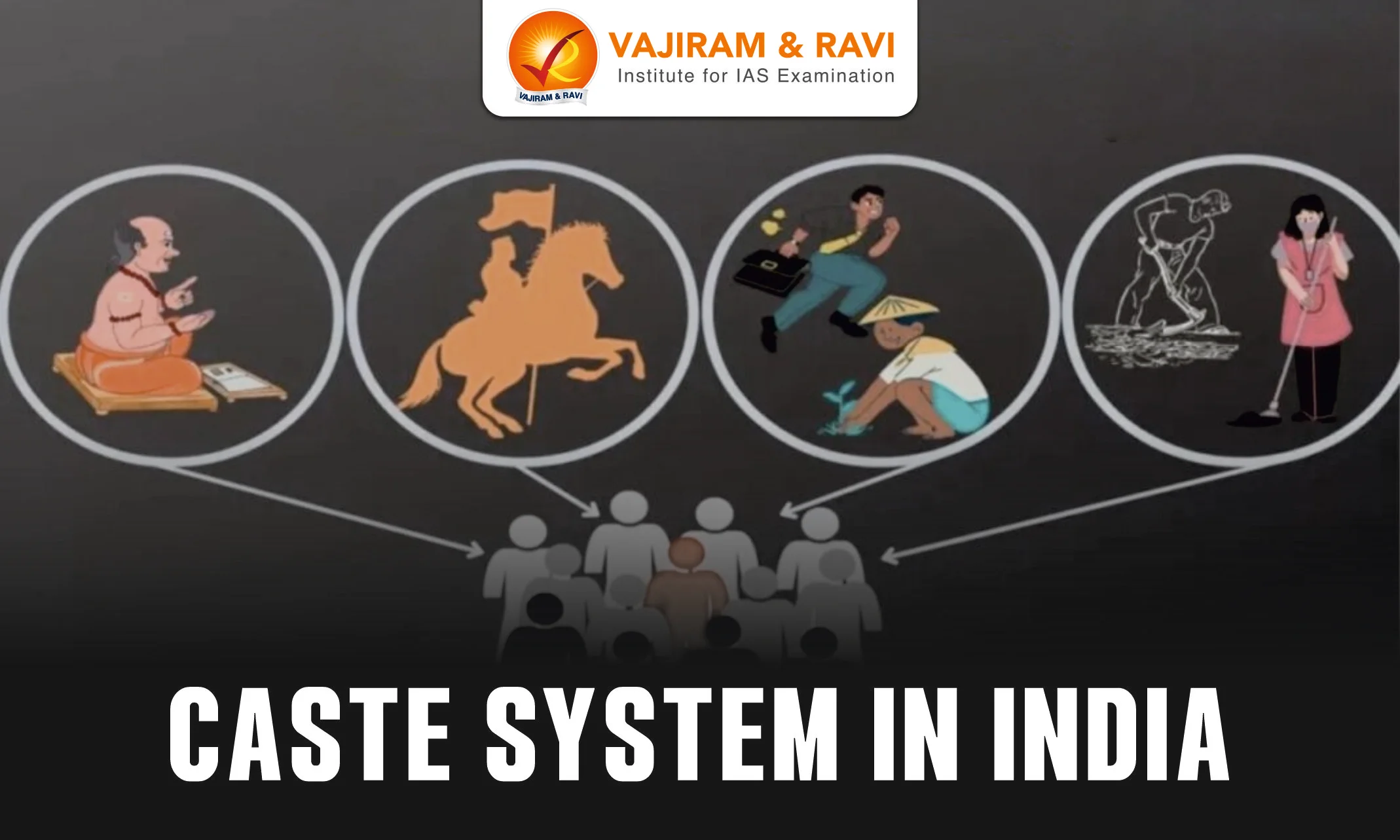
The four Varna - Brahmana, Kshatriya, Vaishya, and Shudra are the classical four divisions of Hindu society. In practice, however, there have always been many subdivisions of these varnas, which today connote castes in India.
Caste System in India Origin
The Caste System originated in the Purusha Sukta of the Rigveda as the early Varna system. The early Varna System divided Hindu society into four main groups based on work and occupation: Brahmins, Kshatriyas, Vaishyas, and Shudras.
At first, this system was flexible and allowed people to change their work. However, over time, it broke down and became rigid. As birth replaced work, strict rules about marrying only within one's group and passing jobs down to children took over. This turned the four broad Varnas into thousands of fixed, birth-based Jatis (castes and sub-castes) that stopped social movement and created a permanent social hierarchy.


Structure of Caste System in India
The caste system in India is a traditional form of social stratification in which social groups were historically organised largely according to birth.
- Two Layers: Its structure can be understood through Varna and Jati. Varna refers to the classical fourfold division of Hindu society, while Jati refers to thousands of localised, hereditary communities associated with particular occupations and social practices.
- Four Varnas: The four major Varnas were Brahmins, Kshatriyas, Vaishyas and Shudras. Brahmins were traditionally associated with priestly, teaching and scholarly roles. Kshatriyas were linked with ruling, administration and warfare. Vaishyas were traditionally associated with agriculture, trade and commerce. Shudras generally performed various artisan, labour and service occupations.
- Dalits and Adivasis: Historically, communities now commonly referred to as Dalits experienced severe social exclusion and discrimination and were placed outside the traditional Varna framework.
- Adivasi communities constitute diverse indigenous and tribal societies and should not be treated as a single caste category. Modern India prohibits caste-based discrimination and untouchability under the Constitution.
Caste System in India Features
Caste is the system of organization in society, dividing labor, distributing goods and services, and defining social roles and obligations. It is a homogeneous community of families bearing common names and ancestry, forming a common hereditary calling.
- Caste is determined by birth: Indian society is primarily divided into different castes. Caste membership is determined by birth and not by accomplishments. Castes also involve sub-divisions within themselves.
- Hierarchy: Castes have a specific scheme of social and ritual hierarchy. With this grading or ranking comes a sense of high and low, superiority and inferiority.
- Restrictions on feeding and social interaction: There are restrictions on the kind of food that can be eaten together, received, or exchanged among castes.
- The ideology of purity and pollution: The ideology of purity and pollution regulates the interaction between different castes significantly.
- Restrictions on Endogamy: Endogamy, or marriage within one’s own caste or sub-caste, is an essential feature of the caste system.
- Rules governing the caste system: There is a prescribed set of norms, values, and sanctions that govern social behaviour within a caste.
- Restricted choice of occupation: Traditionally, each caste was associated with an occupation.
- For example: The Brahmins who occupied the uppermost rank were prescribed the duties of acquiring and teaching sacred knowledge and performing sacrifices, while lower castes, such as Dalits, were historically restricted to jobs such as manual labour.
Caste System in India Caste Discrimination
Caste discrimination is a deeply entrenched system of social hierarchy that subjects lower-caste groups to severe exclusion, economic disadvantage, and human rights violations. Despite constitutional protections, it persists across modern public life, manifesting through structural bias, segregation, and severe systemic violence.
- Atrocities & Violence: NCRB (2023) recorded 57,789 cases under the SC/ST Atrocities Act, with a low conviction rate of ~30–35%. Key hotspot states include UP and MP.
- Prohibited Sanitation Practices: Despite legal bans, over 1,200 sewer-cleaning deaths have occurred since 1993, heavily affecting few Dalit sub-castes (rehabilitation targets set under the NAMASTE scheme).
- Educational Discrimination: Dalit students face severe social segregation during school mid-day meals and systemic campus bias, leading to disproportionately high dropout rates.
- Employment & Academic Bias: Higher education selection committees frequently misuse the "Not Found Suitable" clause to leave reserved posts vacant, while private employers continue to discriminate against Dalit job candidates.
- Housing Segregation: Urban housing markets routinely deny rental properties to lower-caste individuals, forcing them into spatial segregation within under-serviced peripheral slums.
- Untouchability: The caste system in India has divided many villages, and they may not cross the line separating them from the higher castes. Additionally, they might not visit the same tea shops or use the same wells as higher castes.
- Forced labour: Marginalised people are often exploited to work as labourers or do menial jobs under the guise of debt, tradition, etc.
- Intersectionality: Dalit women suffer dual caste-gender exploitation, including forced manual scavenging, sexual violence, and illegal Devadasi practices.
- Social Control: Inter-caste marriages trigger "honour killings" by Khap Panchayats, while legal social boycotts enforce caste hierarchy.
Caste System of India Contemporary Changes
The caste system in contemporary India is shifting away from strict ritual purity hierarchies toward flexible instruments of social, economic, and political mobilization. While traditional occupational restrictions are weakening, caste continues to adapt through new socio-political dimensions.
- Declining Ritual Rigidity: Taboos around food sharing, physical proximity, and untouchability have significantly weakened in public spaces.
- Occupational Mobility: Modern employment choices are increasingly driven by education and market demand rather than traditional, hereditary caste roles.
- Politicization of Caste: Caste identity has transformed into a tool for democratic mobilization, allowing marginalized groups to demand rights, representation, and state resources.
- Casteization of Politics: Political parties strategically leverage caste-based alliances and vote-bank calculations to secure electoral power.
- Shift from Ritual Status to Economic Capital: Social status is increasingly measured by class markers, such as income, education, and lifestyle, rather than ritual purity.
Processes Responsible for Change
Several factors have contributed to changes in the caste system in India over time, which are as follows:
Sanskritisation
It is a process by which any low caste could adapt to the behavior pattern, culture of the high caste and claim membership in that high caste. As lower castes adopt the customs and practices of higher castes, they may be accepted and respected by members of higher castes, which can help to reduce discrimination and social stigma.
Westernisation
Western-style education has led to a greater emphasis on merit and individual achievement than traditional caste system based roles and hierarchies. As people adopt Western-style clothing, food, and other cultural practices, they may also adopt new ideas and values.
Modernisation
It includes establishing scientific, technological, and educational institutions, the rise of nationalism, and new political culture and leadership in the country, which lead to job creation, thereby breaking the occupational rigidity of the caste system.
Industrialisation and Urbanization
Industrial growth, urbanization and expansion of urban space have provided new sources of livelihood to people and made occupational mobility possible. Taboos against food sharing started weakening when industrial workers from different castes lived and worked together. Although this contributed to the disappearance of caste but caused the rise of class.
Caste System in India Reasons for Continuity in Present Times
The caste system remains remarkably resilient in contemporary India despite various efforts, discrimination and prejudice continue to be prevalent. Rather than disappearing, it has adapted to modern structures, reinforced by political mobilization, legal frameworks, economic disparities, and deeply entrenched social practices. The following are the reasons:
- Politicisation of Caste: As Rajni Kothari argued, democratic politics transforms castes into competing interest groups. Political parties strategically deploy caste identities to construct durable "vote banks" (M.N. Srinivas) and secure power.
- Affirmative Action Framework: While reservation policies provide essential social safety nets, claiming state benefits in education and public employment mandates the official retention and assertion of specific caste identities.
- Rural Caste Dynamics: In rural areas, traditional caste hierarchies remain entrenched due to spatial segregation, agrarian dependence on dominant landowning castes, informal sanctions, and daily enforcement of purity-pollution norms.
- Weak Implementation: Legal protections suffer from poor enforcement and low conviction rates under the SC/ST Act, while discrimination increasingly manifests through subtle, implicit biases in hiring, housing, and social interactions that evade legal detection.
- Persistence of Endogamy: Arranged marriage within one's caste remains the primary mechanism for preserving traditional social boundaries, family lineage, and inherited wealth across generations (G.S. Ghurye).
- Entrenched Economic Disparities: Structural inequalities persist as land ownership, capital, and high-status employment remain heavily concentrated among traditional upper-caste groups, limiting true upward mobility for marginalized communities.
- Modern Adaptation: Digital platforms, such as online matrimonial portals and caste-based online associations, replicate traditional caste preferences in modern formats, demonstrating its structural adaptability.
Caste System in India Provisions to Eradicate Caste-based Discrimination
There are certain Constitutional provisions as well as government initiatives to eradicate caste-based discrimination in India. These are summarised below.
Constitutional Provisions
The Constitution of India has provisions such as fundamental rights, affirmative action, and dedicated institutional safeguards, it aims to guarantee structural equality, justice, and dignity for marginalized communities.
|
Article |
Provisions |
|
Article 14 |
- Right to Equality and Equality before law. |
|
Article 15 |
- Prohibition of discrimination on the grounds of religion, race, caste, sex, or place of birth. |
|
Article 16(2) |
- No citizen shall on grounds only of religion, race, caste, sex, descent, place of birth, residence or any of them, be ineligible for any employment or office under the State. |
|
Article 17 |
- Abolish the practice of untouchability and make it a criminal offense. |
|
Article 21 |
- No person shall be deprived of his life or personal liberty except according to procedure established by law. |
|
Article 23 |
- Traffic in human beings and begar and other similar forms of forced labour are prohibited, and any contravention of this provision shall be an offence punishable in accordance with law. |
|
Article 46 |
- Promotion of educational and economic interests of Scheduled Castes, Scheduled Tribes, and other weaker sections. |
|
Article 330 |
- Reservation of seats for Scheduled Castes and Scheduled Tribes in the House of the People in the Parliament. |
|
Article 332 |
- Reservation of seats for the Scheduled Castes and the Scheduled Tribes in the Legislative Assemblies of the States. |
|
Article 338 |
- National Commission for the Scheduled Castes. |
|
Article 338 A |
- National Commission for the Scheduled Tribes. |
|
Article 338 B |
- National Commission for Backward Classes. |
|
Article 341 |
- The President specifies the castes, races or tribes or parts of or groups within castes, races, or tribes be deemed Scheduled Castes in relation to that State. |
Government Initiatives
The Indian government has passed laws to abolish untouchability and implemented numerous reforms to raise the standard of living for the society's weaker segments. Among them, a few are:
- The Protection of Civil Rights Act, 1955: To prescribe punishment for preaching and practice of untouchability for the enforcement of any disability arising therefrom and for matters connected therewith.
- Scheduled Caste and Scheduled Tribe (Prevention of Atrocities) Act, 1989: To prevent the offenses of atrocities against the members of the Scheduled Castes and the Scheduled Tribes.
- Provision of Reservation: The Indian government has implemented policies such as reservation in the education sector and government jobs for individuals from lower castes to address historical discrimination and provide equal opportunities.
- The Prohibition of Employment as Manual Scavengers and their Rehabilitation Act, 2013: To address issues related to the prohibition of manual scavenger employment, rehabilitation of manual scavengers and their families, and related matters.
- Institutional Measures: Establishing social welfare departments and national commissions for the welfare of scheduled castes and scheduled tribes.
Caste System in India Steps for Eradication of Caste
In addressing the persistent effects of the caste system in India, certain crucial steps must be taken to bring about positive change and foster social harmony.
- Spread of Education: Caste feelings should be discouraged in educational institutions, and students should be taught to resist these feelings whether they experience them in daily social interactions.
- Value-Based Education: School curricula should be revamped to teach equality, scientific temperament, and human dignity while actively rejecting caste prejudices.
- Proper implementation of the law: Ensure strict implementation of the Atrocities Act as regards victims of violent abuse and other atrocities.
- Each police station should have an SCs/STs atrocities cell to handle investigations of abuses and alleged violations of the Atrocities Act.
- Economic empowerment: Economic empowerment can help those who have been marginalised due to their caste by providing them with opportunities to improve their economic status.
- Public awareness: Public awareness campaigns can help raise awareness about caste-based discrimination. These campaigns should promote social harmony, a message that everyone is equal, regardless of their caste or social status.
Caste System in India UPSC PYQs
Q1: Intercaste marriages between castes which have socio-economic parity have increased, to some extent, but this is less true of inter-religious marriages. Discuss. (UPSC Mains 2024)
Q2: Why is caste identity in India both fluid and static? (UPSC Mains 2023)
Q3: Has caste lost its relevance in understanding the multi-cultural Indian Society? Elaborate your answer with illustrations. (UPSC Mains 2020)
Q4: “Caste system is assuming new identities and associational forms. Hence, the caste system cannot be eradicated in India.” Comment. (UPSC Mains 2018)
Q5: Debate the issue of whether and how contemporary movements for the assertion of Dalit identity work towards annihilation of caste. (UPSC Mains 2015)

 Last updated on Oct, 2026
→ UPSC 2027 Notification will be released on 13 January 2027 at upsconline.nic.in.
→ Check Nobel Prize 2026 Winners List here.
→ Download PIB PRiSM Monthly Magazine 2026 here.
→ Check UPSC Monthly Current Affairs Magazine The Recitals here.
→ Check out the latest UPSC Syllabus here.
→ Download UPSC Model Answers for Mains 2026
→ UPSC Mains Question Paper 2026 is out now for Essay & GS Paper 1, 2, 3 & 4.
→ UPSC Calendar 2027 has been released.
→ Enroll in Vajiram & Ravi’s UPSC Mains Test Series 2027 for structured answer writing practice, expert evaluation, and exam-oriented feedback.
→ Join Vajiram & Ravi’s UPSC Mentorship Program 2027 for personalized guidance, strategy planning, and one-to-one support from experienced mentors.
→ Go through the UPSC Mains Previous Year Papers to enhance your preparation.
→ UPSC has released UPSC Toppers List 2025 with the Civil Services final result on its official website.
→ Also check Best UPSC Coaching in India
Caste System in India FAQs
Q1. What is the caste system in India?+
Q2. Who created the caste system in India?+
Q3. Is the caste system still present in India today?+
Q4. What are the four caste systems in India?+
Q5. What are the types of castes in India?+
Tags: caste system in India quest UPSC Indian Society Notes