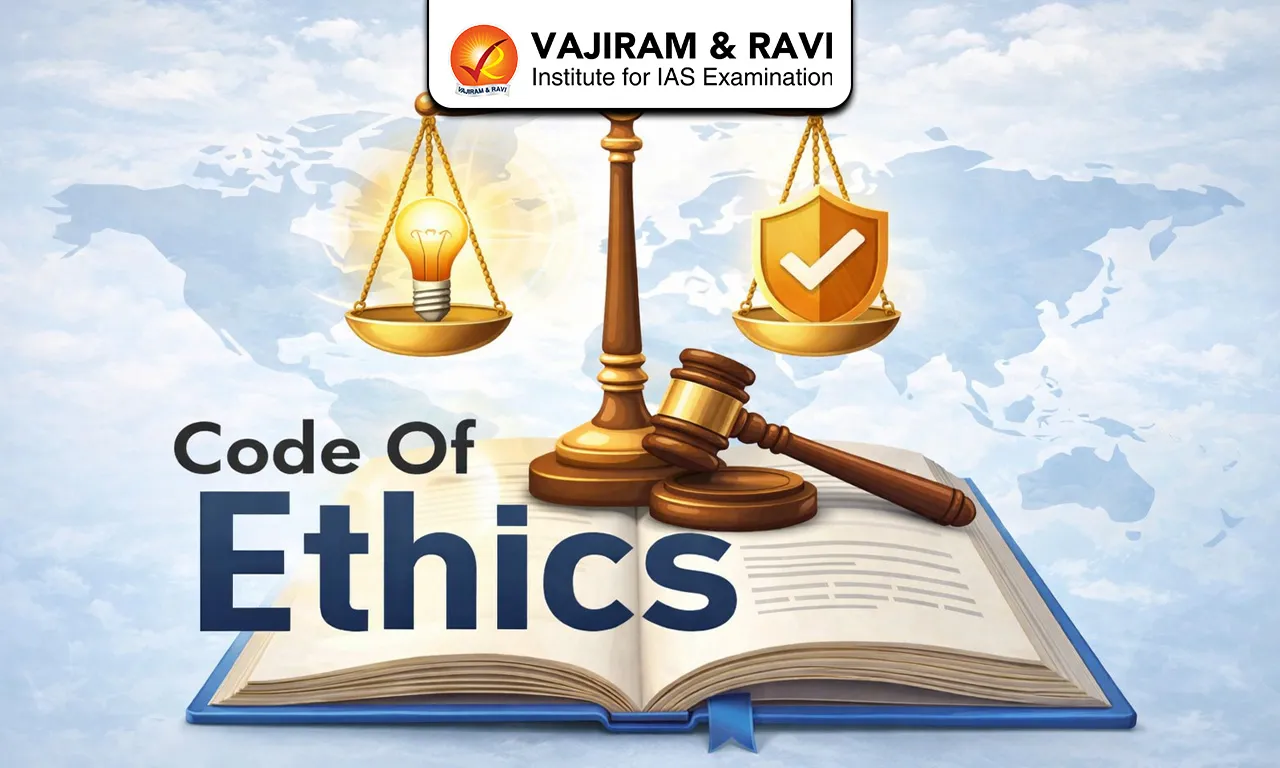
A Code of Ethics is a broad set of guiding principles that define the values, ideals, and standards of behaviour expected from individuals or organizations. It is aspirational in nature and focuses on what is morally right, rather than prescribing specific punishments or detailed rules.
Code of Ethics Objectives
The key objectives of the Code of Ethics are:
- To guide behaviour of individuals in public and professional life.
- To promote integrity, transparency, and accountability.
- To build public trust in institutions.
- To create a shared ethical culture within organizations.
Code of Ethics Key Features
The key features of Code of Ethics are:
- Value-based: Built on core moral values like honesty, integrity, compassion, fairness, and responsibility.
- Broad and general in nature: Provides overall guiding principles rather than detailed rules or procedures.
- Aspirational: Encourages individuals to achieve higher ethical standards and ideal behaviour.
- Self-regulatory: Relies on personal conscience and moral responsibility instead of strict legal enforcement.
- Guides decision-making: Helps individuals choose the right course of action in ethical dilemmas.
- Promotes ethical culture: Creates a shared set of values within an organization or profession.
- Non-punitive in nature: Does not usually prescribe punishments; focuses on guiding behaviour.
- Universal applicability: Applies to all members of an organization or profession equally.
- Foundation for code of conduct: Serves as the moral basis on which specific rules (code of conduct) are framed.


Code of Ethics Utility
- Guides moral decision-making: Helps individuals choose the right course of action in ethical dilemmas.
- Promotes integrity and honesty: Encourages ethical behaviour and reduces corruption and misconduct.
- Builds public trust: Enhances credibility and confidence of citizens in institutions and officials.
- Creates a common value framework: Provides shared principles for all members of an organization or profession.
- Improves accountability and professionalism: Encourages responsible conduct and higher standards of service.
- Example: Doctors following the Medical Council of India’s Code of Ethics ensure professional treatment and patient confidentiality.
- Supports good governance: Leads to transparent, fair, and citizen-centric administration.
Code of Ethics in India
In India, there exists no comprehensive code of ethics for civil servants, which can be found in some other countries. Instead, India relies on a system of conduct rules that specifically prohibit a range of common activities. While these conduct rules serve a particular purpose, they do not constitute a comprehensive code of ethics.
In India, civil servants are governed by two sets of rules: one designed for the All-India Services and the other for the Central Civil Services. The AIS Conduct Rules, established in 1968, and the CCS Conduct Rules of 1964, although separately named, share substantial similarities. The Central Civil Service (Conduct) Rules, 1964, lays down the code of conduct for government servants serving the Union of India. These conduct rules underscore the ethical principles that civil servants are required to adhere to.
Code of Ethics in Public Administration
The Second Administrative Reforms Commission (2nd ARC) recommended a Code of Ethics for civil servants based on core values such as Integrity, Impartiality, Objectivity, Commitment to public service, Transparency, Accountability, Empathy and compassion for weaker section.
Difference Between Code of Ethics and Code of Conduct
Difference between Code of Conduct and Code of Ethics are as follows:
| Difference Between Code of Ethics and Code of Conduct | ||
| Feature | Code of Conduct | Code of Ethics |
|
Focus |
Specific rules and guidelines for behaviour |
Broad principles and values |
|
Purpose |
Defines acceptable and unacceptable behaviour |
Guides ethical decision making |
|
Scope |
Narrower, focusing on specific actions and activities |
Broader, encompassing overall character and conduct |
|
Enforcement |
More formal, with potential consequences for violations |
Less formal, rely on personal and professional integrity |
|
Application |
Typically used in organisations and workplaces |
Applies to individuals and professionals in various contexts. |
|
Examples |
Rules against harassment, discrimination and conflict of interest. |
Principles of honesty, integrity, respect, and responsibility. |

 Last updated on Oct, 2026
→ UPSC 2027 Notification will be released on 13 January 2027 at upsconline.nic.in.
→ Check Nobel Prize 2026 Winners List here.
→ Download PIB PRiSM Monthly Magazine 2026 here.
→ Check UPSC Monthly Current Affairs Magazine The Recitals here.
→ Check out the latest UPSC Syllabus here.
→ Download UPSC Model Answers for Mains 2026
→ UPSC Mains Question Paper 2026 is out now for Essay & GS Paper 1, 2, 3 & 4.
→ UPSC Calendar 2027 has been released.
→ Enroll in Vajiram & Ravi’s UPSC Mains Test Series 2027 for structured answer writing practice, expert evaluation, and exam-oriented feedback.
→ Join Vajiram & Ravi’s UPSC Mentorship Program 2027 for personalized guidance, strategy planning, and one-to-one support from experienced mentors.
→ Go through the UPSC Mains Previous Year Papers to enhance your preparation.
→ UPSC has released UPSC Toppers List 2025 with the Civil Services final result on its official website.
→ Also check Best UPSC Coaching in India
Code of Ethics FAQs
Q1. What is a Code of Ethics?+
Q2. How is a Code of Ethics different from a Code of Conduct?+
Q3. Does India have a formal Code of Ethics for civil servants?+
Q4. Which committee recommended a Code of Ethics for civil servants in India?+
Q5. What is the main purpose of a Code of Ethics?+
Tags: code of ethics ethics ethics notes